
7 Tips for Finding a Dearborn Federal Criminal Defense Lawyer
When Federal Charges Hit Close to Home in Dearborn, MI
If you need a dearborn federal criminal defense lawyer, here is what you need to know right away:
Quick answers:
- Federal charges are more serious than state charges and carry harsher penalties
- Cases are prosecuted in the U.S. District Court for the Eastern District of Michigan
- You have the right to an attorney the moment you are investigated or arrested
- Do not speak to federal agents without a lawyer present — ever
- Contact a federal defense attorney immediately if you receive a target letter, subpoena, or search warrant
Federal charges are not the same as state charges. Not even close.
When the FBI, DEA, or IRS sets its sights on someone in Dearborn or Wayne County, the resources they bring to the table are enormous. Federal prosecutors are highly trained. Federal investigations can run for months or even years before a single charge is filed. And federal convictions often carry mandatory minimum sentences that leave little room for leniency.
The Eastern District of Michigan — which covers Dearborn, Detroit, and all of Wayne County — is known for aggressive enforcement of federal laws. Healthcare fraud, drug trafficking, firearms offenses, and white-collar crimes are among the most commonly prosecuted federal cases in this area.
The stakes could not be higher. A conviction can mean years in federal prison, heavy fines, and a record that follows you for life.
That is why who you hire matters — a lot.
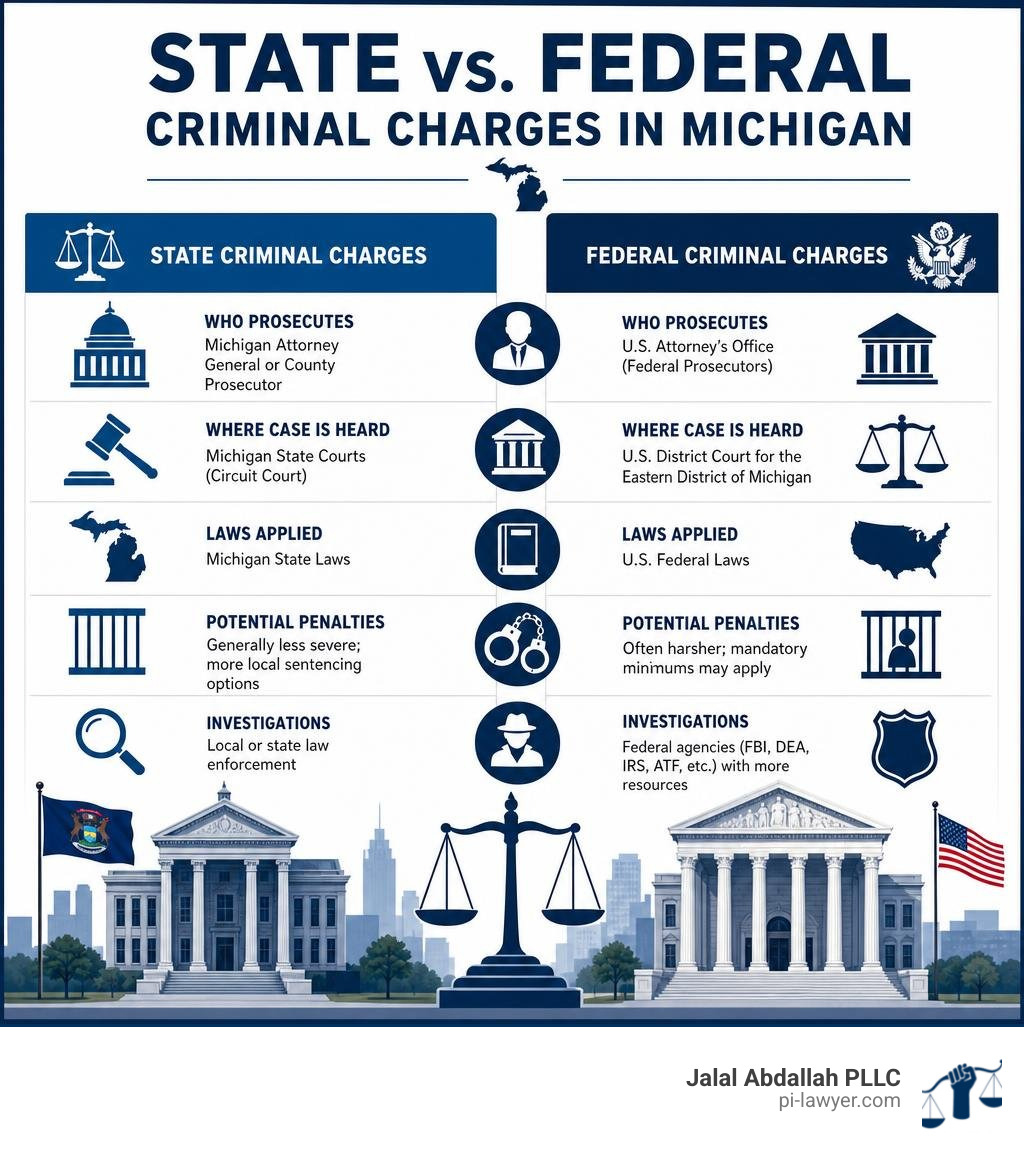
Understanding State vs. Federal Charges in Wayne County
To mount a successful defense, you must first understand the arena you are playing in. Many people assume that a criminal charge is a criminal charge, regardless of who brings it. In reality, state and federal jurisdictions operate in completely different universes.
State laws are enacted by the Michigan Legislature to govern conduct within the state’s borders. If you are accused of a state crime in Dearborn, your case will be prosecuted by the Wayne County Prosecutor’s Office and heard in local state courts, such as the 19th District Court in Dearborn or the Third Circuit Court in Detroit. These cases typically involve offenses like local theft, assault, operating while intoxicated (OWI), or state-level drug possession.
Federal charges, on the other hand, involve violations of federal statutes passed by the United States Congress. A case becomes federal when the alleged crime crosses state lines, occurs on federal property, involves federal agencies, or directly impacts interstate commerce. In Dearborn, federal cases are prosecuted by the United States Attorney’s Office for the Eastern District of Michigan, with proceedings held at the federal courthouse in downtown Detroit.
Federal agencies like the Federal Bureau of Investigation (FBI), the Drug Enforcement Administration (DEA), and the Internal Revenue Service Criminal Investigation Division (IRS CID) handle these investigations. These agencies do not rush. They use highly sophisticated investigative techniques, including wiretaps, financial audits, and undercover operations, often building an airtight case before you even realize you are on their radar.
One of the government’s favorite tools in Wayne County is the conspiracy charge. Federal prosecutors frequently bundle multiple defendants together in a single conspiracy indictment. Under federal law, the government does not need to prove that you knew every other person involved, or even that you played a major role. Simply showing that you agreed to participate in a shared unlawful plan is enough to hold you legally responsible for the actions of the entire group.
In Dearborn, healthcare fraud (such as Medicare or Medicaid overbilling), high-volume drug trafficking, and complex white-collar financial crimes are frequently prosecuted using these aggressive conspiracy theories. If you find yourself swept up in one of these wide-ranging investigations, securing representation from experienced Dearborn federal criminal defense attorneys is the single most important step you can take.
How the Federal Criminal Process Works in the Eastern District of Michigan
The state court system in Michigan is and often focused on high-volume case resolution. The federal criminal justice system is a slow, methodical machine designed to secure convictions. Understanding the stages of this process is critical to reducing the anxiety that naturally comes with federal prosecution.
- The Investigation: Unlike state police officers who might arrest you on the spot, federal agents often spend months gathering evidence, executing search warrants, and conducting audits before filing charges.
- The Indictment or Complaint: A federal case officially begins either with a criminal complaint filed by an agent or a grand jury indictment. The grand jury is a panel of citizens that hears evidence presented exclusively by the prosecutor to determine if there is probable cause to charge you.
- Arraignment and Detention Hearing: Once arrested or summoned, you will appear before a federal magistrate judge. The court will address bond and pretrial release. Unlike state courts, where cash bail is common, the federal system heavily weighs whether you are a flight risk or a danger to the community, often resulting in pretrial detention if the defense does not present a compelling argument.
- Discovery and Pretrial Motions: This is where the battle begins. Your defense team will receive the government’s evidence, which can consist of thousands of pages of financial records, wiretap transcripts, and agent reports. We meticulously analyze this data to identify constitutional violations, filing motions to suppress illegally obtained evidence or dismiss the charges entirely.
- Plea Negotiations or Trial: While many federal cases are resolved through plea agreements, we prepare every single case with the expectation of going to trial. If a trial is necessary, it will take place before a federal district judge and a jury.
- Sentencing: If a conviction occurs, the judge will determine your penalty using the complex Federal Sentencing Guidelines. These guidelines calculate a “score” based on the nature of the offense and your criminal history, which translates into a recommended prison term.
| Procedure / Feature | Michigan State Court (Wayne County) | Federal Court (Eastern District of Michigan) |
|---|---|---|
| Investigating Agency | Dearborn Police, Wayne County Sheriff, MSP | FBI, DEA, IRS, ATF, DHS |
| Prosecuting Authority | Wayne County Prosecutor or Michigan AG | United States Attorney’s Office |
| Charging Mechanism | Complaint/Warrant or Preliminary Exam | Grand Jury Indictment or Information |
| Pretrial Release | Cash bail, personal recognizance, surety bonds | Pretrial Services evaluation, high rate of detention |
| Sentencing Structure | Indeterminate sentencing (e.g., 2 to 5 years) | Determinate sentencing guided by Federal Guidelines |
| Judicial Appointment | Elected by local voters | Appointed for life by the U.S. President |
Critical Steps to Take During a Federal Investigation or Arrest
If you suspect you are under federal investigation, or if federal agents suddenly knock on your door, what you do in the first 24 hours can completely dictate the outcome of your case. The federal government relies heavily on self-incrimination; they want you to talk before you have legal counsel.
Here is what you must do to protect your freedom:
1. Identify What You Received
The government communicates its interest in you in a few specific ways:
- A Target Letter: This is a formal letter from a federal prosecutor explicitly informing you that they have substantial evidence linking you to a crime and that you are the target of a grand jury investigation.
- A Grand Jury Subpoena: This document commands you to either testify before a grand jury or produce specific records (documents, emails, financial ledgers).
- A Search Warrant: If agents show up at your home or business with a warrant signed by a judge, they have the legal right to search the premises and seize property.
2. Exercise Your Right to Remain Silent
This cannot be overstated: Do not answer questions. Federal agents are incredibly polite, professional, and persuasive. They may tell you that they “just want to clear up a few details” or that “cooperating now will make things easier.” This is a tactical maneuver.
You cannot talk your way out of a federal investigation, but you can easily talk your way into a federal prison. Politely but firmly state: “I am exercising my right to remain silent, and I will not answer any questions without my attorney present.”
3. Do Not Obstruct Justice
Never delete emails, destroy documents, wipe hard drives, or instruct others to lie to investigators. Doing so can result in immediate, separate federal charges for obstruction of justice, which are often easier for the government to prove than the original underlying crime.
4. Contact a Defense Lawyer Immediately
Whether you have been arrested and are sitting in federal custody, or you have simply noticed unusual audits of your business, you need to bring in a professional. Early intervention by a dedicated defense attorney can sometimes stop an indictment from ever being filed.
Why You Need a Dedicated Dearborn Federal Criminal Defense Lawyer
Many excellent local defense lawyers handle drunk driving, traffic violations, and state-level assaults every single day. However, taking a state court lawyer into federal court is like asking a high school track coach to manage an Olympic training program. The rules, the culture, and the stakes are entirely different.
Federal criminal defense is a highly complex practice area. The Federal Rules of Criminal Procedure and the Federal Rules of Evidence are strictly enforced, leaving zero margin for procedural errors. Additionally, because federal judges are appointed for life, they run their courtrooms with an immense degree of formality and precision.
An experienced Michigan federal criminal defense team knows how to handle these complexities. We understand how to dissect federal indictments, challenge the government’s witnesses, and negotiate with federal prosecutors who have nearly unlimited budgets. We don’t just look at the charges on paper; we conduct a deep-dive case analysis to expose the weaknesses in the government’s theories, ensuring your constitutional rights are protected at every turn.
7 Tips for Selecting the Right Legal Representation
Choosing the attorney who will stand between you and the federal government is the most critical decision of your life. To make sure you hire the right advocate, use these seven essential tips as your guide.
Tip 1: Verify Specific Experience with a Dearborn Federal Criminal Defense Lawyer
Do not hesitate to ask a prospective attorney about their track record in federal courts. Ask them:
- How many federal cases have you personally handled in the Eastern District of Michigan?
- Have you represented clients facing the exact charges I am accused of?
- What is your history of securing dismissals or favorable sentencing departures?
You need an attorney who is intimately familiar with federal defense history and knows how to build a defense that stands up to federal scrutiny.
Tip 2: Look for a Dearborn Federal Criminal Defense Lawyer Who Understands Federal Agency Tactics
Federal agencies like the FBI, DEA, and IRS use specific, highly calculated strategies to build cases. Your attorney must understand how these investigators operate. Knowing how federal agents conduct interviews, structure wiretaps, and execute search warrants allows your lawyer to identify where law enforcement cut corners or violated your constitutional rights.
Tip 3: Assess Their Knowledge of the Federal Sentencing Guidelines
In the federal system, the trial is only half the battle. If a case results in a conviction or a plea, the sentencing phase is where your future is decided. The Federal Sentencing Guidelines are incredibly complex, relying on a mathematical grid of offense levels, victim counts, loss calculations, and criminal history points.
Your attorney must be a master of these guidelines to successfully argue for downward departures or variances that can keep you out of prison.
Tip 4: Ensure Direct Communication and Personal Attention
Some large, nationwide firms will sign you up using a senior partner’s name, only to immediately hand your file off to an inexperienced junior associate. When your freedom is on the line, you cannot afford to be treated like a case number. Make sure the attorney you hire is the one who will personally review your evidence, answer your phone calls, and stand next to you in court.
Tip 5: Evaluate Their Trial Readiness and Courtroom Advocacy
While many federal cases are resolved before trial, the best way to secure a favorable plea agreement is to show the prosecutor that you are fully prepared to fight them in front of a jury. If a prosecutor knows your lawyer is afraid of the courtroom or lacks federal trial experience, they will offer weak plea terms. You need an aggressive litigator who is ready to take your case all the way to trial if necessary.
Tip 6: Check for Local Experience in the Eastern District of Michigan
Every federal district has its own local rules, standing orders, and judicial personalities. An attorney who practices regularly in the Detroit federal courthouse knows the temperaments of the local judges, the tendencies of the local prosecutors, and the specific administrative procedures of the Eastern District of Michigan. This local familiarity can give your defense a major strategic advantage.
Tip 7: Choose a Firm Committed to Relentless Advocacy
The federal government has unlimited resources, meaning they are used to getting their way. To beat them, you need a law firm built on relentless advocacy. You want a team that embraces the role of the underdog, refuses to back down under pressure, and is deeply committed to protecting your constitutional rights, your family, and your future.
Frequently Asked Questions About Federal Defense in Dearborn
What is the difference between a target letter and a subpoena?
A target letter is a formal notification from the Department of Justice stating that they have evidence linking you to a crime and that you are a primary target of an ongoing grand jury investigation. A grand jury subpoena, however, is a court order requiring you to either testify under oath or produce specific physical evidence (like financial records or corporate documents). Both are extremely serious and require immediate legal representation.
Can a general criminal attorney handle my federal case?
While technically legal for any licensed attorney to represent you, it is highly risky. Federal court procedures, evidentiary rules, and sentencing guidelines are vastly different from state courts. A general practitioner who primarily handles local state misdemeanors may easily find themselves overwhelmed by the speed, complexity, and aggressive nature of a federal prosecution.
What are the chances of avoiding prison in a federal case?
Every federal case is entirely unique, and no attorney can ethically guarantee a specific outcome. However, it is absolutely possible to avoid prison time in many federal matters. Success depends on early intervention, the strength of your defense strategy, challenging the admissibility of the government’s evidence, and presenting compelling mitigation arguments under the Federal Sentencing Guidelines to secure probation or alternative sentencing.
Stand Firm Against the Feds: Let Us Fight for You
When you are facing the immense weight of the federal government, you cannot afford to stand alone. The prosecutors building the case against you have the full backing of the United States government. To protect your life, your family, and your livelihood, you need a legal team that is dedicated to turning the tables on powerful opponents.
At Jalal Abdallah PLLC, we have built our reputation on relentless advocacy for the underdog. We do not back down from powerful federal agencies, and we do not let our clients be intimidated by aggressive prosecutors in Wayne County. From our offices in Michigan, we stand ready to dissect the government’s case, protect your constitutional rights, and fight for the best possible outcome.
If you are under investigation, have received a target letter, or are facing active federal charges, time is not on your side. Explore our comprehensive legal services and contact us today to schedule a confidential consultation. Let us put our experience, local knowledge, and dedication to work for you.
Share This Article

Schedule Your Free Consultation Today!
Reach out today and receive a consultation, completely free of charge - we'll evaluate your case and let you know what comes next.