
Navigating Your Case with a Medical Malpractice Attorney in Dearborn
When a Doctor’s Mistake Changes Everything in Dearborn
If you’re looking for a medical malpractice attorney in Dearborn, here’s what you need to know right away:
Quick answers:
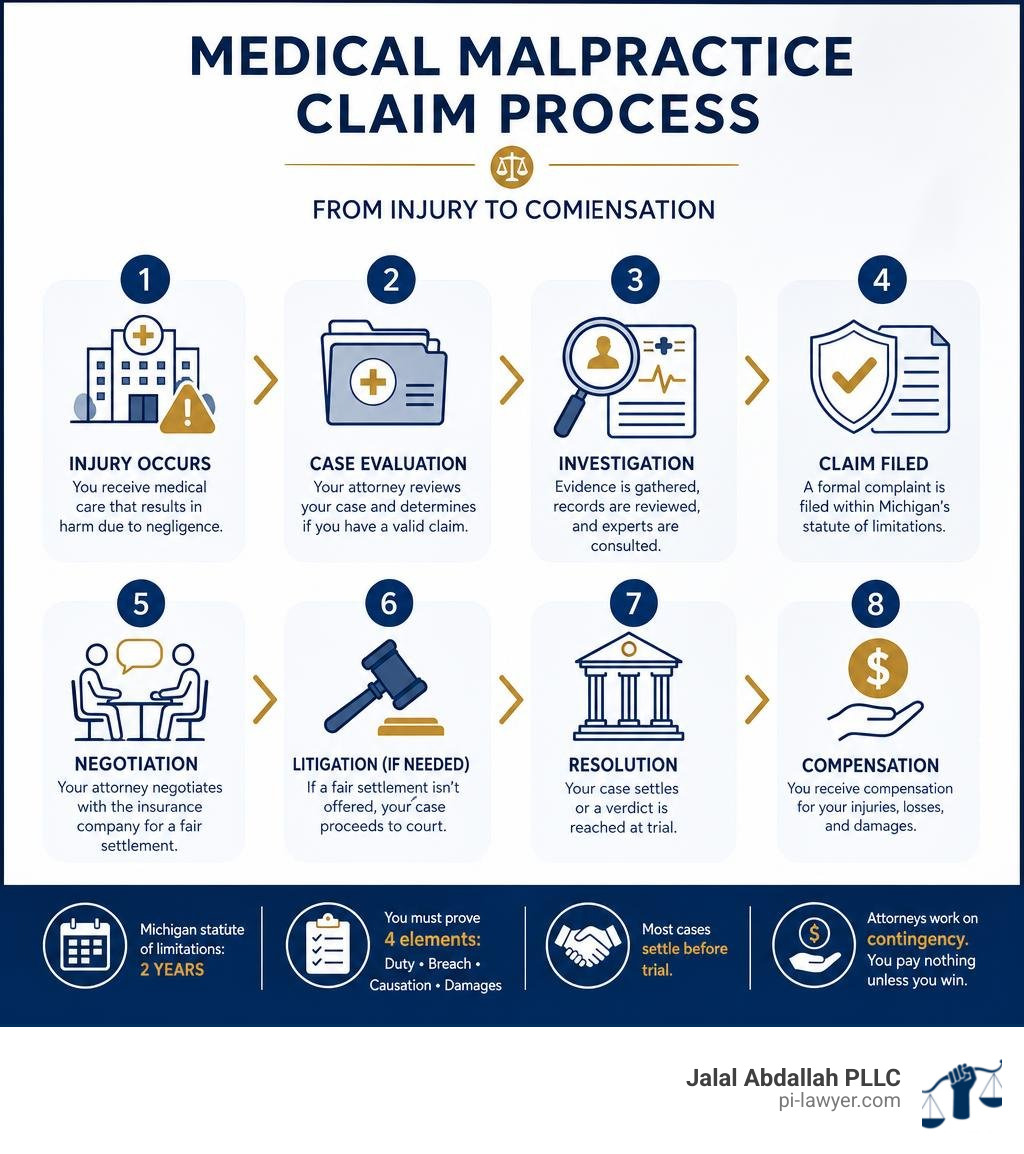
- Michigan gives you 2 years from the date of injury (or discovery) to file a malpractice claim
- You must prove 4 elements: duty of care, breach, causation, and damages
- Most cases (over 95%) settle before trial
- Attorneys work on contingency — you pay nothing unless you win
- Common cases include surgical errors, misdiagnosis, birth injuries, and medication mistakes
You went to a doctor or hospital for help. You trusted them. Then something went wrong — and now your life looks completely different.
Medical malpractice is more common than most people realize. Michigan recorded 904 malpractice reports in 2022 alone, ranking fifth highest in the entire country.
But knowing something went wrong is only the first step. Proving it — legally — is a different challenge entirely.
Hospitals and insurers have teams of lawyers working to minimize what they pay you. The evidence is often controlled by the very providers who harmed you. And the legal process is complex enough to feel impossible without guidance.
This guide walks you through everything you need to understand about pursuing a medical malpractice claim in Dearborn — from what counts as negligence under Michigan law, to how compensation works, to what to look for when choosing legal representation.
Understanding Medical Malpractice Under Michigan Law

Medical malpractice isn’t just a medical treatment that didn’t have a perfect outcome. Medicine is an art as much as a science, and sometimes even the best care doesn’t yield the results we hope for.
Under Michigan law, medical malpractice is defined as a healthcare professional’s failure to provide the accepted standard of care, resulting in injury or death to the patient.
The “standard of care” is the yardstick by which all medical negligence cases are measured. It refers to the level of care, skill, and treatment that a reasonable, similarly situated healthcare professional would have provided under the same or similar circumstances. If a doctor, nurse, pharmacist, or hospital staff member falls below this standard because of carelessness, poor training, or systemic neglect, they have committed medical negligence.
Timing is everything in these cases. In Michigan, the standard statute of limitations for a medical malpractice claim is two years from the date the negligent act or omission occurred.
However, there is a “discovery rule” exception. If you could not have reasonably known about the injury right away, you may file a claim within six months of the date you discovered (or should have discovered) the injury. This is subject to an overall “statute of repose,” which generally cuts off all claims six years after the act occurred, with very narrow exceptions for minors or fraudulent concealment. Because these deadlines are strict and unforgiving, acting quickly to preserve your rights is essential.
The Four Key Elements of a Medical Malpractice Claim
To build a successful case, we must establish four fundamental legal pillars. If even one of these elements is missing, your lawsuit cannot move forward:
- Duty of Care: We must show that a professional relationship existed between you and the healthcare provider. This establishes that the provider had a legal obligation to provide you with competent care.
- Breach of Duty: We must prove that the healthcare provider deviated from the accepted standard of care. This means they did something a competent peer would not have done, or failed to do something a competent peer would have done.
- Causation: This is often the trickiest part of a case. We must directly link the provider’s breach of duty to your injury. It is not enough to show they made a mistake; we must prove that their specific mistake is what caused your physical or mental harm.
- Damages: We must demonstrate that you suffered actual, measurable harm as a result of the injury. This includes physical pain, emotional trauma, extra medical bills, and lost wages.
Why You Need a Medical Malpractice Attorney in Dearborn to Prove Negligence
The deck is stacked heavily against patients from the start. Hospitals and insurance companies have massive legal departments whose sole job is to make your claim disappear. In fact, statistics show that in over half of all filed medical malpractice cases, the defendants succeed in getting the claim dismissed before it ever reaches a jury.
Furthermore, when cases do go to court, plaintiffs win only about one-third of the time. Proving negligence requires an intimate understanding of both medicine and Michigan’s highly technical legal procedures.
By working with a dedicated medical malpractice attorney Dearborn, you level the playing field. An attorney handles the heavy lifting—from pulling medical charts to managing court deadlines—allowing you to focus on your recovery. If you are starting to look at your legal options, directories like Justia can help you compare local practitioners.
Common Types of Medical Negligence in Dearborn Healthcare Facilities
Medical negligence can take many forms, ranging from quick errors in a busy emergency room to chronic oversights in a long-term care facility. In Dearborn, we see a wide variety of errors occurring across local clinics, private practices, and major health systems.
Understanding the most common types of malpractice can help you identify if your injury warrants a legal claim:
- Surgical Errors: Operating on the wrong body part, leaving surgical instruments inside a patient, or accidentally puncturing internal organs during a procedure.
- Anesthesia Mistakes: Giving too much or too little anesthesia, failing to monitor vital signs, or failing to check for patient drug allergies.
- Failure to Monitor: Neglecting a patient after a procedure, ignoring warning signs on monitors, or failing to respond to a patient’s worsening condition.
- Informed Consent Violations: Performing a procedure without fully explaining the risks and obtaining the patient’s explicit permission.
Whether you are visiting a local clinic or a specialized practitioner for reproductive healthcare, you have the right to expect safe, professional treatment at every step.
Birth Injuries and OBGYN Negligence
A birth injury is one of the most devastating outcomes of medical negligence. When a doctor or delivery room team makes a mistake during pregnancy, labor, or delivery, the consequences can last a lifetime.
Common birth injuries caused by negligence include:
- Cerebral Palsy: Often caused by oxygen deprivation to the baby’s brain during a delayed delivery.
- Erb’s Palsy / Brachial Plexus Injuries: Caused by excessive pulling on the baby’s head and shoulders during a difficult delivery.
- Brain Damage: Resulting from a failure to monitor fetal distress signals or improper use of delivery tools like vacuums or forceps.
These cases require deep investigation. A single delivery room error can mean a child requires specialized, around-the-clock care for the rest of their life.
Diagnostic and Medication Errors in Local Hospitals
Diagnostic and medication errors are incredibly common yet frequently overlooked.
Diagnostic errors—which include misdiagnosis, delayed diagnosis, and complete failure to diagnose—account for roughly one-third of all medical malpractice claims. For example, if a radiologist overlooks a suspicious mass on an X-ray, or an ER doctor sends a patient home who is actively experiencing a heart attack, the delay in treatment can be fatal.
Medication errors are equally dangerous. Research indicates that prescription drug errors harm approximately 1.5 million people every year across the country. These errors happen when:
- A doctor prescribes the wrong medication or incorrect dosage.
- An overworked nurse administers the wrong drug to a hospitalized patient.
- A pharmacy fills a prescription with the wrong pills or incorrect instructions.
- A provider fails to check for dangerous drug interactions.
Damages and Compensation in Michigan Malpractice Lawsuits
If your medical malpractice claim is successful, you are entitled to financial compensation, legally referred to as “damages.” Michigan divides these damages into two main categories: economic and non-economic.
| Damage Type | What It Covers | Examples |
|---|---|---|
| Economic Damages | Measurable financial losses with no legal cap. | Medical bills, future rehabilitation costs, lost wages, and loss of earning capacity. |
| Non-Economic Damages | Subjective, non-monetary losses capped by Michigan law. | Physical pain and suffering, emotional distress, loss of enjoyment of life, and loss of companionship. |
Michigan places a legal limit, or “cap,” on non-economic damages in medical malpractice cases. This cap is adjusted annually for inflation. There are two tiers to this cap: a lower cap for standard injuries, and a higher cap for severe, permanent injuries such as brain damage, spinal cord injuries resulting in paralysis, or the loss of a reproductive organ.
The Critical Role of Expert Testimony in Proving Your Case
You cannot simply file a medical malpractice lawsuit based on your own word. Michigan law strictly requires the use of medical witnesses to validate your claim.
Before a lawsuit can even be formally filed, your attorney must file an Affidavit of Merit. This is a document signed by a licensed healthcare professional who practices in the same specialty as the defendant. In this affidavit, the peer must state under oath that they have reviewed your medical records and believe the defendant breached the standard of care, directly causing your injuries.
Without this affidavit, your case will be dismissed immediately. Throughout the lawsuit, these medical professionals will testify to explain complex medical concepts to the judge and jury.
Notable Verdicts and Settlements in Michigan Malpractice Cases
While every case is unique and past results do not guarantee future outcomes, looking at historical outcomes in Michigan highlights how courts value these severe injuries:
- Birth Trauma Cases: Juries have awarded multi-million dollar verdicts (sometimes exceeding $10 million) to cover the lifetime cost of care for children diagnosed with cerebral palsy due to oxygen deprivation during delivery.
- Delayed Treatment of Internal Bleeding: Settlements reaching several million dollars have been secured when hospitals failed to recognize internal bleeding, leading to cardiac arrest and permanent brain damage.
- Surgical Burns and Errors: Verdicts in the range of $1 million to $2 million have been awarded for severe, disfiguring surgical burns or foreign objects left inside patients.
- Wrongful Death: Families of patients who died due to emergency room negligence or misdiagnosed heart conditions have recovered substantial settlements to compensate for lost financial support and emotional loss.
How to Choose a Medical Malpractice Attorney in Dearborn
Choosing the right legal advocate is one of the most important decisions you will make. Medical malpractice claims are highly specialized; you should not hire a general practitioner who occasionally handles car accidents. You need a team with deep experience in medical litigation.
When looking for representation, look for a firm that:
- Has a proven track record of handling complex medical cases.
- Possesses the financial resources to fund expensive litigation (including paying for high-quality medical witnesses).
- Offers compassionate, clear communication and treats you like an individual, not a file number.
- Provides a free, no-obligation consultation to review the facts of your case.
To learn more about the types of cases we handle, visit our personal injury services page.
Evaluating Experience and Track Record
When you meet with a potential attorney, do not be afraid to ask hard questions. You want to know if they have actual courtroom experience. While over 95% of malpractice claims are settled out of court, insurers will only offer fair settlements if they know your attorney is willing and able to take the case to trial. Ask about their history with medical negligence claims in Wayne County and their experience dealing with local hospital networks.
Questions to Ask a Medical Malpractice Attorney in Dearborn During Your Consultation
To get the most out of your initial consultation, bring a list of questions to ask the attorney:
- Do you believe my case has merit based on the initial medical records?
- How many medical malpractice cases have you personally handled?
- What is your fee structure, and will I have to pay any out-of-pocket costs if we lose?
- Who will be the primary point of contact handling my case on a daily basis?
- How long do you expect this legal process to take from start to finish?
Frequently Asked Questions About Dearborn Medical Malpractice Claims
How long do I have to file a medical malpractice lawsuit in Michigan?
In most cases, you have exactly two years from the date of the medical error to file a lawsuit. If you discover the injury later, you have six months from the date of discovery, but this is subject to strict caps. There are limited exceptions for young children, but it is always best to consult an attorney immediately to avoid missing your deadline.
What is the average settlement for a medical malpractice case?
There is no “average” settlement because every injury is different. Settlement values depend on the severity of your injury, the cost of your past and future medical care, your lost wages, and whether the injury is permanent. A permanent brain injury or birth injury case will naturally command a much higher settlement than a temporary injury that resolved after a few weeks of treatment.
Do I have to pay upfront legal fees for my malpractice case?
No. We handle medical malpractice cases on a contingency fee basis. This means we do not charge you any upfront fees, hourly rates, or retainers. We only get paid if we successfully recover money for you through a settlement or a court verdict. If we do not win your case, you owe us nothing for our legal services.
Stand Up and Fight for the Justice and Compensation You Deserve
When a medical error turns your life upside down, you don’t have to carry the burden alone. At Jalal Abdallah PLLC, we believe in relentless advocacy for underdogs. We stand up to powerful insurance companies, hospital systems, and government entities to make sure your voice is heard and your family is protected.
We are proud to serve clients across Michigan, with convenient locations in Southfield, Detroit, Warren, and right here in Dearborn. If you or a loved one has suffered because of medical negligence, we are ready to help you hold the responsible parties accountable.
Do not let an insurance adjuster dictate what your recovery is worth. Contact our legal team today to schedule your free, confidential case evaluation, or visit our homepage to learn more about our commitment to fighting for injured Michigan residents.
Share This Article

Schedule Your Free Consultation Today!
Reach out today and receive a consultation, completely free of charge - we'll evaluate your case and let you know what comes next.