 Skip to content
What Families in Dearborn Need to Know After a Fatal Car Crash
Filing a Dearborn car crash death claim is one of the hardest things a grieving family will ever have to do — and the legal clock starts ticking the moment of the crash.
Here is what you need to know right away:
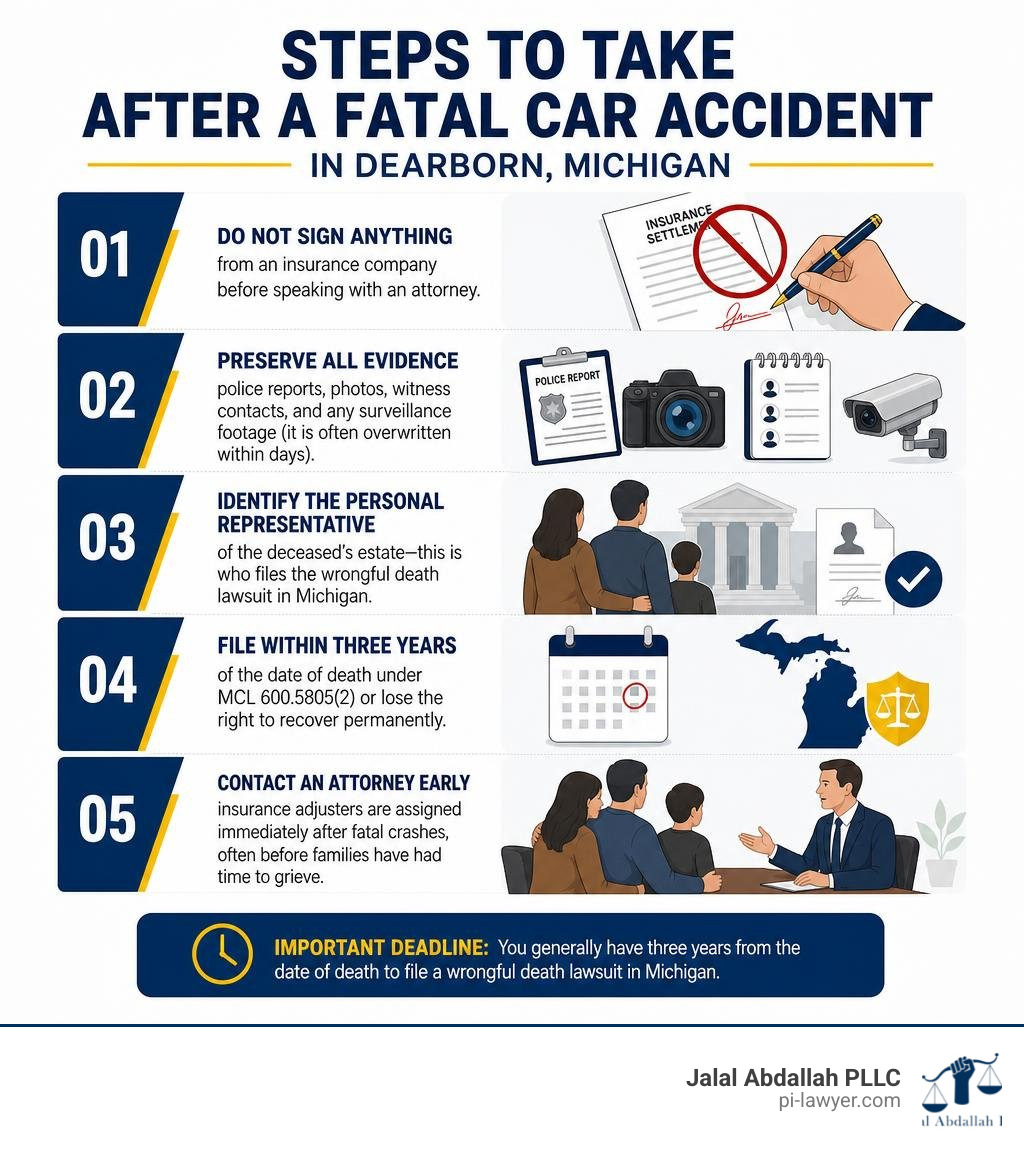
Quick Answer: Key Steps After a Fatal Car Crash in Dearborn
- Do not sign anything from an insurance company before speaking with an attorney
- Preserve all evidence — police reports, photos, witness contacts, and any surveillance footage (it is often overwritten within days)
- Identify the personal representative of the deceased’s estate — this is who files the wrongful death lawsuit in Michigan
- File within three years of the date of death under MCL 600.5805(2) or lose the right to recover permanently
- Contact an attorney early — insurance adjusters are assigned immediately after fatal crashes, often before families have had time to grieve
Wayne County, which includes Dearborn, reported 178 traffic fatalities in 2023 alone — making it one of the deadliest counties in Michigan for road crashes. Real cases from Dearborn’s own streets show how quickly these tragedies unfold: a 33-year-old doctor and mother of three was killed at Michigan Avenue and Nowlin Street when a driver traveling over 100 mph ran a red light. Behind every statistic is a family suddenly facing financial, legal, and emotional devastation — all at once.
Insurance companies know that timeline. They use it.
I’m Jalal Abdallah, a personal injury attorney with deep roots in the Dearborn community, and I have built my practice on fighting for families navigating exactly this kind of dearborn car crash death claim against powerful insurance companies and institutions. In the sections below, I’ll walk you through every step of the process clearly and honestly.
Understanding the Dearborn Car Crash Death Claim Process
When a loved one is taken from us in a sudden collision, the shock can make even basic daily tasks feel impossible. However, the legal and financial realities of their passing will quickly require attention. Under Michigan law, a fatal car accident does not simply result in a standard personal injury claim. Instead, it triggers a specific legal pathway governed by the Michigan Wrongful Death Act (MCL 600.2922).
In Michigan, individual family members cannot directly file a wrongful death lawsuit in their own names. Instead, the law requires that the action be brought by the “personal representative” of the deceased person’s estate.
To start a dearborn car crash death claim, the family must first open an estate in the Wayne County Probate Court. The probate court will formally appoint a personal representative—often a surviving spouse, adult child, or parent. Once appointed, this representative serves as the legal voice for the entire estate, managing the lawsuit and acting on behalf of all eligible beneficiaries.
Opening an estate and managing probate court filings while dealing with insurance companies is a heavy burden. This is why families rely on experienced legal counsel to navigate wrongful death claims and handle the procedural requirements of the Wayne County Probate Court.
Who Can File a Dearborn Car Crash Death Claim?
While the personal representative is the only individual who can physically file the lawsuit, they do so on behalf of the deceased person’s surviving family members. Under Michigan’s Wrongful Death Act, the eligible beneficiaries who may share in any financial recovery include:
- The surviving spouse
- Children and descendants of the deceased
- Parents and grandparents
- Siblings
- Anyone named as a beneficiary in the deceased’s will
Determining who qualifies as an eligible beneficiary and how a settlement or jury verdict should be distributed can sometimes cause internal family friction. Having a clear, objective legal advocate is essential. We focus on protecting the rights of all eligible family members, ensuring that the distribution process is handled transparently and fairly. Taking the time to understand your options starts with choosing a Dearborn vehicle collision attorney who understands both Michigan auto law and local probate court procedures.
Statute of Limitations for a Dearborn Car Crash Death Claim
Time is one of your greatest enemies after a fatal accident. In Michigan, the statute of limitations for filing a wrongful death lawsuit is three years from the date of the victim’s death under MCL 600.5805(2).
Three years might sound like a long time, but in the legal world, it passes in the blink of an eye. Building a strong case requires extensive preparation:
- Obtaining police accident reports and toxicology results
- Reconstructing the high-speed dynamics of the crash
- Securing electronic data from vehicle black boxes
- Opening the estate in probate court and getting the personal representative appointed
If you miss this three-year deadline, Michigan courts will permanently bar your family from seeking compensation from the at-fault driver. Furthermore, if a government entity or municipal vehicle was involved in the crash, the notification deadlines are drastically shorter—sometimes requiring action within just a few months. Knowing what to do immediately after a car accident in Michigan is critical to preserving your family’s right to justice.
How Michigan No-Fault Insurance Affects Fatal Accident Claims
Michigan’s unique no-fault insurance system adds a layer of complexity to fatal car accident cases. Under this system, every driver must carry Personal Injury Protection (PIP) insurance. When an accident occurs, the victim’s own PIP policy is responsible for paying certain economic benefits, regardless of who caused the crash.
However, when an accident results in a fatality, the family has two distinct legal avenues to pursue:
- First-Party No-Fault Claim (Survivor’s Loss Benefits): Filed with the deceased’s own insurance company to cover immediate, tangible financial losses.
- Third-Party Wrongful Death Lawsuit: Filed against the at-fault driver (and their insurance carrier) for pain, suffering, loss of companionship, and excess economic damages.
| Benefit Category | Survivor’s Loss Benefits (First-Party PIP) | Wrongful Death Lawsuit (Third-Party) |
|---|---|---|
| Source of Funds | Deceased’s own auto insurance carrier | At-fault driver’s bodily injury liability insurance |
| Fault Required? | No. Paid regardless of who caused the crash | Yes. Must prove the other driver was negligent |
| Duration Limit | Capped at a maximum of 36 months (3 years) | No time limit on the distribution of recovery |
| What It Covers | Lost financial support, lost services, funeral costs | Pain and suffering, loss of society/companionship, excess financial loss |
| Maximum Cap | Subject to a monthly statutory maximum cap | Limited only by policy limits or the at-fault party’s assets |
Understanding how these two systems interact is vital to maximizing your recovery. Our Dearborn car wreck compensation guide provides a deeper look into how we calculate the true financial value of a crash.
Survivor’s Loss Benefits vs. Wrongful Death Damages
Under MCL 500.3108, survivor’s loss benefits are designed to replace the financial contributions the deceased would have provided to their dependents had they survived. These benefits cover:
- Lost Financial Support: The income, wages, or benefits the deceased would have contributed to the household.
- Replacement Services: The reasonable cost of securing ordinary and necessary domestic services (such as childcare, yard work, and home maintenance) that the deceased would have performed without pay. This is capped at $20 per day.
- Funeral and Burial Expenses: No-fault policies provide a set amount to help cover immediate funeral and burial costs.
However, survivor’s loss benefits are strictly capped by Michigan law and are not payable beyond three years after the date of the crash.
To recover damages that go beyond this three-year window—or to seek compensation for the devastating emotional toll of your loss—the personal representative must file a third-party wrongful death lawsuit. Through this lawsuit, the family can seek non-economic damages, including understanding pain and suffering damages endured by the deceased while conscious before passing, as well as the profound loss of society, companionship, and guidance experienced by the surviving family.
Proving Liability and Gathering Critical Evidence in Dearborn
To succeed in a third-party wrongful death lawsuit, we must prove that the other driver’s negligence directly caused the fatal crash. Proving liability in Dearborn requires acting quickly to gather and preserve evidence before it disappears.
Local intersections and high-speed corridors are frequently the sites of tragic, preventable collisions. For example, a devastating fatal crash on Michigan Avenue occurred when an SUV sped through a red light at over 100 mph, slamming into a pickup truck and killing a 33-year-old mother. In another local incident, a high-speed crash on I-94 near Michigan Avenue resulted in a high-speed crash investigation where a driver was charged with operating while intoxicated (OWI) and reckless driving causing death after slamming into a semi-truck during heavy rains.
To build an undeniable case of negligence, we aggressively gather:
- Police Investigation Reports: Including initial scene diagrams and officer notes.
- Toxicology and Blood-Alcohol Reports: To determine if drugs or alcohol played a role.
- Surveillance and Dashcam Footage: Businesses along Michigan Avenue, Schaefer Road, and the Southfield Freeway often have cameras, but this footage is usually overwritten within days.
- Black Box Data: Modern vehicles contain Event Data Recorders (EDRs) that log speed, braking, and steering inputs in the seconds leading up to a crash.
- Accident Reconstruction: We work with engineering experts to recreate the crash scene and prove speed and point of impact.
Comparative Fault and Shared Responsibility
A common tactic used by insurance defense attorneys is to argue that the deceased person was partially or entirely at fault for the accident. Michigan handles these situations under a modified comparative fault rule (MCL 600.2957).
Under this rule, a jury will assign a percentage of fault to everyone involved in the crash.
- If the deceased is found to be 50% or less at fault: The family can still recover damages, but the total compensation will be reduced by the deceased’s percentage of fault. For example, if a jury awards $1 million but finds the deceased was 20% at fault for speeding, the recovery is reduced to $800,000.
- If the deceased is found to be more than 50% at fault: The family is completely barred from recovering any non-economic damages (such as pain and suffering or loss of companionship) through a third-party lawsuit.
Because the stakes are incredibly high, insurance companies will look for any excuse—a delayed turn signal, a minor speed deviation—to shift the blame onto your loved one. We stand as a shield against these bad-faith tactics, ensuring your loved one’s memory is respected and the truth of the crash is preserved. To learn more about local road risks, read our guide on staying safe on the road and understanding Dearborn fatal crash statistics.
Frequently Asked Questions About Fatal Dearborn Crashes
How long does it take to settle a wrongful death car accident claim in Dearborn?
There is no single timeline for settling a wrongful death claim. A simple case with clear liability and an cooperative insurance company might resolve in six to twelve months. However, complex cases involving commercial semi-trucks, multiple vehicles, disputed liability, or municipal defendants can take two years or longer to resolve.
Additionally, because wrongful death settlements must be approved by the Wayne County Probate Court to ensure fair distribution among beneficiaries, the probate approval process adds several weeks or months to the final resolution. For a detailed breakdown of the legal timeline, consult our car accident lawyer Dearborn guide.
What if the at-fault driver was uninsured or underinsured?
If the negligent driver who caused the fatal crash was uninsured or did not carry enough bodily injury liability insurance to cover your family’s losses, we will look to the deceased’s own auto policy.
If their policy included Uninsured Motorist (UM) or Underinsured Motorist (UIM) coverage, we can file a claim directly with their insurer to recover the difference. If no such coverage exists, we can investigate whether other parties share liability—such as the owner of the vehicle (if different from the driver) or a commercial employer if the driver was working at the time of the crash. Knowing the right 5 moves to make after a car accident can help you protect these avenues of recovery.
Can a family sue a government entity for a fatal road design or employee crash?
Yes, but doing so is exceptionally difficult due to “governmental immunity.” However, there are strict exceptions. You can pursue a claim if a government employee caused the crash while operating a government-owned vehicle, or if a known, neglected highway defect directly caused the accident.
Municipal liability cases often result in intense legal battles. For example, in a notable local case, a jury awarded a massive $25 million verdict against the City of Dearborn after a city ordinance officer, driving a municipal vehicle while off-duty, ran a red light and killed a Ford Motor Co. employee. The city argued the verdict was excessive, illustrating how aggressively government entities will fight to protect their bottom line. Read more about how this local city loses suit over fatal wreck to understand the complexities of municipal claims.
Securing Your Family’s Future with Relentless Legal Advocacy
No amount of money can ever replace a beloved family member. However, a successful dearborn car crash death claim can provide the financial security your family needs to grieve without the looming threat of home foreclosure, unpaid medical bills, or sudden poverty.
Insurance companies assign their most experienced adjusters and defense lawyers to fatal crash claims within hours of the incident. Their primary goal is to settle the claim as quickly and cheaply as possible, often offering early, lump-sum settlements that represent a fraction of what your family actually needs to survive long-term.
At Jalal Abdallah PLLC, we do not back down from powerful insurance companies, corporate trucking fleets, or municipal governments. We believe in providing relentless, compassionate advocacy for families during their darkest hours. We handle all of our wrongful death cases on a contingency fee basis, meaning you pay absolutely nothing upfront, and we only collect a fee if we successfully secure compensation for your family.
Let us carry the legal burden so you can focus on healing together. Contact us today for a free, confidential consultation about contacting a wrongful death attorney. We are ready to stand by your side.
Share This Article

Schedule Your Free Consultation Today!
Reach out today and receive a consultation, completely free of charge - we'll evaluate your case and let you know what comes next.


