 Skip to content
When a Lyft Ride in Dearborn Goes Wrong — Here’s What You Need to Know
Meta Title: Dearborn Lyft Injury Lawyer | Get Your Maximum Recovery Today Meta Description: Injured in a rideshare crash? Learn how a Dearborn Lyft injury lawyer protects your rights under Michigan’s complex no-fault insurance laws. Slug: dearborn-lyft-injury-lawyer
If you’ve been hurt in a rideshare crash, finding a dearborn lyft injury lawyer is one of the most important steps you can take to protect your rights and your recovery.
Here’s a quick snapshot of what you need to know right now:
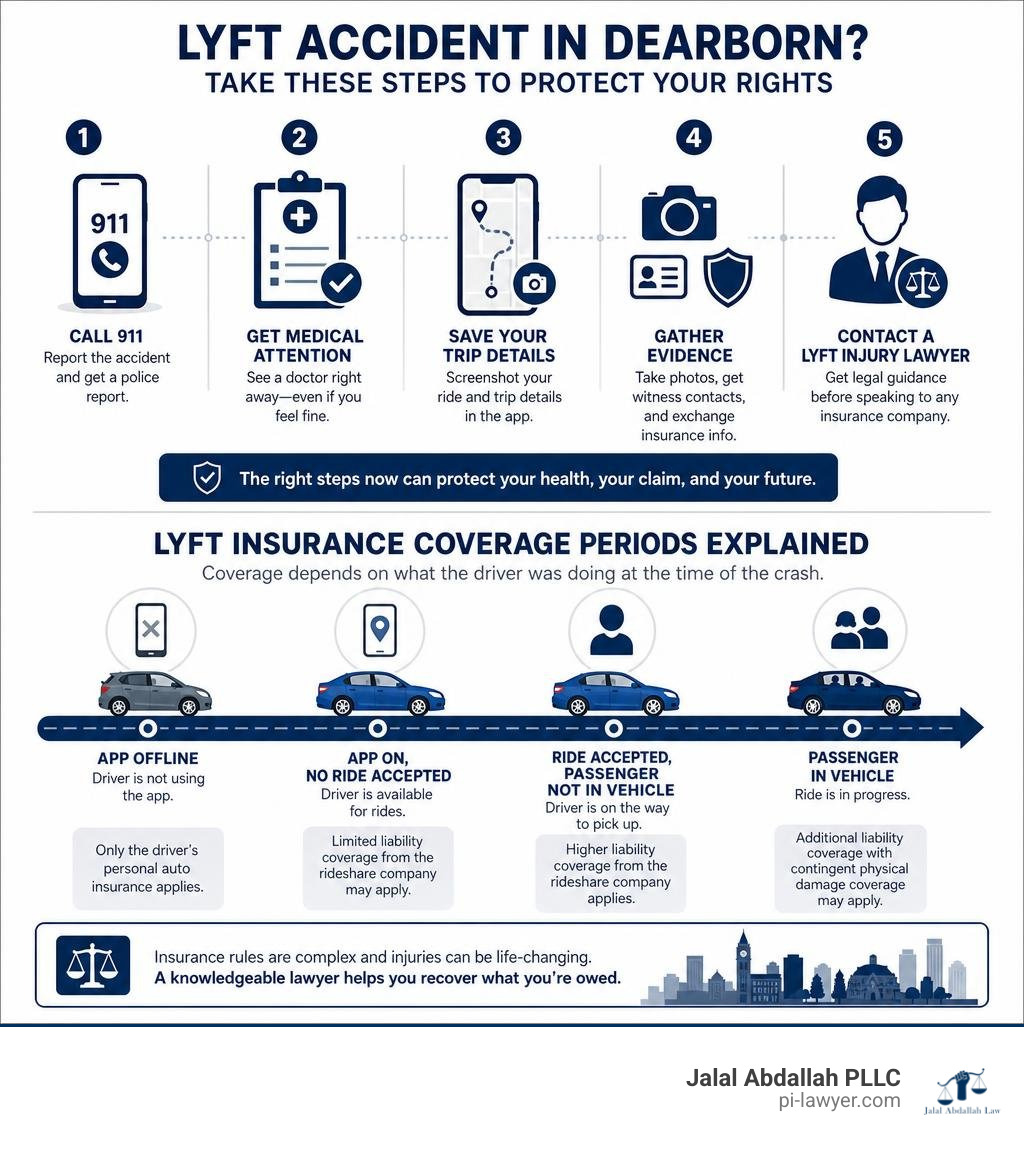
After a Lyft accident in Dearborn, you should:
- Call 911 and get a police report
- Seek medical attention immediately — even if you feel fine
- Screenshot your Lyft trip details in the app before closing it
- Gather photos, witness contacts, and insurance information at the scene
- Contact a Lyft injury lawyer before speaking to any insurance company
The bottom line: Michigan’s no-fault insurance laws are complex, and Lyft’s insurance coverage changes depending on what the driver was doing at the time of the crash. Without legal guidance, injured riders and drivers often settle for far less than they deserve — or miss critical filing deadlines entirely.
Rideshare services like Lyft have exploded in popularity across Dearborn and the greater Wayne County area. More rides mean more accidents. And when those accidents happen, victims face a confusing tangle of insurance layers, corporate legal teams, and strict Michigan deadlines that can derail a valid claim fast.
I’m Jalal Abdallah — a personal injury attorney based in Dearborn with a deep background in Michigan no-fault law, insurance regulations, and rideshare accident claims — and as your dearborn lyft injury lawyer, my goal is to cut through that complexity and fight for every dollar you’re owed. In the sections below, I’ll walk you through exactly how these cases work and what you can do to protect yourself.
Immediate Steps to Take After a Dearborn Lyft Accident
When you are in a collision on Michigan Avenue or near the Henry Ford Museum, the minutes following the impact are chaotic. However, what you do in those moments can make or break your personal injury claim. Insurance companies are notorious for using any gap in medical care or minor inconsistency in your story to deny your claim.
To protect your health and your legal rights, we advise taking these immediate actions:
- Call 911 Immediately: Even if the Lyft driver begs you not to call the police because they are worried about their driving record or rideshare status, call anyway. A police report is an unbiased, third-party record of the crash. It establishes the date, time, location, and initial assessment of fault.
- Seek Prompt Medical Attention: Adrenaline is a powerful mask. You might feel “just a little sore” at the scene, only to wake up the next morning with excruciating neck or back pain. Go to a local Dearborn emergency room or urgent care right away. This creates an immediate medical record linking your injuries directly to the accident. If you wait weeks to see a doctor, the insurer will argue your injuries happened elsewhere. For more details on why this is vital, see our guide on what to do immediately after a car accident in michigan.
- Capture the Digital Evidence: Before you close the Lyft app or exit the vehicle, take screenshots of your ride status, the driver’s name, the vehicle details, and your receipt. This proves you were an active passenger during the crash, which is crucial for triggering Lyft’s high-limit liability insurance policy.
- Document the Physical Scene: If you are physically able, take photos and videos of the vehicle damage (both cars), the road conditions, skid marks, traffic signals, and the surrounding area. Talk to witnesses and get their phone numbers. Don’t rely on the police officer to get everyone’s contact info.
- Watch What You Say: Never apologize or say “I’m fine” to the driver, other passengers, or insurance adjusters. These casual remarks will be twisted and used against you later.
For a deeper dive into protecting your claim from day one, read our breakdown of the 5 moves to make after a car accident lawyer dearborn.
How Michigan No-Fault Law and Lyft Insurance Apply to Your Claim
Michigan’s auto insurance system is notoriously unique. As of July 2026, we still operate under a modified No-Fault system, which means that regardless of who caused the accident, your own auto insurance policy is typically responsible for paying your medical bills and lost wages through Personal Injury Protection (PIP) benefits.
But what happens when you are riding in a Lyft, or if you are hit by a Lyft driver? Who pays then?
Under Michigan law, rideshare companies (technically called Transportation Network Companies, or TNCs) must carry specific levels of insurance coverage. This coverage acts as a safety net, but it only kicks in under specific circumstances. The rules change depending on the “period” or status of the Lyft driver at the exact moment of the crash.
Understanding Lyft’s Three Insurance Coverage Periods
Lyft’s commercial insurance coverage is not a static policy. Instead, it is divided into three distinct periods based on the driver’s activity in the app.
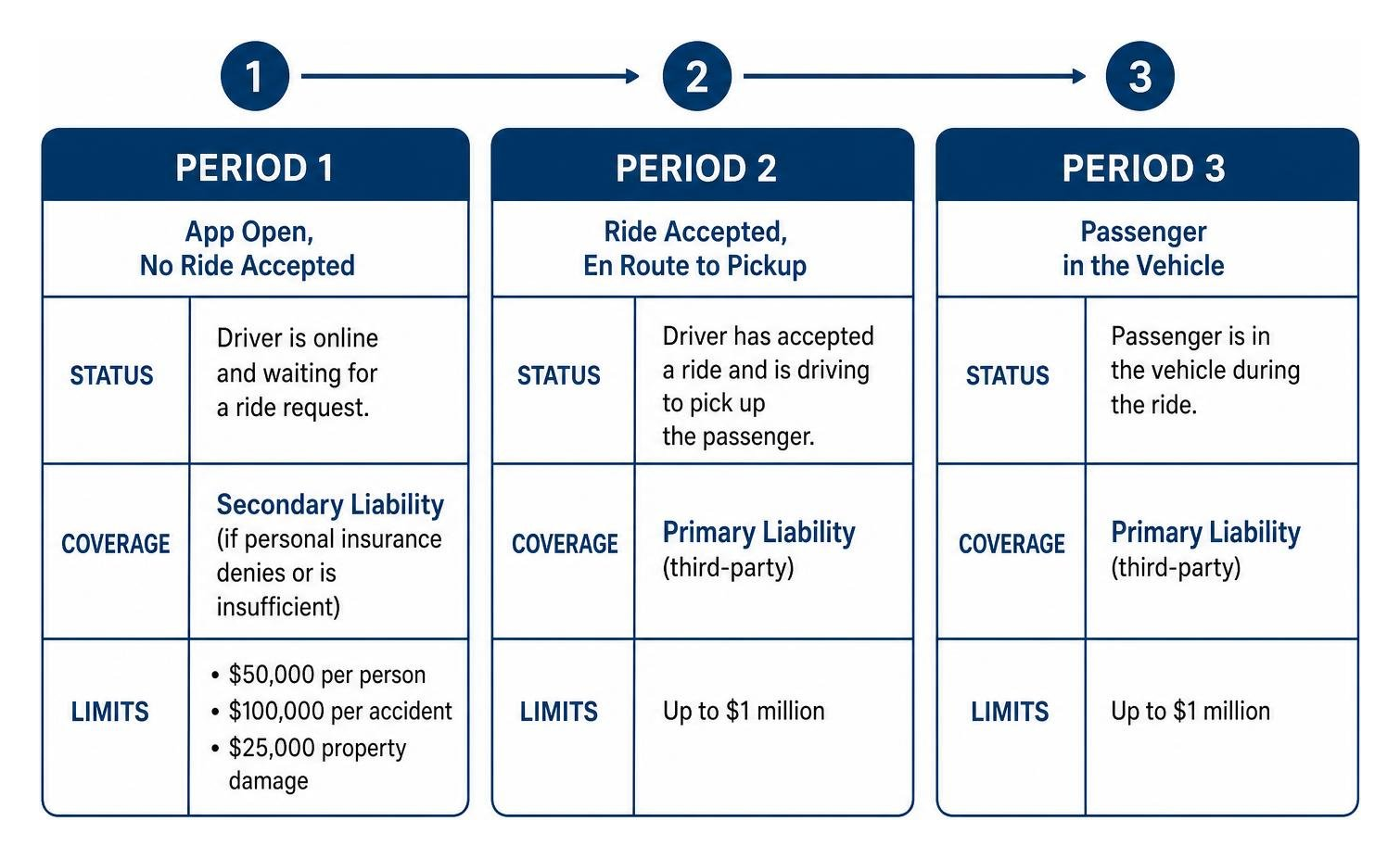
- Period 1: The App is Open, but No Ride is Accepted. The driver is logged into the Lyft app and waiting for a ride request. If they cause an accident during this time, Lyft provides secondary liability coverage if the driver’s personal auto policy denies the claim or is insufficient. This coverage typically includes up to $50,000 per person for bodily injury, $100,000 per accident, and $25,000 for property damage.
- Period 2: A Ride is Accepted, and the Driver is En Route. The driver has accepted a match and is driving to pick up the passenger. From this moment, Lyft’s primary third-party liability insurance increases significantly, providing up to $1 million in coverage.
- Period 3: A Passenger is in the Vehicle. From the moment you step into the Lyft vehicle until you exit, the $1 million primary liability policy is fully active. This policy also includes uninsured/underinsured motorist coverage, which protects you if another negligent, uninsured driver hits your Lyft vehicle.
How a Dearborn Lyft Injury Lawyer Proves Liability
Even with a $1 million policy active, Lyft’s insurance providers do not just hand over checks. To recover compensation beyond basic PIP benefits, we must prove that the Lyft driver (or another driver) was negligent and caused the crash.
Proving liability in a rideshare crash involves:
- Analyzing black box data from the vehicles
- Subpoenaing Lyft’s digital log data to verify the driver’s app status
- Reviewing traffic camera footage along Dearborn’s busy corridors
- Interviewing eyewitnesses and analyzing police reports
Because of the overlapping layers of personal insurance, commercial rideshare insurance, and Michigan no-fault rules, these cases can get messy fast. That is why having an experienced advocate on your side is critical. You can learn more about finding the right representation in our guide to choosing a dearborn vehicle collision attorney.
Recovering Compensation with a Dearborn Lyft Injury Lawyer
If you’ve suffered serious injuries in a Lyft crash, your life may have been turned upside down. You are dealing with doctor appointments, physical therapy, pain, and the stress of missing work.
A skilled dearborn lyft injury lawyer can help you secure two primary types of compensation: PIP benefits (first-party) and bodily injury damages (third-party).
| Compensation Type | What It Covers | Who Pays | Key Requirements |
|---|---|---|---|
| First-Party (PIP) Benefits | Medical expenses, up to 85% of lost wages, household replacement services, mileage to doctor visits. | Your own auto insurer, a household relative’s insurer, or the Michigan Assigned Claims Plan (MACP). | No need to prove fault; must document expenses. |
| Third-Party Damages | Pain and suffering, emotional distress, excess economic damages (lost wages exceeding the PIP cap). | Lyft’s liability insurance or the at-fault driver’s personal insurance. | Must prove the driver was at fault AND your injury meets the “threshold” of serious impairment. |
Economic vs. Non-Economic Damages
To pursue a third-party lawsuit for non-economic damages (pain and suffering), Michigan law requires that your injuries meet a specific legal threshold: a “serious impairment of body function.” This means the injury must be objectively manifested, affect an important body function, and influence your general ability to lead your normal life.
We work closely with medical professionals to document exactly how your injuries—such as herniated discs, traumatic brain injuries, or broken bones—have altered your daily routine. We also calculate the full extent of your economic losses, including future medical care and lost earning capacity. For an in-depth look at how we calculate these values, check out our dearborn car wreck compensation guide what your crash is really worth.
Statute of Limitations for Michigan Rideshare Lawsuits
Time is not on your side after a car crash. In Michigan, there are strict deadlines for filing legal claims:
- The One-Year Rule for PIP Benefits: You must file a claim for No-Fault PIP benefits with the correct insurance company within one year of the date of the accident. If you miss this deadline by even a single day, you lose your right to recover medical expenses and lost wages forever.
- The Three-Year Limit for Third-Party Lawsuits: You generally have three years from the date of the crash to file a personal injury lawsuit against the at-fault driver for pain and suffering.
While three years might sound like a long time, building a winning case takes months of investigation, medical evaluation, and negotiation. Waiting until the last minute can severely damage your chances of success. For more information on navigating these timelines, consult our car accident lawyer dearborn guide.
Overcoming Wayne County Legal Challenges in Rideshare Claims
Filing a personal injury claim in Wayne County comes with its own unique set of hurdles. Insurers are well aware of local jury trends and court backlogs, and they often use aggressive delay tactics to wear you down.
Some of the most common challenges we see in Dearborn rideshare cases include:
- The “Finger-Pointing” Game: Lyft’s insurance company may try to blame your personal auto insurer, while your personal insurer claims Lyft should pay. Meanwhile, you are stuck in the middle with unpaid medical bills.
- Lowball Settlement Offers: Shortly after the crash, an insurance adjuster might offer you a quick settlement. It may look like a decent amount of money, but it rarely covers the long-term costs of physical therapy, future surgeries, or lost career opportunities. Once you sign that release, you can never ask for more.
- Independent Contractor Defense: Lyft historically fights hard to distance itself from its drivers, arguing that because drivers are independent contractors, the corporation shouldn’t be held directly liable for their negligent actions behind the wheel.
Why You Need a Dearborn Lyft Injury Lawyer Instead of Going Alone
Trying to negotiate with multi-billion-dollar corporations like Lyft and their high-powered insurance defense teams on your own is like bringing a plastic butter knife to a sword fight.
When we take on your case, we handle all the heavy lifting:
- We manage all communications and negotiations with the insurance adjusters so you can focus on healing.
- We gather and preserve crucial digital evidence from Lyft’s servers before it is deleted.
- We build a comprehensive medical evidence file to prove the true impact of your injuries.
- We are fully prepared to take your case to court in Wayne County if the insurance companies refuse to offer a fair settlement.
Frequently Asked Questions About Dearborn Rideshare Accidents
What if the Lyft driver was offline during the accident?
If the driver did not have the Lyft app active at the time of the crash, Lyft’s commercial insurance will not cover the accident. Instead, the crash is treated as a standard car accident, and claims must be filed through the driver’s personal auto insurance policy and your own Michigan No-Fault PIP coverage.
Can a passenger sue Lyft directly for an accident in Dearborn?
Because Lyft drivers are classified as independent contractors rather than employees, you generally cannot sue Lyft the corporation directly for a driver’s negligent driving. However, you can make a claim against Lyft’s $1 million commercial liability insurance policy, which is specifically designed to cover passenger injuries during active trips.
How much does it cost to hire a rideshare accident attorney?
At Jalal Abdallah PLLC, we work on a contingency fee basis. This means there are absolutely no upfront costs or hourly fees for you. We only get paid if we successfully secure a settlement or jury verdict on your behalf. If we don’t win your case, you owe us nothing.
Secure Your Recovery with Relentless Legal Advocacy
At Jalal Abdallah PLLC, we don’t back down from powerful insurance companies or corporate legal teams. We believe in leveling the playing field for everyday people who have been hurt due to someone else’s negligence.
If you or a loved one has been injured in a rideshare accident in Dearborn, Southfield, Detroit, or Warren, let us handle the legal battle while you focus on getting your life back.
Contact our legal team today for a free, no-obligation consultation, and let’s discuss how we can help you get the justice and compensation you deserve.
Share This Article
Schedule Your Free Consultation Today!
Reach out today and receive a consultation, completely free of charge - we'll evaluate your case and let you know what comes next.


