 Skip to content
What Families Need to Know After a Fatal Accident in Dearborn
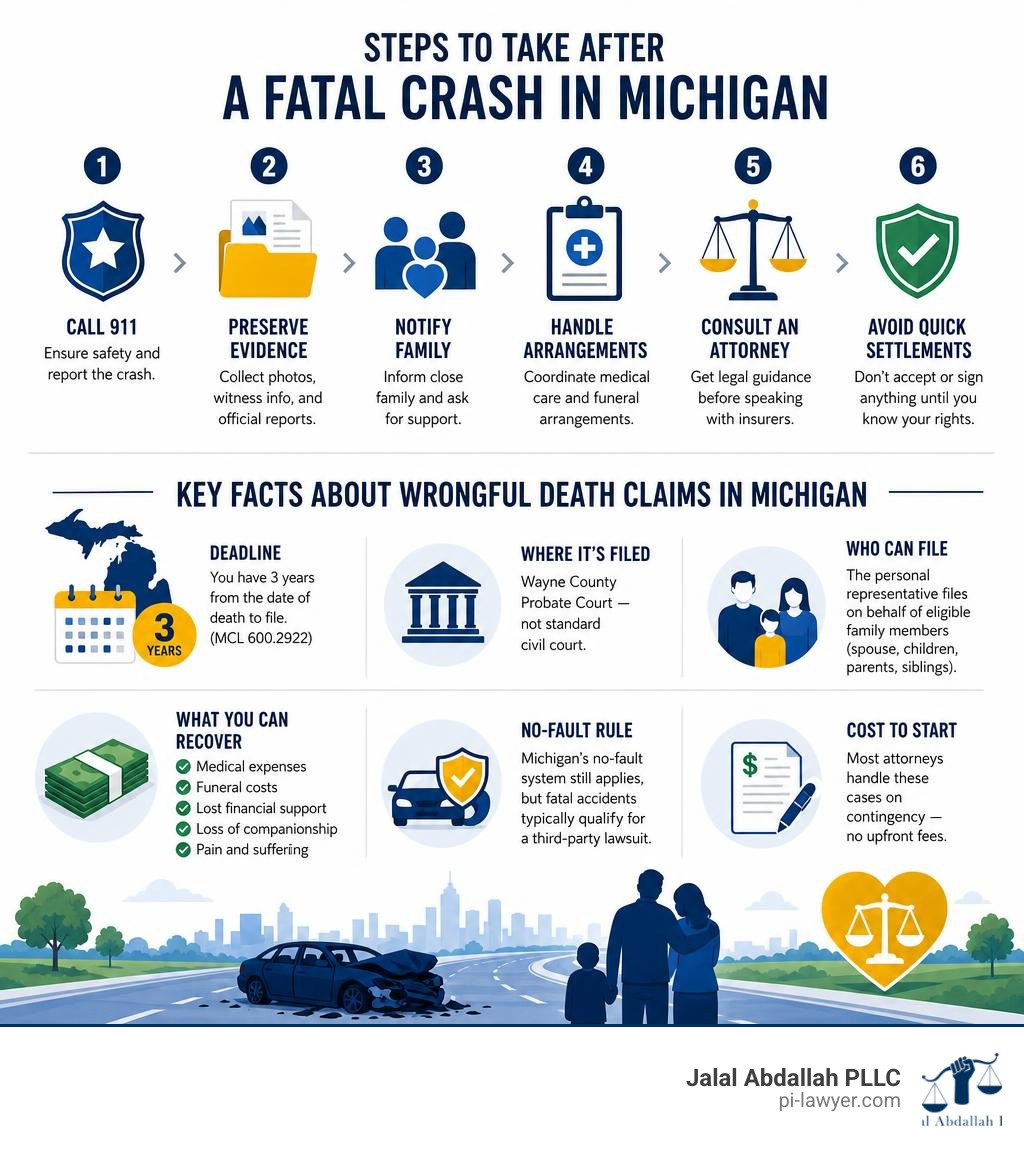
A Dearborn fatal accident lawsuit gives surviving family members a legal path to hold negligent parties accountable and recover compensation after losing a loved one. If you’re trying to understand where to start, here’s what matters most:
Quick answers for grieving Dearborn families:
- Who can file: The personal representative of the deceased’s estate files on behalf of eligible family members (spouse, children, parents, siblings)
- Deadline: You have 3 years from the date of death to file under Michigan law (MCL 600.2922)
- Where it’s filed: Wayne County Probate Court — not standard civil court
- What you can recover: Medical and funeral costs, lost financial support, loss of companionship, and pain and suffering
- No-fault rule: Michigan’s no-fault system still applies, but fatal accidents typically qualify for a third-party lawsuit
- Cost to start: Most attorneys handle these cases on contingency — no upfront fees
Losing someone in a crash is already devastating. Then the insurance company calls within 48 hours. Adjusters are trained to settle fast and for as little as possible — before you fully understand what your family is entitled to.
Wayne County leads all Michigan counties in total crashes, fatal crashes, and injury crashes. In 2023 alone, Michigan recorded 287,953 total crashes, with trucks or buses involved in over 15,000 of them. Dearborn’s location along major freight corridors like I-94 and Michigan Avenue puts local families at real risk.
I’m Jalal Abdallah, a personal injury attorney at Jalal Abdallah PLLC who has built his practice on fighting for families against powerful insurance companies in exactly these situations — including Dearborn fatal accident lawsuits. This guide walks you through every step of the process so you know what to expect and what to do next.
Understanding Liability in a Dearborn Fatal Accident Lawsuit
When a fatal crash occurs in Dearborn, determining who is legally responsible is rarely a simple task. This is especially true when commercial semi-trucks, municipal vehicles, or multiple passenger cars are involved. Because of Dearborn’s dense industrial corridors and heavy commercial traffic, commercial truck accidents are a major concern.
Large commercial trucks account for less than 5% of registered vehicles in the United States, yet they are disproportionately involved in catastrophic and fatal passenger vehicle crashes. The sheer size and weight of these vehicles mean that even a low-speed collision can be fatal for occupants of a passenger car.
Common causes of commercial truck crashes in Wayne County include:
- Driver Fatigue: Federal regulations limit driving hours, but pressure to meet tight delivery deadlines often leads to exhausted drivers falling asleep at the wheel.
- Impaired Driving: Whether from alcohol, illicit drugs, or prescription medications, impairment severely slows reaction times.
- Speeding and Aggressive Driving: Trying to beat traffic on busy freeways like I-94 or the Southfield Freeway.
- Poor Vehicle Maintenance: Worn-out brakes, bald tires, or broken lights on a 80,000-pound vehicle are recipes for disaster.
For a deeper dive into local road safety, read our guide on Staying Safe on the Road and Understanding Dearborn Fatal Crash Statistics.
When a commercial truck causes a fatal crash, liability may extend far beyond the driver. We look at the entire commercial operation. The trucking company can be held liable for negligent hiring, failing to monitor driver hours, or skipping mandatory maintenance.
In some cases, a government entity or city might even be held responsible. For example, in a landmark Michigan case, the City loses suit over fatal wreck – The News Herald reported on a historic $25 million jury verdict against the City of Dearborn. In that case, a city employee operating a municipal vehicle caused a fatal crash. Even though the employee was technically outside their typical job duties at the exact moment of the crash, the city was held liable because they owned the vehicle and permitted its use. This highlights how complex municipal liability and insurance coverage can become.
Proving Negligence in a Dearborn Fatal Accident Lawsuit
Proving that another driver or entity was negligent requires a mountain of concrete evidence. In a Dearborn fatal accident lawsuit, we leave no stone unturned. The moment we take on a case, we begin securing crucial evidence before it can be destroyed or lost.
Key pieces of evidence we gather include:
- Commercial Truck “Black Box” Data: These Electronic Control Modules (ECMs) record speed, braking, steering angles, and hours of service directly before a collision.
- Police Reports and Investigation Files: Dearborn Police Department reports provide the foundational timeline and initial assessments of fault.
- Toxicology Results: Essential if alcohol or drugs are suspected. For instance, in a tragic local case covered by Woman, 26, Could Face Charges In Fatal Dearborn Crash: Police, a driver traveling at speeds exceeding 100 mph ran a red light at Michigan Avenue and Nowlin Street, resulting in a fatal collision. Police held the investigation open specifically to await toxicology results before referring the case for criminal prosecution.
- Witness Statements: Independent accounts from people who saw the crash or captured it on dashcam footage.
- Crash Reconstruction: We work with engineering experts to recreate the physical physics of the crash, proving exactly how and why the collision occurred.
Third-Party Liability and Defective Vehicle Parts
Sometimes, a fatal crash is caused—or made far worse—by a failure in the vehicle itself. This brings product liability laws into play. If a seatbelt fails, an airbag does not deploy, or a vehicle’s roof collapses under minor pressure, the manufacturer may be held liable.
Roof crush resistance is a critical safety feature during rollover crashes. In a notable federal defective vehicle design order, a wrongful death action was brought against Ford Motor Company (which has deep corporate roots in Dearborn) alleging that a defective roof design failed to meet internal safety goals and caused fatal injuries during a rollover.
When vehicle components fail to protect occupants as designed, families can pursue third-party product liability claims against:
- Vehicle Manufacturers: For poor design choices or engineering defects.
- Parts Manufacturers: For defective brakes, tires, or steering systems.
- Cargo Loading Companies: If a truck’s cargo was improperly secured, causing a shift that led to a rollover or jackknife accident.
How Michigan’s No-Fault Insurance System Affects Wrongful Death Claims
Michigan operates under a unique and often confusing no-fault auto insurance system. Under this system, if you are injured in a car crash, you typically turn to your own insurance policy to pay for medical bills and lost wages through Personal Injury Protection (PIP) benefits—regardless of who caused the crash.
However, when an accident results in a fatality, the no-fault system does not prevent you from taking legal action. Instead, the law allows families to step outside the no-fault system and file a third-party lawsuit against the at-fault driver. This is crucial because PIP benefits are limited and do not cover the profound emotional and personal losses associated with wrongful death.
Insurance companies are businesses, and their primary goal is to protect their bottom line. They will use a variety of tactics to minimize their financial exposure. To understand how they operate, read about How Insurance Companies Try to Devalue Your Injury Claim.
To help visualize how these claims work, here is a breakdown of the differences between standard no-fault benefits and a third-party wrongful death lawsuit:
| Feature | Michigan No-Fault PIP Benefits | Third-Party Wrongful Death Lawsuit |
|---|---|---|
| Who Pays? | Your own auto insurance company | The at-fault driver’s liability insurance |
| Fault Required? | No, paid regardless of who caused the crash | Yes, you must prove the other driver was negligent |
| Medical Expenses | Covered (subject to your policy limits) | Excess medical bills not covered by PIP |
| Funeral Costs | Limited allowance (usually up to $5,000) | Full recovery of actual funeral and burial costs |
| Pain & Suffering | Not available | Covered (for the deceased’s suffering and family’s loss) |
| Loss of Companionship | Not available | Covered (compensation for loss of society and comfort) |
The Threshold for Filing a Third-Party Lawsuit
To file a lawsuit against an at-fault driver for non-economic damages (like pain and suffering), the victim’s injuries must meet a certain legal threshold. Under Michigan law, this threshold requires that the crash resulted in:
- Serious impairment of body function,
- Permanent serious disfigurement, or
- Death.
Since a fatal accident clearly meets this threshold, the estate is legally permitted to pursue a third-party tort claim. To learn more about this standard, explore our Personal Injury page.
However, Michigan’s modified comparative fault rules (MCL 600.2957) still apply. Under these rules, if the deceased person was partially at fault for the crash, the total compensation the family can recover will be reduced by their percentage of fault. If the deceased is found to be more than 50% at fault, the family is barred from recovering any non-economic damages from the other driver. We work tirelessly to ensure insurance companies do not unfairly shift the blame onto your loved one to avoid paying what they owe.
Step-by-Step Guide to Filing a Wrongful Death Claim in Wayne County
Filing a wrongful death claim in Michigan involves a specific legal process that differs from standard personal injury lawsuits. It requires coordinating between the civil court system and the Wayne County Probate Court.
Here is the step-by-step process we guide our clients through:
- Appoint a Personal Representative: A wrongful death lawsuit cannot be filed by just any family member. It must be filed by the “personal representative” of the deceased person’s estate. If the deceased had a will, they may have named a representative. If not, the Wayne County Probate Court will appoint one (usually a surviving spouse, adult child, or parent).
- Open the Estate in Probate Court: We assist you in opening an estate case in the probate court. This legal entity holds the right to pursue the lawsuit. Learn more about how this works on our Wrongful Death page.
- Identify Eligible Beneficiaries: Under Michigan’s Wrongful Death Act (MCL 600.2922), eligible beneficiaries who may share in the recovery include:
- Surviving spouse
- Children and descendants
- Parents and grandparents
- Siblings
- Anyone named in the deceased’s will
- File the Lawsuit: Once the estate is open and the representative is appointed, we file the formal civil complaint against the negligent parties.
- Distribute Settlement or Verdict: If the case resolves successfully, the probate court must approve the distribution of the funds among the eligible beneficiaries based on their individual losses.
For a detailed look at how damages are calculated, consult our Dearborn Car Wreck Compensation Guide: What Your Crash Is Really Worth.
Statute of Limitations for a Dearborn Fatal Accident Lawsuit
Time is of the essence when pursuing a wrongful death claim. Under Michigan law, the statute of limitations for filing a wrongful death lawsuit is three years from the date of the victim’s death. If you miss this deadline, your family will lose the right to seek justice and compensation forever.
While three years may sound like a long time, building a robust case takes months of preparation. Furthermore, critical evidence can disappear quickly:
- Surveillance camera footage from local businesses near Michigan Avenue or Schaefer Road is often overwritten within days.
- Physical evidence at the crash scene washes away with weather.
- Witness memories fade.
Additionally, if the crash involved a government vehicle or a hazardous road condition maintained by a public entity, you must file a formal notice of intent within a much shorter timeframe—sometimes as little as 60 to 120 days after the incident.
To ensure you do not miss any critical legal deadlines, review our guide on What to Do Immediately After a Car Accident in Michigan.
Recoverable Damages for Surviving Family Members
The financial impact of losing a family member can be devastating, especially if they were the primary breadwinner. A wrongful death claim seeks to ease this burden by recovering both economic and non-economic damages.
Economic damages are objective, calculable financial losses, including:
- Medical Expenses: The cost of any medical care, surgeries, or emergency transport your loved one received between the time of the crash and their passing.
- Funeral and Burial Costs: The actual expenses incurred to lay your loved one to rest.
- Lost Financial Support: The income, benefits, and retirement savings your loved one would have reasonably contributed to the family had they lived.
- Loss of Services: The value of household tasks the deceased performed, such as childcare, home maintenance, and cooking.
Non-economic damages compensate for the intangible, personal losses your family suffers, including:
- Pain and Suffering: Compensation for the conscious physical pain and mental anguish your loved one experienced between the crash and their death.
- Loss of Society and Companionship: The loss of love, guidance, protection, and comfort that your loved one provided to their family.
To understand how courts evaluate these deeply personal losses, read our detailed article on Understanding Pain and Suffering Damages in Personal Injury Cases.
Frequently Asked Questions About Dearborn Fatal Crashes
Who is legally allowed to file a wrongful death lawsuit in Michigan?
In Michigan, only the court-appointed personal representative of the deceased’s estate is legally authorized to file a wrongful death lawsuit. While the lawsuit is filed by the representative, it is brought on behalf of all eligible beneficiaries, including the surviving spouse, children, parents, and siblings. The Wayne County Probate Court handles the appointment process and oversees the distribution of any recovered funds.
Can we still pursue a lawsuit if my loved one was partially at fault?
Yes. Michigan follows a modified comparative negligence system. This means you can still recover damages as long as your loved one was 51% or less at fault for the accident. However, the final compensation award will be reduced by their percentage of fault. For example, if a jury awards $1 million but finds your loved one was 20% at fault for the crash, the final recovery amount will be $800,000. If their fault exceeds 50%, recovery for non-economic damages is barred.
How long does it typically take to resolve a fatal accident claim?
The timeline varies significantly depending on the complexity of the case. A straightforward claim with clear liability and a cooperative insurance company might resolve in a matter of months. However, complex cases involving commercial trucking companies, defective auto parts, or disputed liability can take one to three years to resolve. If the case must go to trial, the timeline will be longer. We work efficiently to secure a fair settlement while always remaining prepared to fight in court if insurers refuse to offer a just payout.
Securing Justice and Financial Recovery for Your Family
Losing a loved one is one of the most painful experiences a family can endure. During this difficult time, you should be allowed to focus on grieving and supporting one another—not fighting with greedy insurance adjusters or navigating the complex probate and civil court systems.
At Jalal Abdallah PLLC, we provide relentless, compassionate advocacy for families who have lost loved ones due to negligence. We know the tactics insurance companies use to devalue your claim, and we are committed to standing up to them to ensure your family receives the full justice and financial security you deserve.
If you are dealing with the aftermath of a fatal crash in Dearborn, Southfield, Detroit, or Warren, contact us today for a compassionate, free, and no-obligation consultation. Let us handle the legal burden so you can focus on healing.
To learn more about how we can support you, visit our Wrongful Death page.
Share This Article

Schedule Your Free Consultation Today!
Reach out today and receive a consultation, completely free of charge - we'll evaluate your case and let you know what comes next.


