 Skip to content
When Sudden Loss Leaves Your Family Facing the Unexpected
If you’re looking for a wrongful death attorney in Dearborn, here’s what you need to know right away:
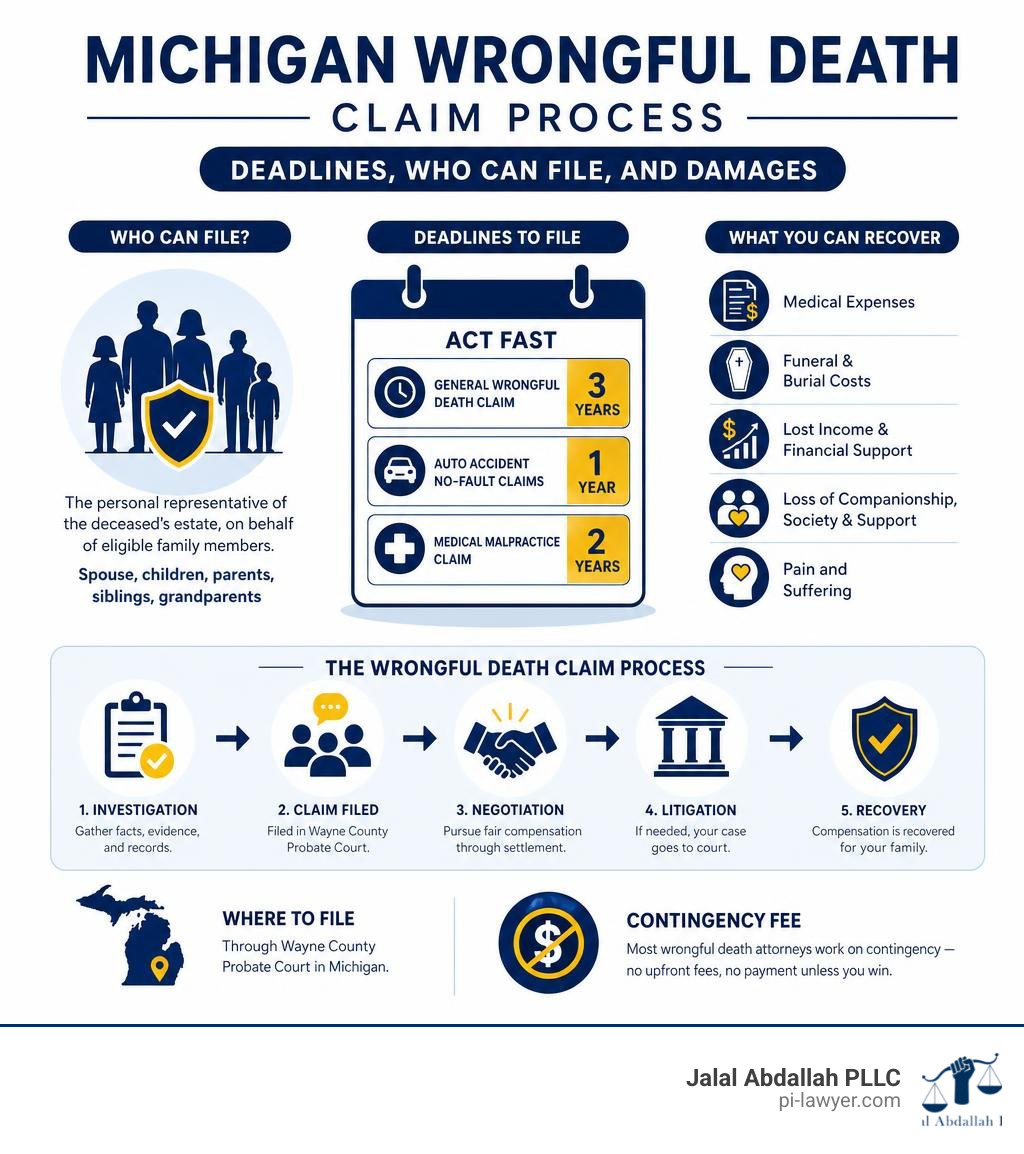
- Who can file: The personal representative of the deceased’s estate, on behalf of eligible family members (spouse, children, parents, siblings, grandparents)
- Deadline to file: Generally 3 years from the date of death — but only 1 year for auto accident no-fault claims and 2 years for medical malpractice
- What you can recover: Medical bills, funeral costs, lost income, loss of companionship, and pain and suffering
- Cost to hire an attorney: Most wrongful death attorneys work on contingency — no upfront fees, no payment unless you win
- Where to file: Through Wayne County Probate Court in Michigan
Losing a family member is devastating on its own. But when that loss was caused by someone else’s negligence — a reckless driver, a careless doctor, an unsafe workplace — the grief is compounded by something that feels deeply unfair.
And then the bills start arriving.
Funeral costs. Medical expenses from the final hospital stay. Lost income that your family depended on. All of this lands on you while you’re still in the middle of grieving.
Insurance companies know that timeline. They often move quickly after a fatal accident — not to help your family, but to settle fast and for as little as possible. Without legal guidance, many families accept far less than Michigan law actually allows them to recover.
Understanding your rights under Michigan’s Wrongful Death Act (MCL 600.2922) is the first step toward protecting your family’s financial future and holding the responsible party accountable.
I’m Jalal Abdallah, a personal injury and criminal defense attorney based in Dearborn, Michigan, and as a wrongful death attorney serving Dearborn and the surrounding Wayne County area, I’ve built my practice on fighting for families who feel outmatched by powerful insurance companies and institutions. If your family has lost a loved one due to someone else’s negligence, I’m here to make sure your voice is heard.
Wrongful death attorney dearborn vocab explained:
How a Wrongful Death Attorney in Dearborn Evaluates Your Case
When you contact us after a tragedy, we do not expect you to have all the answers. Our first job is to listen, offer a compassionate ear, and carefully evaluate whether you have grounds for a civil lawsuit under Michigan Compiled Laws (MCL) § 600.2922.
In Michigan, a wrongful death claim is a civil action. It is entirely separate from any criminal proceedings that the state might pursue against the negligent party. While a criminal case focuses on punishment and jail time, a civil case focuses on providing financial recovery and accountability for the surviving family.
Because of this separation, the burden of proof is different. In a criminal trial, the prosecutor must prove guilt “beyond a reasonable doubt.” In a civil wrongful death claim, we only need to establish liability by a “preponderance of the evidence.” This means we must show that it is more likely than not that the defendant’s negligence or wrongful act caused your loved one’s passing.
During our evaluation, we look for four key elements:
- Duty of Care: Did the responsible party owe your loved one a legal duty to act safely? (e.g., a driver must follow traffic laws, or a doctor must provide standard medical care).
- Breach of Duty: Did they fail in that duty through a negligent act or omission?
- Causation: Did this specific breach directly cause the fatal injury?
- Damages: Did the death result in measurable financial and emotional losses for the surviving family?
Evaluating these cases early is vital. Evidence can disappear quickly—surveillance footage from businesses along Michigan Avenue or the Southfield Freeway can be overwritten in a matter of days. We move fast to preserve physical evidence, obtain police reports, and secure witness statements to build a rock-solid foundation for your claim.
Who Can File a Fatal Accident Claim in Michigan?
One of the most common points of confusion for grieving families is who actually has the legal right to file a lawsuit. Under Michigan law, individual family members cannot simply file a wrongful death lawsuit on their own.
Instead, the lawsuit must be brought by the personal representative of the deceased person’s estate. The personal representative is the legal voice of the estate, acting on behalf of all eligible beneficiaries. If your loved one had a will, they likely named a personal representative. If they did not have a will, or if the named person cannot serve, the Wayne County Probate Court will appoint someone—usually a close relative like a spouse or adult child.
Once the personal representative files the lawsuit, any recovered damages are distributed among the eligible beneficiaries. According to Michigan’s Practice Area: Wrongful Death guidelines, the individuals who may be entitled to receive compensation include:
- The surviving spouse
- Children and stepchildren of the deceased
- Parents and grandparents
- Siblings
- Anyone named as a beneficiary in the deceased’s will
When you are dealing with the loss of a loved one, having a dedicated local attorney who understands the Wayne County court system is invaluable. Personalized, local attention is what truly makes a difference when navigating these complex legal waters, ensuring your family’s rights are fully protected from the very beginning.
When to Consult a Wrongful Death Attorney in Dearborn for Estate Matters
Because wrongful death claims are so deeply intertwined with probate law, you will need to navigate the estate administration process alongside your civil lawsuit. This is where many families feel overwhelmed. You are not just dealing with insurance adjusters; you are also dealing with court filings, asset inventories, and probate judges.
We assist families in opening the estate in the Wayne County Probate Court so that a personal representative can be officially appointed. This step is a prerequisite to moving forward with a civil claim. Consulting us early ensures that all probate requirements are handled correctly, preventing costly procedural delays that could stall your family’s search for justice. You can learn more about how these actions are structured by visiting our comprehensive guide on Wrongful Death.
How a Wrongful Death Attorney in Dearborn Calculates Damages
Calculating the true value of a life is an impossible task, but the civil court system uses financial compensation as its only tool to make things right. When we pursue a claim, we divide the damages into two main categories: economic and non-economic.
Economic Losses (The Financial Impact)
These are the objective, tangible financial costs resulting from the death. They include:
- Medical Bills: The cost of emergency medical care, surgeries, and life support prior to your loved one’s passing.
- Funeral and Burial Expenses: The direct costs of laying your loved one to rest.
- Lost Financial Support: The income, benefits, pensions, and health insurance your loved one would have provided to your family over their expected working lifetime.
Non-Economic Damages (The Personal Impact)
These damages address the emotional and psychological toll of your loss. They are subjective but incredibly significant:
- Loss of Companionship and Society: The loss of love, guidance, advice, and physical presence.
- Pain and Suffering: The physical and mental suffering your loved one experienced between the time of their injury and their death.
- Grief and Mental Anguish: The emotional trauma suffered by the surviving family members.
Unlike some states, Michigan does not place a general statutory cap on non-economic damages in standard wrongful death cases, though specific caps may apply in medical malpractice claims. We work with financial planners and economists to calculate future lost earnings and inflation, ensuring that the insurance company’s settlement offer covers your family’s long-term needs.
Critical Deadlines and Michigan No-Fault Insurance Impacts
Timing is everything in a wrongful death case. If you miss a legal deadline, you lose your right to seek compensation forever, no matter how clear the other party’s fault may be.
In Michigan, the general statute of limitations for a wrongful death lawsuit is three years from the date of the person’s passing. However, this timeline can change dramatically depending on how the accident occurred:
- General Negligence / Slip and Fall: 3 years.
- Medical Malpractice: 2 years.
- Auto Accidents (No-Fault PIP Benefits): 1 year.
Michigan’s unique No-Fault auto insurance system adds a layer of complexity to vehicle accidents. If your loved one was killed in a car crash, your family may be entitled to Personal Injury Protection (PIP) benefits from your own auto insurer, which can cover funeral expenses and a portion of lost wages (known as survivor’s loss benefits). Under Michigan’s No-Fault law, you must file a claim for these benefits within one year of the accident.
To help you keep track of these critical timelines, we have outlined the standard deadlines below:
| Case Type | Statute of Limitations | Key Notice Requirements |
|---|---|---|
| General Wrongful Death | 3 Years | Probate estate must be opened |
| Medical Malpractice | 2 Years | Requires a formal Notice of Intent (NOI) before filing |
| Auto Accident (At-Fault Claim) | 3 Years | Claims against the negligent driver’s liability policy |
| Auto Accident (No-Fault PIP/Survivor’s Loss) | 1 Year | Claims filed with your own auto insurer |
| Claims Against Government Entities | Varies (often 6 months) | Extremely strict written notice deadlines apply |
Common Causes of Fatal Accidents in Dearborn
Dearborn is a bustling hub of industry, culture, and transit. Unfortunately, this high level of activity also means that fatal accidents occur on our roads, in our workplaces, and in our medical facilities.
Some of the most common causes of wrongful death claims in our area include:
- Car and Motorcycle Accidents: High-speed collisions on major thoroughfares like the Southfield Freeway (M-39), Michigan Avenue, and Telegraph Road are a leading cause of fatal injuries.
- Commercial Truck Accidents: Dearborn’s connection to major shipping lanes and the I-94 corridor means heavy semi-truck traffic. Accidents involving commercial trucks often result in catastrophic, fatal injuries due to the sheer size and weight of these vehicles.
- Workplace and Industrial Accidents: With Dearborn’s deep industrial roots, including manufacturing plants and construction sites, workplace fatalities caused by unsafe working conditions or heavy machinery malfunctions are a tragic reality.
- Medical Malpractice: Fatalities can occur when healthcare providers fail to diagnose life-threatening conditions, commit surgical errors, or prescribe incorrect medications.
Frequently Asked Questions About Dearborn Fatal Accident Claims
We understand that you have many questions during this difficult time. Below are answers to some of the questions we hear most frequently from families in Dearborn.
What is the difference between a wrongful death claim and a criminal case?
A wrongful death claim is a civil lawsuit brought by the personal representative of the deceased’s estate in civil court. Its goal is to secure financial compensation for the family’s losses. A criminal case is initiated by government prosecutors (like the Wayne County Prosecutor’s Office) to punish a person for breaking the law.
A civil claim can proceed at the same time as a criminal case, and you can still win a civil lawsuit even if the defendant is acquitted of criminal charges, because the civil court uses a lower burden of proof.
How do contingency fee arrangements work for legal representation?
We represent families on a contingency fee basis. This means you do not pay us any upfront hourly fees or out-of-pocket costs to take your case. We only get paid if we successfully recover a settlement or jury verdict for your family. Our fee is a pre-agreed percentage of that final recovery. If we do not win your case, you owe us nothing. This allows your family to pursue justice without adding financial strain to an already difficult situation.
Can we file a claim if my loved one was partially at fault?
Yes. Michigan follows a system known as “modified comparative fault.” Under this rule, your family can still recover damages even if your loved one was partially to blame for the accident, provided their percentage of fault is not greater than 50%.
If they are found to be partially at fault, the total compensation awarded will be reduced by their percentage of responsibility. For example, if the total damages are calculated at $1,000,000, but your loved one is found to have been 20% at fault, the recovery would be reduced to $800,000. If their fault exceeds 50%, you may be barred from recovering non-economic damages, which makes having a dedicated legal team to dispute unfair allegations of fault incredibly important.
Standing Strong for Your Family When It Matters Most
When you are grieving, the last thing you want to do is fight with insurance adjusters who are trained to minimize your loss. You need a team that will step into the ring for you, handle the paperwork, and push back against lowball settlement offers.
At Jalal Abdallah PLLC, we pride ourselves on being relentless advocates for underdogs. We do not back down from powerful insurance corporations or government entities. We treat our clients like neighbors, offering clear, honest communication and compassionate guidance through every step of the legal process.
If you are ready to discuss your options and protect your family’s future, we are here to help. You can learn more About our firm, explore our personal injury Services, or reach out to us directly through our Contact page to schedule a free, no-obligation consultation. Let us carry the legal burden so you can focus on healing.
Share This Article

Schedule Your Free Consultation Today!
Reach out today and receive a consultation, completely free of charge - we'll evaluate your case and let you know what comes next.


