 Skip to content
Start Your Dearborn Michigan Rideshare Accident Claim Within 7 Days
After a rideshare crash in Dearborn, get medical care, save your Uber or Lyft trip details, report the collision, and notify the right no-fault insurer in writing. A Dearborn Michigan rideshare accident claim usually has two tracks: a no-fault PIP claim for medical bills and lost wages, plus a fault-based claim for pain and suffering when the injury meets Michigan’s legal threshold.
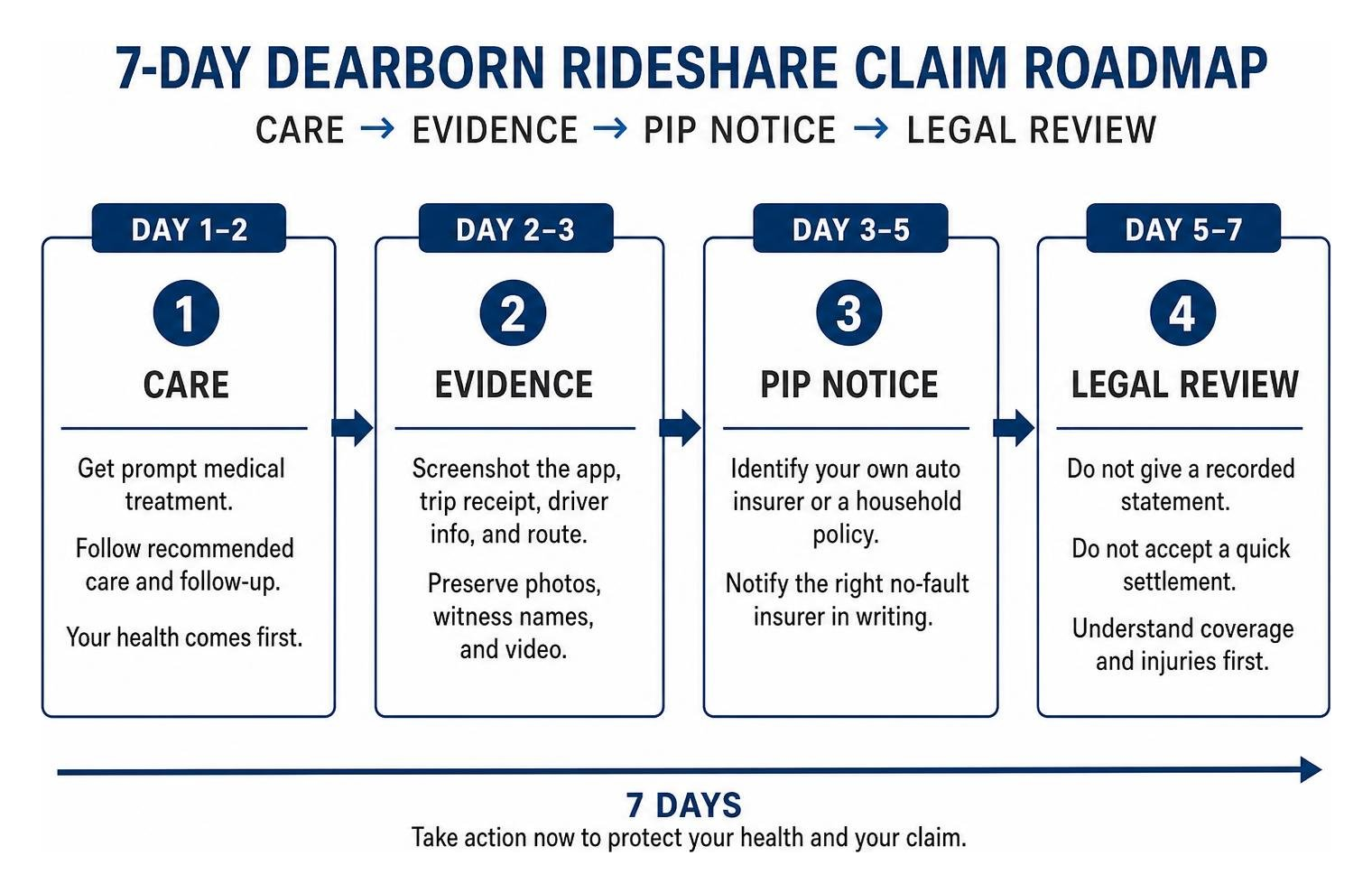
In the first week, focus on these steps:
- Get prompt medical treatment and follow-up care.
- Screenshot the rideshare app, trip receipt, driver information, and route.
- Obtain the crash report and preserve photos, witness names, and video.
- Identify your own auto insurer or a household policy for PIP benefits.
- Do not give a recorded statement or accept a quick settlement before you understand the coverage and injuries.
This matters on busy Dearborn routes such as Michigan Avenue, Warren Avenue, Ford Road, and the Southfield Freeway corridor, where intersection crashes, pedestrian incidents, and disputed lane changes can make fault difficult to sort out. Michigan’s rules are strict: PIP claims generally require action within one year under MCL 500.3145, while an injury lawsuit generally has a three-year filing deadline.
I am Jalal Abdallah, a Michigan trial attorney and licensed insurance producer with a University of Michigan-Dearborn background. Through Jalal Abdallah PLLC, I help people understand the insurance and injury issues that can shape a Dearborn Michigan rideshare accident claim.
Easy Dearborn Michigan rideshare accident claim word list:
Navigating the 7-Day Timeline for a Dearborn Michigan Rideshare Accident Claim

Taking swift, organized action after a crash in Wayne County protects your health and your financial recovery. As of 2026, Michigan’s hybrid insurance structure demands early attention to administrative details that standard tort states never require. The official State of Michigan Traffic Crash Report (Form UD-10) filed by the Dearborn Police Department or Michigan State Police serves as the foundation for both your first-party No-Fault Personal Injury Protection (PIP) claim and your third-party liability action.
Because evidence disappears quickly, organizing your response across a seven-day window prevents insurers from disputing coverage or assigning unfair blame.
Day 1 to 3: Crucial First Steps for Your Dearborn Michigan Rideshare Accident Claim
The immediate aftermath of a collision is about medical stabilization and digital data capture.
- Seek Immediate Medical Attention: Go to an emergency facility such as Corewell Health Dearborn Hospital on Outer Drive. Documenting your symptoms right away prevents insurers from arguing that your injuries resulted from an unrelated event.
- Preserve Digital Evidence: Take complete screenshots of your Uber or Lyft app. Capture the driver’s profile, vehicle make and license plate, the detailed electronic receipt, GPS route tracking, and the exact timestamp.
- Establish the Driving Period: Under MCL 257.2123, rideshare insurance coverage depends entirely on app status. Whether the driver was simply logged in (Period 1), driving to pick you up (Period 2), or transporting you (Period 3) dictates which insurance policy pays out. Reviewing what to do immediately after a car accident in Michigan can help keep these early steps organized.
Day 4 to 7: Preserving Evidence for a Dearborn Michigan Rideshare Accident Claim
The remainder of the first week requires proactive evidence preservation before crucial data is lost or overwritten:
- Secure External Video: Request surveillance footage from commercial storefronts near high-traffic corridors like Ford Road or Michigan Avenue, and secure dashcam recordings from all involved vehicles.
- Identify Witnesses: Gather independent contact details and recorded impressions from bystanders, other motorists, and store clerks who witnessed the collision.
- Control Insurer Contact: Commercial rideshare insurers frequently contact victims early to elicit recorded statements that minimize injury severity or shift fault. Understanding why you need a dedicated Dearborn Uber accident lawyer on your side helps ensure you do not inadvertently surrender essential rights.
- Issue Formal Written Notices: Send written notices of injury to the relevant insurers to satisfy the initial claim requirements.
Required Initial Claim Notices:
- Written Notice of Injury to the priority PIP insurer containing the claimant’s name, address, and crash details.
- Notice of Claim to Uber or Lyft’s commercial carrier under MCL 257.2123.
- Preservation letters to third-party commercial vehicle owners or municipal departments if road defects contributed.
- Formal request for the finalized UD-10 police report from the Dearborn Police Records Bureau.
Michigan No-Fault PIP Priority and Insurance Coverage Tiers
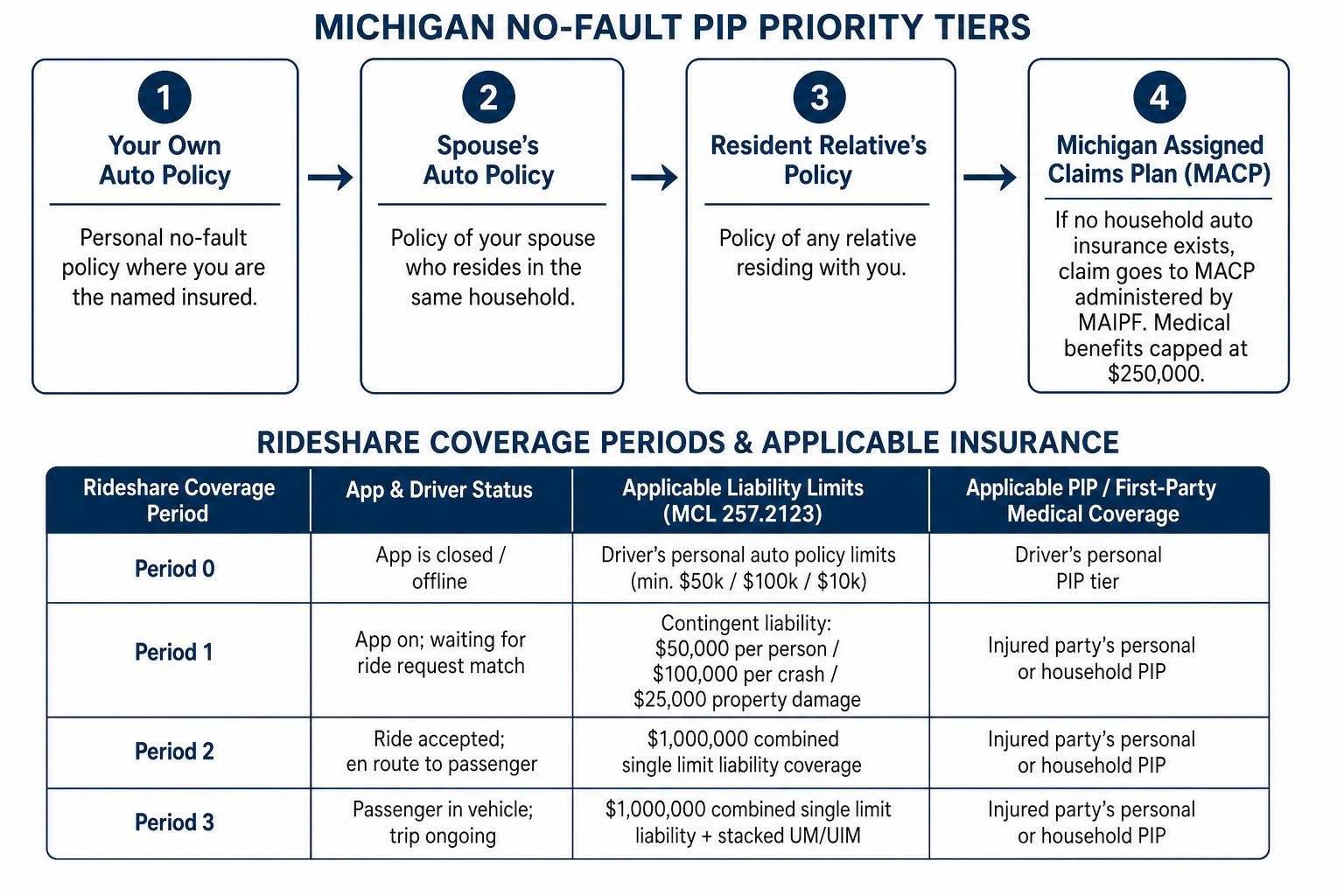
Michigan’s No-Fault Insurance Act uses an “order of priority” to determine which carrier pays your medical expenses, attendant care, 85% of gross lost wages (subject to statutory monthly caps for up to three years), and $20 per day in replacement services.
Under MCL 500.3114, an injured rideshare passenger does not automatically look to Uber or Lyft’s insurance for PIP benefits. Instead, you must progress through a statutory hierarchy:
- Your Own Auto Policy: The personal no-fault policy in which you are the named insured.
- Spouse’s Auto Policy: The policy of your spouse who resides in the same household.
- Resident Relative’s Policy: The policy of any relative residing with you.
- Michigan Assigned Claims Plan (MACP): If no household auto insurance exists, your claim goes to the MACP, administered by the Michigan Automobile Insurance Placement Facility (MAIPF), which caps medical benefits at $250,000.
Choosing your PIP medical coverage tier is a bit like ordering pizza—you pick the package that suits your budget, but choosing the lowest tier leaves you with significant uncovered costs if a major crash occurs.
| Rideshare Coverage Period | App & Driver Status | Applicable Liability Limits (MCL 257.2123) | Applicable PIP / First-Party Medical Coverage |
|---|---|---|---|
| Period 0 | App is closed / offline | Driver’s personal auto policy limits (min. $50k/$100k/$10k) | Driver’s personal PIP tier |
| Period 1 | App on; waiting for ride request match | Contingent liability: $50,000 per person / $100,000 per crash / $25,000 property damage | Injured party’s personal or household PIP |
| Period 2 | Ride accepted; en route to passenger | $1,000,000 combined single limit liability coverage | Injured party’s personal or household PIP |
| Period 3 | Passenger in vehicle; trip ongoing | $1,000,000 combined single limit liability + stacked UM/UIM | Injured party’s personal or household PIP |
Navigating Uber and Lyft Commercial Insurance Limits
When a crash occurs during Periods 2 or 3, Uber and Lyft carry a $1,000,000 combined single-limit liability policy under MCL 257.2123. This policy covers third-party bodily injury and property damage when the rideshare driver is at fault. It also provides uninsured and underinsured motorist (UM/UIM) coverage if another driver causes the crash but lacks sufficient coverage. You can explore potential case values using an online Michigan Uber Accident Settlement Calculator (2026): MI Rideshare Claims.
Strict Statutory Deadlines Under Michigan Law
Michigan enforces strict statutory timelines that will permanently bar your recovery if missed:
- The One-Year Notice Rule (MCL 500.3145): You must provide written notice of injury to the appropriate PIP insurer within one year of the crash date. Failure to do so prevents you from recovering any PIP medical or wage-loss benefits.
- The “One-Year-Back” Rule: In lawsuits for unpaid PIP benefits, you cannot recover for any expenses incurred more than one year prior to filing the complaint.
- Three-Year Tort Statute of Limitations (MCL 600.5805): Lawsuits against at-fault drivers for pain and suffering (noneconomic damages) and excess economic losses must be filed within three years of the crash date.
- Insurance Complaints: If an insurer unreasonably delays or refuses PIP payment, claims can be submitted to the Michigan Department of Insurance and Financial Services (DIFS) for administrative review.
Clearing the McCormick Threshold and Proving Fault in Wayne County
Pursuing noneconomic damages for pain, suffering, and emotional distress requires proving that an at-fault driver caused your crash and that your injuries satisfy Michigan’s legal injury standard. Furthermore, under MCL 600.2959, Michigan applies a 51% modified comparative fault rule: if you are found 51% or more at fault for your injuries, you are completely barred from recovering noneconomic damages. Adjusters use this rule aggressively, and knowing how insurance companies try to devalue your injury claim is vital to defending your recovery.
Settlement dynamics are unique in Wayne County. Claims filed in the 3rd Circuit Court typically produce settlement values 15% to 25% above Michigan statewide averages due to broad jury representation and realistic appraisals of serious injuries.
Proving Serious Impairment Under McCormick v. Carrier
Under MCL 500.3135 and the Michigan Supreme Court’s ruling in McCormick v. Carrier (2010), recovering noneconomic damages requires showing a “serious impairment of body function.” This test requires three distinct prongs:
- Objectively Manifested Impairment: The injury must be observable or verifiable by medical personnel through physical examination or objective diagnostic testing (such as MRIs, CT scans, EMGs, or X-rays), rather than subjective self-reports of pain.
- Important Body Function: The impairment must affect a body function of substantial significance to the individual (e.g., walking, lifting, cognitive processing).
- Affecting General Ability to Lead a Normal Life: The injury must influence the claimant’s capacity to live their normal, pre-accident life, without requiring a permanent disruption.
Our team at Jalal Abdallah PLLC gathers targeted medical imaging, functional capacity assessments, and employment records to clear this statutory threshold. Reviewing resources on understanding pain and suffering damages in personal injury cases can help clarify how these components work together.
Depending on objective medical findings, typical recovery ranges in Michigan rideshare claims vary widely:
- Whiplash / Soft Tissue Injuries: $0 to $18,000 (often barred from pain and suffering without objective imaging).
- Concussions / Mild Traumatic Brain Injuries: $35,000 to $120,000.
- Fractures (Clear Threshold Injuries): $50,000 to $475,000.
- Herniated Discs with Surgical Intervention: $90,000 to $1,000,000.
- Spinal Cord Injury / Paralysis: $750,000 to $5,000,000+.
- Wrongful Death: $750,000 to $5,000,000+.
Dearborn Crash Hotspots and Common Liability Scenarios
Dearborn combines bustling industrial routes, dense retail hubs, and major regional commuter thoroughfares. These environments create specific liability challenges in rideshare cases:
- Warren Avenue Corridor: Heavy pedestrian volume and frequent curb drop-offs often result in door-opening collisions and side-swipe incidents.
- Michigan Avenue & Greenfield Road: Fast-moving traffic and multi-phase left turns create high-impact angle collisions.
- Ford Road (M-153) Retail Zones: Traffic entering and exiting parking plazas near Fairlane Town Center leads to disputed right-of-way collisions and rear-end impacts.
- Southfield Freeway (M-39) Interchanges: High speeds and short merge lanes increase the risk of multi-vehicle pileups. In 2024, the Michigan State Police recorded 288,880 total crashes statewide, with 1,099 fatalities (including 579 related to alcohol or drugs). Nearby intersections like Joy Road and M-39 saw 78 crashes in 2024 alone.
When liability is contested, referencing the ultimate guide to hiring a Dearborn Lyft injury lawyer helps explain how local crash data supports fault allocation.
Frequently Asked Questions About Rideshare Crashes in Wayne County
Whose PIP insurance covers me if I am injured as an Uber passenger in Dearborn?
Under the order of priority established in MCL 500.3114, you must first file a PIP claim through your own personal auto insurance policy. If you do not own a vehicle or carry insurance, you file under the policy of a spouse or resident relative.
If no one in your household owns an insured vehicle, you submit a claim to the Michigan Assigned Claims Plan (MACP). Under MACP guidelines, medical PIP benefits are capped at $250,000. Uber’s commercial liability coverage under MCL 257.2123 pays for pain and suffering and excess economic loss, but does not provide primary PIP benefits to passengers who have personal or household coverage available.
How does the 51% comparative fault rule impact my Michigan rideshare claim?
Under MCL 600.2959, Michigan operates under a modified comparative fault framework with a 51% bar. If you are pursuing a third-party tort claim for noneconomic damages (pain and suffering), your recovery will be reduced by your percentage of fault. If a jury determines you are 51% or more at fault for the crash or your resulting injuries (such as failing to wear a seatbelt, contributing to driver distraction, or entering an unsafe traffic lane as a pedestrian), you are completely barred from recovering noneconomic damages.
Economic damages are reduced proportionally to your percentage of fault, regardless of whether you cross the 51% threshold.
Why are rideshare settlement values higher in Wayne County compared to other Michigan counties?
Settlement values in Wayne County (along with Washtenaw County) routinely run 15% to 25% higher than the statewide average. This difference is driven by Wayne County’s 3rd Circuit Court jury pool, which tends to view corporate defendants and commercial insurance carriers with skepticism while recognizing the true cost of pain and suffering.
Because commercial insurers calculate their financial risk based on potential trial outcomes, they frequently offer higher pre-trial settlements in Wayne County to avoid substantial jury verdicts.
Partner with Relentless Advocates for Your Dearborn Injury Claim
Taking on commercial rideshare enterprises and well-funded insurance carriers requires dedicated, strategic advocacy. At Jalal Abdallah PLLC, we stand up for underdogs across Dearborn, Detroit, Southfield, and Warren, working to ensure that victims receive the full PIP benefits and third-party compensation to which they are entitled under Michigan law.
If you or a loved one was injured in a rideshare crash anywhere across Wayne County, reach out to a trusted Dearborn car accident attorney for guidance on your recovery options. You can also explore our broad legal services through our personal injury and comprehensive legal support platforms, learn more about our firm on our homepage, or reach out directly through our contact page to schedule a consultation.
Share This Article

Schedule Your Free Consultation Today!
Reach out today and receive a consultation, completely free of charge - we'll evaluate your case and let you know what comes next.


