 Skip to content
An Essential Guide to Medical Bills Exceeding Insurance Limits in Dearborn
When crash-related healthcare costs surpass third-party bodily injury limits in Wayne County, unpaid balances are covered through a multi-tiered recovery system involving your own PIP coverage, underinsured motorist (UIM) insurance, health plans, or secondary third-party policies. A severe collision on Michigan Avenue, Ford Road, or the Southfield Freeway can lead to emergency trauma transport, intensive surgical procedures, extended hospital stays at facilities like Corewell Health Dearborn, and months of physical rehabilitation. These treatments easily push medical expenses into the hundreds of thousands of dollars.
The fundamental issue is the massive gap between the actual cost of modern medical trauma and the minimum liability limits carried by Michigan motorists. While state law established higher default bodily injury liability limits of $250,000 per person and $500,000 per accident under the 2019 reforms, drivers are still legally permitted to execute down-sheets reducing their coverage to statutory minimums of $50,000 per person and $100,000 per accident (or even older $20,000/$40,000 limits grandfathered into certain legacy policies). When an at-fault driver carrying a $50,000 limit causes an accident resulting in $250,000 of trauma care, a $200,000 coverage deficit is created instantly.
Understanding what happens if medical bills exceed policy limits requires looking at Michigan’s layered recovery framework. When the negligent driver’s insurer pays out its maximum policy limit, that carrier’s legal obligation to defend or indemnify the driver is largely exhausted. However, that does not mean you are forced to absorb the unpaid balance yourself.
Michigan operates a multi-tiered recovery system designed to address shortfalls:
- First-Party Personal Injury Protection (PIP): Pays your initial medical costs up to your selected policy limit.
- Third-Party Bodily Injury Liability: Covers excess economic losses (including medical expenses that surpass your own PIP limits) and non-economic damages up to the at-fault driver’s policy cap.
- Underinsured Motorist (UIM) Coverage: Steps in from your own auto insurance policy to bridge the remaining deficit.
- Secondary Third-Party Coverages: Taps commercial, employer, or umbrella policies where applicable.
- Personal Asset Recovery & Healthcare Lien Negotiation: Pursues direct civil judgments against the driver or negotiates reductions with medical providers and health plans to protect your net settlement.
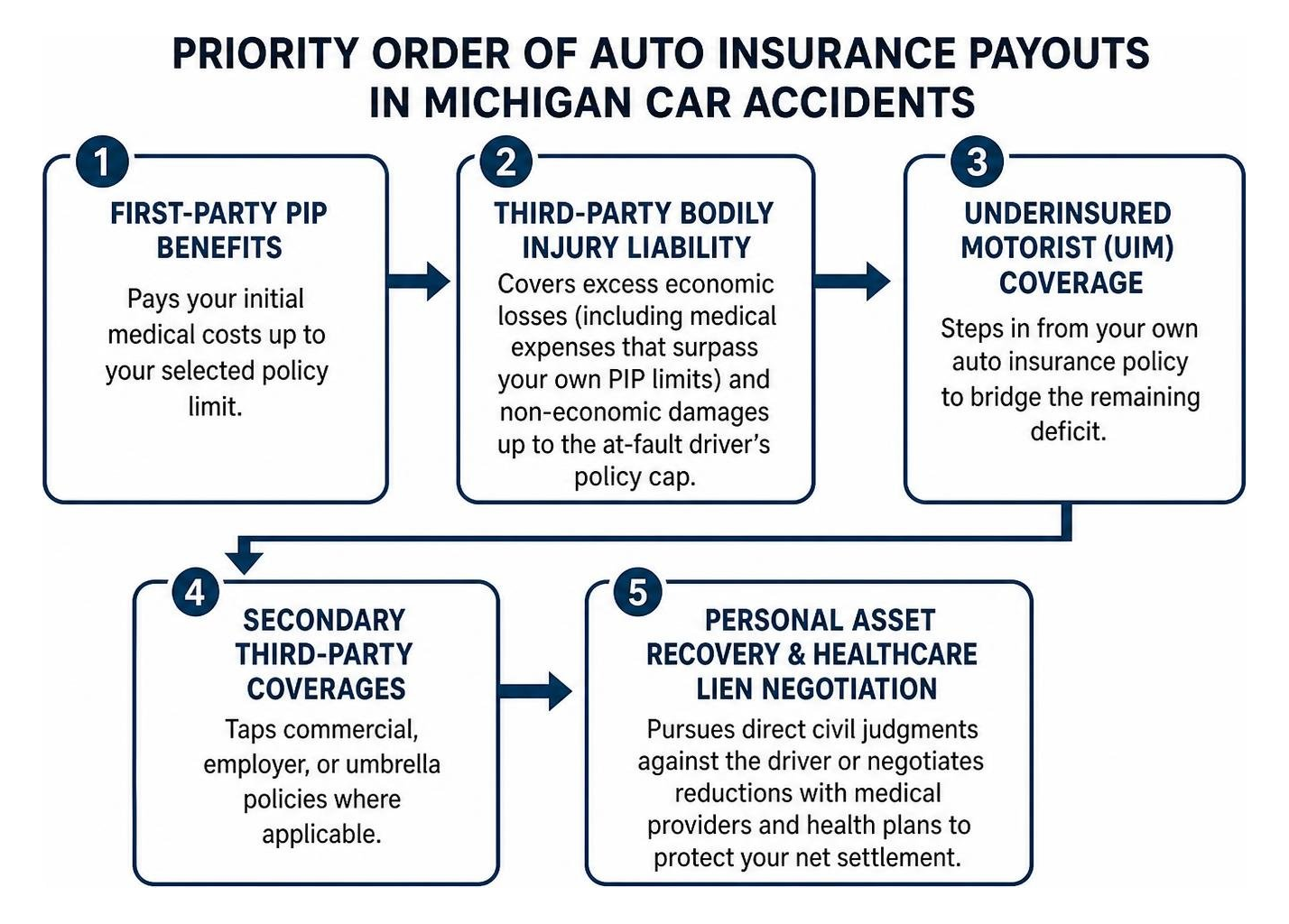
How Do Michigan No-Fault PIP Benefits and Bodily Injury Claims Interact When Coverage Caps Out?

To understand where your medical bills get paid, you must understand how Michigan’s no-fault system functions after the landmark 2019 legislative reforms. Prior to July 2020, every insured Michigan driver was required to carry uncapped, lifetime medical benefits through Personal Injury Protection (PIP). Under the modern framework, drivers select from specific PIP medical coverage levels:
- $50,000 limit: Available only to individuals enrolled in Medicaid whose household members have qualifying health coverage.
- $250,000 limit: Capped medical coverage per person per accident.
- $500,000 limit: Capped medical coverage per person per accident.
- Unlimited lifetime PIP: Uncapped medical benefits for all reasonable and necessary crash-related care.
- Complete PIP opt-out: Available to drivers with Medicare Parts A & B.
Regardless of who caused the collision in Dearborn, your own auto insurance policy is the primary payer for your direct accident-related medical care through your PIP coverage. If you carried unlimited PIP, your insurer pays all necessary medical treatment for life, meaning the at-fault driver’s low liability limits will not leave you with personal medical debt.
However, if you or your policyholder selected a capped tier ($50,000, $250,000, or $500,000) and your medical expenses surpass that limit, the law allows you to bring a third-party claim against the at-fault driver. Under Michigan law (MCL 500.3135), medical expenses that exceed your chosen PIP cap are classified as “excess economic damages.” The at-fault driver’s bodily injury liability coverage automatically steps in to cover these excess medical bills.
When your crash involves catastrophic injuries, determining the full scope of your claim requires careful analysis. Using our Dearborn car wreck compensation guide can help clarify how both economic losses and pain and suffering factor into total case valuation. In addition to unpaid hospital bills, severe crashes inflict physical agony and emotional distress, making understanding pain and suffering damages in personal injury cases critical when negotiating a multi-layer settlement.
How Michigan’s Serious Impairment Threshold Affects Lawsuits
Pursuing an at-fault driver for non-economic damages (pain, suffering, mental anguish, and loss of life enjoyment) requires meeting Michigan’s statutory injury threshold under MCL 500.3135(1). To file a third-party tort claim for non-economic damages, an injured victim must establish that they suffered:
- Death;
- Permanent serious disfigurement; or
- A serious impairment of body function.
Under Michigan Supreme Court precedent (McCormick v. Carrier), proving a serious impairment of body function requires showing an objectively manifested impairment of an important body function that affects the person’s general ability to lead their normal life.
Importantly, excess economic damages do not require meeting the serious impairment threshold. If your medical expenses or wage losses exceed your statutory PIP caps, you can sue the at-fault driver for those excess economic costs even if your physical injuries do not meet the legal definition of a serious impairment.
| Coverage Feature | First-Party PIP Medical Benefits | Third-Party Bodily Injury Liability |
|---|---|---|
| Payer | Your own auto insurance carrier | The at-fault driver’s auto insurer |
| Fault Requirement | Payable regardless of who caused the crash | Must prove the other driver was at fault |
| Coverage Scope | Medical bills up to selected policy cap ($50k, $250k, $500k, or Unlimited) | Excess medical bills, wage loss beyond 3 years, pain and suffering |
| Threshold Requirement | No physical threshold required | Serious impairment threshold required for pain and suffering; no threshold for excess economic loss |
| Policy Limit Trigger | Primary payer from date of injury | Secondary; triggered after your PIP is exhausted or for non-economic losses |
What Alternative Insurance Coverages and Third Parties Can Cover Your Unpaid Bills?
When the at-fault driver’s policy is exhausted, we look beyond the initial auto policy to locate supplemental coverage pools that can make up the difference.
Underinsured Motorist (UIM) Coverage
Underinsured Motorist (UIM) coverage is an optional but vital endorsement you purchase on your own auto policy. While Uninsured Motorist (UM) coverage protects you if the at-fault driver has zero insurance, UIM is designed specifically for situations where the at-fault party has insurance, but their policy limits are too low to pay your total damages.
For example, if you incur $200,000 in excess medical bills and pain and suffering, and the negligent driver has only a $50,000 policy limit, their insurer will tender the $50,000 limit. If you have $250,000 in UIM coverage on your policy, your own insurer must pay the remaining $150,000 shortfall (subject to policy language and offset provisions).
To successfully file a UIM claim:
- You must prove the other driver was legally liable for the accident.
- You must prove your damages exceed the at-fault driver’s policy limits.
- You must formally exhaust the at-fault driver’s liability policy through a policy-limits settlement.
- Crucial: You must obtain written permission from your UIM carrier before signing any release with the at-fault driver, or you risk voiding your UIM coverage entirely.
Umbrella and Excess Liability Policies
Affluent motorists or commercial vehicle owners often carry personal or commercial umbrella liability insurance. Umbrella policies sit on top of underlying primary auto coverage and typically provide additional coverage ranging from $1,000,000 to $5,000,000 or more. If the at-fault driver holds an umbrella policy, it triggers automatically once their primary auto liability limits are completely paid out.
Employer Liability and Commercial Fleet Policies
If the at-fault driver was driving a company vehicle, running an errand for an employer, or operating within the scope of their employment at the time of the crash, the employer can be held vicariously liable under the doctrine of respondeat superior. Commercial auto and corporate liability policies typically carry coverage limits of $1,000,000 or higher, providing substantial protection against catastrophic medical debt.
Similarly, if the crash involved a driver operating for a rideshare service (Uber, Lyft) or delivery platform (DoorDash, Amazon Flex), commercial coverage tiers apply depending on whether the driver had the application open, was en route to pick up a passenger, or was actively transporting a fare.
Secondary Insurance Sources to Investigate After a Dearborn Crash:
- The at-fault driver’s personal umbrella insurance policy
- Commercial liability policies of the driver’s employer
- Transportation Network Company (TNC) commercial coverage (Uber/Lyft)
- Commercial delivery insurance policies
- Resident relative auto policies (where policy language allows coverage extension)
- Property owner liability policies (in cases involving roadway or sightline hazards)
- dram shop liability coverage (if the at-fault driver was visibly intoxicated and overserved at a commercial bar or restaurant)
When fatal injuries occur due to an underinsured motorist, families face both catastrophic emotional loss and substantial final medical expenses. In these circumstances, pursuing a Dearborn fatal accident compensation claim allows surviving relatives to tap wrongful death recovery avenues and all available commercial or personal liability tiers.
Handling Health Insurance Subrogation, ERISA Liens, and Hospital Charity Care
Once your auto insurance PIP coverage is fully exhausted, your private health insurance (such as Blue Cross Blue Shield of Michigan, Priority Health, or HAP), Medicare, or Medicaid becomes the secondary payer for ongoing medical treatment.
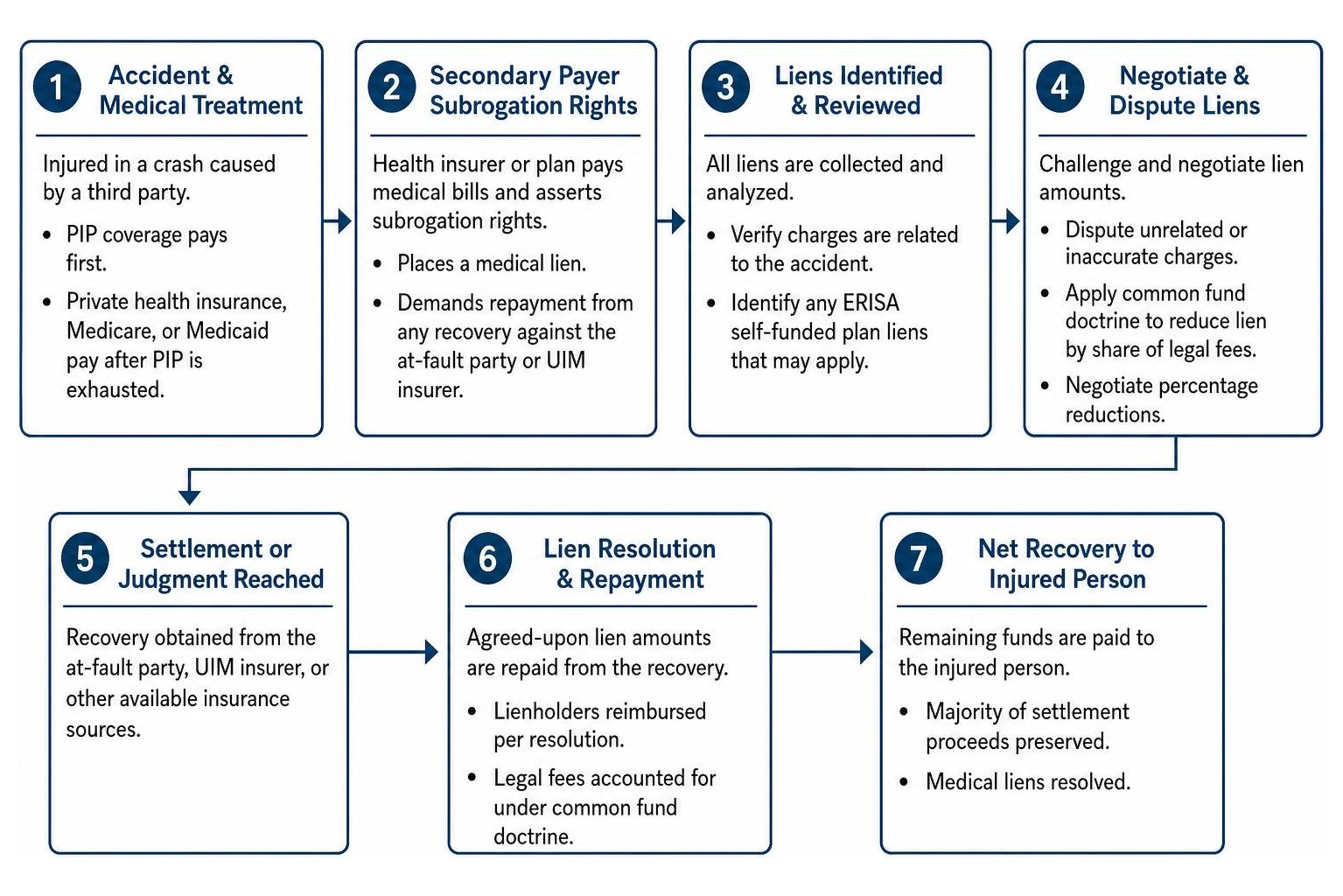
Health Insurance Subrogation and ERISA Liens
When your health insurance company pays medical expenses arising from an auto accident caused by a third party, that insurer typically asserts a “subrogation” right or places a medical lien on your third-party settlement. They demand repayment out of the funds you recover from the at-fault driver or your UIM policy.
Self-funded employer health plans governed by federal law (ERISA) maintain aggressive reimbursement rights that can preempt state laws. However, these liens are not set in stone. We regularly audit medical billing statements, challenge unrelated treatment charges, apply the “common fund doctrine” (forcing the lienholder to pay their proportionate share of legal fees), and negotiate substantial percentage reductions on health insurance liens so that our clients retain the majority of their settlement proceeds.
Protections Under the Federal No Surprises Act
The federal No Surprises Act protects accident victims from unfair “balance billing.” When you receive emergency medical care at an out-of-network hospital or from out-of-network doctors at an in-network facility following a crash, the healthcare providers are legally prohibited from billing you for the difference between their billed charges and what your insurer paid (other than your standard in-network cost-sharing amounts).
Hospital Financial Assistance and Charity Care Programs
Under Section 501(r) of the Internal Revenue Code, all nonprofit hospital organizations (including major healthcare networks across Wayne County and Detroit) must maintain formal Financial Assistance Policies (FAP). These charity care programs provide full forgiveness or steep discounts on hospital bills for individuals and families whose household income falls between 200% and 400% of the Federal Poverty Level. Applying for these programs can eliminate thousands of dollars in outstanding balances before medical debts are sent to collections.
Tax Treatment of Settlements vs. Forgiven Debt
Under Internal Revenue Code Section 104(a)(2), compensatory settlements and jury awards received for physical injuries or physical sickness are entirely non-taxable at both federal and state levels. You do not pay income tax on funds recovered for medical bills, pain and suffering, or disability.
However, if a healthcare provider or collection agency agrees to cancel or write off your outstanding medical debt outside of a formal personal injury settlement, the IRS may treat that forgiven debt as taxable cancellation of debt (COD) income via Form 1099-C, unless you can prove you were legally insolvent at the time the debt was canceled.
Can You Sue the At-Fault Driver Personally If Their Insurance Runs Out?
When an at-fault driver’s insurance coverage is insufficient to satisfy your medical bills and pain and suffering damages, you have the legal right to file a lawsuit directly against the individual driver for the remaining balance. If a jury returns a verdict exceeding the insurance policy limits, the court enters an “excess judgment” against the defendant personally.
However, a legal judgment is only as valuable as the defendant’s ability to pay. Before pouring resources into extensive litigation against an individual, we assess whether the defendant is “judgment-proof”:
- Judgment-Proof Defendants: Individuals who have minimal income, do not own real estate, rent their home, and possess no significant non-exempt financial assets. Obtaining a $500,000 judgment against someone with no assets and minimal wages will not result in financial recovery.
- Defendants with Collectible Assets: Individuals who own multiple properties, maintain significant equity in secondary real estate, hold unshielded investment portfolios, or earn high annual salaries.
Legal Enforcement Mechanisms for Excess Judgments
If the defendant possesses collectible wealth, Michigan law provides several post-judgment collection remedies:
- Wage Garnishment: Under federal and Michigan law, you can garnish up to 25% of the defendant’s disposable weekly earnings (or the amount by which disposable earnings exceed 30 times the federal minimum wage, whichever is less).
- Bank Account Garnishments: Periodic or non-periodic garnishment orders served on financial institutions where the defendant holds checking, savings, or investment accounts.
- Judgment Liens on Real Property: Recording a judgment lien against real estate owned by the defendant in Wayne County or surrounding counties, preventing them from selling or refinancing the property without paying your judgment.
- Execution and Seizure of Property: Directing the county sheriff to seize and auction non-exempt personal property, vehicles, watercraft, or business equipment.
- Driver’s License Suspension: Under the Michigan Motor Vehicle Code (MCL 257.511-512), if an at-fault driver fails to satisfy an auto-accident-related judgment within 30 days, the state can suspend their driver’s license until the judgment is fully paid or an approved payment installment plan is established.
The Danger of Signing a General Release
Insurance companies representing at-fault drivers will attempt to protect their insured by demanding that you sign a General Release before they release the policy-limit check. A general release extinguishes all claims against the at-fault driver, their estate, and all other potential entities forever.
If you sign a standard general release without proper legal structure, you instantly forfeit:
- Your right to pursue the individual driver for their personal assets;
- Your right to claim Underinsured Motorist (UIM) benefits from your own carrier; and
- Your ability to pursue employer or commercial policies.
To protect your rights, your attorney must negotiate a Limited Liability Release or obtain formal written consent from your UIM insurer waiving its subrogation rights before settling with the third-party carrier. Insurance adjusters frequently utilize aggressive settlement tactics to minimize payouts, which is why recognizing how insurance companies try to devalue your injury claim is crucial. Our team at Jalal Abdallah PLLC focuses on shielding clients from these traps and uncovering every possible layer of financial recovery.
What Immediate Legal Steps Should You Take in Dearborn to Protect Your Claim?
Protecting your ability to recover medical expenses that exceed insurance policy limits requires proactive steps from the moment an accident occurs.
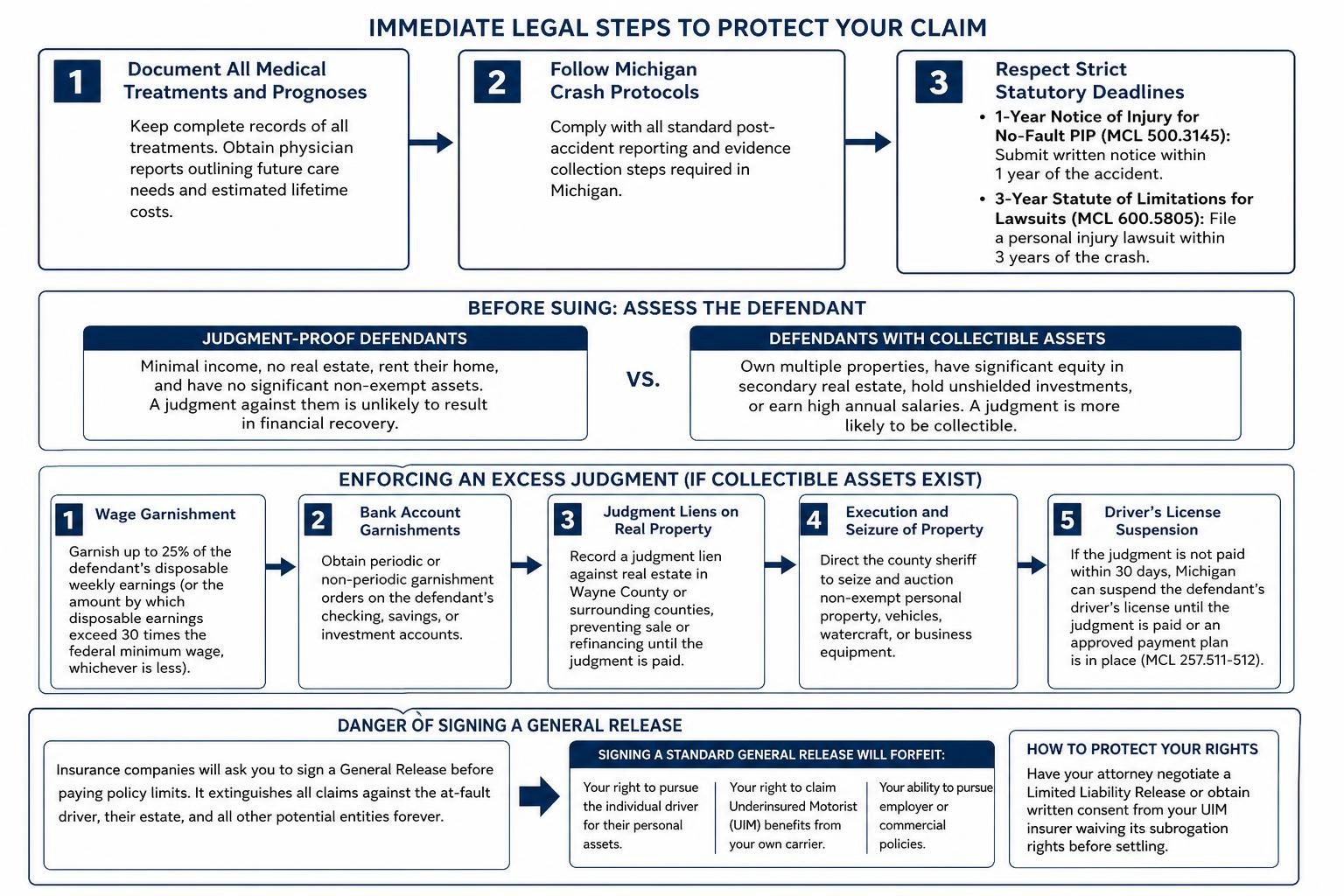
- Document All Medical Treatments and Prognoses: Keep complete records of every emergency room visit, surgical procedure, physical therapy session, and prescription. Request narrative reports from your treating physicians outlining your future medical care needs and estimated lifetime costs.
- Follow Michigan Crash Protocols: Comply with all standard post-accident reporting and evidence collection steps outlined in what to do immediately after a car accident in Michigan.
- Respect Strict Statutory Deadlines:
- 1-Year Notice of Injury for No-Fault PIP: Under MCL 500.3145, written notice of injury must be submitted to your own auto insurer within 1 year of the accident date, or your right to recover PIP benefits is permanently barred.
- 3-Year Statute of Limitations for Third-Party Lawsuits: Under MCL 600.5805, you have 3 years from the date of the crash to file a personal injury lawsuit against the at-fault driver for excess economic loss and non-economic damages.
- Contractual UIM Notice Windows: Unlike statutory claims, Underinsured Motorist claims are governed by the specific language of your auto policy. Many Michigan policies impose strict notice requirements—sometimes as short as 30 to 90 days—to report a potential UIM claim or file for arbitration.
- Do Not Give Recorded Statements or Sign Early Releases: Insurance adjusters will reach out quickly to lock you into statements regarding your injuries or pressure you into a quick, lowball settlement before the full extent of your medical bills is known. Decline to give recorded statements until you have consulted counsel.
- Schedule a Comprehensive Case Review: Arrange a detailed Dearborn injury case evaluation to analyze the at-fault driver’s policy limits, review your own PIP and UIM coverage, perform asset checks on the negligent driver, and coordinate secondary health coverage.
Frequently Asked Questions About Medical Bills Exceeding Insurance Limits in Dearborn?
What Happens If My Medical Bills Exceed Both My PIP Limit and the At-Fault Driver’s Bodily Injury Policy?
When both your first-party PIP coverage and the at-fault driver’s third-party bodily injury limits are completely exhausted, your unpaid medical care transitions to your primary health insurance plan (such as Blue Cross Blue Shield of Michigan, Priority Health, Medicare, or Medicaid).
If you carry Underinsured Motorist (UIM) coverage on your own auto policy, you can file a first-party claim against your insurer to recover compensation for the remaining unpaid medical expenses, future care needs, and pain and suffering.
Simultaneously, we step in to negotiate directly with hospital billing departments and medical lienholders to reduce outstanding balances, apply for hospital financial hardship programs, and ensure you are not left with unmanageable out-of-pocket medical debt.
Can I File a Claim Against My Own Underinsured Motorist (UIM) Policy Without Raising My Rates?
In Michigan, insurance companies are prohibited from raising your auto insurance premiums or canceling your policy solely because you filed a claim for an accident where you were not substantially at fault (MCL 500.2109).
Because a UIM claim is only triggered when another driver is at fault for causing your injuries, accessing your contractual UIM benefits does not constitute an at-fault accident. UIM is coverage that you have paid for specifically to protect you against underinsured drivers; filing a legitimate claim is your contractual right.
How Does Jalal Abdallah PLLC Help When an At-Fault Driver Has Inadequate Insurance?
When policy limits are too low, we deploy a comprehensive strategy to find and recover additional funds:
- In-Depth Asset Investigations: We perform background checks, title searches, and financial asset screenings to determine if the at-fault driver holds real estate, corporate assets, or leviable wealth.
- Discovering Hidden Commercial Policies: We investigate whether the driver was working, driving a corporate vehicle, or operating on a gig-economy platform (rideshare/delivery) at the time of the crash.
- Preserving UIM Claims: We ensure that settlements with the at-fault driver do not inadvertently forfeit your right to recover Underinsured Motorist benefits.
- Aggressive Lien Negotiation: We negotiate with ERISA health plans, Medicare, Medicaid, and hospital billing departments to substantially reduce their reimbursement claims, maximizing the net money that goes directly into your pocket.
How Can Jalal Abdallah PLLC Fight for Your Full Financial Recovery?
Navigating the aftermath of a catastrophic car accident in Dearborn is overwhelming when medical bills continue to mount and the at-fault driver’s insurance coverage runs out. Michigan’s 2026 auto insurance landscape requires thorough knowledge of statutory PIP tiers, third-party tort thresholds, subrogation laws, and contractual underinsured motorist provisions.
At Jalal Abdallah PLLC, we believe that injured victims should never bear the financial cost of someone else’s negligence. Our practice is built on relentless advocacy for underdogs against massive insurance corporations and institutional defendants. We dig deep into every case to locate secondary coverage layers, commercial policies, umbrella insurance, and personal assets that adjusters attempt to conceal.
If you or a family member is facing medical bills that exceed the at-fault driver’s insurance limits in Dearborn, Detroit, Southfield, Warren, or anywhere in Wayne County, you do not have to fight the insurance companies alone. Explore our personal injury legal services to learn more about how we protect injury victims, or reach out to us today to schedule your free legal consultation. We will evaluate your policy limits, handle the bill collectors and lienholders, and pursue every dollar of compensation you deserve.
Share This Article

Schedule Your Free Consultation Today!
Reach out today and receive a consultation, completely free of charge - we'll evaluate your case and let you know what comes next.


