 Skip to content
Navigating Complex Claims with a Dearborn Survivor Benefits Attorney
A Dearborn survivor benefits attorney helps grieving families identify, secure, and coordinate all available death benefits, including Social Security survivor payments, Veterans Affairs Dependency and Indemnity Compensation (VA DIC), and ERISA-governed employer pensions or life insurance plans. By managing complex administrative filings, navigating strict statutory deadlines, and resolving disputed beneficiary designations, legal counsel ensures surviving spouses, children, and dependent parents receive the complete financial support their deceased loved ones earned.
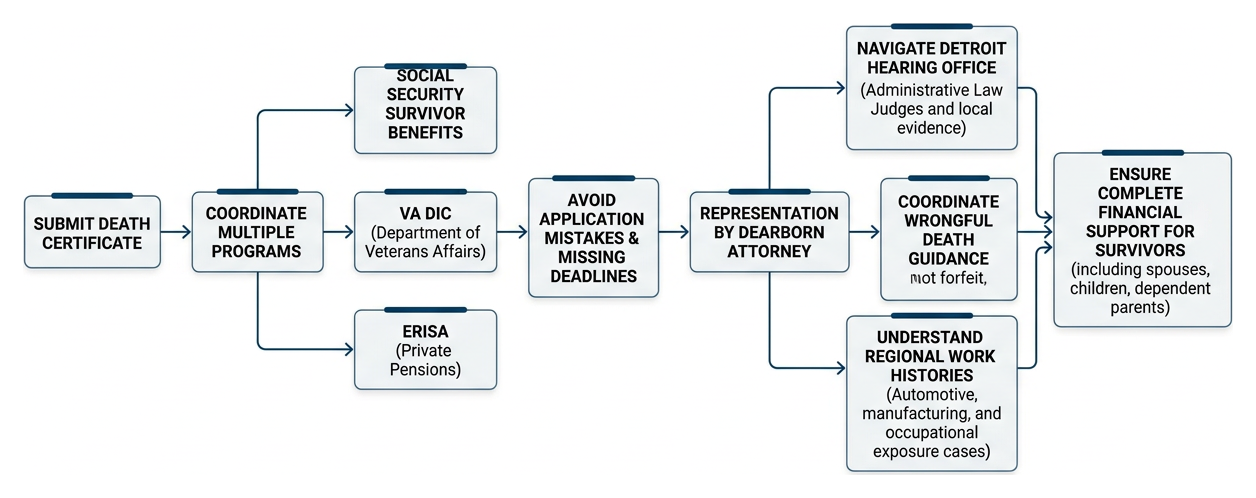
Losing a loved one turns your entire world upside down. While you are trying to process grief, stack after stack of paperwork begins piling up on the kitchen counter. Managing complex government systems, insurance policies, and private pension administrators is often the last thing a grieving family wants to handle. Many people believe these programs work automatically upon submitting a death certificate, but the reality is far more bureaucratic.
Families often must coordinate across multiple programs simultaneously, asserting their legal rights under Social Security, VA DIC, and ERISA to capture every dollar owed to them. A single mistake on an application form or an overlooked deadline can delay essential monthly income for months or result in an outright denial. At Jalal Abdallah PLLC, we stand as relentless advocates for underdogs facing massive insurance corporations and federal bureaucracies, ensuring that surviving spouses, children, and dependent parents receive the complete financial support their loved ones earned.
Why Hiring a Local Dearborn Survivor Benefits Attorney Matters
Local representation makes a profound difference when resolving complicated death benefits and administrative appeals. In Wayne County, claims that progress to administrative hearings are frequently handled through the Detroit Hearing Office. Navigating this venue requires an understanding of how local Administrative Law Judges evaluate evidence, schedule proceedings, and assess medical documentation.
Dearborn and Southeast Michigan also possess a unique industrial and economic background. Decades of heavy automotive manufacturing, metal stamping, and assembly work mean local workers frequently experience workplace injuries at rates slightly above the national average. When a worker passes away due to occupational exposure, manufacturing strain, or a sudden traumatic incident, understanding these regional work histories is essential. When an untimely passing involves negligence, coordinating survivor claims alongside wrongful death legal guidance ensures that families do not inadvertently forfeit broader personal injury recoveries while seeking statutory death benefits.
Overview of Federal, Military, and Employer-Sponsored Death Benefits
Families in Dearborn typically have rights spread across several distinct legal frameworks:
- Social Security Survivor Benefits: Monthly income provided to qualifying widows, widowers, minor children, and dependent parents based on the deceased worker’s earned work credits.
- Veterans Dependency and Indemnity Compensation (DIC): Tax-free monthly benefits paid to eligible survivors of military service members who died in the line of duty or from service-connected disabilities.
- Military Survivor Benefit Plan (SBP): An ongoing annuity paid to designated beneficiaries of retired military personnel.
- ERISA-Governed Pension and 401(k) Annuities: Retirement death benefits and spousal annuities protected under federal employee benefits laws.
- Private and Group Life Insurance Policies: Contractual death payouts provided through private carriers or employer-sponsored coverage.
Understanding Social Security Survivor Benefits and Lump-Sum Death Payments
Social Security survivor benefits form the baseline financial safety net for most American families. When a worker dies after paying into the Social Security system through FICA taxes, their accumulated work credits convert into potential monthly survivor benefits for their immediate family.
The amount paid depends directly on the deceased worker’s Primary Insurance Amount (PIA)—the baseline monthly benefit they would have received at full retirement age. The Social Security Administration (SSA) reviews the worker’s lifetime earnings record to determine this baseline figure.
Eligibility and Benefit Calculations for Spouses, Children, and Dependent Parents
Monthly payment amounts vary based on the survivor’s age, relationship to the worker, and employment status:
- Surviving Spouses at Full Retirement Age: Receive 100% of the deceased worker’s basic benefit amount.
- Surviving Spouses (Age 60 to Full Retirement Age): Receive between 71.5% and 99% of the worker’s basic benefit, reduced for claiming before full retirement age.
- Disabled Surviving Spouses (Age 50 to 59): Eligible for 71.5% if their disability began before or within seven years of the worker’s death.
- Surviving Spouses Caring for a Child Under Age 16: Eligible to receive 75% of the worker’s benefit amount, regardless of the spouse’s age.
- Unmarried Minor Children (Under Age 18, or up to 19 if in high school): Receive 75% of the worker’s primary benefit.
- Disabled Adult Children: Entitled to 75% if their disabling condition began before age 22.
- Dependent Parents (Age 62 and older): Receive 82.5% for one surviving parent, or 75% each for two surviving parents who relied on the deceased worker for at least half of their financial support.
Total family payments are constrained by the Maximum Family Benefit limit, which typically ranges between 150% and 180% of the deceased worker’s basic benefit rate.
The Social Security Lump-Sum Death Payment and Strict Filing Limits
In addition to recurring monthly benefits, the SSA offers a one-time lump-sum death payment of $255. While this amount has remained fixed for decades—barely enough to cover a nice family dinner today—it remains a statutory right that eligible survivors should claim.
The rules governing the $255 payment are strict:
- Eligibility Hierarchy: The payment goes first to a surviving spouse who was living in the same household as the worker at the time of death. If no cohabitating spouse exists, a spouse eligible for monthly benefits in the month of death may qualify. If there is no eligible spouse, the benefit can be paid to an eligible child.
- Two-Year Statutory Deadline: The application must be filed within exactly two years of the worker’s date of death. If this strict window closes, the benefit is permanently forfeited.
Military and Veterans Survivor Benefits: VA DIC and SBP Coordination
Families of military veterans who served our nation are entitled to specific, highly structured death benefits through the Department of Veterans Affairs (VA) and the Department of Defense (DoD). These programs provide substantial long-term security, but their interaction requires careful legal oversight.
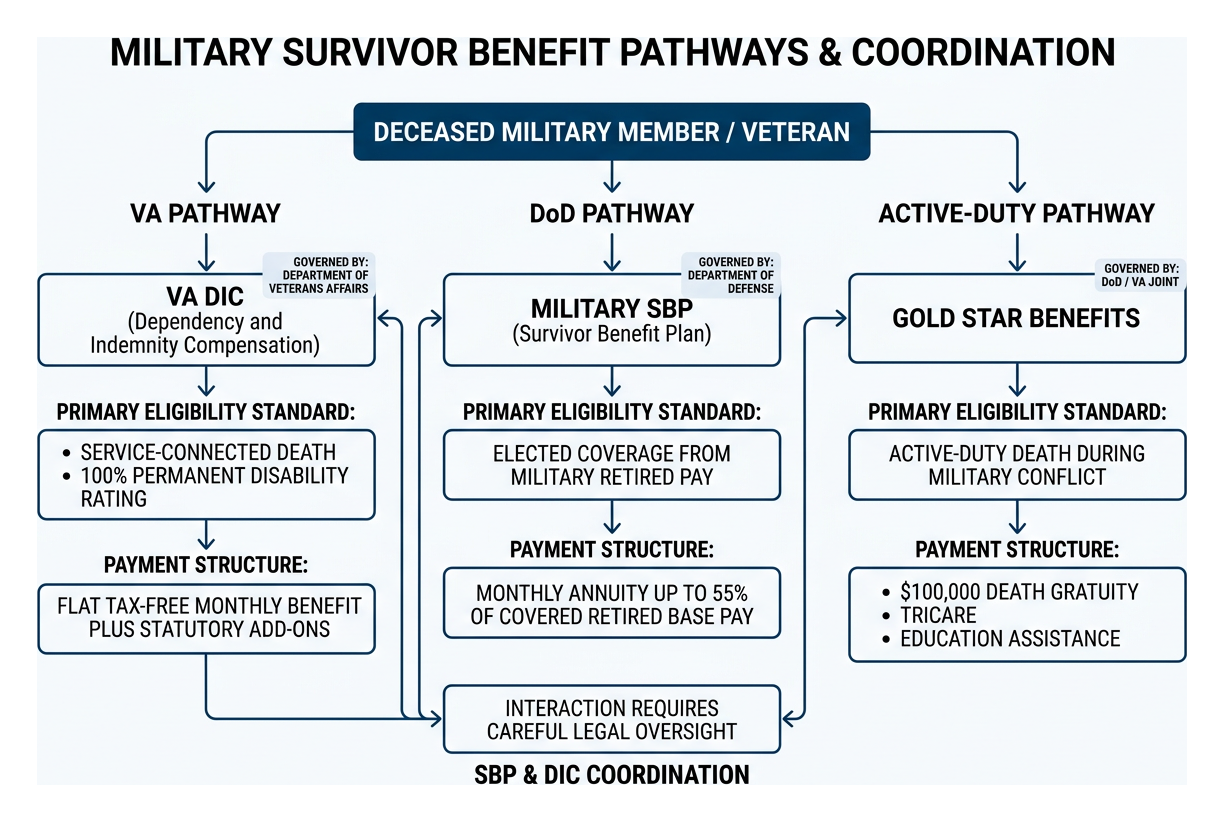
| Benefit Program | Governing Body | Primary Eligibility Standard | Payment Structure |
|---|---|---|---|
| VA DIC | Department of Veterans Affairs | Service-connected death or 100% permanent disability rating | Flat tax-free monthly benefit plus statutory add-ons |
| Military SBP | Department of Defense | Elected coverage from military retired pay | Monthly annuity up to 55% of covered retired base pay |
| Gold Star Benefits | DoD / VA Joint | Active-duty death during military conflict | $100,000 death gratuity, TRICARE, education assistance |
VA Dependency and Indemnity Compensation Eligibility and Rates
Dependency and Indemnity Compensation (DIC) is a tax-free monthly monetary benefit paid to eligible survivors of military service members who died in the line of duty or from service-connected injuries and illnesses.
To qualify, the surviving spouse must show that:
- The veteran died on active duty, active duty for training, or inactive duty training; OR
- The veteran died from a service-connected injury or disease; OR
- The veteran was continuously rated totally disabled (100% disability or Individual Unemployability) for at least 10 years immediately preceding death, for at least 5 years from military discharge, or for at least 1 year if the veteran was a former prisoner of war (known as the 8-year provision and associated rules).
VA DIC provides a flat baseline rate adjusted annually for cost of living. Additional monthly supplements are added if the surviving spouse has dependent minor children, qualifies for Aid and Attendance due to daily living limitations, is housebound, or if the deceased veteran was rated totally disabled for at least eight continuous years before death with the surviving spouse married to them throughout that period.
Military Survivor Benefit Plan Annuities and the Special Survivor Indemnity Allowance
The military Survivor Benefit Plan (SBP) is an annuity program allowing retired service members to allocate up to 55% of their covered retired pay to an eligible surviving spouse or dependent child.
Historically, surviving spouses eligible for both SBP and VA DIC faced a dollar-for-dollar offset—often called the “widow’s tax”—where SBP payments were reduced by the amount of DIC received. Federal legislative reforms have phased out this offset, supported by the Special Survivor Indemnity Allowance (SSIA), allowing surviving spouses to receive their full earned benefits from both programs without unfair administrative reductions.
ERISA Survivor Annuities, Beneficiary Disputes, and Interpleader Actions
Private-sector pensions, 401(k) plans, and group life insurance policies are governed by the Employee Retirement Income Security Act of 1974 (ERISA). ERISA is an intricate federal statute that supersedes state laws, creating strict rules about how retirement death benefits must be distributed.
How a Dearborn Survivor Benefits Attorney Resolves Competing Beneficiary Claims
When a worker passes away, conflicts often erupt regarding who is legally entitled to life insurance proceeds or retirement balances. Common disputes arise when:
- A deceased worker forgot to update a beneficiary designation after a divorce.
- An individual changed a beneficiary designation shortly before death under suspicious circumstances or undue influence.
- State divorce decrees conflict with plan documents governed by ERISA.
When insurance companies or pension plan administrators face competing claims from an ex-spouse, current spouse, or children, they rarely take sides. Instead, they file a federal interpleader action. The insurance company deposits the disputed funds into the court registry and asks the federal judge to decide who gets the money, removing itself from liability.
If your family is dealing with a fatal crash or unexpected loss, taking the proper steps for fatal accident survivors ensures that vital employment documents, insurance contracts, and beneficiary designations are protected early. If you need dedicated guidance, our team at Jalal Abdallah PLLC is ready to protect your rights in both state and federal courts.
Protecting Spousal Rights Under Qualified Pre-Retirement Survivor Annuity Rules
Under ERISA, married participants in defined-benefit pension plans are legally mandated to provide their spouses with a Qualified Pre-retirement Survivor Annuity (QPSA) if the worker dies before reaching retirement age.
A participant cannot simply name a sibling, friend, or child as the sole beneficiary of these retirement funds without their spouse’s knowledge. Federal law requires that:
- The spouse must execute a written waiver consent form.
- The waiver must specifically acknowledge the effect of the non-spouse beneficiary designation.
- The signature must be witnessed by a plan representative or an authorized notary public.
If an employer or plan administrator distributed pension assets or changed a beneficiary without a valid, notarized spousal waiver, the surviving spouse has the right to bring an ERISA lawsuit to invalidate the waiver, hold the plan fiduciary liable, and recover all retroactive annuity payments.
Critical Deadlines, Appeals, and Regional Michigan Support Resources
Survivor benefit claims are subject to unforgiving administrative timelines. If an agency or insurer denies your claim, failing to appeal within the statutory window permanently bars your right to recover those benefits in court.
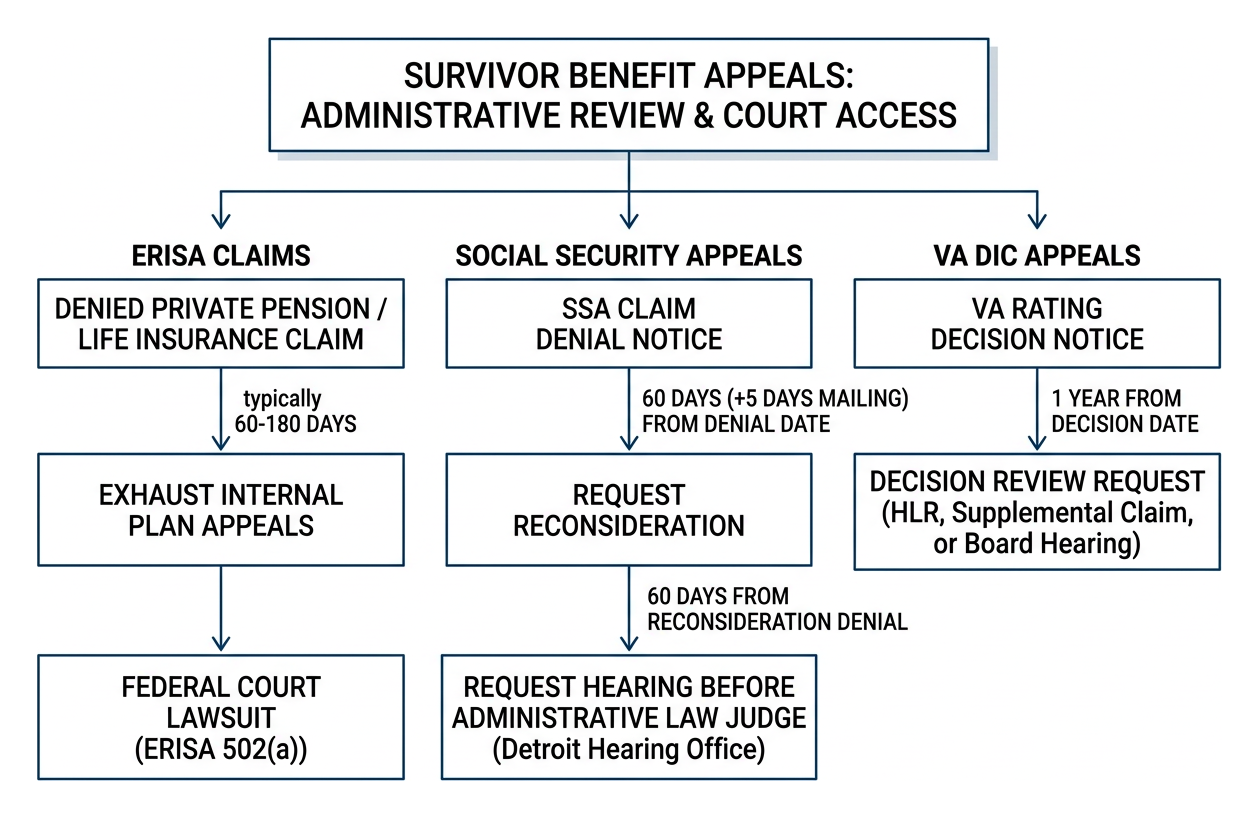
Navigating the SSA, VA DIC, and ERISA Appeal Windows
- Social Security Appeals (60 Days + 5 Days for Mailing): If the SSA denies a survivor claim, you have exactly 60 days from the date on the denial notice (with an assumed 5 days for mailing) to file a Request for Reconsideration. If that is denied, you have another 60 days to request a hearing before an Administrative Law Judge at the Detroit Hearing Office.
- VA DIC Appeals (1 Year): A surviving family member has one year from the date on the VA’s rating decision notice to appeal via the Decision Review Request process (Higher-Level Review, Supplemental Claim with new evidence, or a Board of Veterans’ Appeals hearing).
- ERISA Denials (60 to 180 Days): Denied private pension or group life insurance claims require an immediate administrative appeal under plan rules—typically within 60 to 180 days. You must exhaust all internal plan appeals before you are permitted to file a lawsuit in federal court under ERISA Section 502(a).
Southeast Michigan Resources and Wrongful Death Intersections
Beyond federal avenues, families in Dearborn and Wayne County should explore local and state assistance:
- Wayne County Probate Court: Essential for opening estates, appointing personal representatives, and obtaining letters of authority to access financial accounts.
- Michigan Department of Health and Human Services (MDHHS): Provides State Emergency Relief (SER) to assist low-income families with immediate burial and cremation expenses.
- Veterans Affairs Medical Center (Detroit / Ann Arbor): Provides bereavement counseling and regional VA assistance for surviving families.
When a family member’s death is caused by someone else’s negligence, surviving relatives should understand the full scope of fatal accident lawsuits in Dearborn. Grieving families must also stay vigilant against the deceptive tactics insurance companies use to devalue claims, ensuring that no private insurer pressures them into accepting an undervalued settlement.
Frequently Asked Questions About Dearborn Survivor Benefits
How long do I have to appeal a denied Social Security survivor benefit claim in Michigan?
You have 60 days from the date you receive the SSA denial letter to file your appeal, with the SSA presuming you received the letter five days after the date printed on it. The first level of appeal is Reconsideration. If that is unsuccessful, you have another 60-day window to request a formal administrative hearing before an Administrative Law Judge at the regional Detroit Hearing Office. Missing these deadlines means you must start a new application from scratch, potentially forfeiting months of retroactive back pay.
What happens if an ERISA retirement plan waives survivor benefits without spousal consent?
Under ERISA, any waiver of a Qualified Pre-retirement Survivor Annuity (QPSA) or defined-benefit spousal annuity is legally void unless the surviving spouse consented in writing and had their signature witnessed by a notary public or plan official. If the employer or plan administrator paid out benefits to another party without this valid consent, they committed a fiduciary breach. A survivor benefits attorney can file a federal claim to invalidate the improper distribution and compel the plan to pay the full retroactive and ongoing annuity directly to the surviving spouse.
Can a surviving spouse receive both VA DIC and military SBP payments at the same time?
Yes. Following major federal legislative reforms, the historical dollar-for-dollar offset between VA DIC and military SBP has been eliminated. Surviving spouses are now legally entitled to receive both their full VA DIC monthly tax-free payment and their full earned military SBP annuity concurrently, without administrative penalties or reductions.
Securing Your Family’s Financial Future
When a family member passes away, securing the survivor benefits they worked a lifetime to earn should not feel like an uphill legal battle. Whether you are dealing with an unexpected Social Security denial, a disputed VA DIC claim, or a complex ERISA pension interpleader dispute in Wayne County, you do not have to fight massive government agencies or self-interested insurance carriers on your own.
At Jalal Abdallah PLLC, we pride ourselves on relentless advocacy for families who need an unyielding ally in their corner. We know the administrative hurdles, we understand the local Detroit and Dearborn hearing processes, and we are dedicated to protecting your household’s financial security. If your family needs trusted legal guidance, schedule a confidential consultation with our team today and let us help you claim the full benefits you deserve.
Share This Article

Schedule Your Free Consultation Today!
Reach out today and receive a consultation, completely free of charge - we'll evaluate your case and let you know what comes next.


