 Skip to content
Start Your Semi Truck Injury Claim in Dearborn With Fast Evidence Preservation
After a truck crash, get medical care, report the collision, save every document, and avoid giving a recorded statement to the trucking company’s insurer before you understand your rights. A Semi truck injury claim Dearborn may involve both Michigan no-fault benefits and a separate claim against the driver, trucking company, or another responsible party.
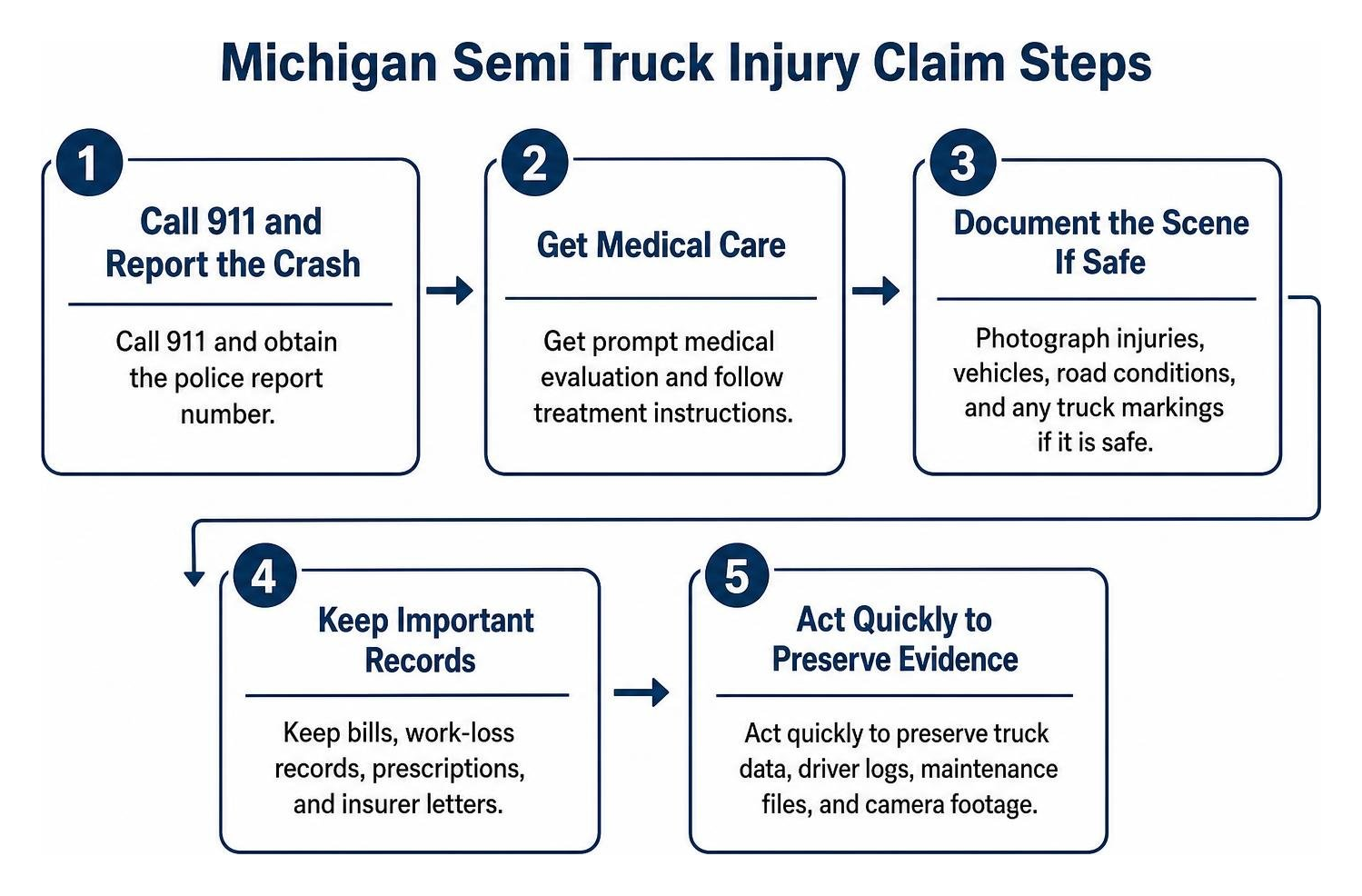
Take these early steps:
- Call 911 and obtain the police report number.
- Get prompt medical evaluation and follow treatment instructions.
- Photograph injuries, vehicles, road conditions, and any truck markings if it is safe.
- Keep bills, work-loss records, prescriptions, and insurer letters.
- Act quickly to preserve truck data, driver logs, maintenance files, and camera footage.
Semi-truck collisions can cause life-changing harm because of a truck’s size and weight. Claims may involve driver fatigue, distracted driving, unsafe lane changes, speeding, poor maintenance, brake problems, or improperly loaded cargo. Federal trucking rules can help show whether a driver or carrier failed to follow safety duties.
Michigan’s insurance rules can be confusing. Injured people may seek certain no-fault benefits for medical care and lost wages through applicable insurance, while a negligence claim may seek pain and suffering and other damages when Michigan’s legal threshold is met. Deadlines matter: many injury lawsuits have a three-year filing period, while notice requirements for certain no-fault benefits can be much shorter.
I am Jalal Abdallah, a Michigan trial attorney and licensed insurance producer with a background in personal injury law and insurance coverage. For a Semi truck injury claim Dearborn, I help injured people understand the records, insurance issues, and legal steps that may affect a fair recovery.
Handy Semi truck injury claim Dearborn terms:
Understanding Trucking Collisions and Michigan Injury Law
Dearborn is one of Michigan’s busiest commercial hubs. With vital transportation arteries like I-94, Michigan Avenue (US-12), and Telegraph Road (US-24) cutting directly through our community, local drivers share the road with thousands of heavy commercial rigs daily. When an 80,000-pound tractor-trailer collides with a standard passenger vehicle, the outcome is rarely minor. Understanding how state and federal laws intersect is critical when navigating your Michigan trucking injury claim.
Truck accidents are fundamentally different from standard passenger vehicle crashes. Commercial motor carriers are governed by stringent Federal Motor Carrier Safety Administration (FMCSA) regulations alongside Michigan state traffic statutes. These rules dictate everything from how long a trucker can stay behind the wheel to how often the vehicle’s air brakes must be inspected. Proving that a commercial carrier cut corners to boost its bottom line is often the key to establishing liability.
How Michigan No-Fault Laws Impact Your Semi Truck Injury Claim in Dearborn
Michigan’s auto insurance system is unique, dividing compensation into two distinct avenues: first-party benefits and third-party tort claims.
- First-Party Personal Injury Protection (PIP) Benefits: Regardless of who caused the crash, your own auto insurer provides PIP coverage. This pays for necessary medical care up to your chosen policy limits, three years of wage loss replacement (up to the statutory monthly cap), replacement services for household chores, and attendant care if you need in-home assistance.
- Third-Party Negligence Claims: When a truck driver or motor carrier causes a collision, PIP benefits alone rarely cover the true cost of catastrophic harm. Under Michigan law, you can pursue a third-party lawsuit against the at-fault parties for non-economic damages (pain and suffering) and excess economic losses. To qualify for non-economic damages, your injuries must cross Michigan’s legal threshold: death, permanent serious disfigurement, or a serious impairment of body function.
Understanding these dual paths is vital for securing fair vehicle crash compensation in Dearborn that accounts for both your immediate bills and your long-term physical recovery.
Common Causes and Commercial Regulations in Wayne County
Commercial truck crashes in Wayne County stem from a variety of operational failures. Federal regulations exist to prevent these incidents, yet carriers and drivers frequently violate them:
- Hours of Service (HOS) Violations: FMCSA rules restrict property-carrying drivers to 11 hours of driving within a 14-hour window following 10 consecutive hours off-duty. Fatigued driving remains a leading trigger for rear-end collisions along congested I-94 ramps.
- Distracted and Reckless Driving: Using handheld mobile devices while operating a commercial vehicle is strictly prohibited by federal law, yet electronic logs often reveal dangerous lapses in attention.
- Improper Maintenance and Brake Failures: Commercial tractor-trailers require routine, documented brake and tire inspections. When fleet owners defer maintenance, catastrophic mechanical failures occur.
- Improperly Secured or Overloaded Cargo: Shifting freight can cause a flatbed or dry van to jackknife or roll over during routine turns along Dearborn’s surface streets.
When fleet operators disregard safety standards, the resulting truck accidents leave innocent motorists facing devastating physical and financial burdens.
Key Steps to Filing a Semi Truck Injury Claim in Dearborn
Filing a commercial injury claim requires a disciplined approach. Knowing what to do immediately after an accident in Michigan ensures that vital evidence does not vanish before you can build your case.
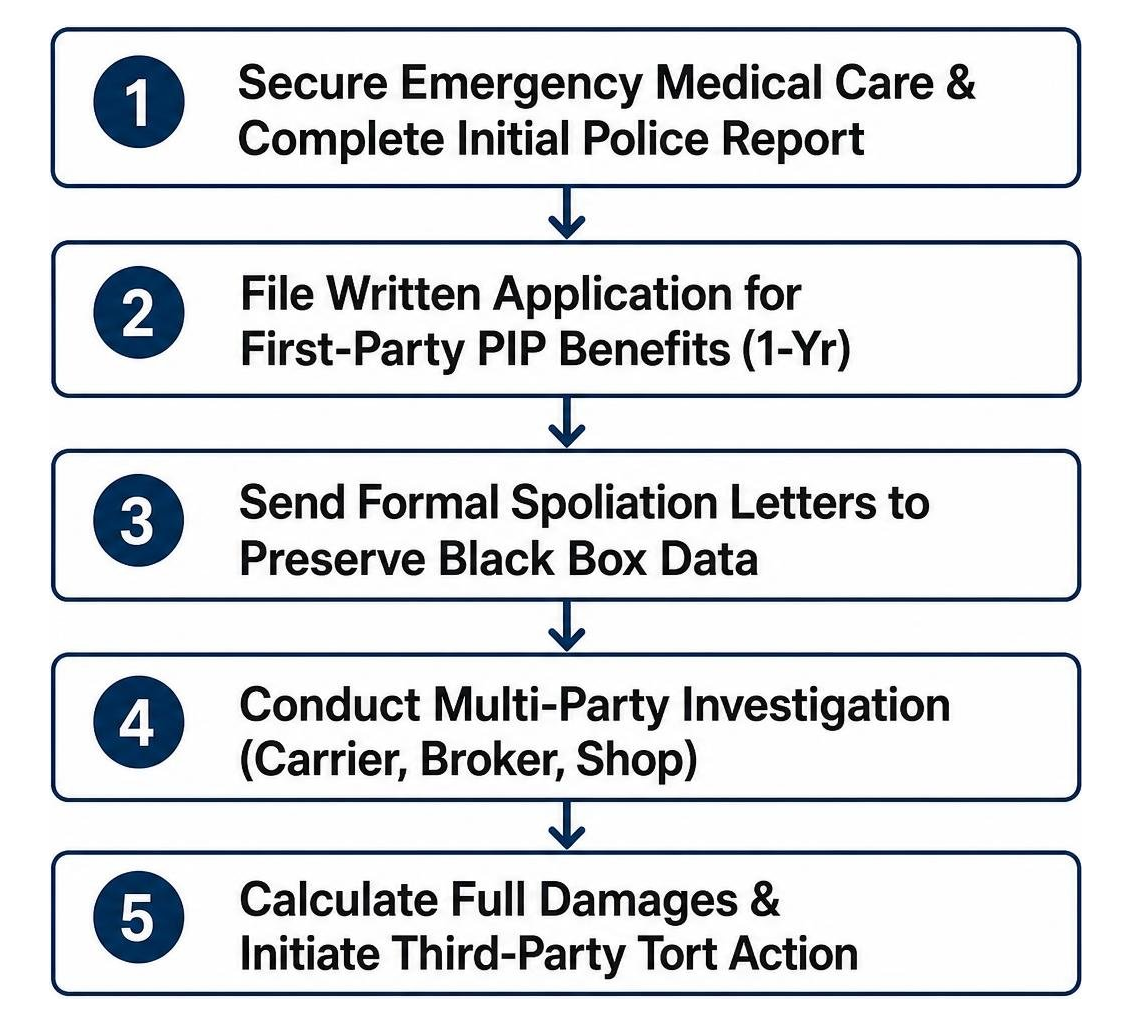
Critical Evidence Needed for a Semi Truck Injury Claim in Dearborn
Trucking companies and their corporate insurers deploy rapid-response teams within hours of a major collision to protect their interests. To level the playing field, we act swiftly to secure critical evidence before it is overwritten or destroyed:
- Engine Control Module (ECM) “Black Box” Data: Records vehicle speed, braking application, throttle position, and seatbelt usage immediately prior to impact.
- Electronic Logging Device (ELD) Records: Provides a digital footprint of driving hours, rest breaks, and potential HOS violations.
- Driver Qualification Files (DQF): Documents the driver’s licensing history, annual driving record reviews, medical certifications, and pre-employment drug screening results.
- Maintenance and Inspection Logs: Proves whether the commercial vehicle met state and federal roadworthiness standards prior to the crash.
- Dearborn Police Department Incident Reports: Official law enforcement documentation, witness contact information, and initial officer assessments of fault.
Commercial insurers often attempt to minimize corporate exposure by disputing liability or shifting blame onto passenger vehicles. Understanding how insurance companies try to devalue your injury claim helps us counter lowball settlement offers with hard electronic and documentary proof.
Calculating Total Damages and Claim Valuation
Valuing a commercial vehicle injury claim requires looking at the full spectrum of your life before and after the collision. Commercial claims often involve higher insurance policy limits (frequently ranging from $750,000 to several million dollars), making an accurate calculation essential.
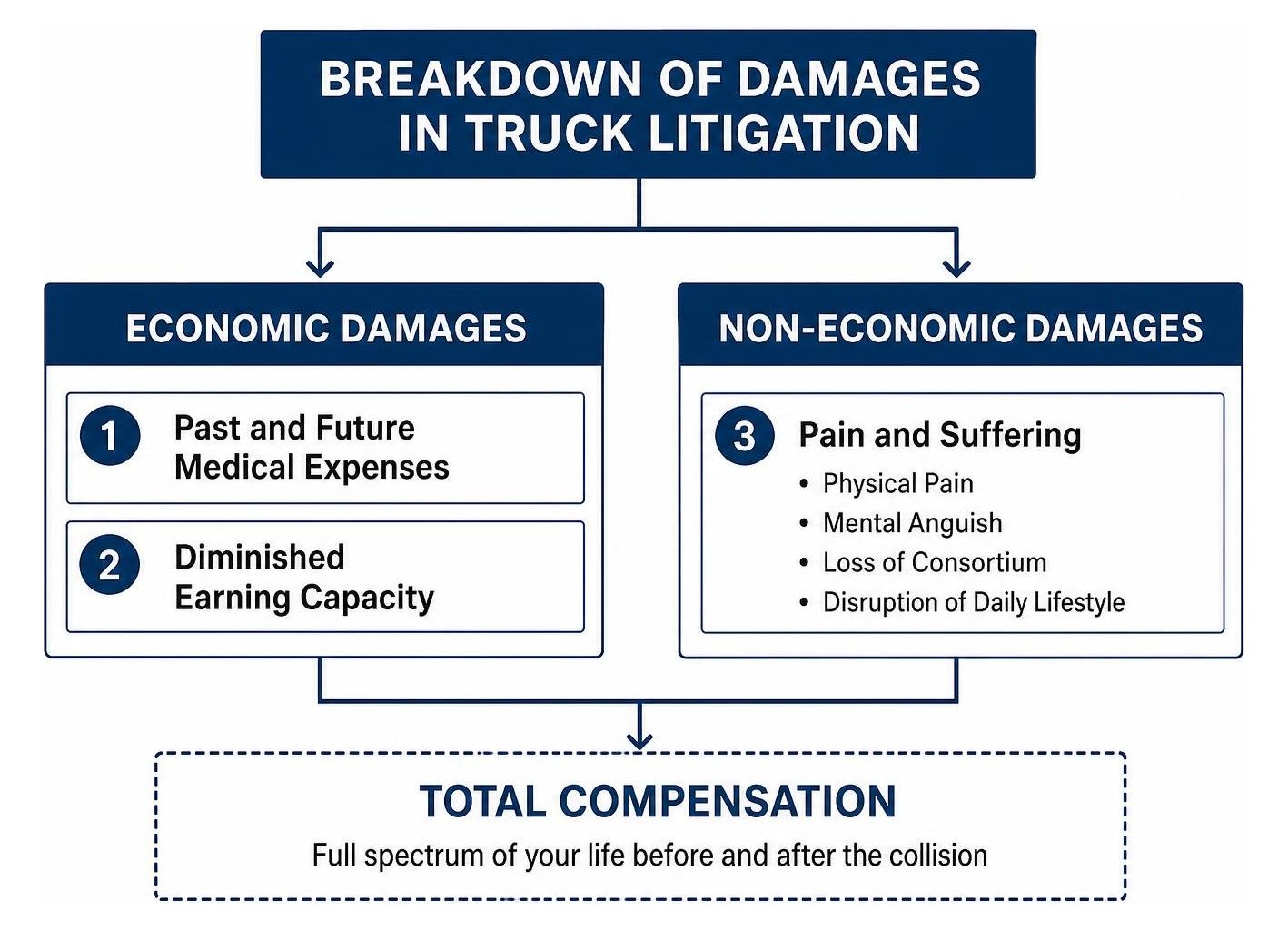
Your compensation should account for:
- Past and Future Medical Expenses: Surgeries, physical rehabilitation, durable medical equipment, and future home modifications.
- Diminished Earning Capacity: The financial difference between what you earned prior to the crash and what you can earn moving forward.
- Non-Economic Pain and Suffering: Physical pain, mental anguish, loss of consortium, and the disruption of your daily lifestyle.
A detailed Dearborn injury case evaluation ensures that no category of recoverable loss is overlooked during settlement negotiations or trial.
Navigating the Legal Process and Statutory Deadlines
Commercial trucking litigation in Michigan involves strict statutory deadlines and multi-layered corporate liability structures. Missing a single filing window can permanently bar your recovery.
| Claim Type | Governing Law / Rule | Statutory Deadline | Key Purpose |
|---|---|---|---|
| First-Party PIP Claim | MCL 500.3145 | 1 Year from crash date | Covers medical expenses, lost wages, and replacement services regardless of fault. |
| Third-Party Negligence Claim | MCL 600.5805(2) | 3 Years from crash date | Secures compensation for pain, suffering, and excess financial loss from at-fault parties. |
| Wrongful Death Action | MCL 600.5852 | Typically 3 Years (with specific representative extension rules) | Compensates surviving family members for loss of companionship and financial support. |
Commercial accidents often involve multiple corporate entities beyond just the individual driver. Depending on the contractual arrangements, liability may extend to:
- The motor carrier (employer vicarious liability)
- Freight brokers who negligently hired an unsafe carrier
- Third-party cargo loading facilities that improperly secured the trailer
- Maintenance contractors responsible for substandard brake or mechanical repairs
Navigating these corporate layers requires dedicated legal advocacy. When facing well-funded defense teams, working with our firm, Jalal Abdallah PLLC, ensures that you have an advocate fighting relentlessly for your rights against powerful insurers. We understand that selecting top legal representation with a personal injury lawyer in Dearborn provides the foundation for holding every negligent party accountable.
Frequently Asked Questions About Commercial Truck Claims
How long do I have to file a truck accident lawsuit in Michigan?
In Michigan, you generally have three years from the date of the collision to file a third-party personal injury lawsuit against the at-fault truck driver or trucking company under MCL 600.5805(2). However, you must provide written notice of your injury to your first-party no-fault auto insurer within one year of the accident to protect your right to PIP benefits. Missing the one-year PIP notice rule permanently forfeits your right to claim medical bill coverage and wage replacement through no-fault insurance.
Who can be held liable in a semi-truck accident?
Multiple parties can share liability in a commercial vehicle collision. These include:
- The commercial truck driver for errors like speeding, distracted driving, or driving while fatigued.
- The trucking company for negligent hiring, improper training, or demanding schedules that force Hours of Service violations.
- Cargo loading companies if unbalanced or unsecured freight caused a rollover or jackknife.
- Third-party maintenance facilities if mechanical or brake failures caused the crash.
- Freight brokers if they knowingly contracted with an unsafe or uncertified carrier.
What makes semi-truck claims different from standard car accident claims?
Semi-truck claims involve significantly higher corporate insurance policies, stricter federal safety standards (FMCSA regulations), and catastrophic injury levels due to vehicle size. Trucking companies also maintain corporate risk management teams that begin investigating immediately to minimize liability. Proving fault requires specialized discovery, such as securing electronic control module (ECM) data, driver qualification records, and dispatch logs through formal preservation requests.
Stand Up Against Commercial Trucking Companies for the Recovery You Deserve
Commercial trucking crashes can upend your health, your career, and your family’s financial stability in a split second. Corporate motor carriers and their multi-layered insurance teams protect their own interests from the moment a collision occurs. You do not have to fight these powerful entities alone.
At Jalal Abdallah PLLC, our commitment is simple: we provide relentless advocacy for underdogs against powerful insurers and corporate defendants across Dearborn, Southfield, Detroit, and Warren. We understand the regulatory frameworks, insurance defense tactics, and medical evidence needed to maximize your compensation.
If you or a loved one has suffered severe injuries in a commercial vehicle collision, take control of your recovery today. Reach out to contact our team or explore our dedicated legal services for truck accidents to arrange a confidential review of your case. Let us handle the legal battle while you focus on healing.
Share This Article

Schedule Your Free Consultation Today!
Reach out today and receive a consultation, completely free of charge - we'll evaluate your case and let you know what comes next.


