 Skip to content
When You Need a Rideshare Accident Lawyer in Dearborn, Here’s What to Know First
If you’re looking for a rideshare accident lawyer in Dearborn, here’s the short answer:
You need a specialized attorney — not a general personal injury lawyer — and you need one fast. Rideshare crashes involve layered insurance policies, app status disputes, and Michigan’s complex No-Fault system. Missing a step early can cost you thousands.
Quick guide to finding the right lawyer:
- Act immediately — Michigan’s statute of limitations gives you three years (MCL § 600.5805), but critical evidence like app data disappears fast
- Choose a rideshare specialist — someone who understands Uber/Lyft insurance tiers, not just standard car accident claims
- Look for trial experience — attorneys who prepare every case for trial get better settlements
- Get a free consultation first — reputable firms charge nothing upfront and work on contingency
- Don’t talk to insurers alone — adjusters are trained to minimize your payout
Getting hurt in an Uber or Lyft leaves most people with one immediate question: who is actually going to pay for this?
The honest answer is: it depends. It depends on whether the driver had a passenger. Whether the app was open. Whether they were en route to a pickup or just idling. Each scenario triggers a completely different insurance policy — and insurance companies know exactly how to use that confusion against you.
Dearborn residents face this problem more often than many realize. Rideshare services are deeply woven into daily life here, from trips to Detroit Metropolitan Airport to late-night rides through the city. More rides mean more crashes — and more complicated claims.
This guide walks you through how to choose the right legal help without getting overwhelmed.
Why Rideshare Crashes Are More Complex Than Standard Car Accidents
At first glance, a rideshare accident looks just like any other fender bender on Michigan Avenue or Telegraph Road. But behind the scenes, a massive legal and financial storm is brewing. Traditional Car Accidents usually involve two drivers and their respective insurance companies. When an Uber or Lyft is involved, the number of interested parties multiplies instantly.
The primary reason for this complexity is the legal classification of rideshare drivers. Uber and Lyft classify their drivers as independent contractors rather than employees. This distinction is a shield that rideshare giants use to distance themselves from direct liability. If an Uber driver causes a crash, you cannot simply sue Uber Technologies Inc. directly for employee negligence in most cases. Instead, you must navigate a complex web of personal auto policies and commercial insurance coverage.
To make matters more complicated, the amount of insurance coverage available fluctuates constantly based on what the driver was doing at the exact millisecond of the impact. This is determined entirely by digital app data and driver logs. Did the driver have the app completely turned off? Were they logged in and waiting for a ride request? Or were they actively transporting a passenger?
If the driver’s personal insurance carrier finds out the vehicle was being used for commercial ridesharing without a specific rideshare endorsement, they will likely deny the claim. Meanwhile, the rideshare company’s corporate insurer will look for any excuse—such as a brief log-out or a GPS glitch—to claim the driver was “offline” and push the liability back onto the driver’s personal policy.
Without an experienced rideshare accident lawyer in Dearborn to subpoena the GPS records, app logs, and internal communications of the rideshare network, you may find yourself caught in an endless loop of insurance companies pointing fingers at each other while your medical bills pile up.
Navigating Michigan’s No-Fault Insurance System in Uber and Lyft Crashes
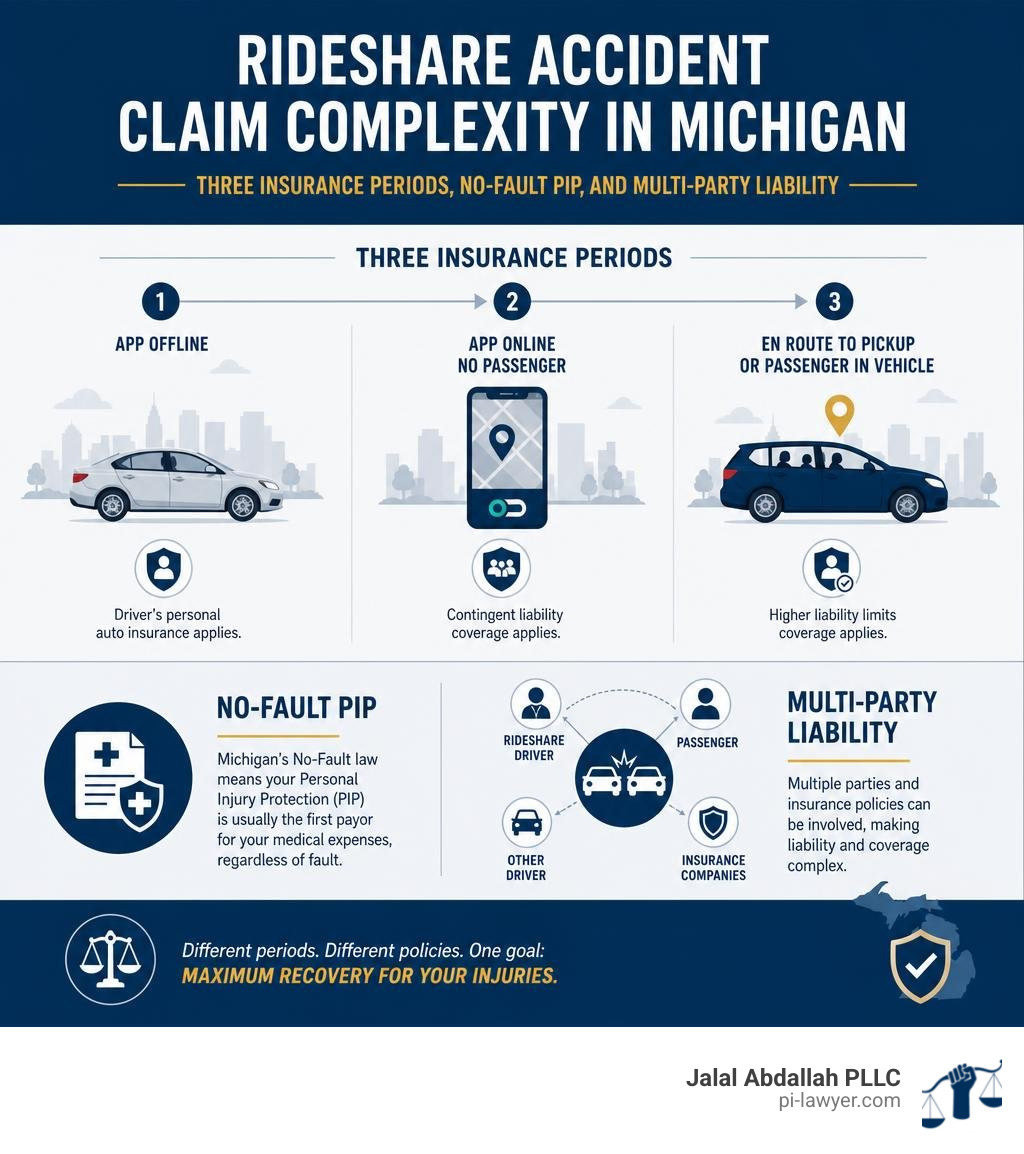
Michigan’s auto insurance landscape is famously unique, and navigating it after a rideshare collision requires a deep understanding of local laws. Under Michigan’s No-Fault system, if you are injured in a motor vehicle accident, your own Personal Injury Protection (PIP) insurance is typically responsible for paying your medical expenses, a percentage of lost wages, and replacement services, regardless of who caused the crash.
However, rideshare vehicles complicate this structure. If you are a passenger in an Uber or Lyft, or if you are another driver hit by a rideshare vehicle, determining which policy pays first can feel like solving a multi-layered puzzle.
To understand how coverage is distributed, we must look at the three distinct insurance periods defined by Michigan law:
| Rideshare Driver Status | Primary Insurance Coverage | Coverage Limits |
|---|---|---|
| Period 1: App is off / Driver is offline | Driver’s personal auto insurance | Standard personal policy limits |
| Period 2: App is open, waiting for a ride request | Rideshare company’s limited liability policy (if personal insurance denies coverage) | $50,000 per person / $100,000 per accident for bodily injury; $25,000 for property damage |
| Period 3: En route to pick up a rider OR actively transporting a passenger | Rideshare company’s commercial policy | $1 million in third-party liability coverage |
If you sustain severe, life-altering injuries that meet Michigan’s “serious impairment of body function” threshold, you may also pursue a third-party liability claim against the at-fault driver for non-economic damages, such as pain and suffering. This is where the $1 million commercial policy becomes crucial. For more details on how these rules are governed at the state level, you can consult the Michigan No-Fault Insurance Guide.
Navigating these thresholds and identifying the priority of insurers is not something you should do alone. If you are seeking specialized representation across Wayne County, consulting an experienced legal team can help you understand the broader legal landscape. Choosing a local firm that treats you like an individual rather than a file number is key to securing the best possible outcome.
Why You Need a Specialized Rideshare Accident Lawyer Dearborn
When you are recovering from a crash, the last thing you want to do is argue with corporate defense lawyers and aggressive insurance adjusters. The insurance companies representing Uber and Lyft do not have your best interests at heart. Their primary goal is to settle your claim for as little money as possible, preferably before you even realize the full physical and financial extent of your injuries.
A specialized rideshare accident lawyer in Dearborn acts as your shield and your voice. We understand how to calculate the true value of your claim, ensuring that you do not leave money on the table. A comprehensive claim must account for both economic and non-economic damages, including:
- Immediate and future medical bills (surgery, physical therapy, prescription medications)
- Lost wages and diminished earning capacity if you cannot return to your previous job
- Rehabilitation and long-term care costs
- Pain, suffering, and emotional distress
Calculating non-economic damages is highly subjective and requires skilled legal advocacy. To learn more about how these calculations work, read our guide on Understanding Pain and Suffering Damages in Personal Injury Cases.
Beyond simple calculations, an experienced attorney prepares every case as if it is heading directly to trial. When insurance companies know that a law firm is trial-ready and willing to fight in front of a Wayne County jury, they are much more likely to offer a fair and just settlement during negotiations.
When to Hire a Rideshare Accident Lawyer Dearborn
The clock starts ticking the moment your accident occurs. Under Michigan Compiled Laws § 600.5805, the statute of limitations for filing a Personal Injury lawsuit after a motor vehicle crash is generally three years from the date of the accident.
While three years might seem like a long time, waiting is one of the biggest mistakes you can make. In the days and weeks following a crash, crucial evidence begins to fade. Rideshare companies do not preserve driver GPS logs, app activity data, and dashcam footage indefinitely. If you do not act quickly to send a formal spoliation letter—a legal notice demanding the preservation of this electronic evidence—it may be lost forever, severely damaging your ability to prove liability.
How to Evaluate a Rideshare Accident Lawyer Dearborn
Not all law firms are created equal. When searching for the right attorney to handle your case, look for these key qualities:
- Boutique Representation: Large “settlement mills” handle thousands of cases at a time, often passing clients off to paralegals and junior associates. A boutique firm provides individualized attention, ensuring your attorney is directly involved in every step of your case.
- Rideshare-Specific Expertise: Ask potential lawyers about their experience specifically handling Uber and Lyft claims. They should be able to explain the three insurance periods and how they apply to your situation without hesitating.
- Proven Local Track Record: Choose a firm with deep roots in Dearborn and the surrounding Metro Detroit communities. Local knowledge of the courts, judges, and local roads makes a significant difference.
- Transparent Communication: You deserve regular updates on your case. Your attorney should be accessible, responsive, and ready to answer your questions in plain English, not confusing legalese. For a full list of the legal support we offer, visit our Services page.
If you want to compare your options, look for highly reviewed regional advocates who understand how to approach Metro Detroit claims and have a proven track record of success in Wayne County.
Crucial Steps to Take Immediately After a Dearborn Rideshare Crash
What you do in the minutes and hours following a rideshare collision can make or break your future legal claim. Even if you are shaken up, try to stay calm and take the following steps to protect your health and your rights:
- Seek Immediate Medical Attention: Your health is the absolute priority. Even if you feel fine, adrenaline can mask serious injuries like whiplash, internal bleeding, or mild traumatic brain injuries. Go to the nearest emergency room or urgent care center in Dearborn.
- Call 911 and File a Police Report: Ensure that the Dearborn Police Department responds to the scene. An official police report provides an unbiased, third-party account of the accident, which is vital evidence for your claim.
- Capture the Digital Evidence: Before you close the Uber or Lyft app, take screenshots of your ride receipt, the driver’s profile, the route map, and any active trip screens. This creates an undeniable digital footprint of your ride status.
- Document the Physical Scene: If you are physically able, take photos and videos of the vehicles, the damage, license plates, road conditions, traffic signs, and any visible injuries.
- Gather Witness Contact Information: Speak to anyone who saw the crash. Collect their names, phone numbers, and brief statements of what they witnessed.
- Report the Crash Within the App: Use the safety or help features inside the Uber or Lyft app to report the accident. Keep your description brief and factual—do not admit fault or downplay your injuries.
- Contact a Lawyer Before Speaking to Insurers: Do not give recorded statements to any insurance adjusters until you have consulted with a legal professional.
For a comprehensive checklist of what to do in the immediate aftermath of a collision, review our detailed guide on What to Do Immediately After a Car Accident in Michigan.
Frequently Asked Questions About Dearborn Rideshare Accidents
Who pays for medical care after a rideshare accident in Dearborn?
Under Michigan’s No-Fault system, your own auto insurance policy is typically the primary source of medical coverage through your Personal Injury Protection (PIP) benefits. If you do not own a vehicle or carry auto insurance, you may be covered under a household relative’s policy. If no other coverage is available, you may receive benefits through the Michigan Assigned Claims Plan (MACP). If you were a passenger in an active rideshare vehicle (Period 3), the rideshare company’s commercial policy may also provide primary or excess PIP coverage depending on the specific circumstances of the crash.
What if the rideshare driver’s insurer refuses coverage?
This is a common scenario. Most personal auto insurance policies contain a “business use exclusion” that allows them to deny coverage if the driver was using the vehicle for commercial purposes. If the driver’s personal insurer denies the claim, the responsibility shifts to the rideshare company’s corporate insurance provider. Depending on whether the driver was waiting for a ride (Period 2) or actively on a trip (Period 3), Uber or Lyft’s commercial policies will step in to provide liability coverage. A skilled attorney will fight to ensure that the correct corporate policy is held accountable.
Can I still recover compensation if I was partially at fault?
Yes. Michigan follows a modified comparative negligence system. This means you can still recover damages as long as your percentage of fault is less than 51%. However, your total compensation will be reduced by your percentage of fault. For example, if you are awarded $100,000 but are found to be 20% at fault for the accident, your final recovery will be $80,000. If you are found to be 51% or more at fault, you are barred from recovering non-economic damages (like pain and suffering), though you may still receive No-Fault PIP benefits.
For those navigating crashes in nearby municipal areas, it is crucial to understand how local courts handle these disputes and to seek representation familiar with the specific jurisdiction where your accident occurred.
Conclusion
A rideshare accident can throw your life into chaos, but you do not have to navigate the legal aftermath alone. At Jalal Abdallah PLLC, we specialize in relentless advocacy for the underdogs. We stand up to powerful insurance corporations and rideshare giants to ensure that injury victims in Dearborn, Detroit, Southfield, and Warren receive the maximum compensation they deserve.
We handle every aspect of your case, from securing app data to negotiating with multi-million-dollar insurance companies, so you can focus on what matters most: your physical recovery.
If you or a loved one has been injured in a rideshare crash, don’t wait until critical evidence is lost. contact our experienced team today for a free, no-obligation consultation. You can also visit our main office or learn more about our practice by visiting us at Jalal Abdallah PLLC on Google Maps or checking out our home page at https://pi-lawyer.com/. Let us fight for the justice and peace of mind you deserve.
Share This Article

Schedule Your Free Consultation Today!
Reach out today and receive a consultation, completely free of charge - we'll evaluate your case and let you know what comes next.


