 Skip to content

How Does Michigan No-Fault Insurance Pay for Pedestrian Injuries?
If you are hit by a car while walking in Dearborn, your initial medical bills and lost wages are paid through Michigan no-fault Personal Injury Protection (PIP) benefits, not by the at-fault driver’s insurance. Under Michigan’s order of priority, your own auto policy pays first; if you do not have one, a resident spouse’s or resident relative’s policy pays; and if no household policy exists, the Michigan Assigned Claims Plan (MACP) pays up to $250,000. The at-fault driver’s bodily injury liability coverage pays only for excess economic losses and pain and suffering if your injuries meet Michigan’s serious injury threshold.
If you got injured and need a Dearborn pedestrian accident lawyer, contact Jalal Abdallah and get a free consultation.
When you are walking down Michigan Avenue, crossing Schaefer Road, or walking through your neighborhood in Dearborn, you do not expect a motor vehicle to hit you. When a collision happens, the physical trauma can be catastrophic, and the resulting medical bills can pile up within days.
Many people assume that because a reckless or distracted driver hit them, that driver’s auto insurance automatically cuts a check for their emergency room bills and ongoing care. In Michigan, however, the claims process follows a very different path.
Michigan operates under a comprehensive no-fault auto insurance framework. Under this system, initial compensation for medical expenses, lost wages, and other financial losses does not come from a traditional fault-based liability claim. Instead, payment is provided through Personal Injury Protection (PIP) benefits. As outlined in standard consumer guidance on What Is Personal Injury Protection (PIP)?, this coverage pays for necessary medical treatment and replacement services regardless of who caused the collision.
Even though you were walking on foot and not driving a vehicle, Michigan law treats pedestrian collisions as auto-related incidents. Because of this, the law dictates a strict legal order determining which auto insurer is responsible for paying your first-party benefits. Your private health insurance generally does not take primary responsibility until your designated auto no-fault coverage is appropriately structured or exhausted.
Understanding Michigan’s Order of Priority for Pedestrians
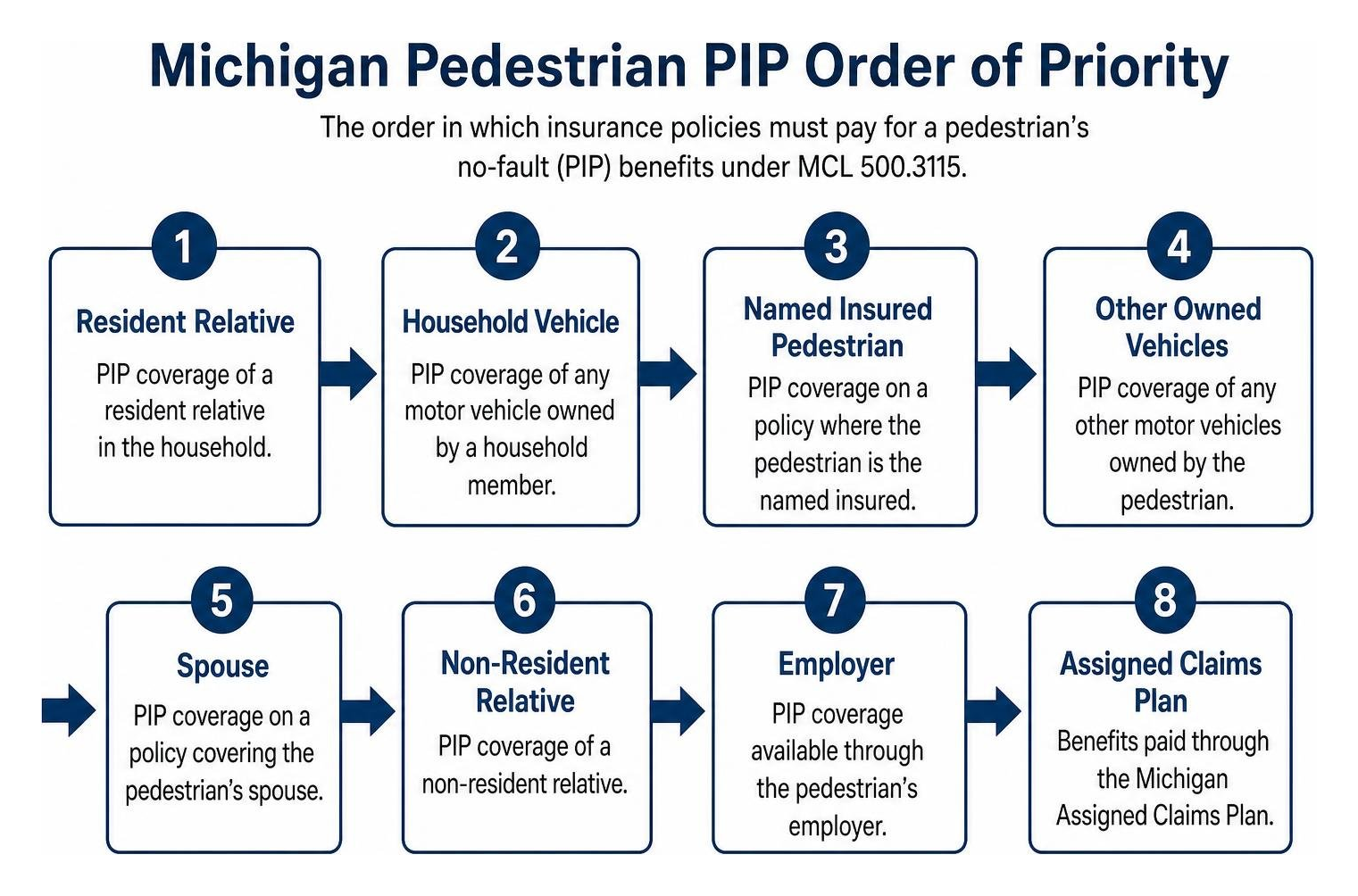
To figure out who pays your immediate expenses, Michigan statutes establish a mandatory “order of priority” under MCL 500.3115. This statute sets the exact sequence of insurance policies that must be billed for your no-fault benefits after a pedestrian collision.
Under Michigan’s post-2019 no-fault reform rules, the order of priority for an injured pedestrian is structured as follows:
- Your Own Auto Policy: If you own a motor vehicle and carry a personal Michigan auto insurance policy with PIP coverage, your insurer is first in line to pay your benefits.
- Your Resident Spouse’s Auto Policy: If you do not own a vehicle or carry auto insurance, you must claim benefits through an auto insurance policy owned by your spouse, provided you reside in the same household.
- A Resident Relative’s Auto Policy: If neither you nor your spouse carries auto coverage, you must look to an auto insurance policy held by any relative who lives in your household (such as a parent, child, or sibling).
- The Michigan Assigned Claims Plan (MACP): If no one in your household owns a vehicle or carries an auto insurance policy, you do not turn to the driver’s insurance as pedestrians once did prior to the 2019 statutory reforms. Instead, your claim must be submitted to the Michigan Assigned Claims Plan, administered by the Michigan Automobile Insurance Placement Facility (MAIPF).
When claims pass to the MACP, the state assigns your case to an authorized private insurance company (such as Farm Bureau, Allstate, or Auto-Owners). However, under state law, no-fault medical coverage through the MACP is capped at $250,000. Navigating these overlapping policies can be challenging, which is why understanding how to handle a pedestrian accident claim is crucial to preventing delays in your medical treatment.
What Personal Injury Protection (PIP) Benefits Cover
First-party PIP benefits are designed to keep you financially stable while you recover from severe injuries. These benefits provide vital economic relief without requiring you to prove that the driver was careless, speeding, or distracted.
Under Michigan law, a full PIP claim covers four core areas of economic loss:
- Reasonable and Necessary Medical Expenses: Covers all emergency transport, trauma surgeries, intensive care stays, diagnostic imaging, physical therapy, prescription medications, and necessary medical equipment up to your policy’s chosen PIP cap (or unlimited coverage if that option was selected).
- Work Loss Benefits: If your injuries prevent you from returning to work, PIP reimburses up to 85% of your gross lost wages for up to three years from the date of the collision, subject to the state’s monthly statutory maximum limit.
- Replacement Services (Household Chores): If you are unable to handle everyday domestic tasks such as cleaning, cooking, lawn care, or grocery shopping, PIP provides up to $20 per day for up to three years to compensate individuals hired or family members helping you manage those tasks.
- Attendant Care: For catastrophic injuries requiring round-the-clock supervision, assistance with daily living, or in-home nursing care, PIP reimburses qualifying commercial or family-provided attendant care services.
| Benefit Category | First-Party No-Fault PIP Benefits | Third-Party Bodily Injury Liability Claims |
|---|---|---|
| Who Pays | Your household auto insurer or the MACP | The at-fault driver’s auto liability insurance |
| Fault Requirement | Payable regardless of who caused the collision | Requires proving the motorist was legally negligent |
| Medical Expenses | Covered up to selected PIP cap (or MACP $250k limit) | Excess medical bills exceeding PIP coverage limits |
| Lost Income | Up to 85% of gross wages (up to 3-year statutory cap) | Wage losses extending beyond three years or statutory caps |
| Pain and Suffering | Not covered under first-party PIP claims | Covered if you meet the serious injury threshold |
| Deadlines | Strict 1-year written notice requirement (MCL 500.3145) | 3-year general personal injury statute of limitations |
Can You Sue the At-Fault Driver for Pain and Suffering in Dearborn?

While first-party PIP benefits take care of direct medical bills and a portion of your lost wages, they do not provide any financial compensation for emotional trauma, physical pain, scarring, or loss of enjoyment of life.
To recover non-economic damages, you must bring a third-party tort claim directly against the negligent driver who struck you. Knowing how to proceed when you sue after a car crash in a no-fault state helps you pursue the full compensation you deserve beyond basic no-fault check disbursements.
Meeting Michigan’s Serious Injury Tort Threshold
You cannot sue an at-fault driver in Michigan for minor bruises or temporary soreness. Under Michigan Compiled Laws (MCL 500.3135), the legislature created a “tort threshold” to limit third-party lawsuits to collisions resulting in significant harm.
To qualify for non-economic damages, an injured pedestrian must establish that their injuries resulted in at least one of the following criteria:
- Death
- Permanent Serious Disfigurement: Significant and lasting physical scarring, facial injuries, or loss of body parts.
- Serious Impairment of Body Function: An objectively manifested impairment of an important body function that affects your general ability to lead your normal, pre-accident life.
Proving a serious impairment requires detailed objective medical evidence, such as MRIs, CT scans, surgical records, and physician-documented physical restrictions. Insurance adjusters frequently argue that a pedestrian’s broken bones or torn ligaments have fully healed and no longer disrupt their life.
By building a comprehensive record of how your injury limits your mobility, career, and daily routines, we help demonstrate your full entitlement to pain and suffering damages in personal injury cases.
Recovering Excess Economic Losses and Extended Damages
Michigan’s 2019 auto insurance reforms introduced tiered PIP choices ($50,000 for Medicaid recipients, $250,000, $500,000, or unlimited). As a result, many pedestrians exhaust their PIP medical coverage long before their medical treatment is complete.
When your trauma care, surgeries, or extended rehabilitation costs surpass your policy limits, you are permitted to pursue those excess financial losses directly from the at-fault driver’s bodily injury liability policy. You can also claim:
- Ongoing lost wages that exceed the state’s three-year PIP limit.
- Monthly income losses that exceed the state’s monthly statutory maximum cap.
- Diminished earning capacity if you are forced into lower-paying work or permanently disabled.
Understanding what happens when medical bills exceed policy limits is vital when calculating the full value of your third-party claim. Reviewing our Dearborn car wreck compensation guide can help clarify how these economic damages are calculated alongside non-economic pain and suffering.
What Happens if the Driver Who Hit You Is Uninsured or Flees the Scene?
Hit-and-run crashes and collisions involving uninsured motorists present serious hurdles for injured pedestrians. When a driver ignores their legal responsibilities, pedestrians often worry that they will be left with no way to pay for their care.
However, Michigan’s statutory frameworks provide backup options for pedestrians who find themselves hit by a car as a pedestrian, ensuring you are not left without financial recourse.
Filing Claims Through the Michigan Assigned Claims Plan (MACP)
If an uninsured driver hits you, or if a motorist speeds away from the scene and cannot be identified, you can still secure PIP benefits for your medical expenses and wage loss.
If you or a resident family member carry an auto policy, that policy still covers your no-fault benefits under the order of priority. But if no auto insurance policy exists in your household, your claim moves to the Michigan Assigned Claims Plan (MACP).
To successfully obtain benefits through the MACP, you must meet strict procedural requirements:
- Prompt Application Filing: An application for no-fault benefits must be formally filed with the MAIPF within one year of the crash.
- Proof of Lack of Coverage: You must demonstrate that no applicable auto insurance policy exists in your household.
- Cooperation with Eligibility Checks: You must complete an eligibility examination under oath and provide medical authorizations.
The assigned insurer must provide up to $250,000 in necessary medical coverage, along with standard wage loss and replacement services. Missing a single administrative deadline or failing to submit verification documents can lead to a denial of benefits.
Utilizing Uninsured and Underinsured Motorist (UM/UIM) Coverage
While the MACP pays basic medical bills up to $250,000, it does not pay non-economic compensation for your pain, suffering, or physical disfigurement. To recover compensation for non-economic damages after a hit-and-run or an accident with an uninsured driver, you must look to Uninsured Motorist (UM) or Underinsured Motorist (UIM) coverage.
UM/UIM coverage is an optional policy addition that protects you when the at-fault driver has no insurance or carries policy limits too low to cover your catastrophic injuries:
- Your Own Auto Policy: If you have UM/UIM coverage on your personal vehicle, it covers you when you are walking as a pedestrian.
- A Resident Family Member’s Policy: If you do not own a car, you may be covered by a resident relative’s UM/UIM policy, depending on the policy language.
Because UM and UIM claims are governed by private insurance contract terms rather than direct state statutes, these policies often have tight notice windows. Some policies require written notice of a hit-and-run crash within 30 days. We review all applicable household policies early to ensure every available source of recovery is protected.
What Immediate Steps Should You Take After Being Struck While Walking in Dearborn?
The minutes and days following a pedestrian crash on high-traffic roads like Ford Road, Telegraph Road, Warren Avenue, or Greenfield Road are critical. Taking the right steps helps protect both your health and your legal rights under Michigan law.
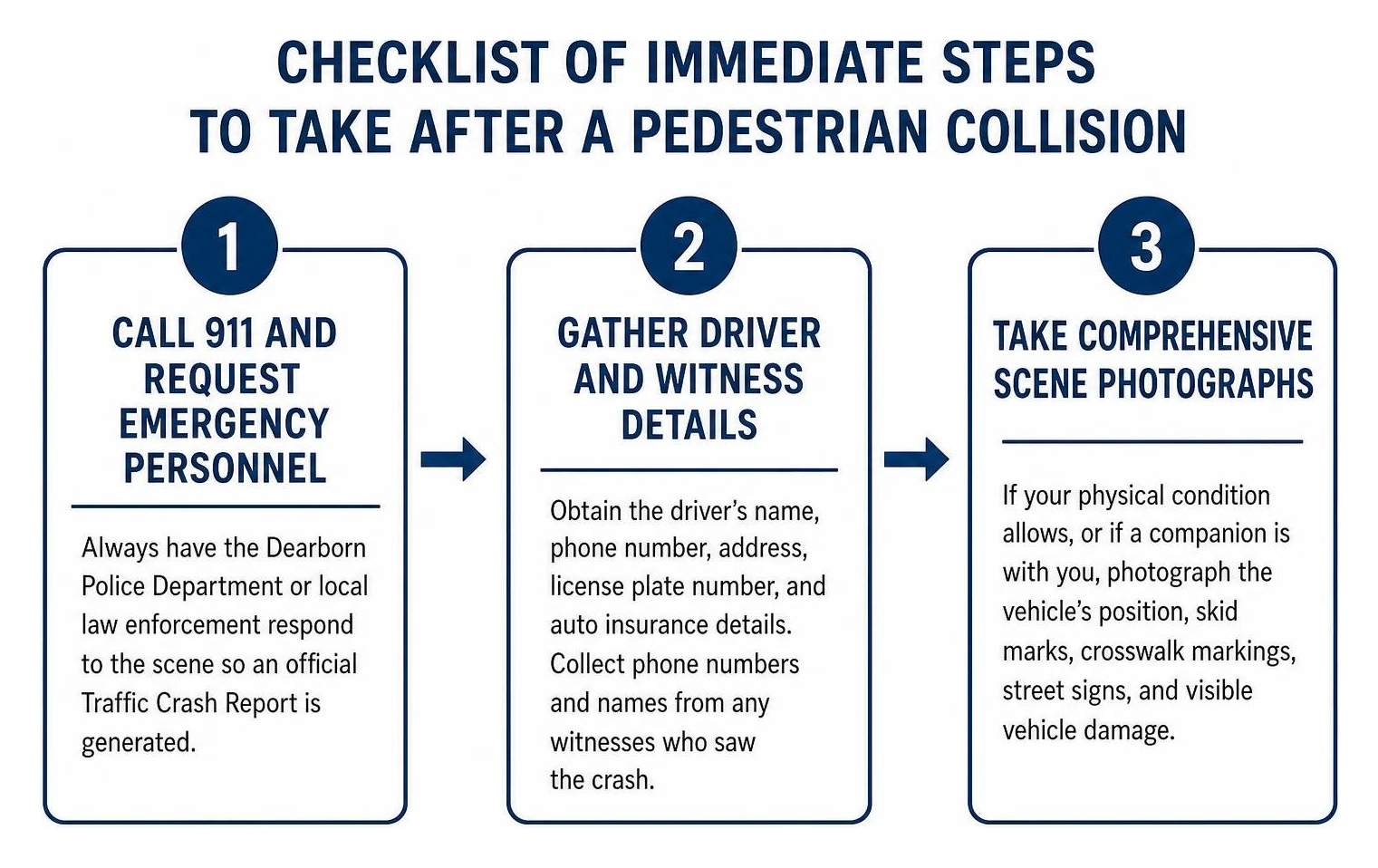
Following our guide on what to do immediately after a car accident in Michigan ensures you avoid early mistakes that insurers might use to devalue your claim:
Documenting the Scene and Seeking Medical Care
- Call 911 and Request Emergency Personnel: Always have the Dearborn Police Department or local law enforcement respond to the scene so an official Traffic Crash Report is generated.
- Gather Driver and Witness Details: Obtain the driver’s name, phone number, address, license plate number, and auto insurance details. Collect phone numbers and names from any witnesses who saw the crash.
- Take Comprehensive Scene Photographs: If your physical condition allows, or if a companion is with you, photograph the vehicle’s position, skid marks, crosswalk markings, street signs, and visible vehicle damage.
- Seek Immediate Medical Treatment: Go directly to an emergency department, such as Corewell Health Dearborn Hospital. Tell treating physicians that you were struck by a vehicle so your medical records clearly connect your injuries to the crash.
- Decline Recorded Statements: Do not provide recorded statements to the at-fault driver’s insurance company before speaking with an attorney. Insurance adjusters are trained to ask leading questions designed to shift blame onto pedestrians.
Investigating Municipal Fault and Roadway Defects
In some pedestrian collisions, the driver may not be the only party at fault. Dangerous road conditions, such as broken pedestrian countdown signals, overgrown vegetation obscuring crosswalk signage, poorly timed signals, or inadequate street lighting, can contribute to a crash.
When roadway design or defective traffic control equipment contributes to an incident, the City of Dearborn, Wayne County, or the Michigan Department of Transportation (MDOT) may share legal responsibility.
Pursuing a claim against a public road authority involves strict governmental immunity rules and narrow notice windows. In Michigan, formal statutory notice of a highway defect claim must often be served within 120 days of the injury. We act quickly to inspect the location, request signal timing data, and preserve nearby security and traffic camera footage before it is recorded over.
What Are the Most Common Questions About Pedestrian Accidents in Dearborn?
Can I receive compensation if I was partially at fault or jaywalking?
Yes. Under Michigan law, being outside a marked crosswalk or crossing against a signal does not completely bar you from financial recovery.
First, your eligibility for first-party PIP no-fault benefits (medical expenses, wage reimbursement, replacement services) is not affected by who caused the collision. Even if you were entirely at fault, your household auto insurer or the MACP must still pay your covered no-fault benefits.
Second, regarding third-party claims for pain and suffering against the driver, Michigan follows a modified comparative negligence rule (the 51% bar rule under MCL 600.2959):
- If you are found 50% or less at fault, your financial recovery for pain and suffering is reduced by your assigned percentage of fault. For example, if your damages total $100,000 and you are found 20% at fault for crossing outside a crosswalk, you will receive $80,000.
- If you are found 51% or more at fault, you cannot recover non-economic damages from the driver, though your no-fault medical and wage benefits remain intact.
How long do I have to file an injury claim after a pedestrian crash in Dearborn?
Michigan enforces strict statutory deadlines for personal injury and no-fault claims. If you miss these windows, you lose your right to pursue compensation:
- No-Fault PIP Benefits Notice (One-Year Rule): Under MCL 500.3145, you must submit a formal written Application for No-Fault Benefits to the responsible auto insurer or the MACP within one year of the date of the crash. Furthermore, you cannot recover benefits for any medical bills incurred more than one year before a lawsuit is filed (the “one-year-back rule”).
- Third-Party Lawsuits for Pain and Suffering: Under MCL 600.5805, you have three years from the date of the collision to file a bodily injury lawsuit against the at-fault driver.
- Governmental Highway Defect Claims: If you are claiming that a city or county road agency was responsible for a defective signal or crosswalk, you must provide formal statutory notice within 120 days.
If you are unsure about your timeline, reviewing whether it is too late to file an injury claim in Dearborn can help you protect your rights before key deadlines pass.
How do insurance adjusters attempt to reduce pedestrian accident payouts?
Insurance companies are profit-driven corporations focused on minimizing claim payouts. After a pedestrian collision, insurance adjusters frequently use several common tactics:
- Shifting Fault to the Pedestrian: Claiming that you were wearing dark clothing, looking down at your smartphone, crossing outside a crosswalk, or darting into traffic.
- Disputing Medical Necessity: Reviewing medical bills to claim that certain MRIs, physical therapy sessions, or surgical procedures were unnecessary or related to pre-existing conditions.
- Pushing Quick, Lowball Settlements: Contacting injured pedestrians shortly after the crash with small cash offers in exchange for signing a full liability release, before the full extent of their injuries is known.
- Delaying Benefit Approvals: Stalling payment for attendant care or wage loss checks in hopes that financial pressure will force you to accept a lower settlement.
Knowing how insurance companies try to devalue your injury claim helps you recognize these tactics and protect the true value of your recovery.
Securing the Recovery You Deserve with Jalal Abdallah PLLC
Pedestrian collisions in Dearborn can disrupt your life in an instant. Dealing with multiple insurance companies, overlapping policies, and confusing no-fault rules while managing serious injuries is a heavy burden.
At Jalal Abdallah PLLC, we stand up for underdogs against powerful insurance carriers and negligent motorists across Dearborn, Detroit, Southfield, and Warren. We understand how insurers handle no-fault claims, and we use that knowledge to demand the full financial benefits our clients are owed under the law.
When you work with our firm, we:
- Identify every available insurance policy under Michigan’s order of priority.
- File all required first-party PIP and MACP claims to protect your medical and wage recovery.
- Gather police reports, traffic camera footage, and witness statements to establish driver liability.
- Work closely with your medical providers to document the full impact of your injuries.
- Pursue maximum compensation for pain, suffering, disfigurement, and excess economic losses.
If you are wondering when should you hire a Dearborn pedestrian injury attorney, reaching out right after your accident ensures all evidence and claim deadlines are protected. For dedicated legal support, work with a personal injury lawyer in Dearborn who will fight for you every step of the way.
Contact Jalal Abdallah PLLC today to schedule a free case consultation. We are ready to listen to your story, explain your legal options, and help you secure the full compensation you deserve.
Share This Article

Schedule Your Free Consultation Today!
Reach out today and receive a consultation, completely free of charge - we'll evaluate your case and let you know what comes next.


