 Skip to content

How to Prove Negligence in a Dearborn Fatal Pedestrian Accident
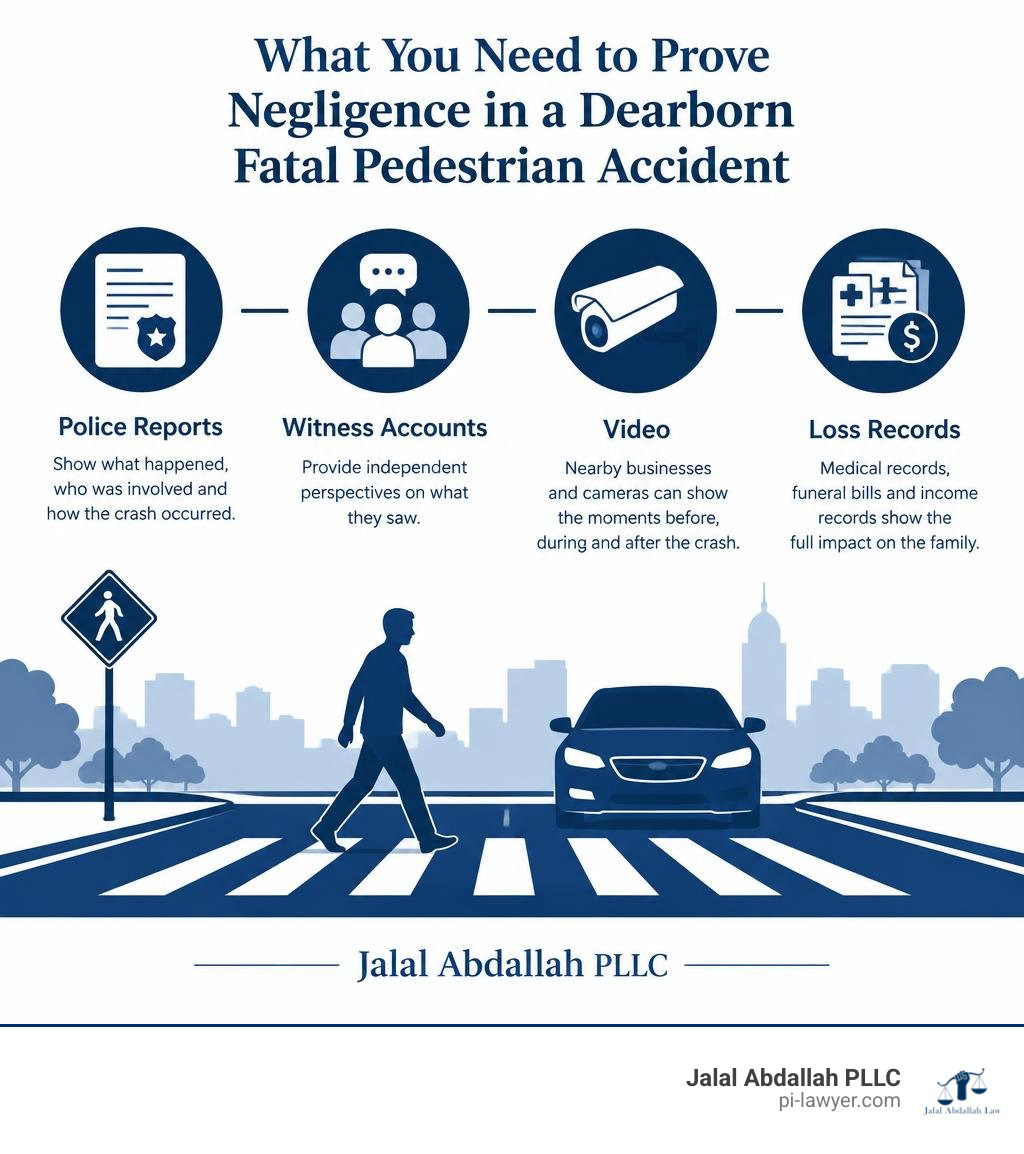
To support a fatal pedestrian accident claim, preserve evidence that shows what the driver did, how the crash happened, and what the family lost. Request the police report, identify witnesses, and ask nearby businesses to save video before it is erased. Keep medical records, funeral bills, and records of the victim’s income. Evidence of a driver’s mistake alone is not enough; a claim must also connect that mistake to the death.
In April 2026, a 63-year-old man died after a driver struck him in a marked crosswalk at Michigan Avenue and Mason Street. The driver stayed and cooperated with police, who said they would send the case to the Wayne County Prosecutor’s Office for review. A criminal charge is not required to pursue a civil claim.
I’m Jalal Abdallah, a Michigan attorney whose personal injury practice includes standing up to insurance companies. That work shapes how I approach the evidence in a Dearborn fatal pedestrian accident claim, starting with what a family can preserve now.
Related content about Dearborn fatal pedestrian accident:
- Dearborn fatal accident compensation
- Dearborn fatal accident lawsuit
- Dearborn fatal car crash attorney
Understanding Negligence After a Dearborn Fatal Pedestrian Accident
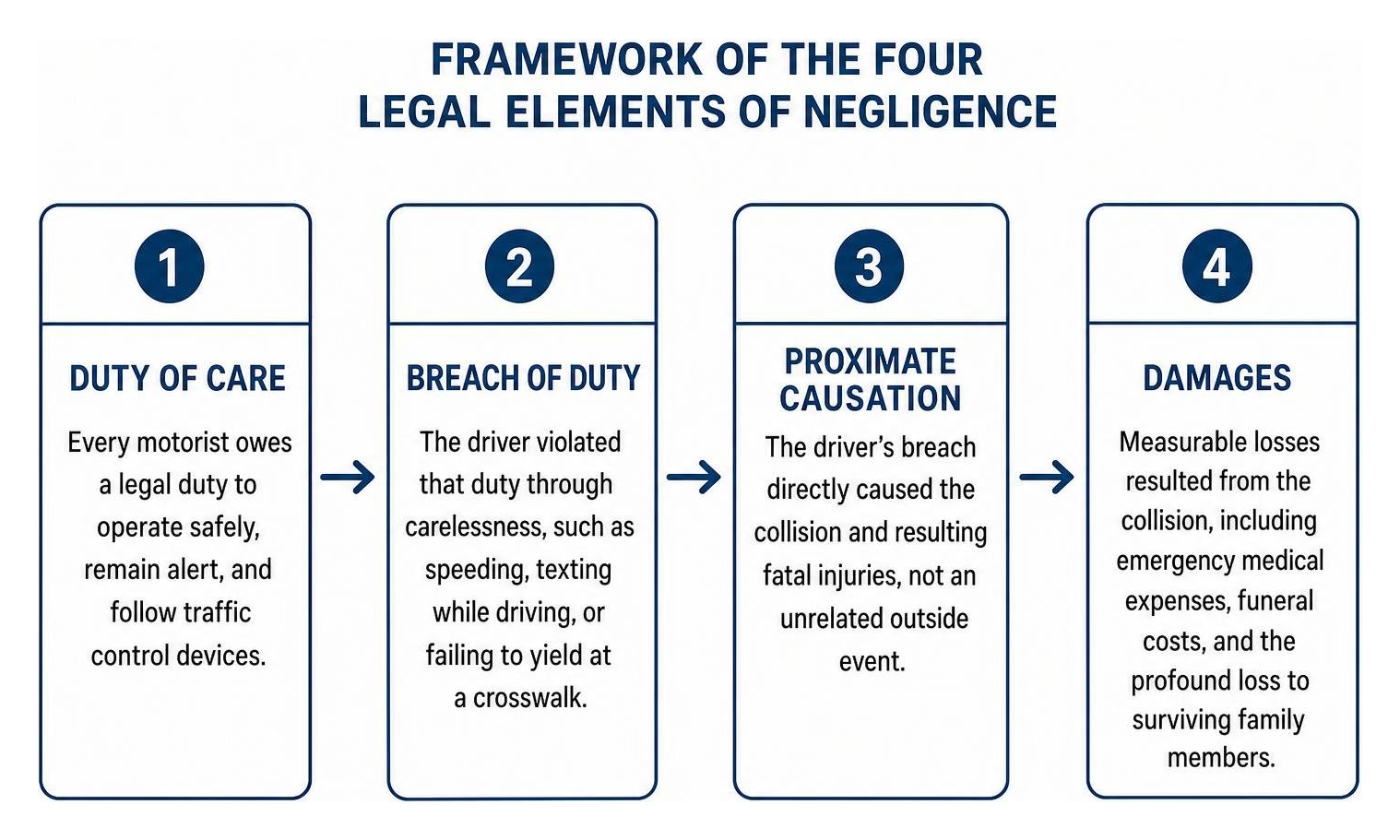
Proving liability after a fatal collision requires establishing specific legal elements under Michigan law. When we handle pedestrian accident cases, we must establish four central pillars of tort law:
- Duty of Care: Every motorist operating a vehicle on Dearborn roads owes a legal duty to operate their vehicle safely, remain alert, and follow traffic control devices.
- Breach of Duty: The driver violated that duty through an act of carelessness, such as speeding, texting while driving, or failing to yield at a marked crosswalk.
- Proximate Causation: The driver’s breach directly caused the collision and resulting fatal injuries, rather than an unrelated outside event.
- Damages: Measurable losses resulted from the collision, including emergency medical expenses, funeral costs, and the profound personal loss experienced by surviving family members.
Michigan traffic regulations establish clear protections for pedestrians, particularly regarding crosswalk compliance and traffic signals. When a driver ignores these statutory protections, their violation serves as compelling evidence of negligence.
Legal Standards and Burden of Proof for Families
In civil litigation, the standard of proof differs significantly from criminal court. While prosecutors must prove guilt beyond a reasonable doubt, civil wrongful death actions require a preponderance of the evidence. This means we must demonstrate that it is more likely than not (greater than 50% probability) that the driver’s careless actions caused the fatal injuries.
Under the Michigan Wrongful Death Act (MCL 600.2922), an action cannot be filed directly by individual family members. Instead, it must be brought by the personal representative of the deceased person’s estate, who is appointed by the probate court. Taking the essential legal steps for fatal accident claims early ensures that the personal representative is properly appointed and that critical evidence is not lost.
Driver Responsibilities and Michigan Right-of-Way Laws
Under Michigan law, motorists must exercise due care to avoid colliding with pedestrians. Drivers must:
- Stop and yield the right-of-way to pedestrians within marked crosswalks.
- Obey all pedestrian control signals and intersection lights.
- Maintain a careful and prudent speed that allows them to stop within the assured clear distance ahead.
- Avoid distractions, including mobile phones and in-vehicle screens.
When drivers fail to fulfill these duties, insurance companies often attempt to shift blame onto the victim. Proving that the driver violated explicit statutory duties is vital to defeating these tactics.
Essential Categories of Evidence to Establish Driver Liability
Winning a wrongful death claim requires gathering objective proof before memories fade or physical evidence disappears. Insurance carriers deploy adjusters immediately; we respond by collecting comprehensive evidence from the outset.

Gathering Physical Evidence from a Dearborn Fatal Pedestrian Accident Scene
Physical evidence provides an unbiased account of how an impact occurred. Key roadway evidence includes:
- Skid Marks and Yaw Marks: Measuring tire marks reveals whether the driver attempted to brake, their initial travel speed, and the vehicle’s trajectory.
- Point of Impact (POI): Debris fields, vehicle fluid spills, and personal items establish whether the victim was struck within a designated crosswalk or lane of travel.
- Event Data Recorders (EDRs): Modern vehicle “black boxes” record crucial metrics in the seconds preceding a crash, including vehicle speed, throttle position, brake application, and steering angles.
- Vehicle Telematics and Mobile Phone Records: Digital data helps confirm whether a driver was texting, talking, or using applications at the moment of the crash.
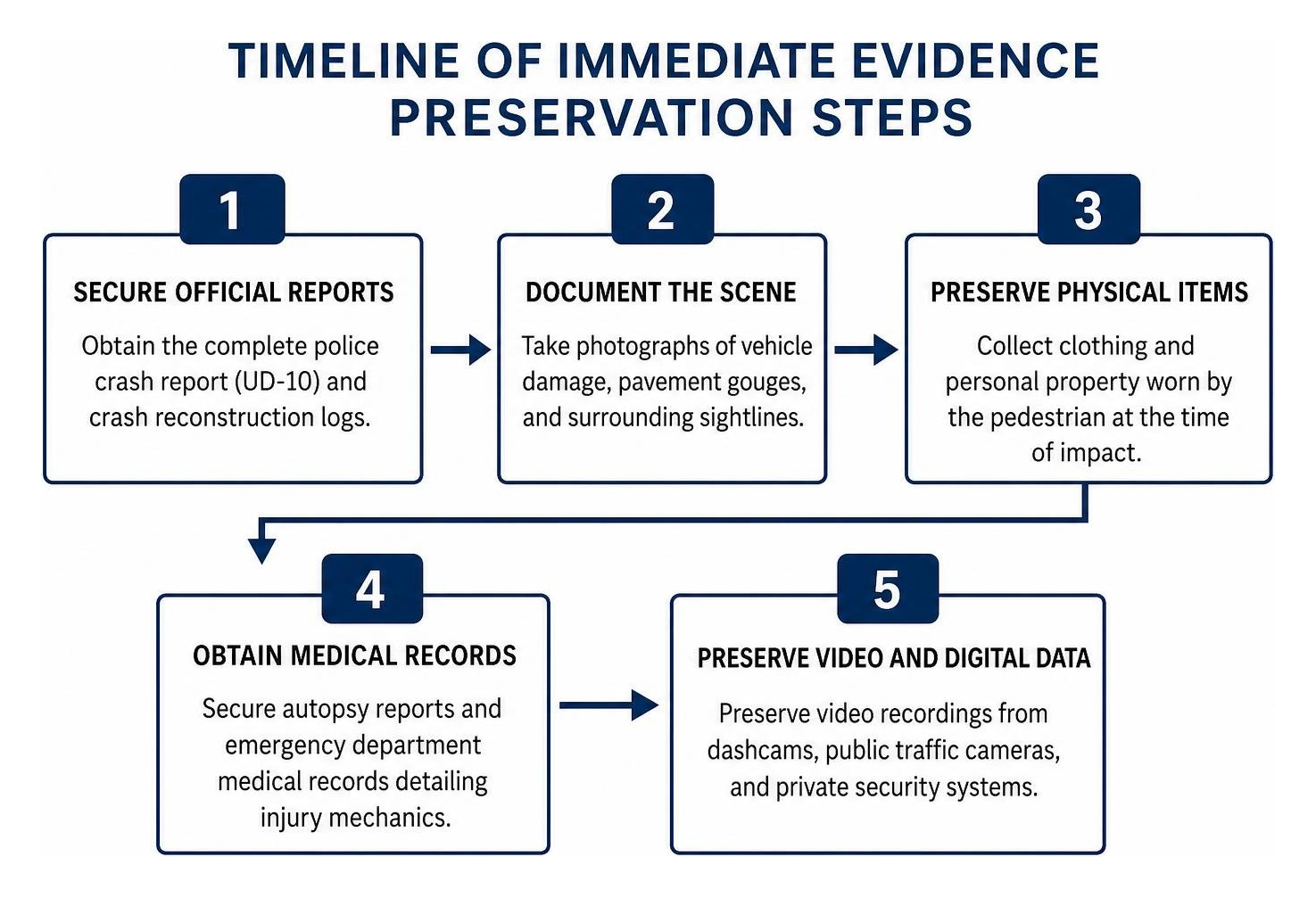
To protect your rights, keep this checklist of critical evidence to preserve immediately:
- Complete police crash report (UD-10) and crash reconstruction logs.
- Photographs of vehicle damage, pavement gouges, and surrounding sightlines.
- Clothing and personal property worn by the pedestrian at the time of impact.
- Autopsy reports and emergency department medical records detailing injury mechanics.
- Video recordings from dashcams, public traffic cameras, and private security systems.
Eyewitness Testimony and Video Surveillance
Objective third-party accounts are invaluable. Eyewitnesses often provide crucial observations regarding:
- The color of traffic lights at the moment of impact.
- The pedestrian’s position within the crosswalk.
- Erratic driver behavior, such as swerving, drifting, or visible phone use.
Surveillance cameras from nearby commercial establishments, gas stations, and residential doorbell cameras often capture the collision or the vehicle’s speed leading up to the impact. Because private surveillance systems often overwrite footage within days, our team at Jalal Abdallah PLLC sends formal spoliation letters to preserve this critical footage immediately.
Real-World Case Analyses and Fatal Crash Patterns in Dearborn
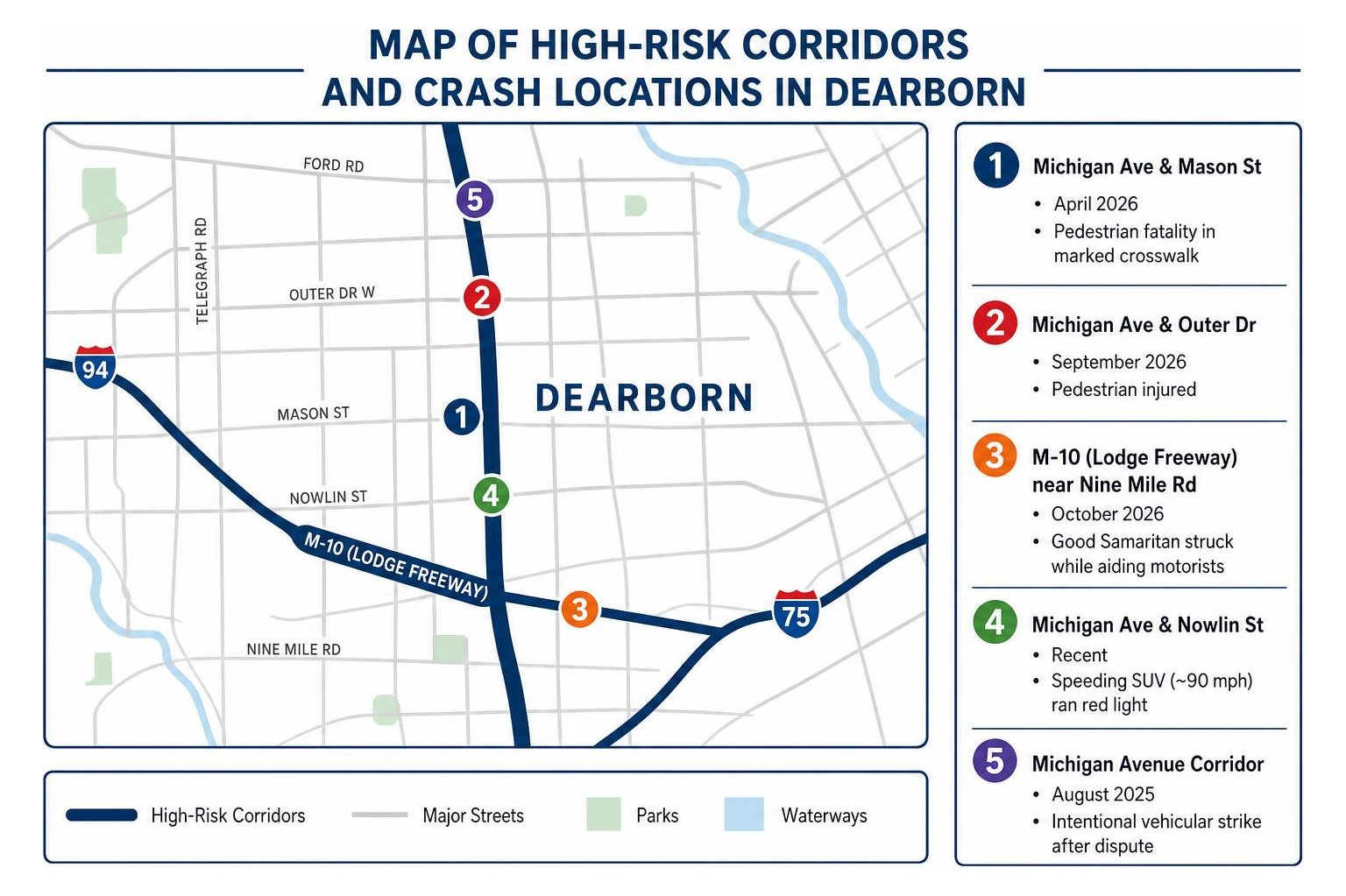
Analyzing local traffic incidents across Dearborn reveals troubling patterns regarding corridor design, speed, and driver behavior. A closer look at Dearborn fatal crash statistics shows that high-volume arterial roads, especially Michigan Avenue, present substantial risks to pedestrians.
| Incident Location | Date / Period | Key Factors Involved | Outcome / Status |
|---|---|---|---|
| Michigan Ave & Mason St | April 2026 | 63-year-old crossing in marked crosswalk; daytime impact | Pedestrian fatality; driver cooperated; prosecutor review |
| Michigan Ave & Outer Dr | September 2026 | Midday intersection collision involving a white Hummer | Pedestrian injured; driver remained at scene |
| M-10 (Lodge Freeway) | October 2026 | 19-year-old Good Samaritan struck while aiding motorists | Pedestrian fatality; driver cooperated; no charges filed |
| Michigan Ave & Nowlin St | Recent | Speeding SUV (estimated ~90 mph) ran red light | Fatal collision; beloved local doctor killed |
| Michigan Avenue Corridor | August 2025 | Intentional vehicular strike after ongoing dispute | Pedestrian critically injured; $750K bond; attempted murder charges |
Key Factors and Patterns in Dearborn Fatal Pedestrian Accident Incidents
A review of recent local cases highlights recurring challenges pedestrians face on Dearborn roadways:
- Crosswalk Vulnerabilities: In April 2026, a 63-year-old man was fatally struck while crossing within a marked crosswalk at Michigan Avenue and Mason Street. Although the motorist remained at the scene and cooperated, the police submitted the case to the Wayne County Prosecutor’s Office to evaluate criminal charges, demonstrating that compliance after a crash does not eliminate potential negligence.
- High-Traffic Intersections: In September 2026, emergency crews responded to Michigan Avenue and Outer Drive West after a white Hummer struck a pedestrian, leaving her with severe leg trauma.
- Freeway and Good Samaritan Risks: Pedestrians on highway shoulders face extreme hazards. In October 2026, 19-year-old Hazem Hussein was killed on the southbound Lodge Freeway near Nine Mile Road after crossing lanes to assist victims of an earlier multi-vehicle collision.
- Excessive Speed and Signal Disregard: High-speed impacts on commercial corridors have proven catastrophic. At Michigan Avenue and Nowlin Street, an SUV traveling at an estimated 90 mph ran a red light, striking a truck and killing Dr. Ghada Mustapha.
- Intentional Vehicular Assault: In August 2025, Haidar Al Fadawi was deliberately struck by an SUV on Michigan Avenue following a dispute. The driver was apprehended and charged with assault with intent to murder, held on a $750,000 bond.
Impact of Driver Speed and Traffic Signal Violations
Vehicle speed directly influences both collision probability and pedestrian survivability. When a motorist speeds or runs a red light, their available stopping distance expands dramatically while the pedestrian’s reaction window shrinks to fractions of a second.
High-velocity impacts generate severe blunt force trauma. In civil claims involving excessive speed, proving that the driver exceeded posted limits is essential to showing that the motorist created an unavoidable hazard.
Navigating Wrongful Death Damages and Comparative Fault Defenses
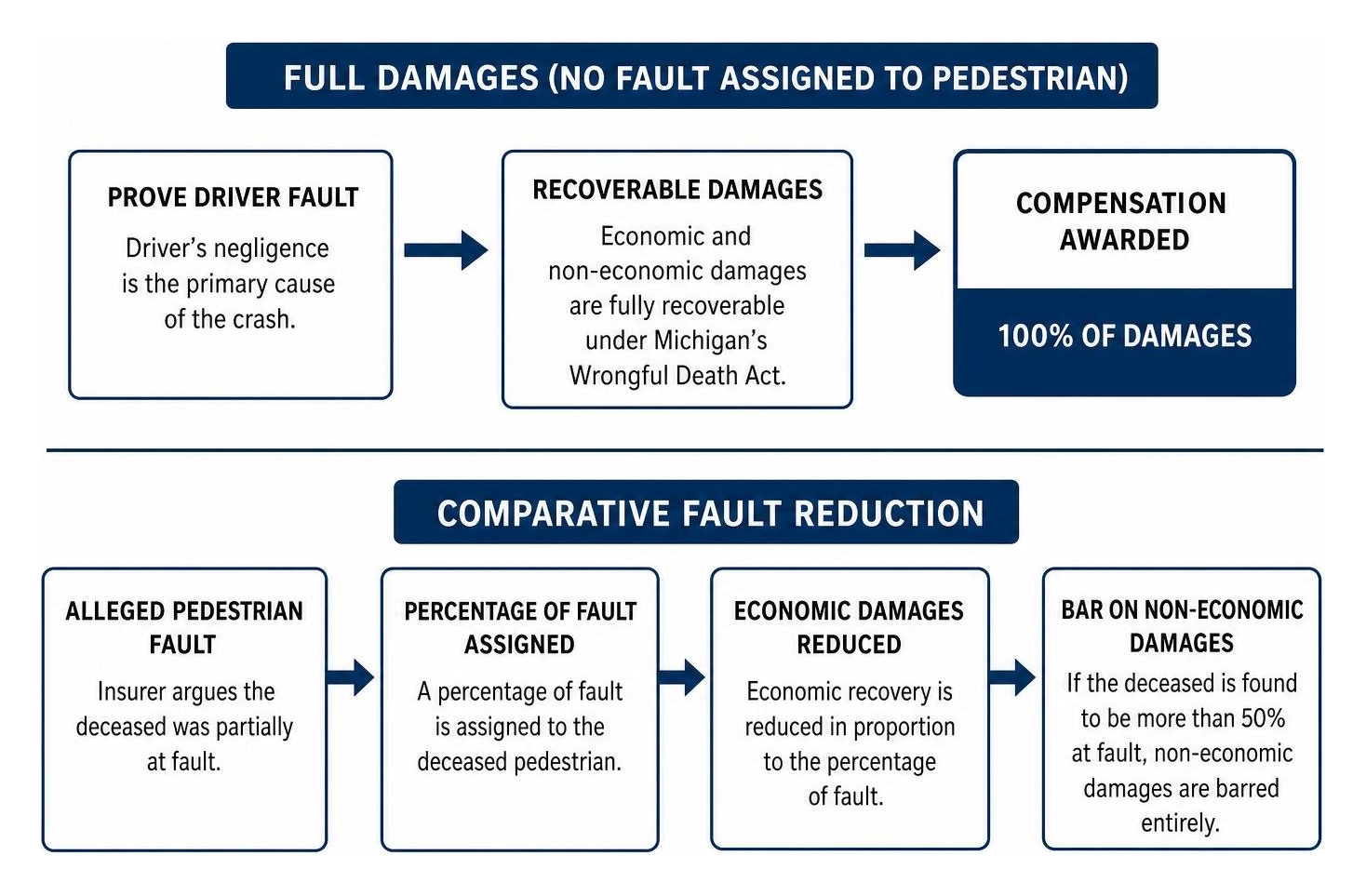
Under Michigan’s Wrongful Death Act, surviving family members may pursue financial recovery for both economic and non-economic losses. Understanding your wrongful death compensation options helps ensure that all applicable damages are documented.
Recoverable damages in a Michigan fatal pedestrian claim typically include:
- Reasonable medical, hospital, and surgical expenses incurred prior to death.
- Reasonable funeral and burial costs.
- Compensation for the pain and suffering consciously endured by the deceased between injury and death.
- Loss of financial support and future earnings that the deceased would have provided to dependents.
- Loss of society, companionship, guidance, and consortium suffered by surviving family members.
Overcoming Comparative Negligence Defenses
Insurance adjusters routinely attempt to reduce their financial exposure by arguing that the pedestrian was partially or entirely at fault. Under Michigan’s modified comparative fault system (MCL 600.2959):
- A plaintiff’s economic recovery is reduced in proportion to their percentage of fault.
- If the deceased is found to be more than 50% at fault, non-economic damages (such as pain and suffering and loss of companionship) are barred entirely.
Insurers frequently argue that the pedestrian wore dark clothing, looked at a phone, or crossed outside a marked crosswalk. We counter these arguments using EDR data, lighting analysis, and witness testimony to establish that the driver’s failure to maintain a proper lookout was the primary cause of the crash.
Frequently Asked Questions About Fatal Pedestrian Claims in Dearborn
How does a criminal investigation impact a civil pedestrian wrongful death claim?
A criminal investigation runs separately from a civil wrongful death lawsuit. While the Wayne County Prosecutor’s Office decides whether to file criminal charges, civil actions proceed independently. Evidence gathered by law enforcement—such as blood alcohol test results, accident reconstruction reports, and 911 audio—can often be subpoenaed and used to establish negligence in your civil claim, even if criminal charges are resolved or never filed.
What financial compensation can surviving family members recover?
Surviving family members (including spouses, children, parents, and siblings) can recover compensation through the estate for:
- Final medical bills and emergency care costs.
- Funeral and burial expenses.
- The loss of future financial earnings and benefits.
- The loss of emotional support, companionship, and guidance.
- Pain and suffering experienced by the deceased prior to passing.
How long do families have to file a fatal pedestrian accident claim in Michigan?
Under Michigan law (MCL 600.5805), the statute of limitations for personal injury and wrongful death claims is generally three years from the date of death. However, establishing the estate in probate court and preserving time-sensitive electronic evidence requires action well before this deadline. Delaying can result in the loss of critical video surveillance or vehicle data.
Securing Accountability for Your Loved One
Proving negligence after a fatal collision requires swift action, detailed evidence collection, and unwavering determination. At Jalal Abdallah PLLC, we stand up for families against major insurance companies and corporate defendants. We investigate every detail of the crash, secure critical electronic and physical proof, and fight to hold reckless drivers fully accountable. If your family is facing the aftermath of a fatal collision, consult our dedicated wrongful death team for compassionate guidance and strong legal representation.
Share This Article

Schedule Your Free Consultation Today!
Reach out today and receive a consultation, completely free of charge - we'll evaluate your case and let you know what comes next.


