Dearborn Car Wreck Compensation Guide: What Your Crash Is Really Worth
What Your Dearborn Car Wreck Compensation Could Actually Be Worth
Dearborn car wreck compensation can cover far more than just your immediate medical bills — but most people never collect everything they’re owed.
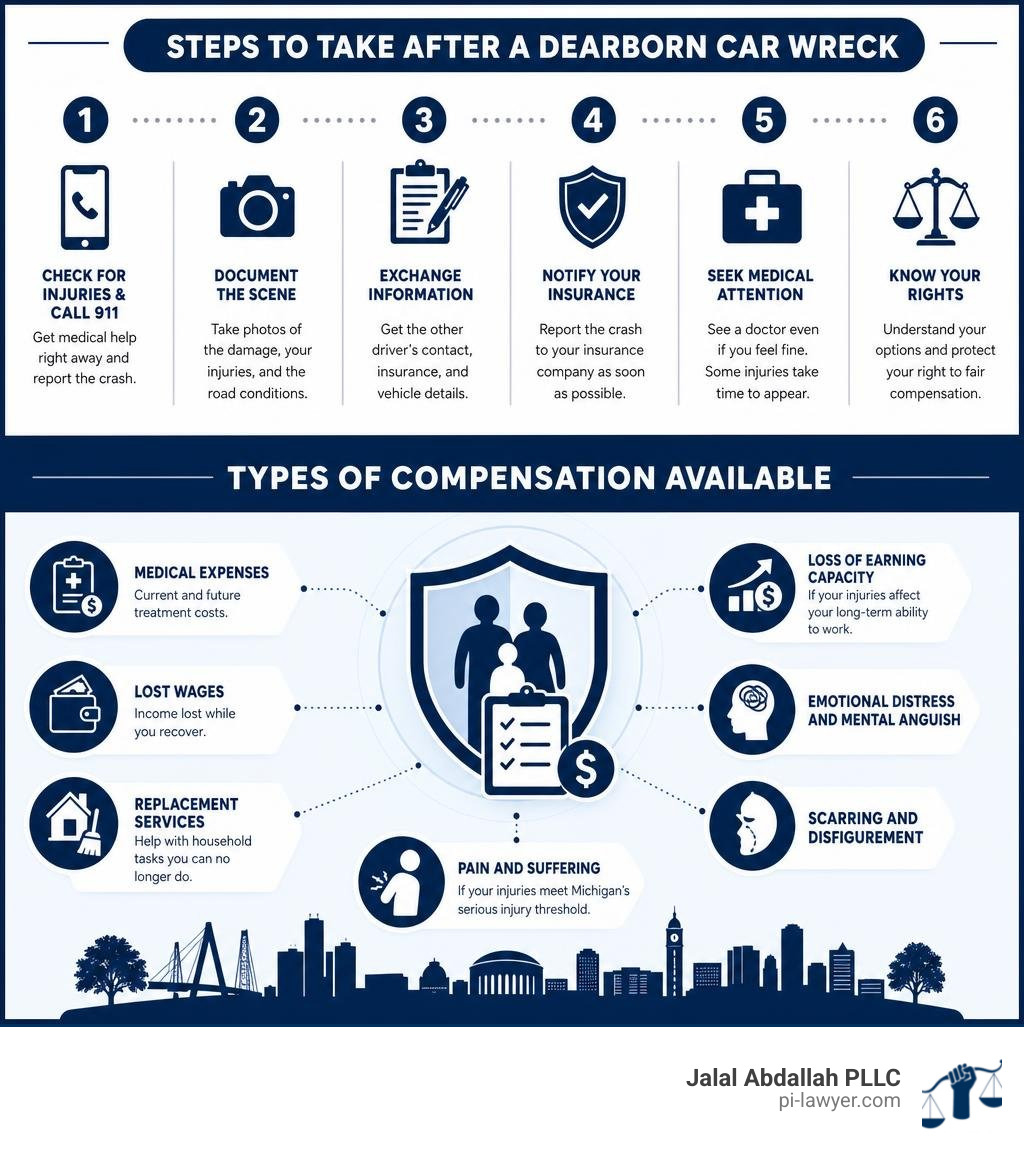
Here’s a quick overview of what you may be entitled to after a crash in Dearborn, MI:
- Medical expenses — current and future treatment costs
- Lost wages — income lost while you recover
- Replacement services — help with household tasks you can no longer do
- Pain and suffering — if your injuries meet Michigan’s serious injury threshold
- Loss of earning capacity — if your injuries affect your long-term ability to work
- Emotional distress and mental anguish
- Scarring and disfigurement
Wayne County is one of the most crash-heavy counties in Michigan. In 2020 alone, it recorded 44,017 car accidents, resulting in 234 deaths and over 10,000 injuries. Dearborn sits right in the middle of that, with thousands of crashes occurring on its roads every year.
Yet many victims walk away with far less than they deserve. Why? Because Michigan’s No-Fault insurance system is genuinely complex. Insurance companies know the rules better than most injured people do — and they use that advantage.
The physical pain is hard enough. The last thing you need is a confusing legal process standing between you and the money you’re owed.
This guide breaks down exactly how compensation works in Dearborn, what your claim may be worth, and what steps protect your right to recover it.
Understanding Michigan No-Fault Laws and Dearborn Car Wreck Compensation
To understand how Dearborn car wreck compensation is calculated, we must first look at Michigan’s unique auto insurance system. Michigan is a No-Fault insurance state. In simple terms, this means that after a motor vehicle accident, your own auto insurance policy is responsible for paying certain basic economic benefits, regardless of who caused the crash.
However, the system underwent massive structural reforms recently. Historically, every driver in Michigan was required to carry unlimited Personal Injury Protection (PIP) coverage. Today, drivers can choose from several PIP coverage limit tiers:
- Unlimited coverage: Pays for all reasonably necessary medical care for your lifetime.
- $500,000 limit: Caps medical coverage at half a million dollars.
- $250,000 limit: Caps medical coverage at a quarter-million dollars.
- $50,000 limit: Only available if the named insured is enrolled in Medicaid and meets specific household criteria.
- PIP Opt-Out: Available under highly specific circumstances if you have qualified health coverage (like Medicare Parts A and B).
These limits mean that if you suffer catastrophic injuries in a crash on Michigan Avenue or Telegraph Road, your own insurance might run out quickly if you opted for a lower tier. When your medical bills exceed your selected PIP limits, or if you want to pursue compensation for your physical pain and mental trauma, you must look beyond your own policy.
Because Wayne County has the highest crash rates in the state, navigating these limits is a daily reality for local drivers. This is why having a dedicated Dearborn Car Accident Lawyer on your side is critical. We help you identify every available source of insurance coverage so that you are not left paying out of pocket for a crash you did not cause.
PIP Benefits and First-Party Claims
When you file a first-party claim with your own auto insurer, you are seeking Personal Injury Protection (PIP) benefits. These benefits are designed to keep you financially afloat while you recover from your physical injuries.
Under Michigan No-Fault law, PIP covers several key types of economic losses:
- Medical Expenses: All reasonable and necessary medical care, surgeries, physical therapy, medications, and medical equipment resulting from the Car Accidents.
- Lost Wages: If your injuries prevent you from working, PIP covers up to 85% of your lost income for up to three years from the date of the accident, subject to a monthly state cap.
- Replacement Services: If you can no longer perform ordinary household chores—such as cleaning, cooking, lawn care, or grocery shopping—PIP will pay up to $20 per day to compensate someone else for doing them.
- Attendant Care: If your injuries are severe enough that you require in-home nursing or assistance with daily living activities (bathing, dressing, eating), PIP covers these services.
While these benefits sound straightforward, insurance adjusters frequently look for excuses to terminate or reduce PIP payments. They may require you to attend a biased “Independent Medical Examination” (IME) to claim your recovery is complete, even when your treating doctors disagree.
When Can You Sue for Additional Dearborn Car Wreck Compensation?
If your own No-Fault insurance covers your medical bills and a portion of your lost wages, when can you actually file a lawsuit against the at-fault driver?
In Michigan, you can pursue a third-party personal injury lawsuit against the negligent driver under two primary conditions:
- You Meet the Serious Injury Threshold: Michigan law requires that your injuries constitute a “serious impairment of body function,” permanent serious disfigurement, or death. A serious impairment of body function is defined as an objectively manifested impairment of an important body function that affects your general ability to lead your normal life.
- You Have Excess Economic Losses: If your medical bills exceed your PIP choice limits, or if your lost wages go beyond the three-year limit or the monthly statutory cap, you can sue the at-fault driver to recover these excess economic damages.
Filing a third-party lawsuit is the only way to recover non-economic damages, which compensate you for the human toll of the crash. To understand how these damages are defined and evaluated, you can read more about Understanding Pain and Suffering Damages in Personal Injury Cases.
Types of Damages Recoverable in a Dearborn Car Accident
When building a claim for Dearborn car wreck compensation, we categorize your losses into economic and non-economic damages. This structure ensures that both your concrete financial bills and your subjective personal suffering are accounted for in a settlement demand.
| Damage Category | Type of Loss | What It Covers | How It Is Proven |
|---|---|---|---|
| Economic Damages | Financial | Medical bills, future surgeries, rehabilitation, lost wages, and home modifications. | Receipts, invoices, pay stubs, and expert economic testimony. |
| Non-Economic Damages | Personal / Physical | Pain and suffering, emotional distress, mental anguish, scarring, and loss of life enjoyment. | Medical records, psychological evaluations, and personal diaries. |
To recover the maximum compensation possible, we must thoroughly document every single item in both categories. This requires collaborating with medical experts, reconstructive specialists, and lifecare planners who can project your long-term needs. Whether you suffer a mild concussion or a life-altering spinal cord injury, our goal at Jalal Abdallah PLLC is to make sure the insurance company recognizes the true scope of your Personal Injury.
Calculating Pain and Suffering and Non-Economic Damages
Unlike a medical bill, which has a clear dollar amount printed on it, pain and suffering does not come with a price tag. Calculating non-economic damages is one of the most highly contested aspects of any car accident case.
To establish the value of your pain and suffering, we look at several factors:
- The severity and permanency of your injuries (e.g., traumatic brain injuries, spinal damage, or amputations).
- The presence of visible scarring or disfigurement, which can cause profound emotional distress.
- How the injury limits your ability to engage in hobbies, care for your children, or enjoy daily life.
- The depth of your mental anguish, including diagnosed PTSD, anxiety, or depression following the wreck.
Insurance companies often use computer software programs to assign a lowball value to your pain and suffering. We counter these cold algorithms by telling your human story—showing exactly how a reckless driver disrupted your daily routine, your family life, and your peace of mind.
How Fault Impacts Your Dearborn Car Wreck Compensation
Even though Michigan is a No-Fault state for basic medical benefits, fault matters immensely when you sue an individual driver for pain and suffering or excess economic damages.
Michigan follows a legal doctrine known as modified comparative negligence (under MCL 600.2959). Here is how it works:
- You can recover non-economic damages as long as you are 50% or less at fault for the accident.
- Your final compensation award will be reduced by your percentage of fault. For example, if a jury determines your total damages are $100,000, but finds you were 20% at fault because you were traveling slightly over the speed limit, your recovery is reduced to $80,000.
- If you are found to be 51% or more at fault, you are completely barred from recovering any pain and suffering damages.
Because of this “50% bar rule,” insurance adjusters will do everything they can to shift the blame onto you. They might twist your words during phone conversations or claim your actions caused the collision. Understanding How Insurance Companies Try to Devalue Your Injury Claim can help you spot these traps before they ruin your case.
Step-by-Step Guide: How to Protect Your Right to Compensation
The actions you take in the hours and days following a collision will directly impact your ability to secure fair Dearborn car wreck compensation.
To protect your rights, follow these essential steps:
- Call 911 and Request a Police Officer: Never agree to “settle things privately” with the other driver. You need an official police report to establish an objective record of the crash. When the officer arrives, state the facts clearly without apologizing or admitting fault.
- Document the Scene: If it is safe to do so, take extensive photos and videos of the vehicles, the damage, skid marks, road conditions, traffic signs, and any visible injuries.
- Gather Witness Information: If anyone stopped to help, write down their names and phone numbers. Their unbiased testimony can be invaluable if the at-fault driver changes their story later.
- Seek Immediate Medical Attention: Go to the nearest emergency room, such as Corewell Health Dearborn Hospital, or an urgent care clinic. Some serious injuries, like internal bleeding, whiplash, or concussions, may not show symptoms immediately due to adrenaline. A prompt medical evaluation links your injuries directly to the crash.
- Report the Crash to Your Insurer: Notify your auto insurance provider that an accident occurred, but stick strictly to the basic facts (date, time, location). Do not give a recorded statement or sign any medical release forms without speaking to an attorney first.
- Consult an Attorney: The sooner you have legal representation, the safer your claim will be.
For a detailed, printable checklist of what to do on the road, read our comprehensive guide on What to Do Immediately After a Car Accident in Michigan.
Common Mistakes That Can Devalue Your Claim
It is incredibly easy to accidentally damage your personal injury claim. Insurance defense lawyers and claims adjusters are trained to watch for these common missteps:
- Giving Recorded Statements: Insurers will search your recorded words for any statement they can interpret as an admission of fault or a sign that your injuries are minor.
- Delaying Medical Care: If you wait weeks to see a doctor, the insurance company will argue that your injuries were caused by something else, or that you failed to mitigate your damages.
- Accepting an Early Settlement: Insurers love to offer quick cash settlements right after a crash. These offers are almost always lowball figures designed to make you sign away your right to sue before you know the true cost of your medical care.
- Posting on Social Media: Avoid posting photos of your recovery, vacation trips, or even status updates about the crash. Defense attorneys regularly monitor public profiles to argue that your injuries are not as severe as you claim.
Timeline and Legal Deadlines for Dearborn Car Accident Claims
When pursuing Dearborn car wreck compensation, you must keep a close eye on the calendar. Under Michigan law, there are strict legal deadlines that cannot be missed:
- The One-Year No-Fault Notice: You must file a written application for PIP benefits with your No-Fault insurance company within one year of the date of the accident. If you miss this deadline, you lose your right to collect PIP benefits forever.
- The Three-Year Statute of Limitations: For third-party lawsuits (suing the at-fault driver for pain and suffering or excess economic damages), you must file your lawsuit within three years of the date of the crash under MCL 600.5805.
While three years may seem like a long time, building a winning personal injury case takes months of diligent preparation. Evidence can disappear, witnesses move away, and memories fade. The sooner we can begin investigating your crash, the stronger your case will be. If you are ready to discuss your legal options, you can Contact a Dearborn Car Accident Attorney today for a free evaluation.
Frequently Asked Questions About Dearborn Car Wreck Claims
How long does it take to get a car accident settlement in Dearborn?
There is no single timeline for a car accident settlement. A straightforward claim with minor injuries and clear liability might resolve in a few months. However, complex cases involving severe injuries can take a year or longer.
We generally advise against settling your claim until you have reached Maximum Medical Improvement (MMI). This is the point at which your doctors believe your condition has stabilized. If you settle too early, you cannot go back and ask for more money if you discover you need an unexpected surgery down the road.
What if I am partially at fault for the car accident?
As discussed under Michigan’s comparative fault rules, you can still recover compensation as long as you are not more than 50% responsible for the crash. Your final settlement or jury award will simply be reduced by your percentage of fault. If liability is disputed, we gather traffic camera footage, accident reconstruction data, and witness statements to minimize the amount of blame assigned to you.
Do I need a lawyer if Michigan is a no-fault state?
Yes. While the No-Fault system was designed to simplify medical payments, the reality is highly adversarial. Insurance companies are businesses focused on protecting their bottom lines. They regularly deny legitimate claims, delay payments, and offer pennies on the dollar for pain and suffering. An experienced attorney knows how to counter these tactics, navigate the complex interaction between health insurance and auto insurance, and fight to maximize your final settlement.
Conclusion
Securing fair Dearborn car wreck compensation requires a deep understanding of Michigan’s evolving No-Fault laws, insurance tactics, and local court systems. You do not have to face powerful insurance corporations alone.
At Jalal Abdallah PLLC, we pride ourselves on providing relentless advocacy for the underdogs of Michigan. From our offices in Dearborn and across Metro Detroit, we fight to ensure our clients receive every dollar they deserve for their medical bills, lost wages, and pain and suffering.
Let us handle the legal battles so you can focus on healing. If you or a loved one has been injured in a crash, Contact Jalal Abdallah PLLC today for a free, no-obligation consultation.
Share This Article

Schedule Your Free Consultation Today!
Reach out today and receive a consultation, completely free of charge - we'll evaluate your case and let you know what comes next.