How to Choose the Best Dearborn Bus Accident Lawyer Without Getting Run Over
What Happens When a Bus Accident Turns Your Life Upside Down in Dearborn
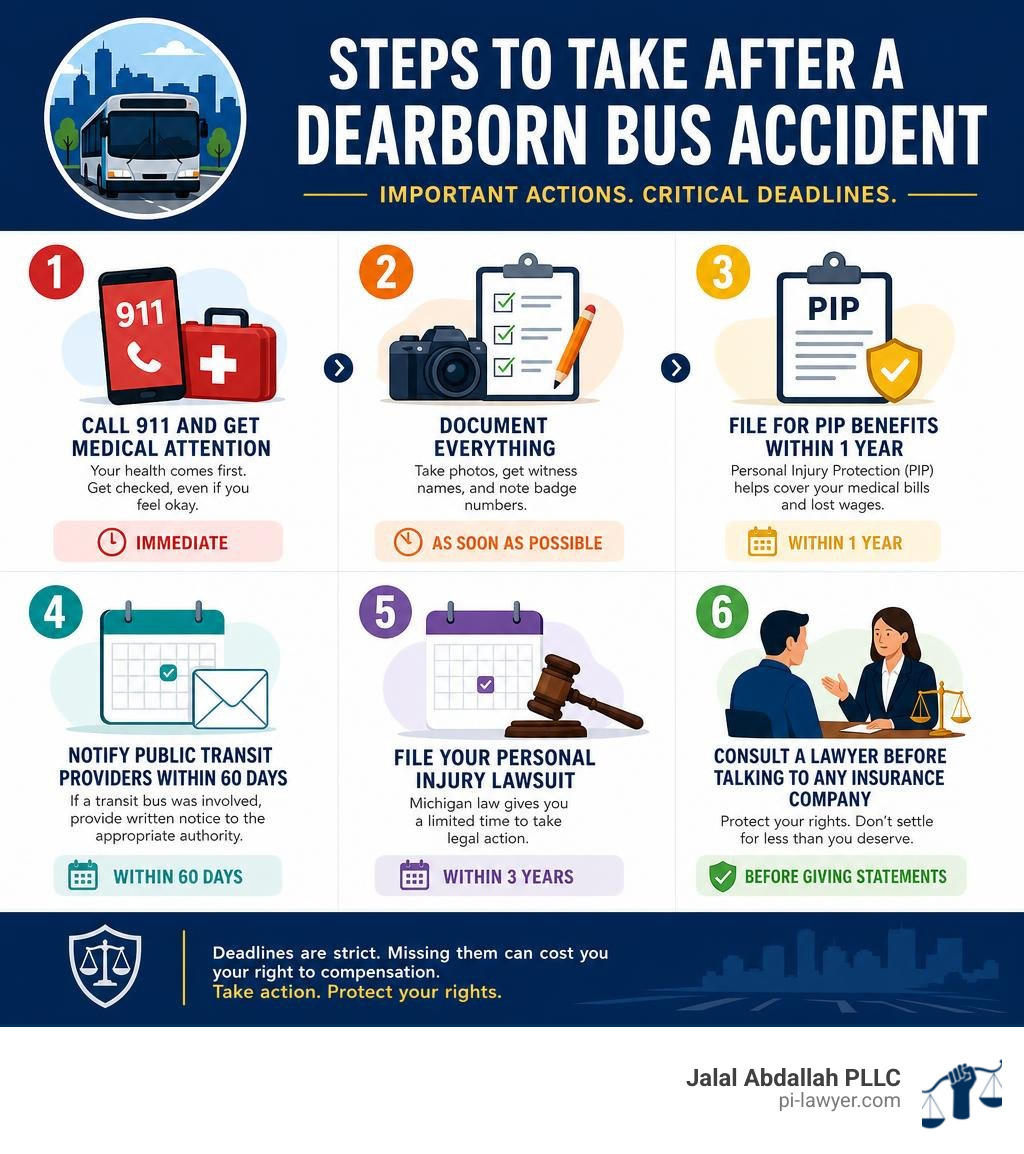
If you’re looking for a Bus Accident Lawyer Dearborn residents trust, here’s what you need to know right away:
Quick answers for bus accident victims in Dearborn, MI:
- Call 911 and get medical attention — even if you feel okay right now
- Document everything — photos, witness names, badge numbers
- File for PIP benefits within 1 year of the accident
- Notify public transit providers within 60 days if a SMART or DDOT bus was involved
- File your personal injury lawsuit within 3 years under Michigan law
- Consult a lawyer before talking to any insurance company
Bus accidents in Dearborn are not like typical car crashes. The vehicles are bigger. The injuries are worse. And the legal rules are far more complicated.
You may be dealing with a government-operated transit agency, multiple insurance companies, and deadlines that can quietly expire before you even know they exist. Michigan law, for example, requires written notice to a public transit provider within just 60 days of the accident — a deadline most people don’t know about until it’s too late.
Meanwhile, you’re in pain, missing work, and fielding calls from adjusters who want to settle fast and cheap.
That’s exactly when having the right lawyer in your corner matters most.
This guide walks you through how to choose a Dearborn bus accident lawyer who will actually fight for you — not just process your claim like a number.
Immediate Steps to Take After a Dearborn Bus Crash
The moments immediately following a bus crash are chaotic. Whether you were a passenger on a SMART bus rolling down Michigan Avenue, a pedestrian near West Warren Avenue, or a driver in another vehicle, your adrenaline is pumping, and your body is in shock. However, what you do in these critical hours can make or break your eventual legal claim.
First and foremost, check yourself and those around you for injuries. Call 911 immediately to dispatch emergency medical services and the Dearborn Police Department. Even if you do not feel immediate pain, seeking a comprehensive medical evaluation is vital. The sheer size and weight of a transit bus mean that occupants absorb massive kinetic energy during a collision. Soft tissue damage, concussions, and internal injuries frequently mask themselves behind an adrenaline rush, only to flare up days later.
While waiting for emergency responders, if you are physically able to do so safely, begin collecting evidence at the scene:
- Take Photos and Video: Capture the positions of all vehicles, the damage to the bus and other cars, skid marks, traffic signals, road conditions, and any visible injuries.
- Identify Witnesses: Speak to other passengers, bystanders, or passing motorists. Get their names, phone numbers, and brief statements of what they saw.
- Gather Official Information: Note the bus number, route details, and the driver’s name and employee ID. If the police arrive, ensure they take your statement and ask for the incident report number.
- Avoid Discussing Fault: Do not apologize or speculate on what caused the crash to the bus driver, transit staff, or insurance adjusters.
To understand the full scope of your immediate responsibilities and protect your health, you can read our comprehensive guide on What to Do Immediately After a Car Accident in Michigan. Taking these structured steps preserves evidence that an experienced Bus Accident Lawyer Dearborn can later use to build an ironclad case on your behalf.
How a Bus Accident Lawyer Dearborn Can Help Maximize Your Compensation
Navigating the aftermath of a bus accident in Michigan requires a deep understanding of the state’s unique insurance landscape. Because Michigan operates under a No-Fault system, your financial recovery is split into two distinct categories: first-party Personal Injury Protection (PIP) benefits and third-party tort claims (lawsuits for pain and suffering).
A specialized attorney is essential to help you identify which insurance policies are responsible for your bills and to aggressively pursue the maximum compensation available under both pathways.
To help visualize how these two recovery systems work, consider the following breakdown:
| Compensation Category | Covered Benefits / Damages | Who Pays? | Key Requirements & Limitations |
|---|---|---|---|
| First-Party PIP Benefits | Lifetime medical expenses, up to 3 years of 85% lost wages, attendant care, and daily replacement services. | Your own auto insurer, a family member’s policy, the bus insurer, or the Michigan Assigned Claims Plan (MACP). | Paid regardless of who caused the accident. Must file a claim within 1 year of the crash. Subject to selected coverage limits. |
| Third-Party Tort Claim | Non-economic damages such as physical pain, emotional suffering, loss of enjoyment of life, and excess economic losses. | The at-fault party’s insurance (the bus driver, private bus company, transit authority, or third-party motorist). | Requires proving negligence. Victim must meet Michigan’s “threshold injury” standard (serious impairment of body function). |
Our team at Jalal Abdallah PLLC works tirelessly to ensure that your PIP insurer does not wrongfully terminate your medical treatments or cut off your wage loss benefits. At the same time, we meticulously calculate your non-economic damages to hold the negligent parties accountable.
To learn more about how non-economic recoveries are calculated and evaluated under Michigan law, explore our detailed resource on Understanding Pain and Suffering Damages in Personal Injury Cases.
Proving Negligence and Liability Under Michigan Law
Proving who caused a bus accident is significantly more complicated than resolving a standard passenger vehicle crash. Because of the commercial and public nature of bus transit, establishing liability requires looking beyond the driver’s actions at the wheel.
Building a successful case requires gathering and analyzing highly specialized evidence, including:
- Electronic Control Module (Black Box) Data: Modern buses record speed, braking patterns, and throttle positions in the seconds leading up to a crash.
- Internal Video Surveillance: Most public and charter buses are equipped with multiple cameras capturing the driver’s behavior, passenger cabin activity, and forward-facing road views.
- Driver Qualification Files: This includes commercial driver’s license (CDL) records, medical examiner certificates, drug and alcohol testing history, and hours-of-service logs.
- Maintenance and Inspection Records: Federal and state laws require strict maintenance schedules. Failing to address worn brakes, bald tires, or steering defects can point directly to corporate or municipal liability.
If you are interested in how commercial vehicle investigations differ from standard car crashes, you can read more about our approach to handling major commercial vehicle crashes by visiting our Truck Accidents page.
Why You Need a Specialized Bus Accident Lawyer Dearborn to Prove Fault
Buses are legally classified as “common carriers.” Under Michigan law, common carriers owe their passengers a heightened duty of care. This means they are required to exercise the highest degree of care, diligence, and safety consistent with the practical operation of their vehicles.
Despite this strict legal standard, proving a breach of duty is incredibly difficult without dedicated representation. A general personal injury attorney may not know how to secure maintenance logs before they are legally destroyed, or how to cross-examine a transit agency’s safety director on federal compliance standards. We know exactly what to look for—whether it is a driver operating past their legal hourly limits, or a transit authority ignoring repeated mechanical write-ups.
How Michigan’s Modified Comparative Negligence Rule Affects Your Claim
As of June 2026, Michigan continues to enforce a strict modified comparative negligence standard. This rule directly impacts how much compensation you can recover if you are found partially at fault for the accident (for example, if you were a pedestrian crossing outside a crosswalk or a driver who was slightly speeding when the bus struck you).
Under this rule:
- You can recover damages as long as your percentage of fault is 50% or less.
- Your final financial recovery will be reduced by your exact percentage of fault. For example, if a jury awards you $100,000 but finds you 20% responsible for the crash, you will receive $80,000.
- If you are found to be 51% or more at fault, you are legally barred from recovering any non-economic damages (such as pain and suffering).
Insurance companies representing bus lines and municipalities are highly skilled at shifting the blame onto victims to save money. We anticipate these tactics and use objective physical evidence, accident reconstruction experts, and witness testimony to minimize your fault percentage and protect your right to compensation.
Strict Deadlines and Navigating the Claims Process
When you are recovering from severe injuries, the last thing on your mind is a calendar. However, missing a filing deadline in a Michigan bus accident case will completely destroy your right to recover compensation. The legal timelines vary wildly depending on who owns and operates the bus.
If you are hit by a private charter bus, a school bus, or a commercial shuttle, the standard personal injury statute of limitations is three years from the date of the accident. For first-party PIP benefits, you must file an application with the correct insurance carrier within one year of the crash.
However, if your accident involved a public transit provider—such as the Suburban Mobility Authority for Regional Transportation (SMART) or the Detroit Department of Transportation (DDOT)—you face incredibly short notice windows. Under Michigan’s Governmental Tort Liability Act, you must submit a formal, written notice of your intent to file a claim to the public entity within just 60 days of the accident. This notice must contain specific details, including the exact location, time, nature of the injuries, and names of any known witnesses. Failing to submit this notice in perfect compliance with the law will result in your case being permanently dismissed.
Because navigating these complex timelines is so critical, you can refer to our dedicated guide on Car Accidents to understand how these insurance claims and notification systems operate in tandem.
To ensure you have the representation you need across the Metro Detroit area, we serve clients locally and provide specialized legal support for various regions, including Dearborn, Detroit, Warren, and Southfield.
Choosing a Dedicated Bus Accident Lawyer Dearborn vs. a General Practice Firm
Many law firms claim to handle “all personal injury cases,” but treating a bus accident like a standard fender-bender is a recipe for disaster. Public transit authorities are shielded by complex doctrines of governmental immunity. Overcoming this immunity requires proving the “motor vehicle exception” (MCL 691.1405), which applies specifically to the negligent operation of a government-owned vehicle.
A general practice firm may lack the trial readiness and specialized resources required to go toe-to-toe with municipal legal departments or major commercial insurance syndicates. At Jalal Abdallah PLLC, we focus heavily on the complex intersections of transportation law, insurance priority rules, and government liability.
To learn more about our broad personal injury capabilities and why specialized advocacy matters, visit our Personal Injury practice page.
Frequently Asked Questions About Dearborn Bus Accidents
How much is a typical bus accident case in Dearborn worth?
There is no “average” settlement value for a bus accident case because the compensation is entirely dependent on the unique facts of your accident. The total value of your claim is determined by:
- The severity of your physical injuries and the cost of your past and future medical treatments.
- The amount of income you have lost and whether your injuries permanently impact your future earning capacity.
- The emotional and physical pain you have endured, and how the injuries have impacted your daily life.
- The available insurance policy limits of the negligent parties.
Cases involving catastrophic injuries, such as traumatic brain injuries or spinal damage, often result in significant settlements or verdicts, while minor soft-tissue cases will have lower values.
What is the priority order for PIP benefits if I don’t have auto insurance?
If you were a passenger on a bus or a pedestrian struck by a bus, and you do not own a vehicle or live with a relative who has an active Michigan auto insurance policy, you are still entitled to PIP benefits. Michigan law establishes a strict “priority order” to determine which insurance company is responsible for paying your medical bills:
- Your own personal auto insurance policy.
- The auto insurance policy of a spouse or a resident relative.
- The insurer of the owner or registrant of the bus involved in the crash.
- The insurer of the operator of the bus.
- The Michigan Assigned Claims Plan (MACP), which serves as a state-administered safety net for uninsured victims.
Navigating this priority system can be incredibly frustrating, as insurance companies frequently engage in “priority disputes,” trying to pass the blame to another carrier while your medical bills pile up. We handle these disputes directly so your care is never interrupted.
Can I sue a public transit provider like SMART or DDOT in Dearborn?
Yes, but you must overcome the hurdle of governmental immunity. Under Michigan’s Governmental Tort Liability Act, public entities are generally immune from lawsuits. However, the law provides a critical “motor vehicle exception” (MCL 691.1405). This exception allows you to sue a government agency if your injuries were the direct result of the negligent operation of a government-owned motor vehicle by an employee.
To preserve your right to sue a public transit agency, you must file a highly detailed written notice of your claim with the agency within 60 days of the crash.
Conclusion
Getting hurt in a bus accident can make you feel completely powerless. You are facing physical pain, mounting financial stress, and an incredibly complex legal system designed to protect large transit authorities and multi-billion-dollar insurance companies.
At Jalal Abdallah PLLC, we pride ourselves on being relentless advocates for the underdog. We do not back down from powerful insurers or government entities, and we are committed to helping you secure every dollar of compensation you deserve. If you or a loved one has been injured, let us handle the legal heavy lifting while you focus on healing.
To learn more about our firm and our commitment to our clients, visit our homepage or explore our full range of legal services. You can also find our physical location and read reviews on our Google Maps profile.
Do not let strict legal deadlines pass you by. Schedule a free consultation with our legal team today, and let us put our experience to work for you.
Share This Article
Schedule Your Free Consultation Today!
Reach out today and receive a consultation, completely free of charge - we'll evaluate your case and let you know what comes next.