How to Choose a Dearborn Auto Accident Lawyer Without Losing Your Mind
What to Know Before Hiring a Dearborn Auto Accident Lawyer
Finding the right Dearborn auto accident lawyer can feel overwhelming when you’re already dealing with pain, medical bills, and insurance companies pushing back on your claim.
Here’s a quick snapshot of what you need to know:
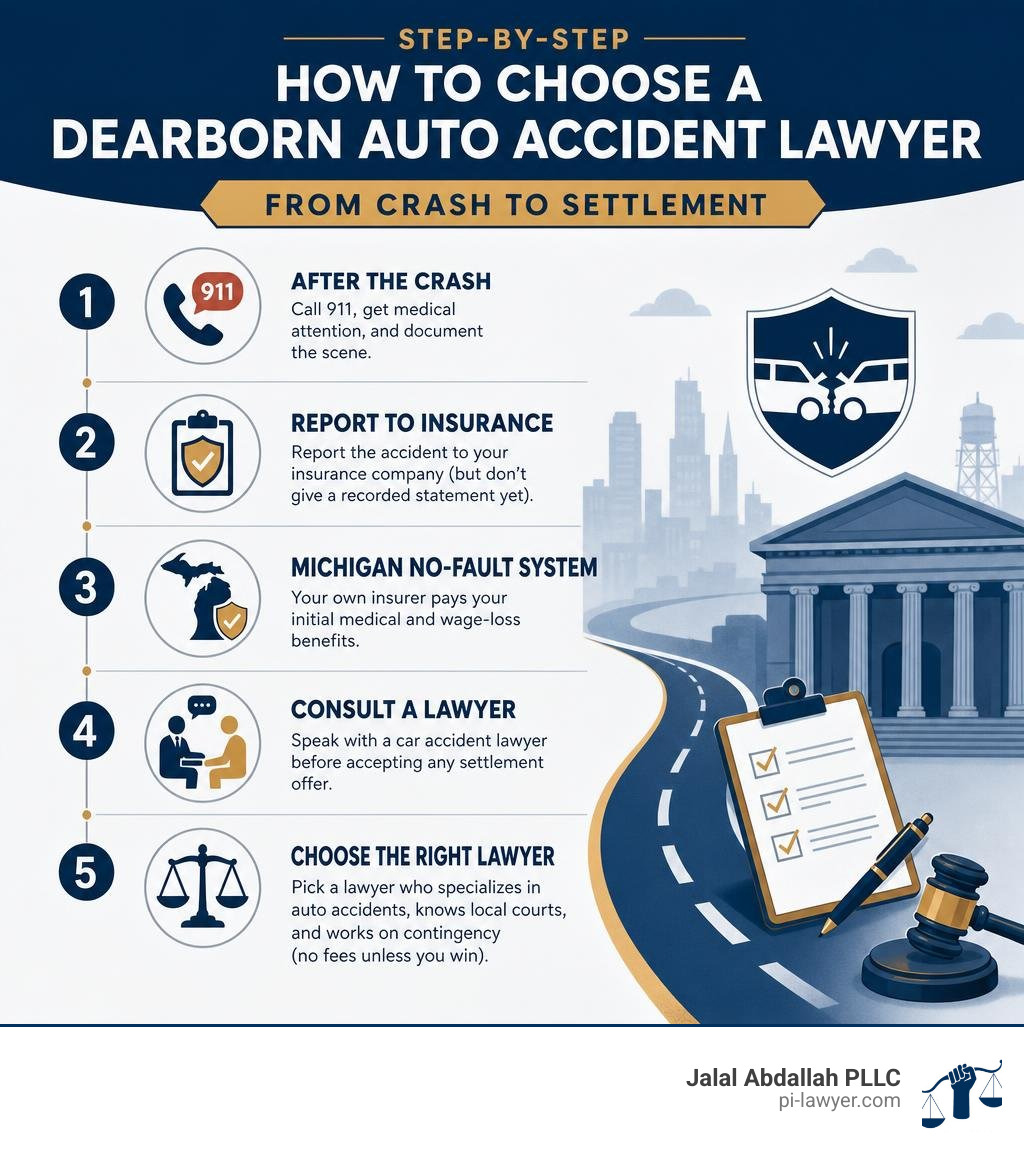
- Step 1: Call 911, get medical attention, and document the scene
- Step 2: Report the accident to your insurance company (but don’t give a recorded statement yet)
- Step 3: Understand Michigan’s no-fault system — your own insurer pays your initial medical and wage-loss benefits
- Step 4: Consult a car accident lawyer before accepting any settlement offer
- Step 5: Choose a lawyer who specializes in auto accidents, knows local courts, and works on contingency (no fees unless you win)
Wayne County — which includes Dearborn — recorded over 54,000 crashes in a single recent year, resulting in hundreds of injuries and fatalities. That’s not a rare event. It’s a daily reality on roads like Michigan Avenue and Telegraph Road.
And yet, most accident victims have no idea what their claim is actually worth. Insurance companies count on that.
The good news? You don’t have to figure this out alone. This guide walks you through exactly how to choose the right legal help — without the confusion.
Immediate Steps and Navigating Michigan’s No-Fault System
The moments immediately following a car crash are pure chaos. Your heart is racing, your adrenaline is pumping, and your brain is trying to process what just happened. However, the actions you take in these critical moments can make or break your future legal case.
First and foremost, always call 911. Even if the other driver begs you not to involve the police, a formal police report is a vital piece of evidence. It establishes a paper trail of the incident, documenting who was involved, the weather conditions, and initial assessments of fault. While waiting for the authorities, if it is safe to do so, document the scene. Take photos of the damage to all vehicles, the surrounding road layout, and any visible injuries.
Once the scene is cleared, your next priority is medical attention. Even if you feel fine, go to a hospital or an urgent care clinic. Many serious injuries, like whiplash, internal bleeding, or traumatic brain trauma, do not show symptoms right away. Delaying medical care gives insurance companies a perfect excuse to claim your injuries were not caused by the accident. For a detailed breakdown of these critical post-crash moments, check out our guide on What to Do Immediately After a Car Accident in Michigan.
Understanding how the medical bills get paid brings us to Michigan’s unique, and often confusing, No-Fault insurance system. In Michigan, if you are injured in a motor vehicle accident, your own auto insurance carrier is responsible for paying your first-party benefits—regardless of who caused the crash. These are called Personal Injury Protection (PIP) benefits.
Under Michigan’s No-Fault laws, your PIP benefits cover:
- Allowable Expenses: All reasonably necessary medical care, rehabilitation, and equipment for your recovery.
- Work Loss Benefits: Up to 85% of your lost income for up to three years if your injuries prevent you from working.
- Replacement Services: Up to $20 per day for up to three years to pay someone to perform household tasks you can no longer do (like cleaning, cooking, or yard work).
However, first-party benefits do not cover your pain, suffering, or emotional distress. To recover those damages, you must file a third-party claim against the at-fault driver.
| Benefit Type | Who Pays? | What Does It Cover? | Limits & Deadlines |
|---|---|---|---|
| First-Party (PIP) Claims | Your own auto insurance company | Medical bills, 85% of lost wages, $20/day replacement services | Must file a claim within 1 year of the accident |
| Third-Party Claims | At-fault driver’s insurance company | Pain and suffering, excess economic damages, mental anguish | Must file a lawsuit within 3 years of the accident |
Navigating these dual paths can make your head spin. That is why having an experienced advocate on your side is essential to ensure you receive everything you are legally owed.
How a Dearborn Auto Accident Lawyer Evaluates Your Case
When you sit down with us for a case evaluation, we don’t just look at a police report and throw out a random number. We perform a comprehensive, multi-layered evaluation to determine the true value of your case.
First, we conduct a thorough liability assessment. We look at who caused the accident, how it happened, and whether there are multiple liable parties. For instance, if you were hit by a commercial vehicle, both the driver and their employer might share responsibility.
Next, we look at insurance policy limits. A claim is often constrained by the amount of insurance coverage available. If you were hit by a rideshare driver (like Uber or Lyft), they carry different levels of insurance coverage depending on whether they had a passenger in the car or were simply waiting for a ride request. In Michigan, rideshare companies must maintain up to $1 million in liability coverage under certain conditions, which drastically changes how we approach the negotiations.
Finally, we handle the heavy lifting of evidence gathering. This includes ordering medical records, interviewing witnesses, securing traffic camera footage, and sometimes even working with accident reconstruction experts to prove exactly how the crash occurred.
When to Hire a Dearborn Auto Accident Lawyer
You might be wondering, “Do I really need a lawyer for this?” If your accident was a minor fender-bender with no injuries and minimal property damage, you might be able to handle it directly with your insurer. But you should absolutely hire a dearborn auto accident lawyer if you experience any of the following:
- Severe or Permanent Injuries: If you have broken bones, required surgery, or are facing long-term physical limitations.
- Disputed Liability: If the other driver is lying about what happened, or the insurance company is trying to blame you for the crash.
- Insurance Delays or Denials: If your own insurance company is dragging its feet on paying your PIP medical benefits or has outright denied your claim.
- Rideshare or Commercial Vehicle Involvement: Accidents involving semi-trucks, delivery vans, or Uber/Lyft drivers are legally complex and require immediate intervention.
If you are facing any of these hurdles, learn more about how we handle these specific challenges by visiting our page on Car Accidents.
Common Injuries and Recoverable Damages
Car crashes exert massive physical forces on the human body, leading to a wide array of painful and life-altering injuries. Some of the most common injuries we see in Dearborn auto accidents include:
- Traumatic Brain Injuries (TBIs): Ranging from mild concussions to severe cognitive impairment. TBIs are incredibly common in side-impact and high-speed rear-end collisions.
- Spinal Cord and Back Injuries: Herniated discs, fractured vertebrae, or chronic whiplash that can cause radiating pain and limit your ability to work.
- Broken Bones and Orthopedic Trauma: Fractured arms, legs, hips, or torn rotator cuffs that often require surgical intervention and months of physical therapy.
- Psychological Trauma: Post-Traumatic Stress Disorder (PTSD), severe anxiety, and depression following a near-death experience on the road.
If you have suffered these or other serious harms due to someone else’s negligence, you may be eligible to recover both economic and non-economic damages through a Personal Injury claim.
Economic damages are direct financial losses with a specific receipt or dollar value attached, such as outstanding medical bills, future rehabilitation costs, and lost wages. Non-economic damages are intangible losses, such as physical pain, loss of enjoyment of life, and emotional suffering. To understand how these non-monetary losses are calculated and defended, read our guide on Understanding Pain and Suffering Damages in Personal Injury Cases.
Statutes of Limitations and Settlement Timelines
Time is your worst enemy after a car crash. Under Michigan law, there are strict deadlines—known as statutes of limitations—for filing lawsuits:
- Third-Party Lawsuits (Pain and Suffering): You have three years from the date of the accident to file a lawsuit against the at-fault driver, as outlined by the Michigan Legislature.
- First-Party (PIP) Claims: You must notify your insurance company and file a claim for PIP benefits within one year of the crash. If they refuse to pay a specific medical bill, you must file a lawsuit within one year of that medical expense being incurred.
If you miss these deadlines, you lose your right to recover compensation forever.
As for how long it takes to settle a case, the timeline varies. A straightforward claim where liability is clear might settle in four to six months. However, if your injuries are severe and require ongoing treatment, we often advise waiting until you reach Maximum Medical Improvement (MMI). This ensures we know the true lifetime cost of your medical care before we sign any settlement agreements.
How to Choose the Right Legal Representation
Now that you know how the system works, how do you choose the right lawyer to fight for you? This is where many people lose their minds. They hire the first attorney they see on a billboard, only to find out their case has been passed off to a legal assistant who never returns their calls.
When choosing legal representation, look for three key traits:
- True Specialization: You do not want a general practitioner who handles divorces, wills, and occasional car accidents. You need a team that lives and breathes personal injury law.
- Trial Experience: Insurance companies know which lawyers actually go to court and which ones settle every case for pennies. If your lawyer has a reputation for taking cases to trial, the insurance company will take your claim much more seriously.
- Clear Communication: You deserve an attorney who answers your questions in plain English, keeps you updated on your case, and treats you like a human being—not a file number.
What to Look for in a Dearborn Auto Accident Lawyer
When searching for a dearborn auto accident lawyer, local experience matters. You want an attorney who is active with the State Bar of Michigan and regularly practices in local courts, such as the 19th District Court in Dearborn or the Third Judicial Circuit Court in Detroit.
A local attorney knows the local judges, understands how local defense lawyers operate, and knows how to gather evidence quickly from local authorities like the Dearborn Police Department. This local familiarity can give your case a distinct advantage.
Understanding Attorney Fees and Contingency Agreements
One of the biggest myths about hiring a lawyer is that it is too expensive. We work on a contingency fee agreement. This means:
- You pay zero upfront costs.
- We cover all the litigation expenses (filing fees, expert witness fees, police report costs).
- We only get paid if we win your case. Our fee is a percentage of your final settlement or verdict.
This levels the playing field, allowing you to go toe-to-toe with multi-billion-dollar insurance companies without risking your family’s savings. It is a vital shield, especially considering the various ways How Insurance Companies Try to Devalue Your Injury Claim to keep their payouts as low as possible.
Frequently Asked Questions About Dearborn Car Accidents
Can I still recover compensation if I was partly at fault?
Yes. Michigan follows a system of modified comparative negligence. You can still recover non-economic damages (like pain and suffering) as long as you were 50% or less at fault for the accident. However, your compensation will be reduced by your percentage of fault. For example, if a jury awards you $100,000 but finds you 20% at fault for speeding, your final recovery will be $80,000. If you are found to be 51% or more at fault, you are barred from recovering non-economic damages.
How long does it usually take to settle a car accident claim in Dearborn?
Most auto accident claims settle within four to six months, but complex cases involving severe injuries or disputed liability can take a year or longer. The timeline depends heavily on how long it takes you to complete medical treatment and how cooperative the insurance company decides to be during negotiations.
What is the difference between first-party and third-party claims?
A first-party claim is filed with your own auto insurance company for No-Fault PIP benefits (medical bills, wage loss, and replacement services), regardless of fault. A third-party claim is a personal injury lawsuit filed against the at-fault driver’s insurance company to recover non-economic damages like pain, suffering, and emotional distress.
Conclusion
At Jalal Abdallah PLLC, we believe in relentless advocacy for the underdogs. We know how terrifying it is to stand up to powerful insurance companies that care more about their bottom line than your physical recovery. We are here to level the playing field, handle the legal headaches, and fight for every single dollar you deserve.
If you or a loved one has been injured in a crash in Dearborn, Southfield, Detroit, or Warren, don’t face the insurance giants alone. Reach out and contact our team today for a free, no-obligation consultation. Let us do the heavy lifting so you can focus on getting your life back.
Share This Article

Schedule Your Free Consultation Today!
Reach out today and receive a consultation, completely free of charge - we'll evaluate your case and let you know what comes next.