The Ultimate Guide to Choosing a Slip and Fall Accident Lawyer
What a Slip and Fall Accident Lawyer Can Do for You in Michigan
If you’re looking for a slip and fall accident lawyer, here’s what you need to know right away:
- You may have a valid claim if you were injured on someone else’s property due to a hazardous condition they knew about — or should have known about.
- Michigan gives you three years from the date of your accident to file a personal injury claim.
- You can still recover compensation even if you were partially at fault, as long as you were less than 50% responsible.
- Most slip and fall lawyers work on contingency — you pay nothing unless they win your case.
- Acting fast matters — surveillance footage is often deleted within 14 to 30 days, and witness memories fade quickly.
Slip and fall accidents are far more serious than many people realize. Falls account for over 8 million emergency room visits every year in the United States. They are the leading cause of traumatic brain injuries and a major cause of hip fractures, spinal damage, and long-term disability.
In Michigan, where icy winters and aging commercial properties create constant hazards, these accidents happen every day — in grocery stores, parking lots, apartment buildings, and restaurants.
And yet, when victims try to get fair compensation, they often run into a wall. Property owners deny responsibility. Insurance adjusters offer low settlements or reject claims outright. Medical bills pile up. Income disappears.
That’s exactly where having the right legal advocate changes everything.
Introduction

When you walk into a grocery store in Detroit, a retail shop in Southfield, or an office building in Dearborn, you expect the floors to be dry, the walkways to be clear, and the stairwells to be secure. Unfortunately, property owners and managers frequently neglect basic maintenance. This negligence transforms everyday spaces into dangerous obstacles.
According to national data, slip and fall accidents account for more than 1 million emergency room visits annually. In Michigan, these statistics are amplified by harsh winter weather, which brings freezing rain, heavy snowfall, and dangerous black ice. For older adults, the stakes are even higher. Falls are the leading cause of nonfatal injuries and injury-related deaths for seniors, often resulting in a complete loss of independence or worse.
Understanding Premises Liability Law in Michigan
In Michigan, slip and fall cases fall under a subset of personal injury law known as premises liability. To secure compensation, you cannot simply point to the fact that you fell and got hurt. You must prove that the property owner or manager failed to maintain their premises in a reasonably safe condition, directly causing your injuries.
Michigan law categorizes visitors into three groups, which determines the level of care a property owner owes them:
- Invitees: Customers, retail shoppers, and business clients. Property owners owe them the highest duty of care, which includes regularly inspecting the property, repairing hazards, and warning of known dangers.
- Licensees: Social guests. Owners must warn them of known, hidden dangers but do not necessarily have an ongoing duty to inspect the property for new hazards.
- Trespassers: People on the property without permission. Generally, owners only owe a duty to avoid willful or wanton harm.
Navigating these legal distinctions requires the seasoned hand of an experienced slip and fall accident lawyer who understands the local courts in Wayne, Oakland, and Macomb counties.
Common Causes and Severe Injuries in Premises Liability Cases
Many people assume a slip and fall is just an embarrassing trip that results in a bruised knee and wounded pride. In reality, the physical trauma can be catastrophic. When a human body unexpectedly loses traction or trips over an unseen obstacle, the impact with hard concrete or tile can cause permanent, life-altering damage.
Wet Surfaces, Icy Walkways, and Hidden Hazards
Michigan’s climate presents a constant barrage of slipping hazards. Some of the most common causes of premises liability claims include:
- Untreated Ice and Snow: Neglected parking lots, icy sidewalks, and snow-packed entryways in Warren and Detroit.
- Liquid Spills: Uncleaned puddles in grocery store produce aisles, leaking commercial refrigerators, or freshly mopped floors without warning signs.
- Hidden Hazards: Sudden changes in floor elevation, loose rugs, and poorly designed ramps.
Broken Pavement, Loose Carpeting, and Poor Lighting
Indoors and outdoors alike, structural defects frequently cause severe trips and falls:
- Potholes and Broken Pavement: Cracked sidewalks, crumbling concrete stops, and deep potholes in commercial parking lots.
- Interior Defects: Torn or loose carpeting, broken floorboards, and missing or loose handrails on stairwells.
- Poor Lighting: Dimly lit corridors, dark stairwells, and unlit parking areas that conceal obstacles from unsuspecting visitors.
Severe Injuries: Traumatic Brain Injuries, Bone Fractures, and Spinal Damage
The medical consequences of a fall are often severe and long-lasting:
- Traumatic Brain Injuries (TBIs): Falls are the leading cause of TBIs. A sudden blow to the head can cause concussions, fractured skulls, cognitive impairments, and permanent brain damage.
- Bone Fractures: Broken hips, wrists, ankles, and collarbones are incredibly common. Hip fractures are particularly dangerous for older adults, often leading to secondary health complications and a high rate of mortality.
- Spinal Cord Injuries: Slipping and landing flat on your back can herniate discs, fracture vertebrae, or cause spinal cord damage resulting in chronic pain or paralysis.
- Tailbone Injuries: Falling backward directly onto a hard surface can bruise or fracture the coccyx, leading to agonizing pain that makes sitting or walking nearly impossible for months.
When property owners ignore these hazards, they aren’t just letting their maintenance slide—they are actively jeopardizing the lives of everyone who steps onto their property.
Why You Need a Slip and Fall Accident Lawyer to Fight for You
Many injury victims believe they can handle their claims alone. They assume that because the hazard was obvious and the property owner was clearly at fault, the insurance company will do the right thing and pay their medical bills.
This is a dangerous misconception. Insurance companies are multi-billion-dollar corporations focused on protecting their bottom lines. They employ teams of adjusters and defense lawyers whose sole job is to minimize, delay, or completely deny your claim.
Common Insurance Tactics Designed to Minimize Payouts
If you attempt to negotiate without a slip and fall accident lawyer, you can expect the insurance company to deploy several classic tactics:
- Blaming the Victim: They will claim you weren’t looking where you were going, were distracted by your phone, or were wearing improper footwear.
- Downplaying Injuries: They will argue that your herniated disc or joint pain is a pre-existing condition related to aging rather than the fall itself.
- The Quick Lowball Offer: They may offer a small, immediate check in exchange for you signing a release form. Once you sign, you forfeit your right to seek additional compensation when delayed symptoms or future surgical needs arise.
- Delaying the Claim: They will stretch out communications, hoping you will become desperate as medical bills pile up and agree to a fraction of what your case is actually worth.
How to Handle Immediate Claim Denials and Liability Disputes
When an insurer issues an immediate denial, it can feel incredibly discouraging. They might claim there is “no proof” the hazard existed or that the store had no notice of the spill.
We do not back down from these disputes. We step in immediately to demand preservation of evidence, obtain internal corporate communications, and challenge their denials with hard facts.
The Power of Relentless Legal Representation Against Big Insurance
At Jalal Abdallah PLLC, we pride ourselves on being relentless advocates for the underdog. We understand the physical, emotional, and financial toll a sudden injury takes on your family. When you partner with us, you are sending a clear message to the insurance company: we will not be bullied, and we will not settle for pennies.
We take over all communication with the insurance adjusters, allowing you to focus entirely on your physical recovery. If you want to learn more about how we handle these cases, you can read more info about personal injury services to see our comprehensive approach to client advocacy.
How a Slip and Fall Accident Lawyer Maximizes Your Settlement
To secure a settlement that truly covers your needs, we must meticulously calculate and document every single dollar of your losses. We divide your damages into two primary categories: economic and non-economic.
Calculating Economic Damages
Economic damages are the tangible, quantifiable financial losses resulting from your accident. These include:
- Medical Bills: Emergency room visits, hospital stays, surgeries, physical therapy, medications, and medical equipment.
- Future Medical Care: Anticipated surgeries, ongoing rehabilitation, and home health aides.
- Lost Income: Wages lost during your recovery, including missed bonuses, overtime, and paid time off.
- Loss of Earning Capacity: If your injuries prevent you from returning to your previous profession, we calculate the long-term career earnings you have lost.
Quantifying Non-Economic Damages
Non-economic damages compensate you for the intangible, subjective ways the injury has altered your life. These are harder to calculate but are often the most devastating aspects of an injury:
- Pain and Suffering: The physical agony and discomfort caused by your injuries and medical treatments.
- Mental Anguish: Anxiety, depression, PTSD, and sleep disturbances stemming from the trauma of the fall.
- Loss of Enjoyment of Life: The inability to participate in hobbies, play with your children, or enjoy daily activities.
| Damage Type | What It Covers | How It Is Proven |
|---|---|---|
| Economic Damages | Medical bills, lost wages, future treatment, rehabilitation costs | Receipts, pay stubs, medical invoices, expert economic testimony |
| Non-Economic Damages | Pain and suffering, emotional distress, loss of life enjoyment, scarring | Medical records, personal journals, witness testimony, psychological evaluations |
When to Contact a Slip and Fall Accident Lawyer After an Injury
The short answer is: as soon as possible. The days immediately following an accident are critical for building a strong foundation for your claim.
Understanding the Strict Michigan Three-Year Statute of Limitations
In Michigan, the statute of limitations for personal injury claims is three years from the date of the accident. While three years may sound like a long time, building a winning premises liability case takes months of preparation. Furthermore, claims against government entities (such as slipping on a public sidewalk or inside a municipal building) have much shorter notice requirements—sometimes as little as 120 days. If you miss these deadlines, you lose your right to seek compensation forever.
Why Waiting Can Destroy Critical Evidence
If you wait weeks or months to contact a slip and fall accident lawyer, vital evidence may disappear forever:
- Surveillance Footage: Retail stores, supermarkets, and gas stations routinely overwrite their security camera footage every 14 to 30 days.
- Cleaning and Maintenance Logs: Sweep sheets and maintenance records can be lost or discarded.
- Witness Memories: People who saw your fall or noticed the hazard beforehand will forget key details over time.
- The Hazard Itself: Property owners will quickly repair broken stairs, patch potholes, or fix leaking pipes once they realize someone was hurt, erasing the physical proof of their negligence.
Proving Liability Across Different Property Types
Proving fault in a premises liability case requires demonstrating that the property owner failed to act reasonably. The legal strategy we use depends heavily on where the accident occurred.
Establishing Actual Notice vs. Constructive Notice
To win your case, we must prove the property owner had “notice” of the dangerous condition. Notice is established in one of two ways:
- Actual Notice: The property owner or an employee directly knew about the hazard. For example, a customer reported a spill to a store manager, but the manager failed to clean it up or block off the area.
- Constructive Notice: The hazard existed for such a length of time that the property owner should have discovered and corrected it if they were exercising reasonable care. We prove this by reviewing maintenance logs, examining security footage, and interviewing witnesses to establish how long the danger was present.
Differences in Claims: Private, Commercial, and Government Properties
- Private Property: Falls on residential properties, such as a friend’s home or a rented apartment complex. These claims are usually filed against the homeowner’s or landlord’s insurance policy.
- Commercial Property: Falls in businesses, retail stores, or parking garages. These cases often involve massive corporate defendants with aggressive legal teams and large commercial liability policies.
- Government Entities: Falls on public sidewalks, in government offices, or public parks. These claims are highly complex due to governmental immunity laws and require strict adherence to rapid filing deadlines.
Michigan’s Comparative Negligence Laws and the 50 Percent Fault Threshold
Michigan operates under a modified comparative negligence system. This rule means that your compensation will be reduced by your percentage of fault. For example, if a jury determines your total damages are $100,000, but finds you were 20% at fault for looking at your phone when you tripped, your recovery will be reduced to $80,000.
Crucially, under Michigan law, if you are found to be more than 50% at fault, you are barred from recovering any non-economic damages (such as pain and suffering), and your economic recovery will be severely limited. Insurance companies know this rule well and will aggressively try to shift the blame to you. We fight back by gathering objective evidence to prove the property owner was the primary negligent party.
Frequently Asked Questions About Slip and Fall Claims
What should I do immediately after a slip and fall accident?
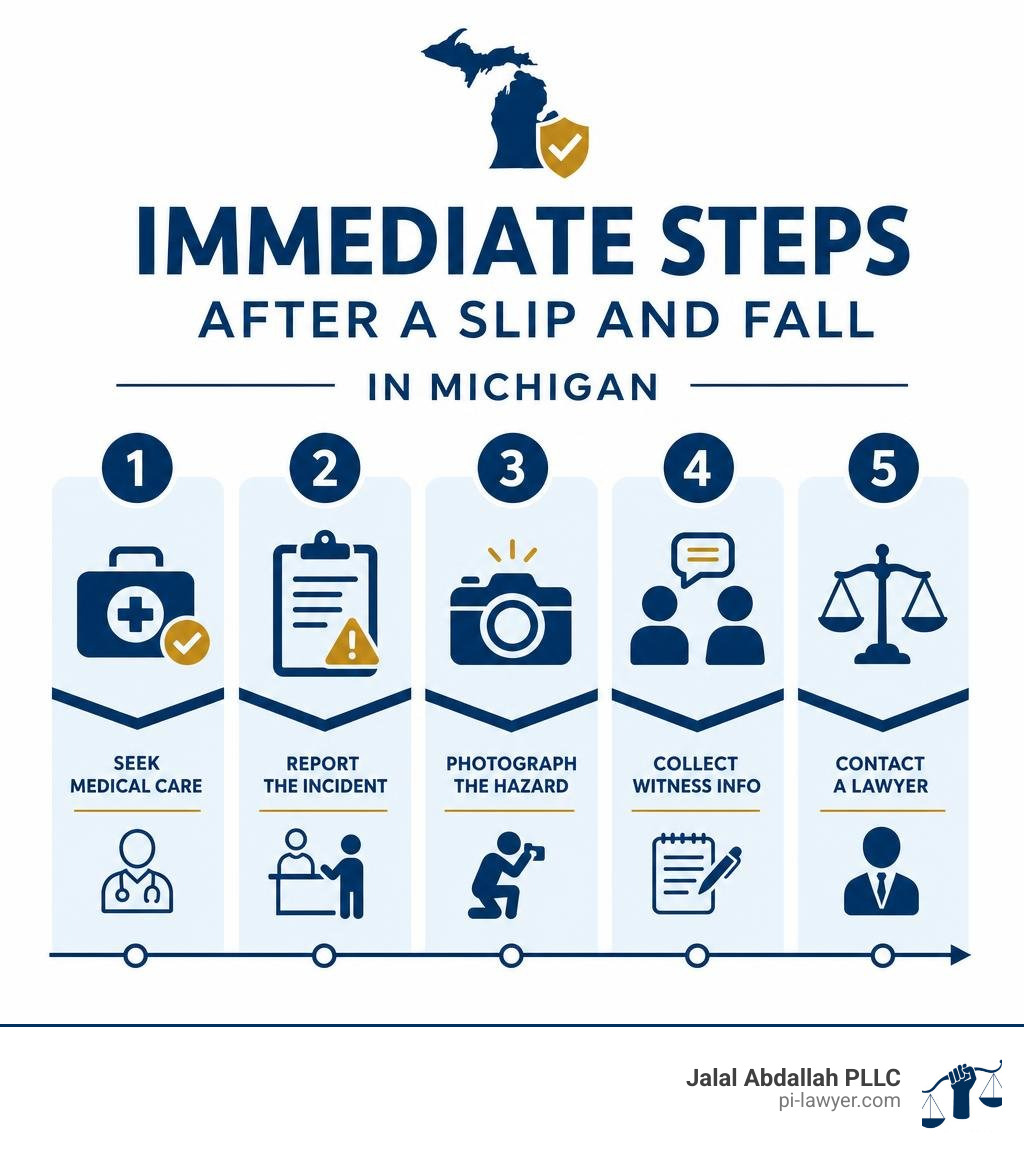
- Seek Medical Attention Immediately: Your health is the top priority. Visiting a doctor right away also creates an official medical record linking your injuries directly to the fall.
- Report the Incident: Notify the property manager, landlord, or store owner before leaving. Request a copy of the written incident report.
- Document the Scene: Take detailed photos and videos of the hazard (the ice, spill, broken pavement), the surrounding area, lighting conditions, and any lack of warning signs.
- Collect Witness Contact Info: Ask for the names, phone numbers, and statements of anyone who saw the fall or noticed the hazard.
- Preserve Your Footwear and Clothing: Keep the shoes and clothes you were wearing in a safe place; they may serve as crucial evidence.
- Contact a Lawyer: Speak with us before talking to insurance adjusters or giving recorded statements.
Can I still recover compensation if I was partially at fault for my fall?
Yes. Under Michigan’s modified comparative negligence rule, you can still recover damages as long as your share of the blame is 50% or less. Your final compensation will simply be reduced by your percentage of fault. If your fault is determined to be 51% or higher, you cannot recover non-economic damages. This is why having a skilled advocate to minimize your percentage of blame is vital.
How much is the average slip and fall case worth?
There is no single “average” value, as every case depends on the severity of the injuries and the clarity of liability. A minor slip resulting in soft tissue strains might settle for $15,000 to $75,000. However, severe cases involving traumatic brain injuries, spinal damage, or fractures requiring surgery frequently result in settlements or verdicts ranging from $100,000 to over $1,000,000. Key factors include medical bills, lost wages, the extent of permanent disability, and the insurance policy limits of the negligent party.
Secure Your Recovery with Relentless Legal Advocacy
A sudden slip and fall accident can turn your life upside down in a fraction of a second. The physical pain, emotional stress, and financial burden of medical bills and lost wages can feel completely overwhelming. You do not have to carry this heavy burden alone.
At Jalal Abdallah PLLC, we are committed to standing up for the underdogs. We do not back down from powerful insurance companies, large corporations, or government entities. We prepare every single case as if it is going to trial, ensuring we have the leverage needed to negotiate the maximum possible settlement for you and your family.
From our offices in Michigan, we proudly serve injured clients across Southfield, Dearborn, Detroit, and Warren. We work on a contingency fee basis, which means you pay absolutely nothing upfront, and we only get paid if we win your case.
Don’t let a negligent property owner get away with putting your life on hold. Take control of your recovery today. Contact our legal team today to schedule your free, no-obligation case evaluation. Let us fight for the justice and financial peace of mind you deserve.
Share This Article

Schedule Your Free Consultation Today!
Reach out today and receive a consultation, completely free of charge - we'll evaluate your case and let you know what comes next.