 Skip to content

Who is Liable for a Semi-Truck Crash on I-94 in Dearborn?
Liability depends on what each party did before the crash. The car’s driver may be liable if impaired or reckless driving caused it. The truck driver or trucking company could share fault if the truck was stopped unsafely or lacked needed warnings. A government claim for flooding would require proof of a highway defect and notice.
In the July 2026 crash on eastbound I-94 in Dearborn, a car struck a semi-truck stopped because of flooding. Three passengers died, and the car’s driver faces charges. Those charges do not, by themselves, decide civil liability. A commercial truck accident lawyer dearborn can examine the crash evidence and insurance coverage.
I’m Jalal Abdallah, a Michigan personal injury and criminal defense attorney who advocates for people facing powerful insurers and government agencies. In this case study, I’ll explain the evidence behind the question, Who is Liable for a Semi-Truck Crash on I-94 in Dearborn?
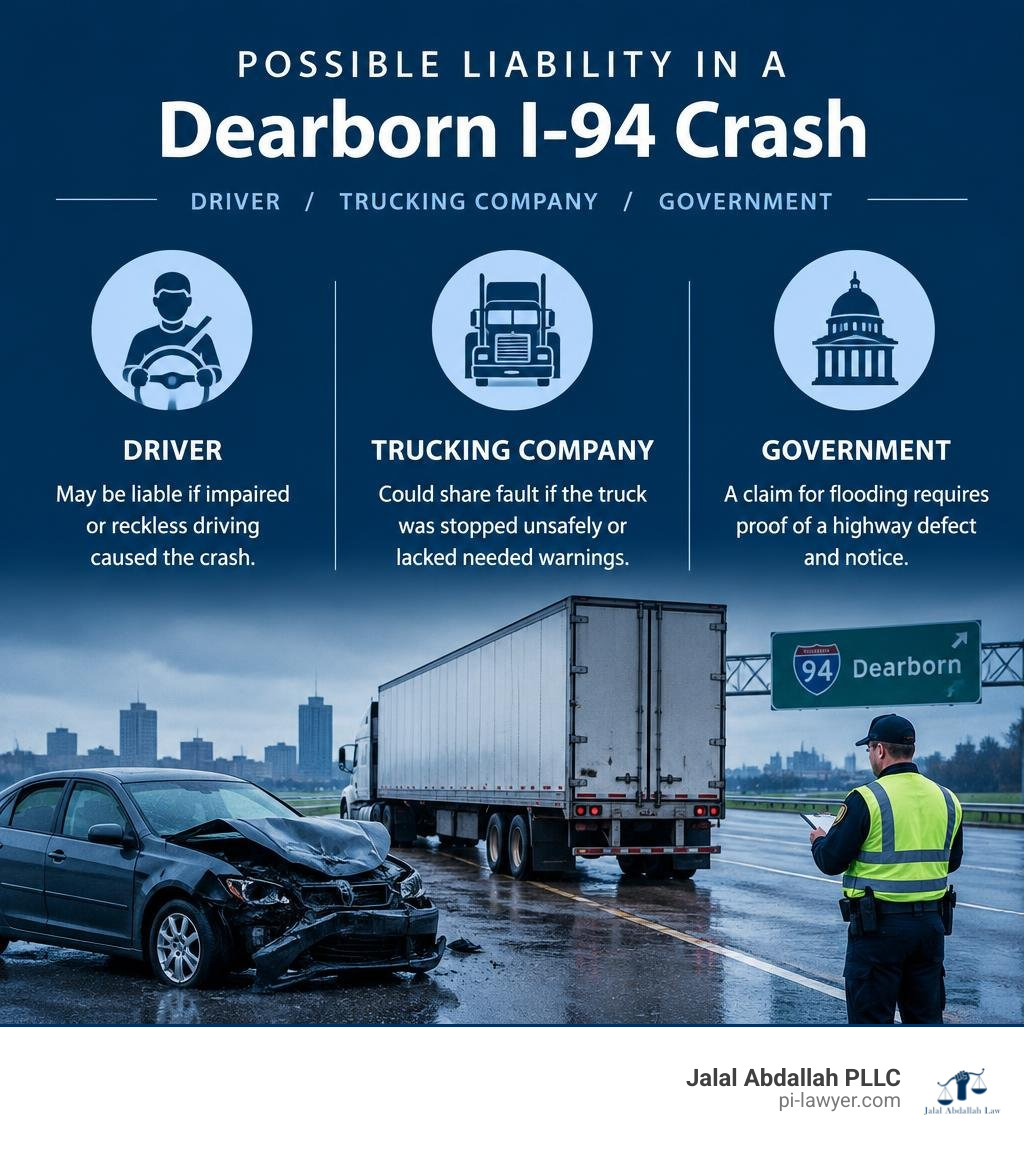
Who is Liable for a Semi-Truck Crash on I-94 in Dearborn? terms simplified:
Determining legal responsibility requires examining driver conduct, commercial safety standards, and road conditions. Liability often falls on the reckless motorist, but commercial operators and highway authorities can also share fault. A thorough investigation reviews police crash reports, electronic logging devices, and maintenance records to assign accountability.
On late Friday night, July 3, 2026, a catastrophic collision occurred on eastbound Interstate 94 near Michigan Avenue and Wyoming Avenue in Wayne County. Hilton Dorian Yopp III, 26, of Westland, allegedly drove at excessive speeds while intoxicated before crashing into the rear of a stationary semi-truck. As reported by local coverage of how a Westland man charged after triple fatal crash with semi-truck on I-94, the incident resulted in the tragic deaths of three young passengers in Yopp’s vehicle.
Prosecutors charged Yopp in Wayne County’s 19th District Court with three counts of operating while intoxicated causing death and three counts of reckless driving causing death. Beyond criminal culpability, establishing civil liability demands a comprehensive review of all contributing factors, including why the commercial vehicle was stopped in active lanes.
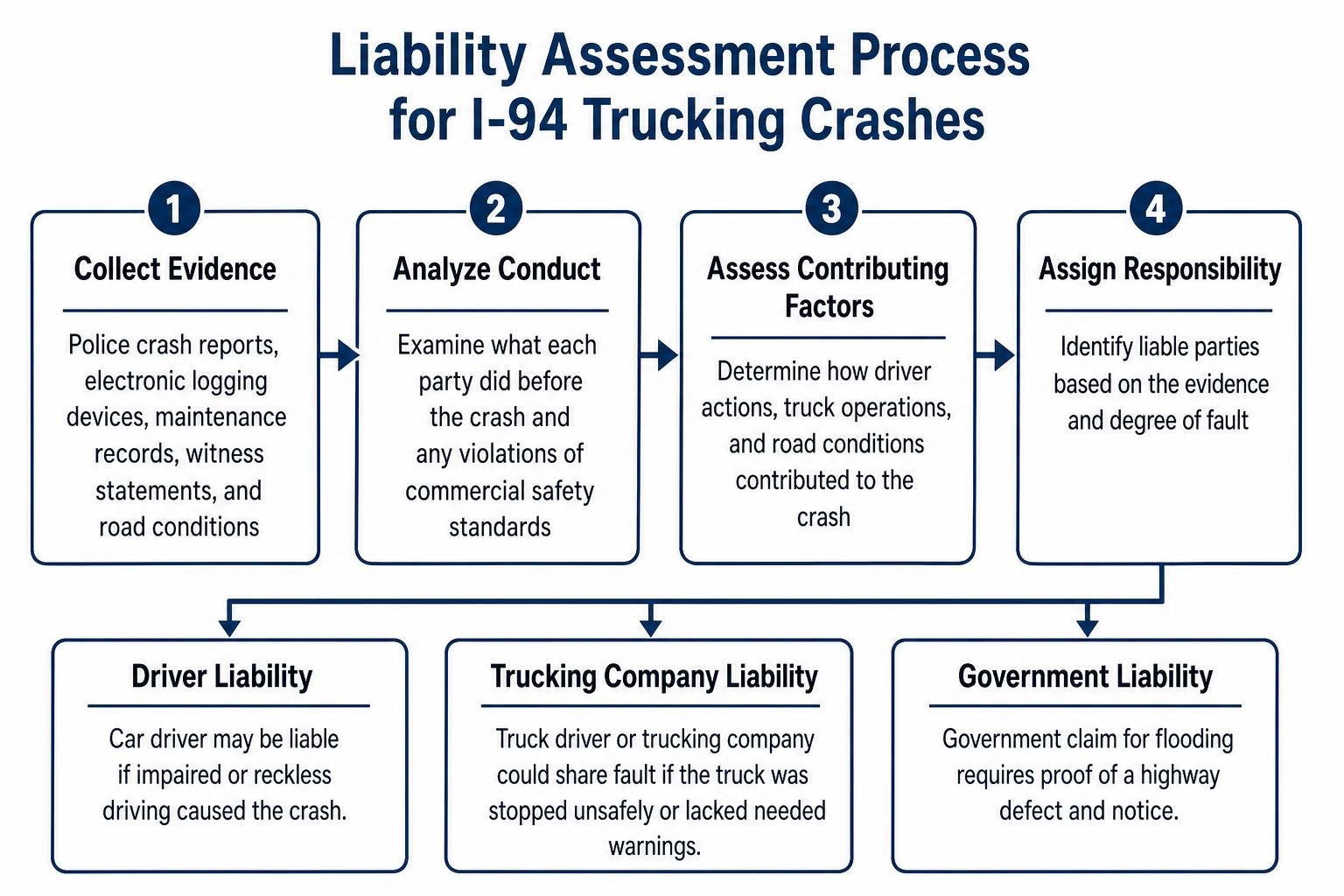
Evaluating Who is Liable for a Semi-Truck Crash on I-94 in Dearborn When Drivers Are Intoxicated
When a driver operates a vehicle under the influence, civil law allows victims and surviving families to pursue wrongful death lawsuits. While criminal courts punish unlawful acts, civil claims provide financial recovery for funeral expenses, medical bills, and emotional loss.
A civil wrongful death claim proceeds independently of criminal prosecution. A criminal conviction requires proof beyond a reasonable doubt, whereas civil liability relies on a preponderance of the evidence. When families begin a Dearborn fatal accident claim essential legal steps for families, our team at Jalal Abdallah PLLC collects toxicology reports, witness statements, and crash reconstruction data to hold reckless motorists accountable.
Third-party civil claims also look at where the driver obtained alcohol. Under Michigan’s dram shop laws, commercial establishments that serve visibly intoxicated individuals may share civil liability for resulting collisions.
Can the Trucking Company or Driver Share Fault for Stopping on the Highway?
Commercial vehicle operators must adhere to strict state and federal safety standards when stopping on active interstates. Under Federal Motor Carrier Safety Administration (FMCSA) regulations, drivers who stop on travel lanes or shoulders must immediately activate hazard warning flashers and deploy reflective warning devices within ten minutes.
If a truck driver stops due to localized highway flooding without deploying proper warning triangles or flares, that failure can constitute negligence. The trucking carrier may also face vicarious liability under the doctrine of respondeat superior for the actions of its employee behind the wheel.
Carriers have an independent duty of care to train drivers on adverse weather protocols and hazard mitigation. If corporate safety failures or negligent maintenance contributed to an unexpected stop, injured parties can pursue direct claims against the motor carrier.
Can Government Agencies Be Held Liable for I-94 Highway Flooding Defects?
Government agencies can be held liable for highway flooding only if the road design or maintenance constitutes a dangerous defect under specific statutory exceptions. Claimants must prove the agency had actual or constructive notice of the condition and sufficient time to correct it.
Under Michigan law (MCLA 691.1402), state and municipal agencies have a duty to maintain public highways in reasonable repair so they are reasonably safe and convenient for public travel. While governmental immunity protects public bodies from many lawsuits, the defective highway exception allows civil actions when poor drainage creates hazardous conditions.
MCLA 691.1403 establishes that liability requires proof the agency knew or should have known of the highway defect and had reasonable time to repair it. In the landmark decision Peters v. Dept. of State Highways, the Michigan Supreme Court established that design defects in highway drainage systems can satisfy notice requirements without relying solely on standard time presumptions.
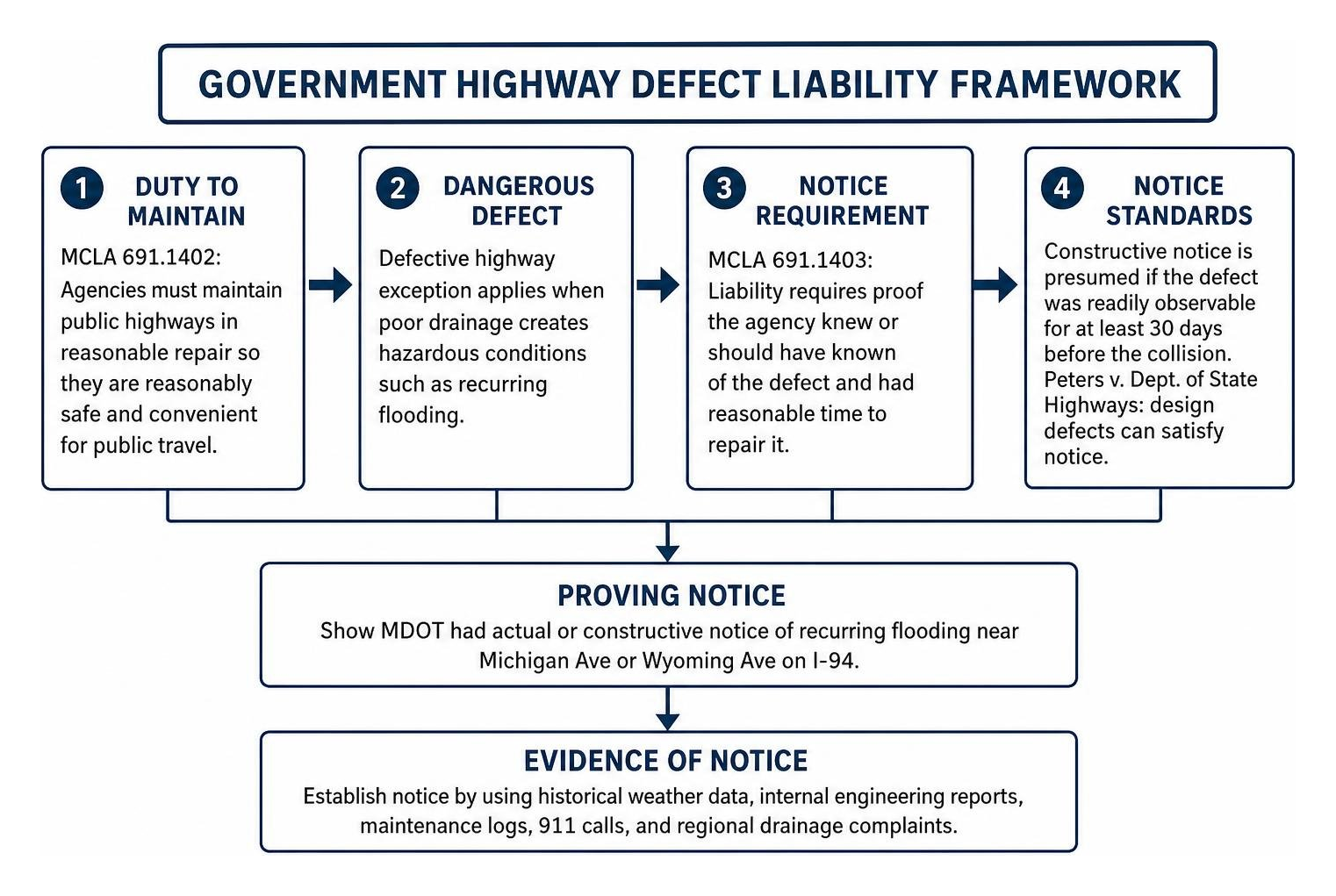
Proving Actual or Constructive Notice for Inadequate Highway Drainage
Establishing governmental liability requires showing the Michigan Department of Transportation (MDOT) had notice of recurring flooding near Michigan Avenue or Wyoming Avenue on I-94. Constructive notice is legally presumed under MCLA 691.1403 if a defect was readily observable for at least 30 days before the collision.
Plaintiffs can establish notice by demonstrating that historical weather data and internal engineering reports revealed recurring ponding risks. Subpoenaing past maintenance logs, 911 dispatch calls, and regional drainage complaints often reveals whether transportation agencies failed to address known water accumulation hazards.
Litigating against state agencies requires strict compliance with statutory procedures. Lawsuits against MDOT must be filed in the Michigan Court of Claims, and claimants must provide formal written notice of the injury and highway defect within 120 days of the incident.
How Does Michigan No-Fault Insurance Apply to Commercial Big Rig Crashes?
Michigan’s auto insurance system requires personal injury protection benefits to cover medical costs and wage loss regardless of fault. However, victims of serious collisions can step outside no-fault limits to pursue third-party tort claims against negligent commercial drivers and motor carriers for catastrophic losses.
Under Michigan’s No-Fault Act, injured passengers and surviving family members receive first-party Personal Injury Protection (PIP) benefits from their own auto insurer or the Michigan Assigned Claims Plan. When questions arise regarding whether can I sue after a Dearborn car crash in a no-fault state, severe injuries and fatalities meet the statutory threshold allowing survivors to pursue third-party claims for pain and suffering damages.
| Coverage Category | First-Party Michigan No-Fault (PIP) | Third-Party Tort / Wrongful Death Claim |
|---|---|---|
| Fault Requirement | Payable regardless of driver fault | Requires proving driver, carrier, or state negligence |
| Medical Expenses | Covered up to selected policy limits | Covers excess past, present, and future medical damages |
| Lost Income | Up to statutory monthly maximum for 3 years | Unlimited future wage loss and loss of earning capacity |
| Pain & Suffering | Not covered under basic PIP | Recoverable for death, serious impairment, or disfigurement |
| Property Damage | Capped at $1 million under standard PPI | Expanded coverage available under federal motor carrier rules |
Who is Liable for a Semi-Truck Crash on I-94 in Dearborn Involving Hazardous Cargo?
Commercial carriers transporting hazardous cargo must maintain significantly higher liability insurance minimums than standard passenger vehicles. Under the Motor Carrier Safety Act (MCSA), private haulers must carry between $1 million and $5 million in financial responsibility, depending on the hazardous classification of the freight.
While standard property protection insurance (PPI) under Michigan no-fault is capped at $1 million, hazardous materials carriers operate under specialized rules. In Department of Transportation v Initial Transport Inc, the Michigan Court of Appeals held that the MCSA creates an exception to the $1 million no-fault cap for hazardous cargo carriers, ensuring public infrastructure repairs and catastrophic damage claims can be fully compensated.
Insurers that unreasonably delay paying valid claims may also be subjected to a 12 percent annual penalty interest under MCL 500.2006.
Frequently Asked Questions About Dearborn Semi-Truck Accidents
What damages can families recover in a fatal I-94 semi-truck crash?
Surviving family members can recover economic damages, including reasonable medical, hospital, funeral, and burial costs. Non-economic damages compensate for the loss of financial support, loss of parental guidance, and the loss of society and companionship of their deceased loved one.
How long do you have to file a highway defect claim against MDOT in Michigan?
Under MCLA 691.1404, claimants must serve formal written notice to the government agency within 120 days of the injury. The notice must specify the exact location and nature of the defect, the injuries sustained, and known witnesses, followed by filing in the Michigan Court of Claims.
What happens if an at-fault driver faces criminal OWI charges?
Criminal OWI charges proceed separately from civil lawsuits and do not prevent families from seeking civil wrongful death damages. While criminal courts may order restitution, these awards rarely cover the complete financial and emotional losses, making parallel civil action essential.
Demanding Accountability for Dearborn Highway Collisions
Catastrophic collisions on Interstate 94 demand thorough investigation into every level of legal responsibility. When drunk driving, commercial carrier non-compliance, and defective roadway maintenance intersect, multiple entities must answer for the harm they cause.
At Jalal Abdallah PLLC, we provide relentless advocacy for underdogs against powerful insurance corporations and government entities across Wayne County. If you or a family member suffered devastating injuries in a collision, contact an experienced attorney at Jalal Abdallah PLLC today for guidance on protecting your rights.
Share This Article

Schedule Your Free Consultation Today!
Reach out today and receive a consultation, completely free of charge - we'll evaluate your case and let you know what comes next.


