 Skip to content

How to Choose a Garden City Car Accident Lawyer
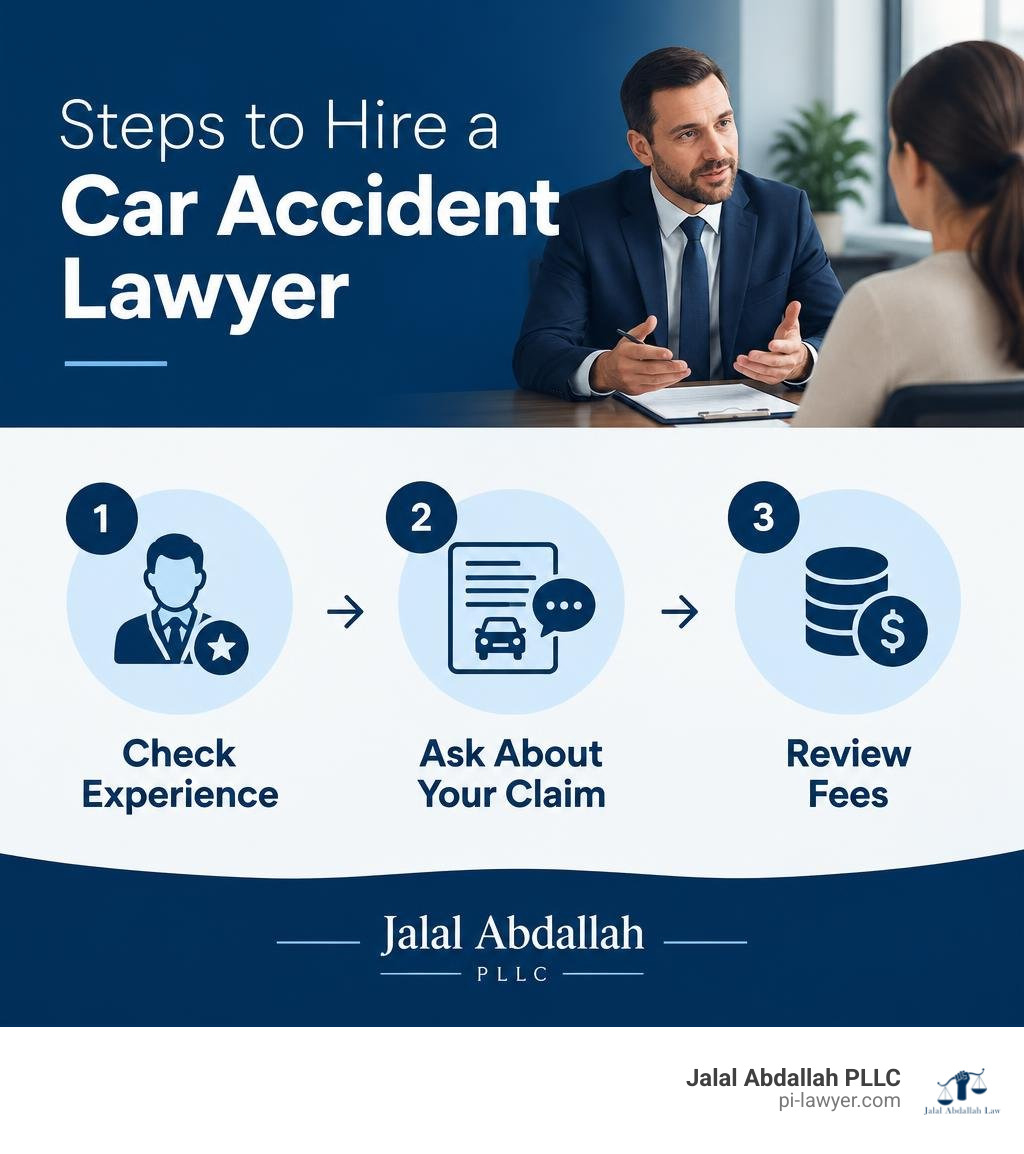
If you were hurt in a crash in Garden City, Michigan, look for a lawyer who handles Michigan car accident claims. Ask how they would deal with your no-fault benefits, investigate the crash, and explain your options if the insurer disputes your claim. Before signing, confirm who will handle your case, how often they will update you, and what fees and case costs you may owe.
I’m Jalal Abdallah, a Michigan attorney who handles personal injury cases and is also a licensed property and casualty insurance producer. If you’re looking for a Garden City car accident lawyer, this guide will help you compare attorneys and prepare for that first conversation.
Garden City car accident lawyer terms to know:
- Dearborn auto accident attorney
- affordable car accident lawyer Dearborn
- Dearborn car wreck compensation
Critical Steps to Take Immediately After a Crash

When a crash happens on a busy corridor like Ford Road or Middlebelt Road, the initial moments are chaotic. Protecting your health and your legal rights starts right at the scene. Knowing what to do immediately after a car accident in Michigan ensures that you build a solid foundation for any insurance claim or lawsuit that follows.
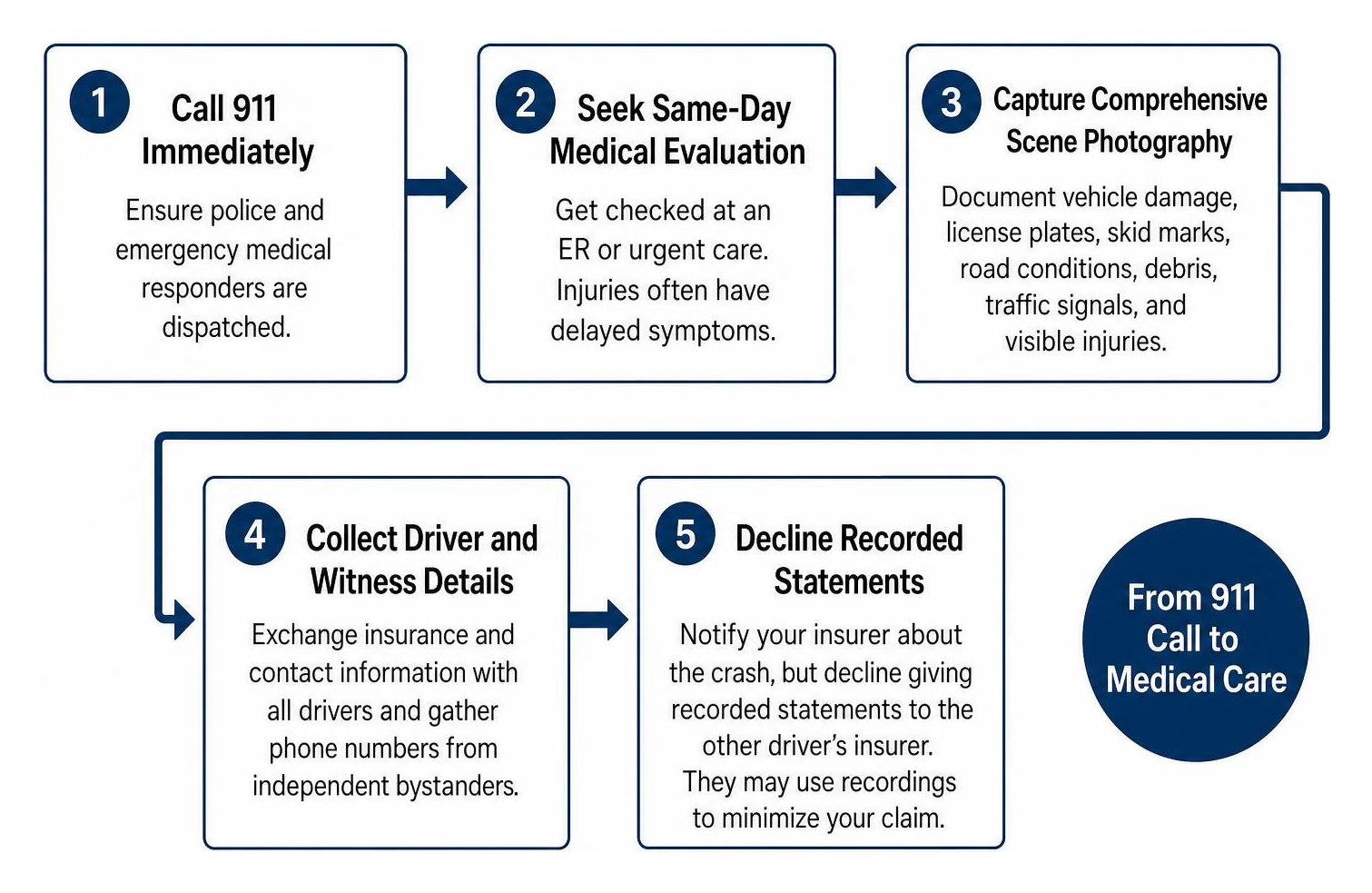
- Call 911 Immediately: Ensure local police and emergency medical responders are dispatched. An official police report provides an objective record of the crash scene, vehicle positions, and initial driver statements.
- Seek a Same-Day Medical Evaluation: Adrenaline masks pain. Injuries like whiplash, internal bleeding, and concussions often show delayed symptoms. Getting checked at an emergency room or urgent care clinic creates an immediate link between the collision and your injuries.
- Capture Comprehensive Scene Photography: Take photos and video of all vehicle damage, license plates, skid marks, road conditions, debris, traffic signals, and any visible injuries.
- Collect Driver and Witness Details: Exchange insurance and contact information with all involved motorists, and gather phone numbers from independent bystanders.
- Decline Giving Recorded Statements to Insurers: You must notify your own insurer about the crash, but you are not obligated to provide a recorded statement to the at-fault driver’s insurance adjuster. Adjusters use these recordings to undermine your credibility and minimize payouts.
Preserving Vital Evidence and Documenting Injuries
Physical evidence disappears fast. Road crews clear debris, weather washes away skid marks, and commercial surveillance cameras can overwrite footage within days. Securing dashcam video, nearby business security footage, and vehicle black box data requires fast action.
Equally important is tracking your physical recovery. Keep a detailed daily log of your pain levels, missed work shifts, and medical visits. Maintain copies of all physical therapy notes, prescription receipts, and diagnostic imaging scans. Gaps in medical treatment give insurance adjusters an excuse to argue that your injuries were not serious or were caused by something else entirely.
Navigating Hit-and-Run and Uninsured Motorist Claims
Hit-and-run crashes present unique challenges, but they do not eliminate your options for financial recovery. In Michigan, your own auto policy provides primary Personal Injury Protection (PIP) for medical costs regardless of whether the fleeing driver is identified.
To recover compensation for pain and suffering or vehicle damage after a hit-and-run, we look to your policy’s Uninsured Motorist (UM) and Underinsured Motorist (UIM) endorsements. Because insurance carriers treat UM claims with the same skepticism as third-party lawsuits, we notify your insurer immediately, preserve police findings, and establish the other driver’s fault to secure the coverage you paid for.
Understanding Fault, Insurance Rules, and Legal Deadlines
Michigan operates under a unique no-fault auto insurance framework. Following a crash, your own insurance carrier pays for your economic losses through PIP benefits, which cover reasonable medical care, wage loss replacement (up to statutory caps for up to three years), and replacement services for daily household chores.
However, no-fault benefits do not compensate you for pain, emotional distress, or permanent physical impairment. To recover these non-economic damages, you must step outside the no-fault system and file a third-party tort claim against the at-fault driver. Understanding when and how you can sue after a car crash in a no-fault state is critical to maximizing your recovery.
| Benefit Category | No-Fault PIP Benefits (First-Party) | Liability Lawsuit Damages (Third-Party) |
|---|---|---|
| Payer | Your own auto insurance company | At-fault driver’s liability insurance |
| Fault Requirement | Payable regardless of who caused the crash | Must prove the other driver was negligent |
| Medical Expenses | Covered up to your selected policy limit | Covers excess and future medical expenses |
| Lost Income | Up to statutory monthly maximum for 3 years | Uncapped past and future wage loss |
| Pain and Suffering | Not covered under standard PIP | Full compensation for non-economic damages |
| Filing Deadline | 1 year from the crash date (notice requirement) | 3 years under the personal injury statute of limitations |
Timing is essential under Michigan law. Under Michigan Compiled Laws (MCL) § 600.5805, you generally have three years from the date of the collision to file a third-party personal injury lawsuit. If a crash results in a fatality, the wrongful death deadline is three years from the date of death. Crucially, if your crash involved a government vehicle (such as a city bus or municipal road maintenance truck) or an unmaintained roadway defect, you may need to file a formal notice of claim within 90 to 120 days.
Meeting the Serious Injury Threshold for Lawsuits
To bring a third-party lawsuit against a negligent driver in Michigan, your injuries must satisfy the statutory “serious injury threshold” under MCL § 500.3135. This law requires you to prove that the collision caused:
- Death,
- Permanent serious disfigurement (such as visible facial scarring or severe burns), or
- Serious impairment of body function.
A serious impairment of body function requires an objectively manifested impairment of an important physical or mental capacity that affects your general ability to lead your normal life. Courts evaluate your lifestyle before and after the crash—including your ability to work, perform household duties, and engage in recreational activities. Establishing this threshold requires thorough documentation from treating physicians, including diagnostic test results and functional capacity evaluations.
Comparative Fault and Partial Liability Rules
In multi-vehicle crashes or intersection collisions, insurance companies frequently argue that you share blame for the incident. Michigan applies a modified comparative fault system (specifically, a 51% bar rule for non-economic damages).
Under this standard:
- You can recover economic damages regardless of your percentage of fault, though your award is reduced proportionally by your share of negligence.
- You can recover non-economic damages (pain and suffering) as long as your fault is 50% or less.
- If a court finds you are 51% or more at fault, you are barred from recovering non-economic damages from the other driver.
For example, if your total damages equal $100,000 and you are determined to be 20% at fault for failing to brake quickly enough, your recovery is reduced by 20%, leaving you with $80,000. We push back against insurance adjusters who manipulate comparative fault arguments to devalue legitimate claims.
How Claim Valuation Works and What Damages You Can Recover
Every collision creates unique physical, emotional, and financial burdens. Calculating the true value of your case requires assessing direct out-of-pocket costs alongside non-economic harms. When we calculate your car wreck compensation, we account for every dollar needed to restore your financial security.
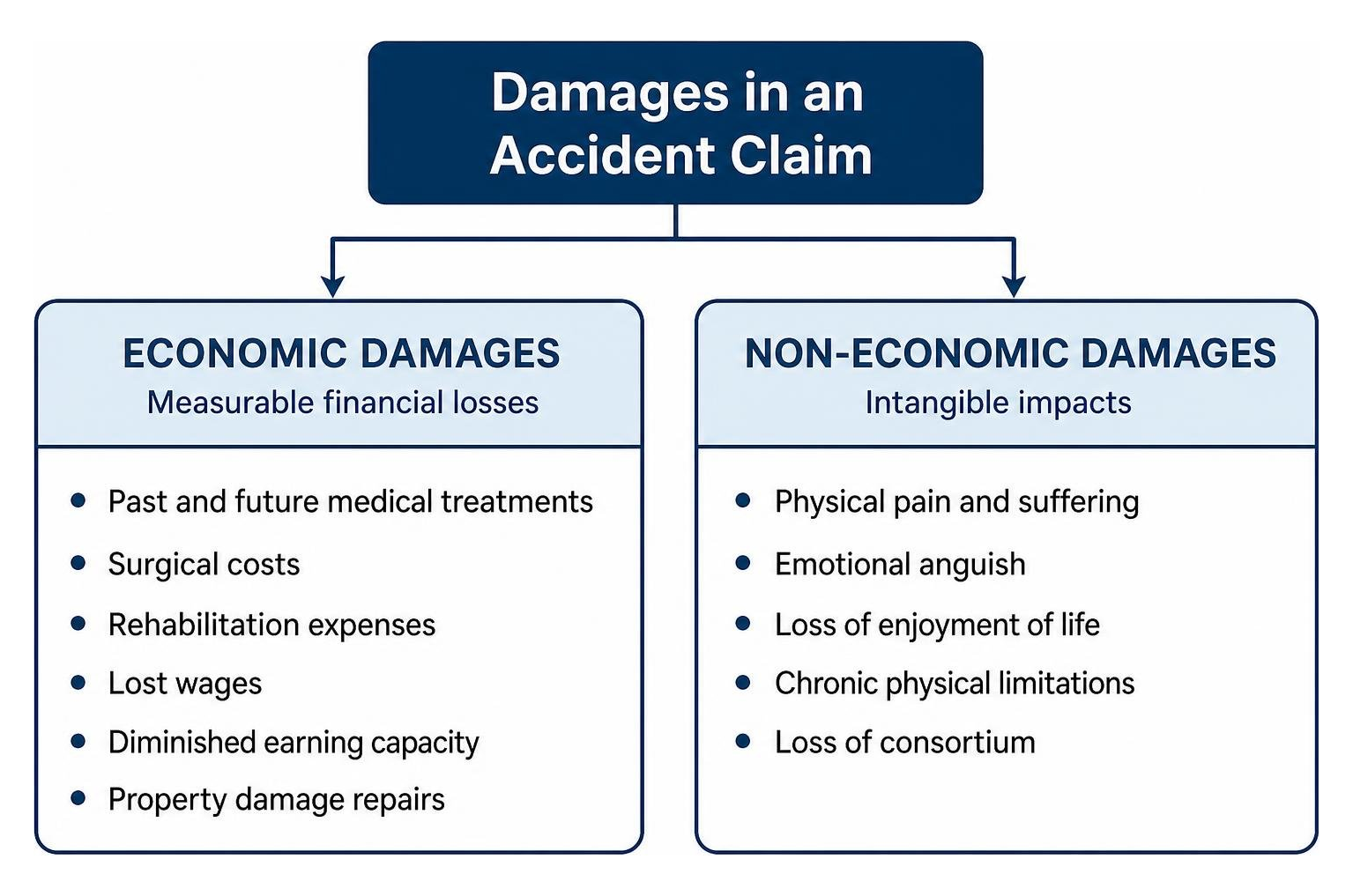
Recoverable damages are split into two primary categories:
- Economic Damages: Measurable financial losses, including past and future medical treatments, surgical costs, rehabilitation expenses, lost wages, diminished earning capacity, and property damage repairs.
- Non-Economic Damages: Intangible impacts, such as physical pain and suffering, emotional anguish, loss of enjoyment of life, chronic physical limitations, and loss of consortium.
The Risk of Early and Quick Settlement Offers
Soon after a collision, an insurance adjuster might reach out with a quick settlement check, sometimes within days. While a fast payout is tempting when bills start piling up, accepting it is one of the most expensive mistakes you can make.
Early settlement offers are designed to close your file before you understand the full extent of your injuries. Once you sign a liability release, your claim is closed permanently. If you discover weeks later that your neck pain is a herniated disc requiring surgery, you cannot reopen the claim to demand additional compensation. Never sign an insurance release or accept a settlement draft without having an attorney review the agreement.
Case Resolution Timelines and Negotiation Stages
Resolving a car accident claim is a structured legal process. While some straightforward claims settle in a few months, complex cases involving severe injuries or disputed fault may take a year or longer to reach a resolution or verdict.
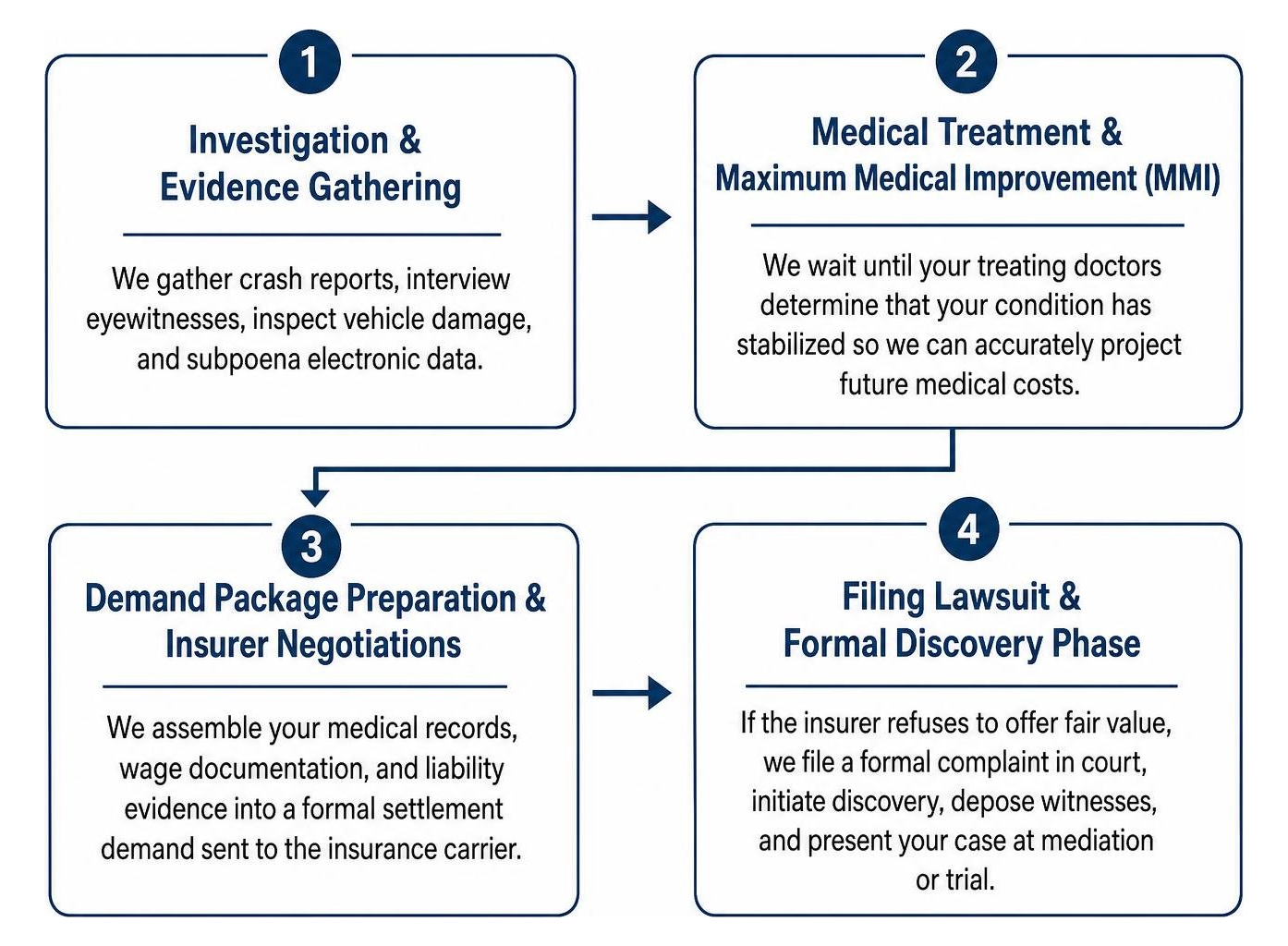
- Investigation and Evidence Gathering: We gather crash reports, interview eyewitnesses, inspect vehicle damage, and subpoena electronic data.
- Reaching Maximum Medical Improvement (MMI): We wait until your treating doctors determine that your condition has stabilized so we can accurately project future medical costs.
- Comprehensive Demand Package: We assemble your medical records, wage documentation, and liability evidence into a formal settlement demand sent to the insurance carrier.
- Negotiation and Litigation: If the insurer refuses to offer fair value, we file a formal complaint in court, initiate discovery, depose witnesses, and present your case at mediation or trial.
Why Hiring an Experienced Garden City Car Accident Lawyer Matters
Insurance carriers employ teams of adjusters, investigators, and defense attorneys with a single objective: minimizing the amount of money paid out on claims. Attempting to negotiate on your own puts you at a severe disadvantage against their corporate resources.
Working with Jalal Abdallah PLLC levels the playing field. We provide relentless advocacy for underdogs against powerful insurers and government entities. Our team understands local traffic corridors throughout Wayne County—including high-crash intersections along Middlebelt Road, Ford Road, and Warren Road—and we understand how local courts manage injury dockets. Knowing how to choose auto accident legal counsel ensures you partner with an advocate ready to take your case to a jury if the insurance company will not pay what is fair.
When to Hire a Garden City Car Accident Lawyer After a Crash
You should consult an attorney immediately if you face any of the following circumstances:
- You sustained injuries requiring hospitalization, surgery, or ongoing physical therapy.
- The insurance company blames you for the crash or disputes how the collision occurred.
- The at-fault motorist was driving uninsured, underinsured, or fled the scene.
- Your own no-fault insurance carrier delays, reduces, or cuts off your PIP medical and wage benefits.
- You are being pressured by adjusters to sign medical authorizations or accept an early settlement check.
What to Look for in a Garden City Car Accident Lawyer
When evaluating law firms, look for an attorney who focuses on personal injury litigation, maintains transparent communication, and prepares every case as if it will proceed to trial. Ask directly whether your case will be managed by an experienced attorney or handed off to administrative staff.
You also want an attorney who operates on a clear contingency fee agreement. To learn more about how fee arrangements work without creating financial strain, consult our guide on finding an affordable car accident lawyer.
Frequently Asked Questions About Car Accident Claims
How much does it cost to retain an attorney after an auto accident?
We represent car accident victims on a contingency fee basis. That means you pay zero upfront retainers and zero out-of-pocket legal fees. Our legal fee is a set percentage deducted from the financial recovery we secure on your behalf. If we do not win your case or obtain a settlement, you owe us nothing in attorney fees.
Do I need legal representation if the crash was not my fault?
Yes. Even when liability seems clear, the at-fault driver’s insurance company will often try to minimize the value of your medical care, argue your injuries were pre-existing, or claim you were partially at fault under comparative negligence rules. An attorney ensures your damages are accurately calculated, prevents lowball settlements, and protects your right to full compensation.
How long do I have to file a motor vehicle collision claim?
In Michigan, you generally have three years from the date of the crash to file a third-party personal injury lawsuit against the at-fault driver. For first-party no-fault PIP benefits from your own insurer, you must provide written notice of your injury within one year of the crash. Claims involving government entities or municipal vehicles often require written notice within 90 to 120 days.
Protecting Your Future After a Motor Vehicle Collision
A serious car accident disrupts your health, your career, and your family’s financial stability in an instant. You do not have to take on insurance adjusters and complex no-fault claims on your own.
At Jalal Abdallah PLLC, we stand up for injured individuals against powerful insurance corporations to demand every dollar of compensation our clients deserve. If you or a loved one were hurt in a crash, explore our comprehensive car accident legal services and reach out to our team today for a free, no-obligation case evaluation. We are ready to take on the legal fight so you can focus entirely on healing.
Share This Article

Schedule Your Free Consultation Today!
Reach out today and receive a consultation, completely free of charge - we'll evaluate your case and let you know what comes next.


