Who Pays When the Tour Bus Crashes? Charter Bus Accident Lawyer Guide
Dearborn Charter Bus Accident Lawyer: When the Tour Bus Crashes, Who Pays?
If you’re looking for a charter bus accident lawyer, here’s what you need to know right away:
Quick Answer: Who is liable after a charter bus crash?
- The bus driver — for fatigue, distraction, speeding, or reckless driving
- The charter bus company — for poor maintenance, inadequate driver training, or ignoring federal safety rules
- A parts manufacturer — if a defective component caused the crash
- A maintenance contractor — if faulty repair work contributed to the accident
- A third-party driver — if another vehicle caused or contributed to the collision
Charter buses carry dozens of passengers at a time. When something goes wrong, the results can be devastating. According to research from a University of Michigan study, charter bus drivers are statistically more likely to have poor driving records than other commercial drivers. And unlike school or transit buses — where passenger fatalities account for less than 5–10% of total crash deaths — a full third of charter bus crash fatalities are passengers and drivers themselves.
That’s a striking and sobering gap.
These crashes are also legally complex. Multiple parties can share fault. Federal regulations from the FMCSA govern driver hours and vehicle safety. Insurance policies for commercial carriers can run into the millions. And bus companies — along with their insurers — have legal teams working immediately to limit what they pay out.
If you or a loved one was hurt in a motorcoach crash in Michigan, understanding who is responsible — and acting fast — can make the difference between fair compensation and nothing at all.
Common Causes of Motorcoach Crashes and Who Is Liable
When a massive commercial tour bus collides with another vehicle or runs off the road, the sheer physical force is catastrophic. Proving liability in these cases requires looking closely at why the crash happened. Unlike a typical two-car fender bender in Dearborn or Detroit, a charter bus crash is rarely simple.
Several common factors frequently cause these collisions:
- Driver Fatigue: Driving a massive motorcoach for hours on end is physically exhausting. Many operators push past legal limits to keep schedules, leading to slowed reaction times or falling asleep at the wheel.
- Negligent Vehicle Maintenance: Charter buses log tens of thousands of miles every year. When companies skip routine inspections or cut corners on brake repairs and tire replacements, they put everyone on the road in danger.
- Inadequate Driver Training: Maneuvering a 40,000-pound vehicle through heavy traffic on I-94 or during a Michigan winter requires specialized skill. Some companies hire drivers without proper credentials or fail to train them on defensive driving techniques.
- Distracted or Impaired Driving: Whether checking a GPS, managing passengers, or driving under the influence of medications, a distracted bus driver is a recipe for disaster.
Determining liability means identifying every party whose negligence contributed to the crash. This can include the driver, the charter company, third-party maintenance shops, or even the manufacturer of a defective tire or brake system.
How Federal Regulations Impact Your Charter Bus Accident Lawyer Case
Commercial passenger carriers must follow strict rules established by the Federal Motor Carrier Safety Administration (FMCSA). These regulations are designed to keep unsafe drivers and poorly maintained vehicles off the road.
When we build a case, we look directly at these federal standards:
- Hours-of-Service (HOS) Limits: Federal law strictly limits how long a bus driver can stay behind the wheel. Generally, passenger-carrying drivers are limited to 10 hours of driving after 8 consecutive hours off duty.
- Electronic Logging Devices (ELDs): Modern charter buses must use ELDs to automatically record driving time. These digital logs prevent companies from falsifying paper logbooks to hide HOS violations.
- Out-of-Service Rates: The FMCSA tracks safety violations and can pull drivers or entire fleets off the road if their out-of-service rates exceed safety thresholds. If a company allowed a driver or bus with known safety violations to operate, it is strong evidence of negligence.
Why You Need a Charter Bus Accident Lawyer After a Crash
If you are injured in a crash, the bus company’s insurance representatives will likely reach out to you quickly. They might seem incredibly helpful, offering to pay your immediate medical bills or presenting a quick settlement package.
Do not fall for these tactics.
Commercial insurance companies are in the business of protecting their own bottom line. An early settlement offer is almost always a “lowball” figure designed to get you to sign away your right to sue before you even know the full extent of your injuries. Once you sign, you cannot ask for more money—even if you need additional surgeries or can never return to work.
We launch an immediate, independent investigation to preserve critical evidence before it disappears. Bus companies are known to repair vehicles, clear digital logs, or overwrite video footage if given the opportunity. Having a dedicated legal team on your side ensures your rights are protected from day one. If you were injured in the Dearborn area, consulting with the Best Bus Accident Lawyer Dearborn can help you understand the true value of your claim.
Why You Need a Dearborn Charter Bus Accident Lawyer to Investigate
Proving negligence in a commercial vehicle crash requires deep-dive technical evidence. When we investigate a charter bus accident, we demand and analyze:
- Black Box Data (Electronic Control Modules): Much like commercial airplanes, modern buses have black boxes that record speed, braking patterns, and engine data right before a collision.
- Driver Qualification Files: We review the driver’s background, medical certifications, drug testing history, and past driving violations.
- Maintenance Records: We look for gaps in safety inspections, deferred repairs, or systemic issues within the charter company’s fleet.
- Accident Reconstruction: We work with engineering professionals to reconstruct the scene, analyze skid marks, and prove exactly how the collision occurred.
Severe Injuries and Damages Suffered in Charter Bus Crashes
Because most charter buses lack basic safety features like seat belts or airbags for passengers, the injuries sustained in a crash are often life-altering. Passengers are frequently thrown from their seats, colliding with hard interior surfaces or other passengers.
| Injury Category | Typical Impact on Victims |
|---|---|
| Traumatic Brain Injuries (TBI) | Cognitive impairment, memory loss, and personality changes |
| Spinal Cord Damage | Partial or full paralysis, requiring lifelong physical therapy and care |
| Catastrophic Fractures | Broken limbs, crushed joints, often requiring multiple reconstructive surgeries |
| Wrongful Death | Sudden, devastating loss of a family member, stripping families of companionship and financial support |
If you have suffered these or other severe injuries, you have the right to pursue both economic and non-economic damages. Economic damages cover tangible financial losses like hospital bills, rehabilitation costs, and lost wages. Non-economic damages compensate you for physical pain, emotional suffering, loss of enjoyment of life, and mental anguish.
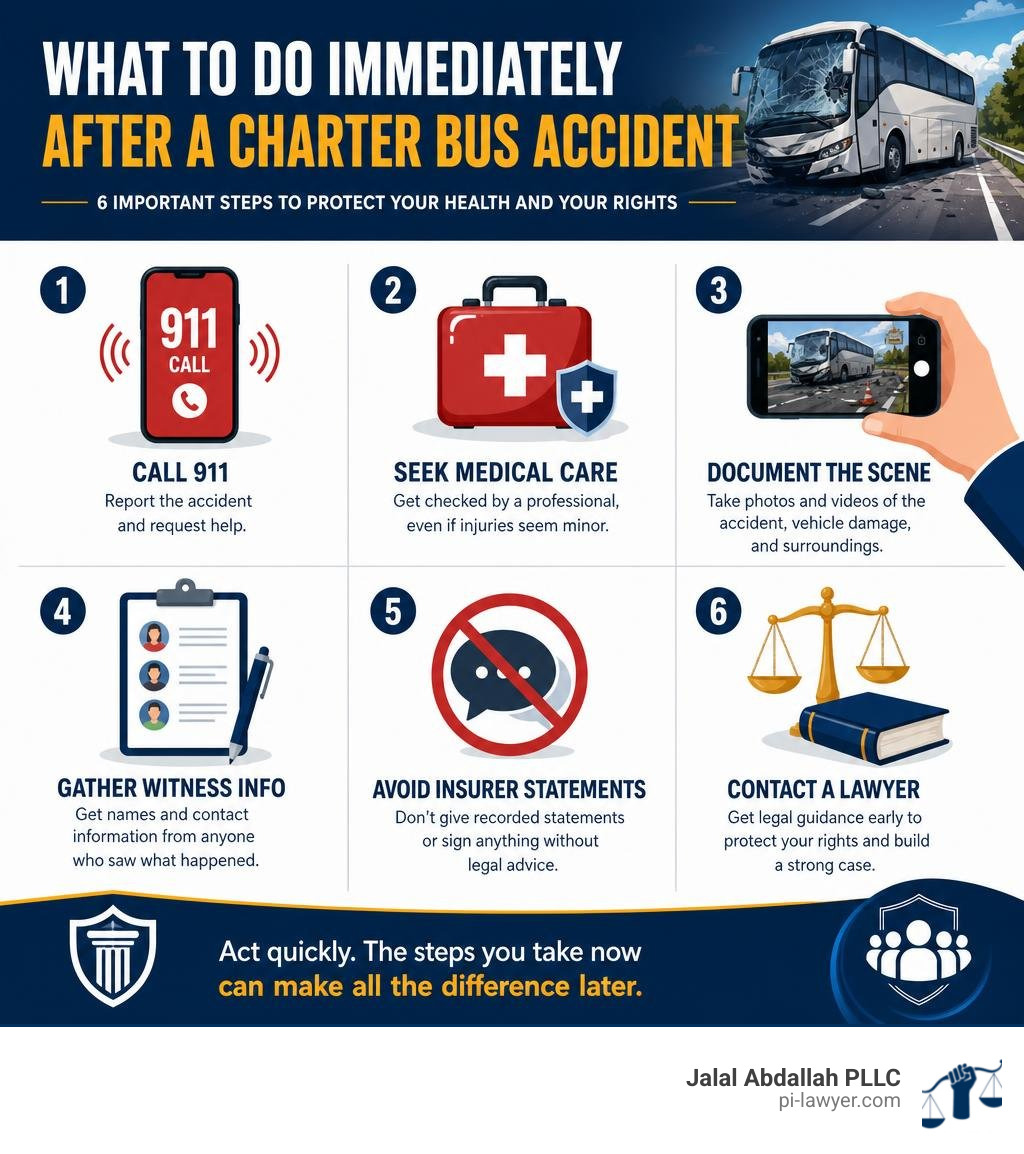
Immediate Steps to Take After a Michigan Bus Crash
What you do in the moments and days following a bus crash can impact both your physical recovery and your legal claim. If you are involved in a collision in Southfield, Detroit, Warren, or Dearborn, take these steps to protect yourself:
- Seek Immediate Medical Attention: Your health is the absolute priority. Even if you feel fine, adrenaline can mask serious injuries like internal bleeding or concussions. Get evaluated by a doctor immediately.
- Call the Police: Ensure law enforcement responds to the scene and creates an official traffic crash report. This report serves as a foundational piece of evidence.
- Document the Scene: If you are physically able, take photos of the bus, other vehicles, road conditions, and your visible injuries.
- Gather Witness Contact Info: Collect names and phone numbers of fellow passengers and bystanders who saw what happened.
- Avoid Giving Statements: Do not give recorded statements to the bus company’s insurance adjusters. Politely decline and tell them to speak with your attorney.
- Review Local Accident Guides: To better understand how Michigan laws handle collisions, consult our guide on What To Do Immediately After A Car Accident In Michigan.
Suing Private Charter Companies vs. Government Transit Entities
There is a massive legal difference between suing a private charter company (like a private tour operator) and a government-run transit bus (like DDOT in Detroit or SMART buses operating throughout Wayne, Oakland, and Macomb counties).
Under Michigan law, government entities enjoy “sovereign immunity.” While you can still sue them for injuries resulting from the negligent operation of a government vehicle, the rules are incredibly strict:
- Notice Requirements: For a private charter crash, you generally have a three-year statute of limitations to file a lawsuit in Michigan. However, if you are injured by a government-owned transit bus, you must file a formal notice of intent to sue within a very short timeframe—sometimes as short as 60 to 120 days depending on the agency. Failing to file this notice on time can completely bar you from recovering compensation.
- The Common Carrier Standard: Both private and public bus operators are legally classified as “common carriers.” This means they owe their passengers the highest duty of care under the law. They must exercise extreme diligence to ensure passenger safety, making it easier to establish liability when they fail to meet this high standard.
Understanding these differences is critical to protecting your rights. Whether you were injured on a private charter bus or a public transit vehicle, consulting with an experienced legal team immediately ensures you do not miss critical deadlines or lose your right to seek compensation.
Frequently Asked Questions About Charter Bus Accidents
Can passengers sue if they are injured on a charter bus?
Yes. Passengers on a charter bus are legally classified as “invitees.” Because the bus company is a common carrier, they owe you a heightened duty of care. If the driver’s negligence, a mechanical failure, or poor company protocols caused your injuries, you have every right to file a lawsuit to recover damages. For a broader look at how local injury claims work, check out our Car Accident Lawyer Dearborn Guide.
How do lawyers prove negligence in a bus crash?
We build a compelling case by gathering multiple layers of evidence:
- Video Evidence: Demanding both inward-facing driver cameras and outward-facing road cameras before deposing the driver.
- Driver Depositions: Questioning the driver about their schedule, fatigue levels, and training.
- Maintenance Logs: Checking for a history of skipped inspections or cheap repairs.
- Professional Testimony: Working with accident reconstructionists to prove how the crash occurred and medical professionals to outline the lifetime costs of your injuries.
Why shouldn’t I accept an early settlement offer?
Insurance adjusters want to resolve claims quickly and cheaply. An early offer rarely accounts for the long-term impact of your injuries. If you need future surgeries, physical therapy, or can never return to your career, a lowball settlement will leave you paying those costs out of pocket. We calculate your lifetime care costs to ensure we demand every penny you actually deserve.
Standing Up to Powerful Insurers on Your Behalf
When you or a loved one is injured in a charter bus crash, you are up against massive commercial corporations and their high-powered insurance legal teams. They have endless resources designed to wear you down and minimize your recovery.
We don’t let them.
At Jalal Abdallah PLLC, we pride ourselves on relentless advocacy for underdogs. We stand up to powerful insurance companies and municipal authorities to ensure our neighbors in Dearborn, Detroit, Southfield, and Warren get the justice they deserve. We handle the paperwork, the investigations, and the aggressive negotiations so you can focus entirely on your physical recovery.
Do not fight this battle alone. Contact our legal team today for a free, confidential consultation, and let us start fighting for you.
Share This Article

Schedule Your Free Consultation Today!
Reach out today and receive a consultation, completely free of charge - we'll evaluate your case and let you know what comes next.