 Skip to content
What Grieving Families in Dearborn Need to Know About a Medical Malpractice Death Claim
A Dearborn medical malpractice death claim gives families a legal path to justice when a loved one dies because of a healthcare provider’s negligence. Here is a quick overview of what that means for you:
At a glance — key facts about a Dearborn medical malpractice death claim:
- Who can file: The personal representative of the deceased’s estate files on behalf of surviving family members.
- What you must prove: Duty of care, breach of that standard, proximate causation, and damages.
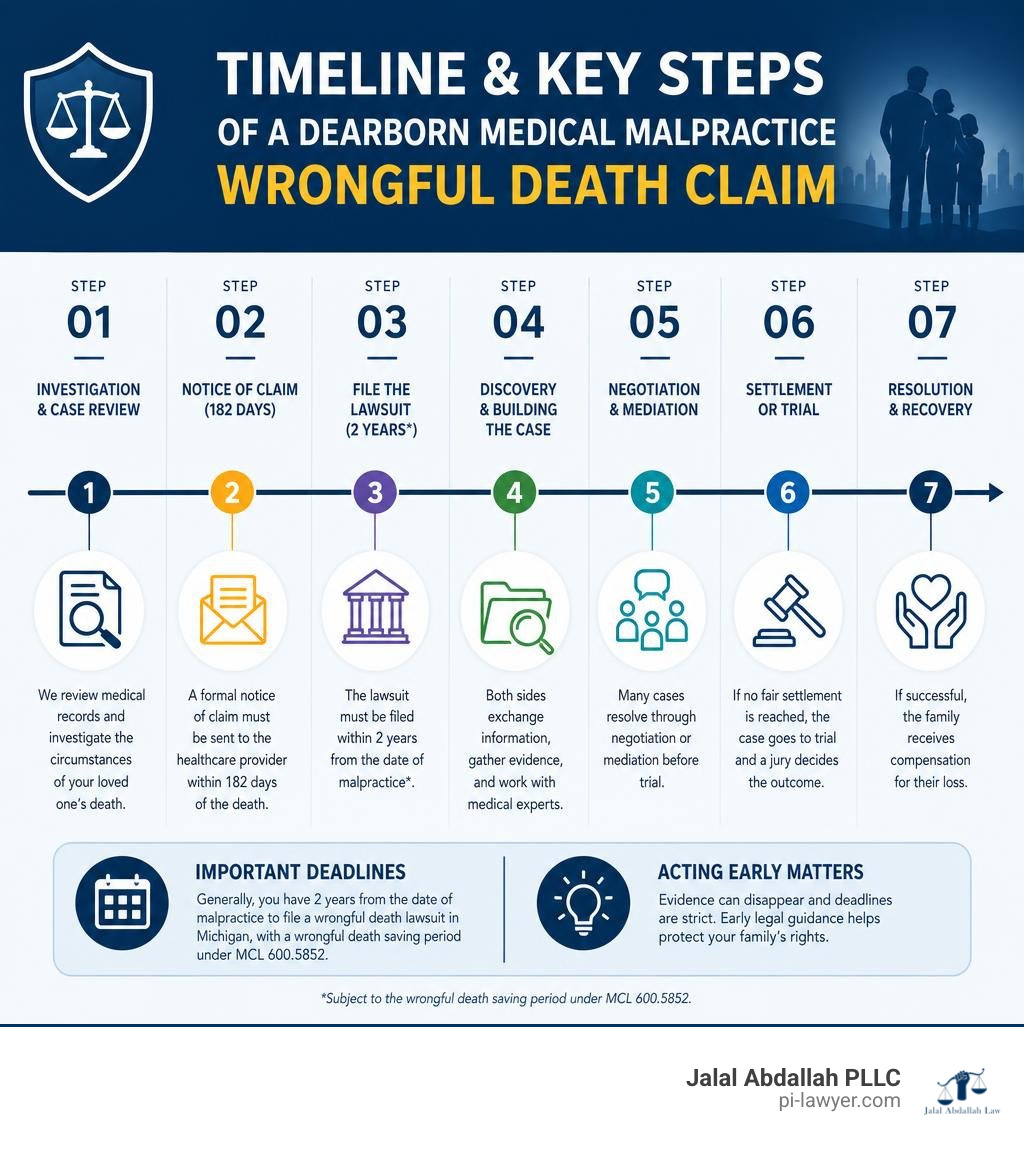
- Time limit: Generally two years from the date of malpractice, with a wrongful death saving period under MCL 600.5852.
- Damages available: Lost future earnings, medical expenses, and non-economic losses like pain and suffering.
- Medicaid liens: If the deceased received Medicaid, the state (DHHS) may seek reimbursement — but that amount can often be reduced.
These cases are not simple. Michigan courts require qualified expert testimony, strict procedural deadlines, and careful calculation of damages. One timing mistake — even a few months — can permanently close the courthouse door to your family, as courts across the state have repeatedly confirmed.
The grief of losing a loved one to a preventable medical error is already devastating. Understanding your legal rights should not add to that burden.
I’m Jalal Abdallah, a Michigan personal injury attorney who has built my practice around fighting for families who feel outmatched by hospitals and insurance companies — including those pursuing a dearborn medical malpractice death claim. This guide walks you through every critical step, from proving negligence to protecting your settlement recovery.
Legal Standards for a Dearborn Medical Malpractice Death Claim
To successfully pursue a dearborn medical malpractice death claim, a grieving family must establish four foundational legal elements. Under Michigan law, these elements are:
- Duty: The healthcare professional or hospital owed a professional duty of care to the patient. This is established by showing a doctor-patient relationship existed.
- Breach: The medical professional or facility failed to meet the accepted standard of care. This means they did not act with the same level of care and skill that a similarly situated, reasonable healthcare professional would have used under similar circumstances.
- Causation: There must be a direct link between the medical professional’s breach of care and the patient’s death. This is often split into “cause in fact” (the injury would not have occurred but for the negligence) and “proximate cause” (the injury was a foreseeable result of the negligence).
- Damages: The estate must show that the patient’s death resulted in quantifiable financial and emotional losses, such as medical bills, funeral costs, and the loss of companionship.
Working with an experienced medical malpractice attorney in Dearborn is vital because these elements cannot be proven with general assertions. They require meticulous documentation, complete medical record reviews, and the testimony of qualified peer professionals.
Proving Causation and Surviving Summary Disposition
In many medical malpractice lawsuits, defense attorneys will file a motion for summary disposition under Michigan Court Rule (MCR) 2.116(C)(10). This motion essentially asks the judge to dismiss the case before it ever reaches a jury, arguing that the plaintiff lacks enough factual evidence to prove a genuine issue of material fact regarding causation.
To survive this motion, we must present strong, clear evidence showing a logical sequence of cause and effect. A powerful example of this standard can be seen in the case of Estate of Ryan Harsh v. McLaren Port Huron Hospital.
In that case, a 36-year-old autistic patient was admitted to the hospital following a seizure and a fall. The initial CT scan was compromised due to the patient moving, yet a repeat scan was delayed for over 24 hours because hospital staff noted the patient was too restless. Tragically, the patient suffered a massive, undetected middle cerebral artery stroke and passed away.
The defense argued that the outcome was inevitable and that the patient’s restlessness prevented them from completing the diagnostic imaging. However, the Michigan Court of Appeals reversed the trial court’s summary dismissal. The appellate court ruled that a genuine issue of material fact existed because the plaintiff’s testifying medical professional presented logical evidence that:
- The hospital had a duty to safely sedate the patient to obtain a clear, repeat diagnostic scan.
- Had the scan been performed on time, medical interventions (such as hyperosmolar therapy to reduce brain swelling or surgical decompression) would have more likely than not saved the patient’s life.
This case highlights that hospitals cannot escape liability by claiming a patient was too difficult to scan. If diagnostic delays turn fatal, we will aggressively challenge their excuses.
Retained Foreign Objects and Res Ipsa Loquitur
Another complex medical scenario involves foreign objects left inside a patient’s body after surgery. While laypeople often assume this is an open-and-shut case under the doctrine of res ipsa loquitur (the thing speaks for itself), Michigan courts still require a precise legal showing of standard-of-care breaches.
In Estate of Steven John Ahearn v. Henry Ford Health System, a patient underwent spinal surgery and subsequently had a surgical drain tube removed by a nurse practitioner. Months later, during a follow-up procedure, a different surgeon discovered a four-inch piece of broken plastic drain tubing left inside the patient’s spine, fully encased in a ball of scar tissue.
The defense tried to dismiss the case, claiming the patient died of unrelated causes later on and that the retained tubing did not cause a severe active infection. However, the Court of Appeals reversed the dismissal. The court established that:
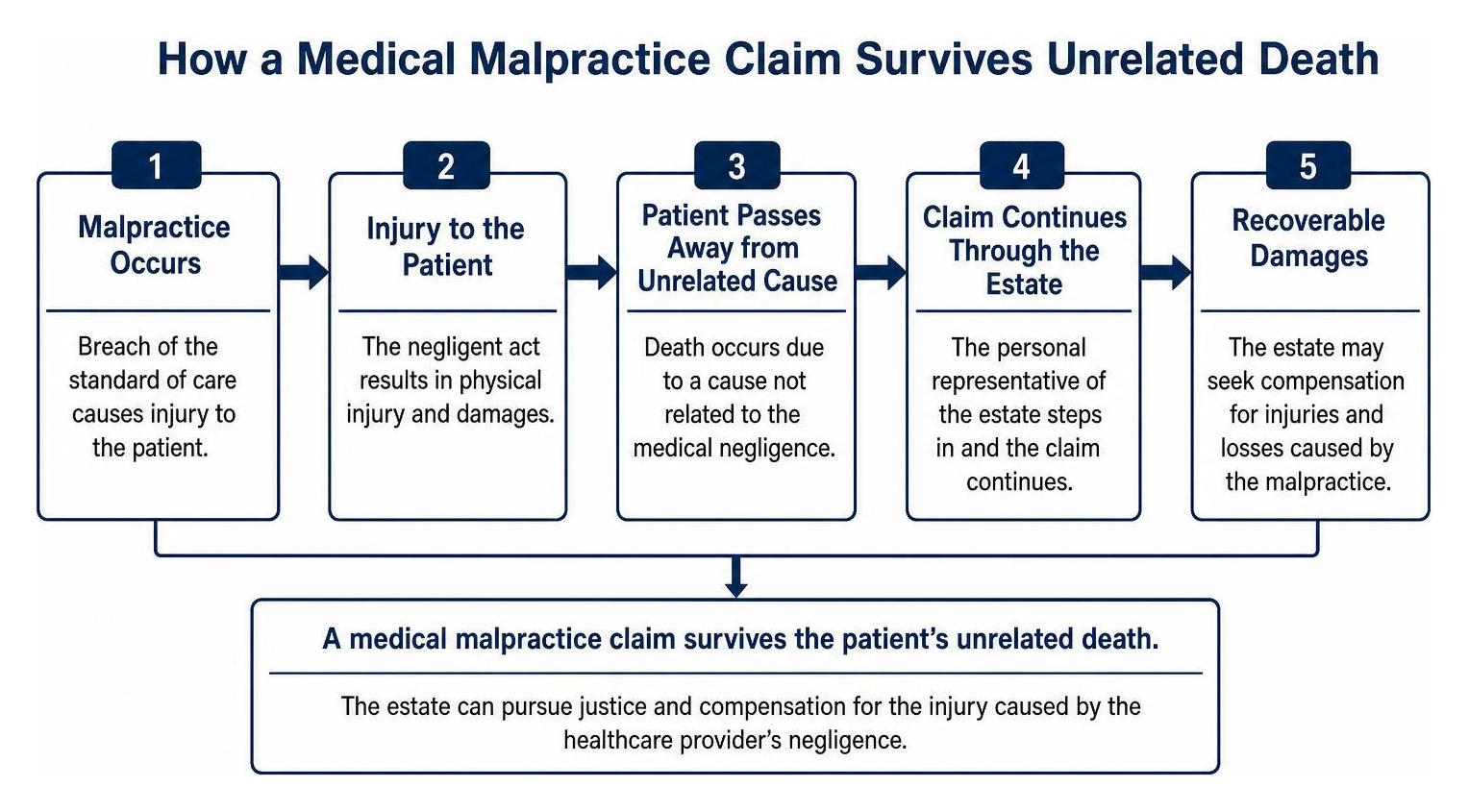
- A medical malpractice claim survives the death of the patient, allowing the personal representative of the estate to continue the lawsuit even if the death was unrelated to the malpractice.
- The presence of the four-inch broken tube and the resulting localized scar tissue (granuloma) constituted a legally cognizable physical injury.
- There was a genuine factual dispute over whether the nurse practitioner breached the standard of care by failing to inspect the drain tube upon removal to ensure it was fully intact.
Admissibility of Testimony in a Dearborn Medical Malpractice Death Claim
To bring a medical malpractice claim in Michigan, you must file an Affidavit of Merit signed by a qualified medical professional. Michigan courts are highly strict about who is legally qualified to testify regarding the standard of care.
A major battleground in these cases is the qualification of testifying witnesses. In Khosho v. Ascension Macomb Oakland Hosp., a 61-year-old patient with myasthenia gravis was treated with high-dose steroids, which shut down his immune system. Due to a delayed diagnosis of pseudomonas pneumonia, the patient passed away.
The defense argued that because the patient was transferred to a second hospital and temporarily improved before passing, the first hospital’s negligence was not the proximate cause of death. They also challenged the qualifications of the plaintiff’s testifying medical witness.
The Michigan Court of Appeals rejected the defense’s arguments, holding that:
- A temporary return to baseline or brief improvement at a transfer hospital does not break the chain of causation if the initial hospital’s negligence set a fatal process in motion (such as suppressing the immune system past the “point of no return”).
- A board-certified medical professional in a specific field (like neurology) is legally qualified to testify against a general practitioner in that same field, even if the testifying professional primarily focuses on a subspecialty (like neurocritical care).
Qualifying Witnesses for a Dearborn Medical Malpractice Death Claim
Michigan law demands a strict match between the professional credentials of the defendant and those of the testifying witness. If the defendant is a board-certified doctor, the testifying witness must share that exact board certification.
This rule is strictly applied to mid-level providers as well. As demonstrated in the Ahearn case, a registered nurse (RN) is not legally qualified to testify regarding the standard of care for a nurse practitioner (NP). Under Michigan licensing requirements, these are considered distinct health professions. Failing to retain a testifying witness with matching credentials will result in the immediate dismissal of your claim. We make sure to identify and retain the exact matching medical professionals necessary to protect your case.
Recovering Damages and Lost Future Earnings
Under the Michigan Wrongful Death Act (MCL 600.2922), the personal representative of an estate can seek both economic and non-economic damages.
- Economic damages include objectively verifiable financial losses, such as medical expenses, funeral costs, and the loss of financial support or future earnings.
- Non-economic damages cover subjective losses, such as the loss of society, companionship, and the mental anguish suffered by surviving family members. Michigan places statutory caps on non-economic damages in medical malpractice cases, which are adjusted annually for inflation.
To help understand how financial recoveries are structured, it is important to distinguish between different types of economic claims:
| Damage Type | Who Receives the Recovery? | How is it Proven? |
|---|---|---|
| Lost Financial Support | Direct dependents (spouse, children) who relied on the deceased’s income. | Based on the deceased’s historic earnings and actual financial contributions to the household. |
| Lost Future Earnings | The deceased’s estate (distributed to heirs according to probate law). | Based on the deceased’s earning capacity, potential career path, and statistical work-life expectancy. |
Calculating Future Earnings for Minors and Unemployed Decedents
One of the most common defense tactics is arguing that future earnings are “too speculative” to calculate if the deceased was a child or was unemployed at the time of their death. However, Michigan courts have firmly rejected this blanket defense.
In the landmark case Daher v. Prime Healthcare Services-Garden City LLC, a 13-year-old boy tragically died from bacterial meningitis due to a failure to diagnose and treat his condition. The hospital argued that because the boy was only 13 and had no work history, his family could not claim lost future earnings.
The Michigan Court of Appeals ruled in favor of the family, holding that:
- A child’s expected future earning potential is not inherently too speculative to permit recovery in a wrongful death action.
- Earning capacity can be proven with reasonable certainty by looking at unique traits, academic achievements, family background, school systems, and participation in extracurricular activities.
- By the time a child reaches middle school, teachers and family can readily identify their aspirations, strengths, and personality traits (such as conscientiousness) to build a realistic career projection.
In these cases, we work closely with professional economists to build a comprehensive projection of what your loved one’s lifetime earning capacity would have been, ensuring their potential is fully valued under the law.
Resolving Medicaid Liens and Frivolous Motion Sanctions
When a medical malpractice claim is settled, winning the settlement is only the first step. If the deceased received healthcare coverage through Medicaid, the Michigan Department of Health and Human Services (DHHS) has a statutory right to seek reimbursement from the settlement proceeds.
However, a skilled attorney can legally prevent the state from taking your entire recovery. In the landmark Dearborn case Peterson by Johnson v. Oakwood Healthcare, Inc., a patient was discharged from a Dearborn emergency room despite having an abnormal ECG and low potassium levels. A month later, the patient suffered a catastrophic cardiac arrest and permanent brain damage, leading to a massive medical malpractice lawsuit.
After a settlement was reached, DHHS asserted a Medicaid lien of $268,357.33, demanding full payment. The trial court held an evidentiary hearing and determined that the settlement amount represented only 21.25% of the total, true value of the case. Therefore, the court reduced the Medicaid lien to a pro rata share of 21.25%, ordering the estate to pay only $57,025.93. The Michigan Court of Appeals affirmed this decision, protecting the family’s recovery from excessive state reimbursement claims.
Penalties for Frivolous Filings and E-Filing Duties
The Peterson case also established a major precedent regarding how state agencies must behave during lien negotiations. After losing the initial lien hearing, DHHS filed a motion for relief from judgment under MCR 2.612, claiming they did not receive proper email notifications of the court’s orders.
The Court of Appeals upheld severe monetary sanctions against DHHS, ordering them to pay $4,000 to the plaintiffs and $2,000 to the defendants. The court found that:
- The state’s motion was legally frivolous because it lacked arguable legal merit.
- Attorneys and state agencies have a professional duty to actively monitor court e-filing systems and registers of action. Failing to receive an email notification does not constitute “excusable neglect.”
- Relying on outdated or inapplicable case law to bypass missed appeal deadlines is unacceptable.
We do not back down when government entities or insurance companies try to drain your settlement with groundless motions. We fight to keep the maximum amount of compensation in your family’s hands.
Frequently Asked Questions About Dearborn Wrongful Death Claims
What is the statute of limitations for a medical malpractice death claim in Michigan?
In Michigan, the standard statute of limitations for a medical malpractice claim is two years from the date the claim accrued (the date the negligent act occurred). However, because these cases involve death, the wrongful death saving provision under MCL 600.5852 provides an extension:
- A personal representative must file the lawsuit within two years of receiving their Letters of Authority from the probate court.
- The lawsuit must be started no later than three years after the standard two-year period of limitations has expired (a maximum of five years from the date of the malpractice).
Failing to meet these timelines is fatal to your case. In Estate of Rodney Robinson v. Detroit Medical Center, the estate representative filed a lawsuit five months after the wrongful death saving period expired. The court dismissed the case as untimely.
Does a Notice of Intent toll the wrongful death saving period?
No. Under the Michigan Supreme Court’s ruling in Waltz v. Wyse, filing a mandatory Notice of Intent (NOI) to sue tolls the standard two-year medical malpractice statute of limitations, but it does not toll the wrongful death saving period under MCL 600.5852. This is a common legal trap that can permanently ruin a claim if your attorney does not calculate the dates properly.
Can a successor representative file a new claim if the first was dismissed?
No. In the Robinson case, after the first representative’s lawsuit was dismissed for being late, a successor personal representative was appointed and tried to file a brand-new, identical lawsuit.
The Court of Appeals ruled that the doctrine of res judicata barred the second suit entirely. Under Michigan law, an involuntary dismissal based on the statute of limitations is considered a “decision on the merits.” Because the successor representative shares legal “privity” with the original representative, they cannot bypass a prior untimely dismissal by filing a new complaint.
Secure Relentless Advocacy for Your Family’s Rights
When you are grieving the loss of a loved one, the last thing you should have to worry about is navigating complex probate timelines, arguing with hospital attorneys, or negotiating Medicaid liens.
At Jalal Abdallah PLLC, we specialize in standing up for the underdog. We take on powerful hospital networks, insurance giants, and government agencies to secure the justice and financial security your family deserves. We handle cases across Michigan, including Southfield, Dearborn, Detroit, and Warren.
If you suspect that medical negligence caused your loved one’s death, do not wait until a critical deadline passes. Contact us today for wrongful death representation and a compassionate, thorough evaluation of your claim.
Share This Article

Schedule Your Free Consultation Today!
Reach out today and receive a consultation, completely free of charge - we'll evaluate your case and let you know what comes next.


