 Skip to content
Truck Accident Lawyer Dearborn representation can help you protect evidence, understand Michigan no-fault benefits, and pursue a claim against a truck driver, trucking company, or other party when a commercial crash causes serious harm.
After a collision on corridors such as I-94 or M-39, the right legal help can matter quickly because trucking companies and insurers may begin their own investigation right away.
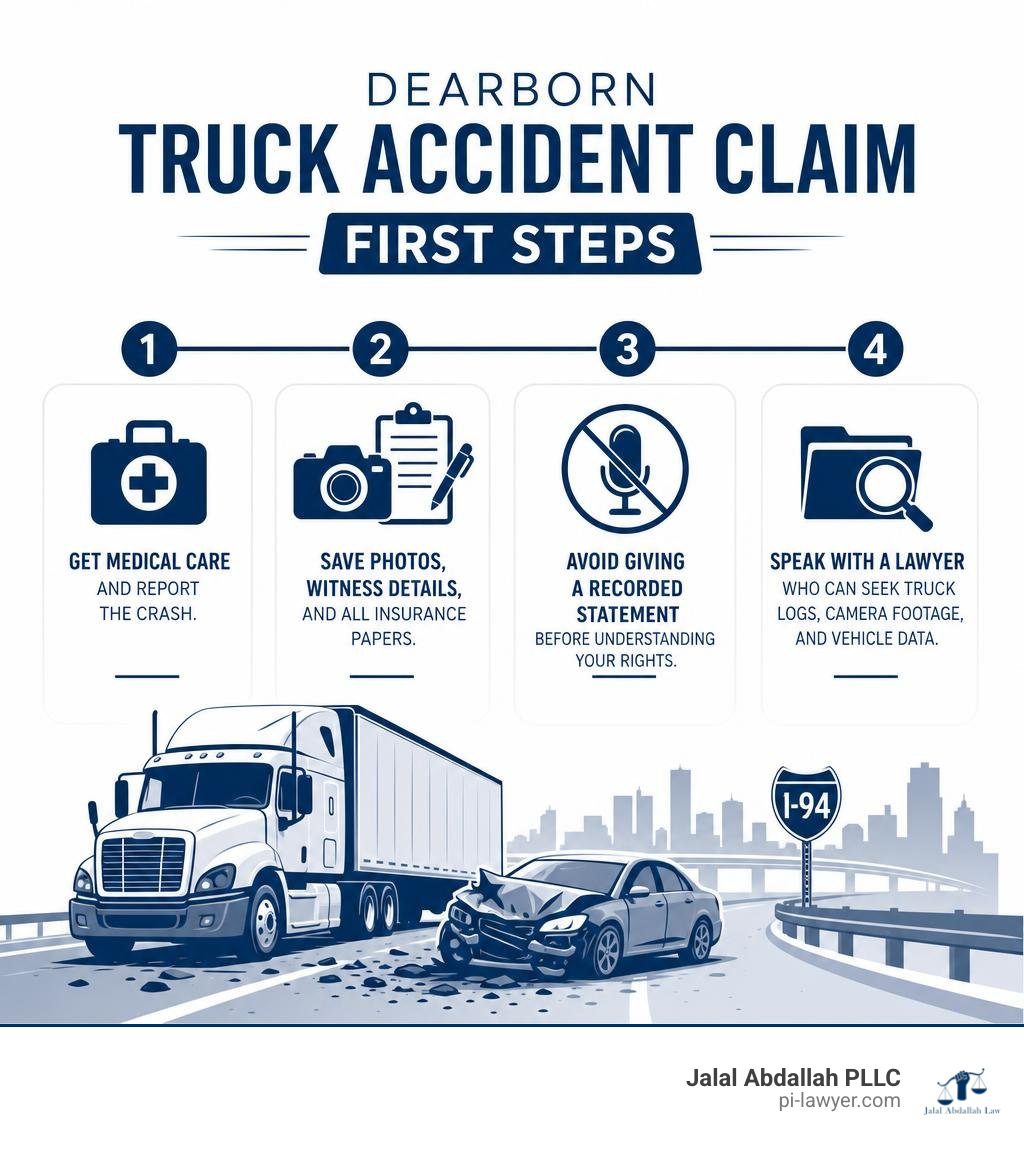
- Get medical care and report the crash.
- Save photos, witness details, and all insurance papers.
- Avoid giving a recorded statement before understanding your rights.
- Speak with a lawyer who can seek truck logs, camera footage, and vehicle data.
Truck crashes often involve severe injuries, large insurance policies, federal safety rules, and more than one potentially responsible party. Michigan recorded 5,700 large-truck crashes in 2021, including 130 fatal crashes and 3,200 injuries.
I am Jalal Abdallah, a Michigan attorney serving injury clients and a licensed insurance producer with property and casualty credentials. As a Truck Accident Lawyer Dearborn residents can turn to, I bring a practical understanding of insurance issues and a commitment to standing up for people facing powerful companies.
Common Causes and Regulations Governing Dearborn Truck Accidents
Dearborn is a hub of commercial freight traffic. Positioned right along major shipping routes like Interstate 94, Highway M-39 (Southfield Freeway), Michigan Avenue, and Telegraph Road, our local roads host thousands of heavy semi-trucks, tractor-trailers, and delivery vehicles every single day. While commercial transportation is vital for the local economy, it also presents significant risks to motorists in smaller passenger vehicles. In fact, Dearborn sees an average of 15 to 20 serious truck-related accidents each year. Across the nation, commercial vehicle crashes account for approximately 10% of all traffic fatalities annually.
When an 80,000-pound commercial rig collides with a 3,000-pound passenger sedan, the laws of physics are unforgiving. National safety data shows that roughly 72% of fatal truck crashes involve a combination of driver error, fatigue, or preventable mechanical failures.
Understanding why these crashes happen is the first step toward building a successful claim. The most common causes of commercial vehicle collisions in Dearborn include:
- Driver Fatigue and Hours-of-Service Violations: Truck drivers often face demanding delivery schedules and financial incentives to cover long distances quickly. Despite regulations limiting driving hours, extreme exhaustion remains a leading cause of slow reaction times, lane drifting, and catastrophic rear-end crashes.
- Mechanical Failure and Poor Maintenance: Worn-out brakes, defective steering mechanisms, tire blowouts, and faulty trailer couplings can instantly transform a commercial truck into a dangerous hazard on high-speed highways like I-94.
- Improper Loading and Cargo Overload: Cargo that is improperly secured, unevenly distributed, or exceeds legal weight limits can cause a semi-truck to rollover, jackknife, or lose control during sudden maneuvers.
- Speeding and Reckless Driving: Because heavy trucks require significantly longer stopping distances than passenger cars, driving at high speeds or tailgating in dense Wayne County traffic frequently leads to severe multi-vehicle pileups.
- Distracted Driving: Texting, using navigation systems, or handling mobile devices while operating a commercial vehicle diverts a driver’s attention during critical moments.
- Inadequate Driver Training: Trucking companies sometimes rush underqualified or poorly trained drivers onto busy highways without proper safety supervision.
Federal FMCSA Standards vs. Michigan Commercial Trucking Laws
Commercial trucking operate under a dual system of oversight: strict federal regulations and state-specific transportation laws. Uncovering violations of these laws is often the key to proving fault in court.
At the national level, commercial interstate trucking is governed by the Federal Motor Carrier Safety Administration (FMCSA). The FMCSA establishes mandatory safety rules that carriers and drivers must obey, including:
- Hours-of-Service (HOS) Regulations: These rules strictly limit commercial drivers to a maximum of 11 hours of driving after 10 consecutive hours off duty. Drivers are also barred from driving beyond the 14th consecutive hour after coming on duty.
- Electronic Logging Devices (ELDs): Commercial trucks must be equipped with tamper-proof electronic logging devices that automatically record driving time, engine hours, vehicle speed, and location data to prevent falsified paper logbooks.
- Mandatory Inspection and Maintenance: Trucking fleets must maintain comprehensive routine inspection logs and fix known safety defects immediately.
- Drug and Alcohol Testing: Drivers must undergo pre-employment screening, random substance testing, and mandatory post-accident drug and alcohol checks.
In addition to federal standards, truck drivers in Dearborn must comply with local rules enforced by the Michigan Department of Transportation (MDOT) and the Michigan State Police Commercial Vehicle Enforcement Division. Michigan laws establish specific axle weight limits, maximum gross vehicle weights, winter road clearance mandates, and strict commercial driver license (CDL) qualifications. When a motor carrier or driver violates either set of regulations, our legal team uses those infractions as clear evidence of negligence.
How Michigan No-Fault Insurance Affects Semi-Truck Crash Claims
Navigating Michigan’s unique auto insurance laws after a commercial truck accident can feel overwhelming. Michigan operates under a modified no-fault insurance system, which means that regardless of who caused the crash, your own auto insurance policy is typically the primary source for initial medical and financial relief.
Through Personal Injury Protection (PIP) benefits, your auto insurer is responsible for paying:
- Allowable Medical Expenses: Necessary medical treatment, surgeries, rehabilitation, hospital stays, and long-term care equipment related to your crash injuries.
- Wage Loss Benefits: Reimbursement for up to 85% of your lost income (up to a monthly state cap) for up to three years if your injuries prevent you from returning to work.
- Replacement Services: Allowance of up to $20 per day to pay for daily household chores, childcare, or yard work that you can no longer perform yourself.
However, because commercial truck crashes involve massive force, victims often suffer catastrophic harm that far exceeds basic PIP policy limits or cap structures. When a negligent trucker or trucking enterprise inflicts severe harm, you are not restricted solely to no-fault benefits.
To bring a “third-party” negligence lawsuit against the fault driver or carrier for non-economic damages (such as pain, suffering, emotional distress, and permanent disability), your injuries must meet Michigan’s legal “threshold.” Under Michigan law, this threshold requires proving that you suffered death, permanent serious disfigurement, or a serious impairment of body function.
A serious impairment of body function is defined as an impairment that:
- Is objectively manifested (verifiable by medical tests, X-rays, or clinical findings).
- Affects an important body function (such as walking, lifting, or cognitive processing).
- Affects your general ability to lead your normal life.
Average settlements for Michigan commercial truck injury claims generally range from $50,000 to over $500,000, with catastrophic claims reaching significantly higher depending on liability and insurance coverage depth. You can learn more about how claim valuations work in our Dearborn Car Wreck Compensation Guide What Your Crash Is Really Worth and explore Why a Dearborn Semi-Truck Lawyer Is Your Best Bet.
Recovering Economic and Non-Economic Damages in Severe Crashes
When we pursue a third-party claim against a negligent commercial fleet or driver, we fight to secure maximum financial compensation across two main categories of losses:
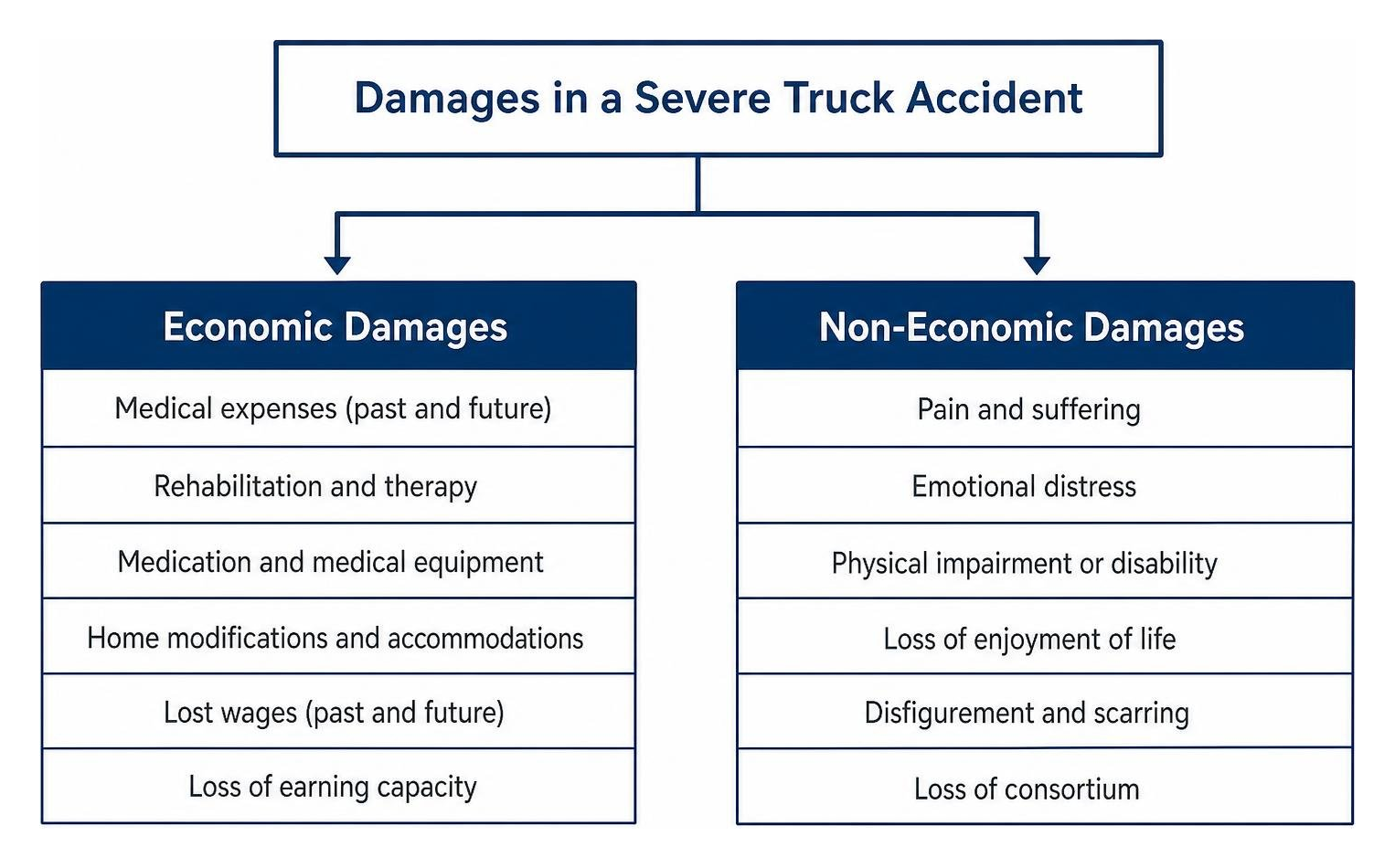
- Economic Damages: These represent tangible, calculable financial losses. They include medical bills exceeding your PIP coverage limits, future medical procedures, specialized equipment, physical therapy, home accommodations, lost earning capacity, and lost future wages.
- Non-Economic Damages: These cover intangible losses that impact your quality of life. They include physical pain, mental anguish, physical impairment, loss of enjoyment of life, severe scarring, and loss of consortium (damage to family relationships).
In the most tragic circumstances where a commercial truck collision results in a loss of life, surviving family members can file a claim under Michigan’s Wrongful Death Act (MCL 600.2922). Wrongful death damages can cover funeral expenses, final medical care, and compensation for the loss of companionship, care, and financial support. For compassionate guidance on these sensitive cases, review our resource on the Best Wrongful Death Attorneys in Dearborn.
Why You Need a Truck Accident Lawyer Dearborn Drivers Trust
After a major truck crash, commercial insurers do not wait to protect their interests. Within hours, corporate rapid-response teams, investigators, and insurance adjusters arrive on the scene to gather evidence, interview witnesses, and look for ways to minimize company liability.
Attempting to handle a multi-million-dollar transportation company on your own puts you at a distinct disadvantage. You need an aggressive advocate on your side who understands how corporate insurers operate and won’t let them push you around. At Jalal Abdallah PLLC, we take pride in being relentless advocates for underdogs facing powerful insurers, global transport fleets, and government entities.
When you hire our team, we handle every aspect of the legal process so you can focus on healing:
- Immediate Evidence Preservation: We move quickly to stop trucking companies from destroying critical onboard data.
- Independent Accident Reconstruction: We work with mechanical analysts and collision reconstruction team members to prove how the crash occurred.
- Comprehensive Insurance Analysis: We inspect all available liability policies, excess umbrella policies, and cargo insurance terms to identify every source of compensation.
- Firm Settlement Negotiation: We calculate your total lifelong damages and fight back against lowball settlement offers.
- Courtroom Litigation: If the insurer refuses to pay what is fair, we prepare your case for trial in Wayne County courts.
For more details on our firm’s track record and approach, visit our resource on Top Legal Representation with a Personal Injury Lawyer in Dearborn.
How a Truck Accident Lawyer Dearborn Advocate Proves Liability
Establishing fault in a commercial truck crash requires a deeper level of investigation than standard passenger car claims. We dig beneath surface-level police reports to unearth hidden evidence of negligence.
To build an unassailable case, our firm focuses on gathering key technical and corporate proof:
- Event Data Recorders (EDRs): Commonly known as the truck’s “black box,” the EDR records vital telemetry data in the seconds leading up to a crash, including vehicle speed, braking pressure, engine RPM, throttle position, and steering inputs.
- Spoliation Letters: Immediately after taking your case, we send formal legal notices called spoliation letters to the motor carrier. This legally compels them to preserve electronic logs, maintenance records, dashcam video, and physical truck components.
- Vicarious Liability Claims: Under the legal doctrine of respondeat superior, trucking companies are held legally responsible for the negligent actions of their drivers while on duty.
- Negligent Hiring and Retention: We examine personnel files to see if the carrier hired a driver with a dangerous driving record, past safety violations, or inadequate CDL licensing.
- Maintenance and Repair Records: We evaluate fleet service logs to verify whether known mechanical issues—such as worn brake pads or bad tires—were ignored prior to the crash.
Key Qualities of a Top Truck Accident Lawyer Dearborn Injury Victims Choose
Choosing the right attorney to handle your recovery is one of the most important decisions you will make following a life-altering accident. You deserve an attorney who combines deep legal knowledge with local court experience.
Here are the key qualities you should look for when selecting legal counsel:
- Local Wayne County Court Familiarity: Understanding local court procedures, judges, and jury pools in Dearborn and Wayne County gives your case a distinct advantage.
- Experience in Commercial Trucking Claims: Commercial litigation requires distinct familiarity with FMCSA guidelines, black box telemetry, and complex insurance structures.
- Contingency Fee Representation: You should never have to pay upfront out-of-pocket legal fees. Reputable firms operate on a contingency fee model, meaning you pay zero legal fees unless we win financial compensation for you.
- Direct, Transparent Communication: You deserve straightforward answers and personal attention from your attorney—not getting passed off to non-attorney staff.
To learn more about selecting the right legal representative for your vehicle claim, read our articles on How to Choose a Dearborn Auto Accident Lawyer and our comprehensive Guide to Choosing a Dearborn Vehicle Collision Attorney.
Key Differences Between Truck Accidents and Passenger Car Crashes
While any motor vehicle collision can be stressful, commercial truck accident claims differ significantly from traditional two-car automobile accidents. The legal, financial, and technical factors involved in commercial freight cases demand a far more strategic legal approach.
| Key Aspect | Passenger Car Accident Claim | Commercial Truck Accident Claim |
|---|---|---|
| Potential Defendants | Usually limited to the single negligent driver. | Multiple parties: driver, carrier, cargo loader, maintenance vendor, parts manufacturer. |
| Insurance Coverage Limits | Typically standard personal auto limits ($25k–$250k). | High-value commercial policies ($750k to $5M+ per incident). |
| Regulatory Framework | Michigan vehicle codes and general traffic laws. | Complex federal (FMCSA) and state commercial vehicle regulations. |
| Evidence Complexity | Police report, basic photos, witness statements. | EDR black box telemetry, ELD digital logs, fleet maintenance records, bill of lading. |
| Corporate Defense Teams | Standard insurance claims adjusters. | Aggressive corporate defense attorneys and rapid-response investigators. |
| Injury Severity | Moderate to severe (whiplash, fractures). | Severe to catastrophic (TBI, spinal cord damage, amputation, fatality). |
Because commercial insurers face potentially massive financial payouts, they defend these cases far more aggressively. Having a dedicated legal team on your side evens the playing field. For a detailed breakdown of handling passenger vehicle crashes, visit our Car Accident Lawyer Dearborn Guide.
Frequently Asked Questions About Dearborn Truck Accident Claims
What is the statute of limitations for filing a truck accident lawsuit in Michigan?
In Michigan, the standard statute of limitations for a personal injury lawsuit against a negligent truck driver or motor carrier is three years from the date of the crash (MCL 600.5805). If you miss this deadline, you forfeit your right to recover financial compensation in court.
However, time limits for no-fault insurance PIP claims are much shorter! Under Michigan’s “one-year back rule,” you must file your initial claim for PIP no-fault medical and wage benefits within one year of the crash date.
In cases involving fatal crashes, the legal personal representative of the deceased person’s estate must file a wrongful death lawsuit within the specific statutory timeline. For families facing these challenging circumstances, we invite you to review A Family’s Guide to Fatal Accident Lawsuits in Dearborn and Dearborn Car Crash Death Claims and the First Steps for Survivors.
What critical evidence must be preserved immediately following a commercial truck crash?
Crucial electronic and physical evidence in commercial crash cases can disappear rapidly if prompt action is not taken. Trucking companies are only required under federal rules to retain certain driver logs for six months before routinely purging or overwriting data.
Key evidence that must be secured includes:
- ELD Driver Logbooks: Digital records detailing driving time, duty status, rest breaks, and hours-of-service compliance.
- EDR Black Box Data: Telemetry recording vehicle speed, braking, gear selection, and engine parameters prior to impact.
- In-Cab Dashcam Footage: Forward-facing and driver-facing video recordings capturing the moments surrounding the impact.
- Driver Qualification Files: Background checks, medical certifications, drug test records, and CDL driving records.
- Maintenance Logs: Repair work orders, brake inspection histories, and daily vehicle inspection reports (DVIRs).
- Physical Scene Proof: Photographs of vehicle resting positions, skid marks, highway debris, road signs, and weather conditions.
How do trucking companies defend against commercial vehicle liability claims?
Commercial trucking carriers and their defense lawyers utilize well-rehearsed strategies to minimize payouts or deny liability altogether:
- Comparative Negligence Assertions: Under Michigan’s modified comparative fault rule (MCL 600.2959), if an insurer can prove you were partly at fault for the accident, your financial recovery will be reduced by your percentage of fault. If you are found to be more than 50% at fault, you are barred from receiving non-economic damages. Defense lawyers often claim motorists cut off the truck or stopped abruptly.
- Independent Contractor Claims: Motor carriers often argue that the truck driver was an “independent owner-operator” rather than an employee, attempting to shield the company from corporate financial liability.
- Pre-Existing Medical Conditions: Insurance adjusters routinely review your medical history to argue that your spinal injuries, pain, or mobility issues existed before the crash occurred.
Our legal team is familiar with these defense tactics and prepares comprehensive counter-evidence to protect your right to full financial recovery.
Partner with Jalal Abdallah PLLC for Relentless Advocacy
A serious commercial truck collision can upend your life, leaving you with overwhelming medical expenses, lost income, and intense personal stress. You do not have to confront corporate insurance companies alone. At Jalal Abdallah PLLC, we bring relentless legal advocacy, deep insurance knowledge, and personal dedication to every personal injury case we represent throughout Dearborn, Wayne County, Detroit, Southfield, and Warren.
We fight tirelessly to hold negligent truckers and corporate carriers accountable so that injury victims receive every dollar of compensation they deserve.
Take the first step toward getting your life back on track today. Schedule a free consultation with our dedicated truck accident litigation team or contact us directly at our firm to learn how we can help you build a strong case. You can also explore our full range of legal services by visiting our main website at pi-lawyer.com, checking our broader range of legal options under pi-lawyer.com/services/, or getting in touch with us through our contact page.
Share This Article

Schedule Your Free Consultation Today!
Reach out today and receive a consultation, completely free of charge - we'll evaluate your case and let you know what comes next.


