 Skip to content
What to Do After a Distracted Driving Crash in Dearborn
After a crash caused by a driver using a phone, eating, or otherwise not watching the road, a Dearborn distracted driver injury lawyer can help protect evidence, deal with insurers, and pursue every available source of compensation.
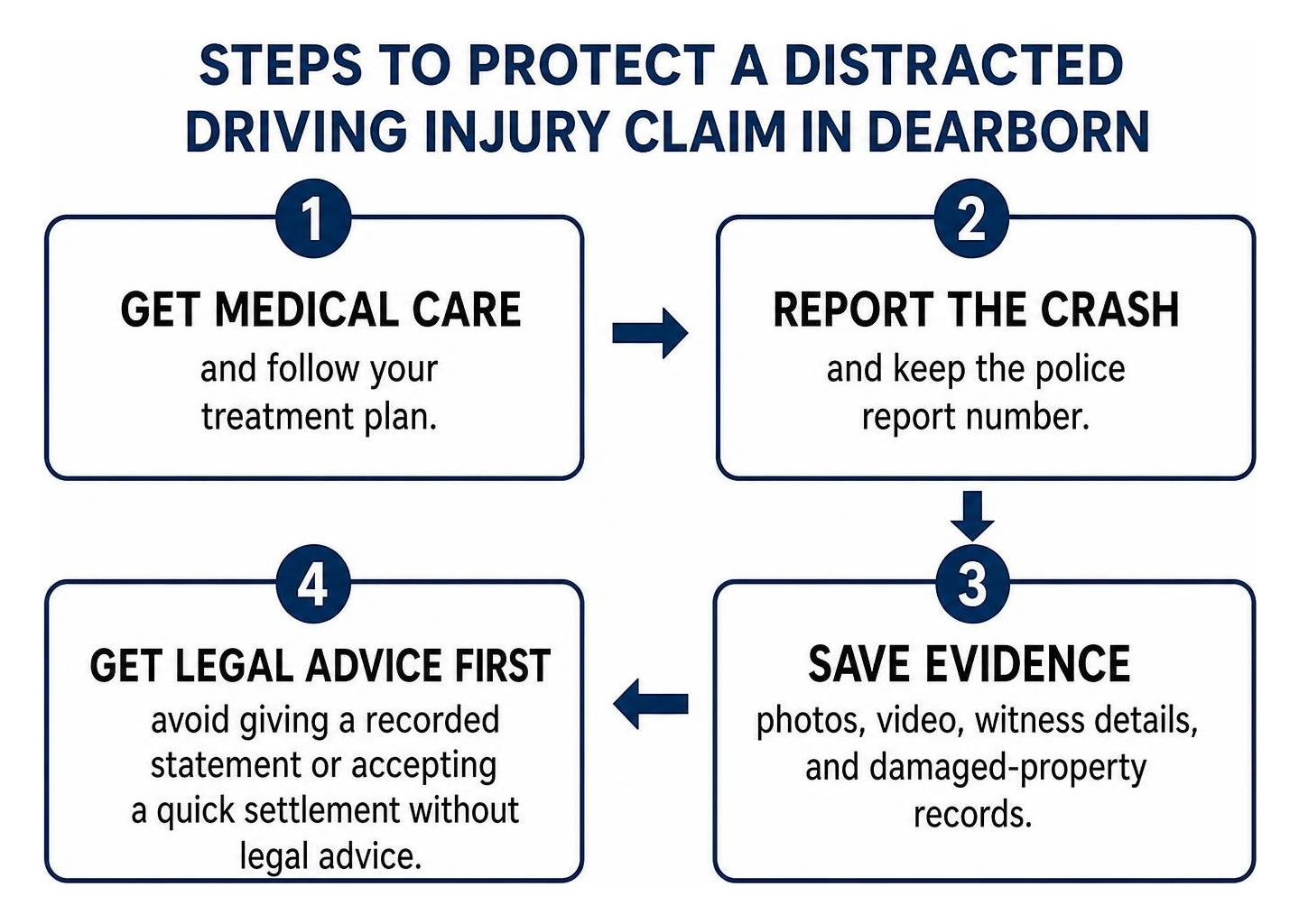
Take these steps as soon as you can:
- Get medical care and follow your treatment plan.
- Report the crash and keep the police report number.
- Save photos, video, witness details, and damaged-property records.
- Avoid giving a recorded statement or accepting a quick settlement without legal advice.
Michigan’s hands-free driving rules can help establish fault, but proof matters. Phone records, traffic-camera footage, vehicle data, witness accounts, and the crash report may show that distraction caused the collision. Michigan reported 59 distracted-driving deaths and more than 14,000 related injuries in 2022.
I am Jalal Abdallah, a Michigan trial attorney who represents people facing insurance companies after serious injuries. As a Dearborn distracted driver injury lawyer, I draw on personal injury litigation experience and insurance-industry knowledge to fight for fair treatment and accountability.
Quick Dearborn distracted driver injury lawyer definitions:
Understanding Michigan Distracted Driving Laws and Fault
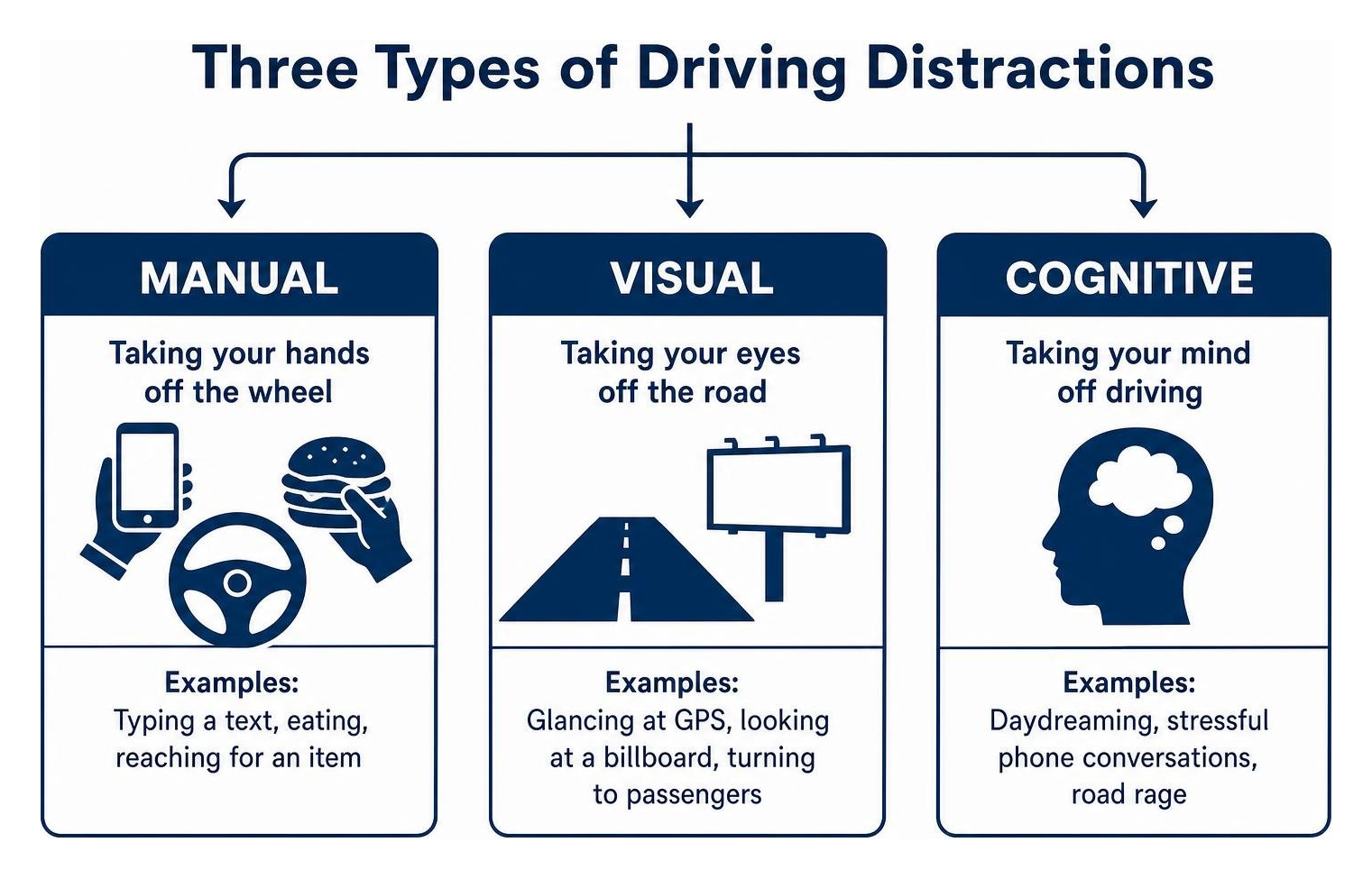
Distracted driving takes many forms on the road. Under Michigan law, driving requires full attention, yet countless motorists take their minds and eyes off the road every single day. In our state, distracted driving generally falls into three main categories:
- Visual distractions: Taking your eyes off the road (such as glancing at a GPS screen, looking at a billboard, or turning around to check on passengers).
- Manual distractions: Taking your hands off the steering wheel (such as typing a text, eating lunch, or reaching for an item in the passenger seat).
- Cognitive distractions: Taking your mental focus away from driving (such as daydreaming, stressful hands-free phone conversations, or road rage).
Michigan’s hands-free driving laws make it illegal to manually hold or use a mobile electronic device while operating a vehicle. This ban includes texting, scrolling social media, dialing numbers, watching videos, or browsing the internet while driving or sitting at a red light.
Cell phone use remains the most common distraction, involved in roughly 12% of all distracted driving collisions statewide. In Wayne County alone, over 1,200 crashes occurred in 2022 where driver distraction was cited as a primary factor. Because Dearborn features major arterial roads like Michigan Avenue, Ford Road, and Telegraph Road, heavy commuter traffic frequently mixes with inattentive drivers, resulting in severe wrecks.
Michigan No-Fault Insurance and Threshold Requirements
Michigan operates under a unique no-fault auto insurance system. Under this structure, your own auto insurance policy covers certain economic losses through Personal Injury Protection (PIP) benefits, regardless of who caused the collision. PIP benefits help pay for:
- Reasonable and necessary medical expenses up to your selected coverage limit.
- Up to three years of wage loss benefits (subject to statutory monthly caps).
- Replacement services (up to $20 per day) for household tasks you can no longer perform.
- Attendant care services if your injuries require ongoing assistance.
However, PIP benefits do not compensate you for physical pain, emotional distress, or reduced quality of life. To pursue a third-party claim against the at-fault driver for these non-economic damages, Michigan requires your injuries to meet a legal threshold. Under Michigan law, the injury must result in death, permanent serious disfigurement, or the “serious impairment of an important body function.” Establishing this threshold is essential for holding reckless drivers accountable beyond basic medical bill reimbursement.
| Benefit Category | First-Party PIP Benefits (Your Insurer) | Third-Party Liability Claim (At-Fault Driver) |
|---|---|---|
| Fault Requirement | No-fault (payable regardless of who caused crash) | Requires proof of the other driver’s negligence |
| Medical Costs | Covered up to your policy’s chosen PIP limit | Excess medical expenses not covered by PIP limits |
| Lost Wages | Up to 85% of gross wages for up to 3 years (capped) | Excess wage losses and future lost earning capacity |
| Pain & Suffering | Not available under no-fault PIP coverage | Available if your injury meets the statutory threshold |
| Vehicle Damage | Covered via optional collision coverage / mini-tort | Mini-tort coverage up to $3,000 for uncovered damage |
Why You Need a Dearborn Distracted Driver Injury Lawyer After a Crash

When another motorist ignores the road and slams into your car, the physical and financial consequences can be overwhelming. Insurance companies rarely step forward to hand over full and fair compensation willingly. They employ teams of adjusters and defense lawyers whose primary objective is to minimize payouts and protect corporate profit margins.
At Jalal Abdallah PLLC, we act as relentless advocates for underdogs. We take on massive insurance corporations to ensure our clients are treated with dignity and compensated fairly. Proving that another driver was distracted requires quick action, detailed legal knowledge, and thorough investigative resources.
How a Dearborn Distracted Driver Injury Lawyer Proves Liability
Motorists rarely admit to police officers that they were texting or watching videos right before an impact. To build an unshakeable claim, we gather objective, indisputable evidence. A proper Dearborn injury case evaluation helps identify the specific evidence needed to establish negligence, including:
- Cell phone carrier subpoenas: Subpoenaing detailed mobile records that show call logs, data usage, and text timestamps matching the exact minute of the collision.
- Event Data Recorders (EDRs): Pulling vehicle “black box” data to measure pre-crash steering inputs, braking application, speed, and throttle position.
- Surveillance and dashcam footage: Securing traffic camera footage, nearby business security video, or eyewitness dashcam files before they are overwritten.
- Eyewitness testimony: Interviewing bystanders and other drivers who observed erratic swerving, delayed braking, or the driver looking down at their lap.
- Police crash reports and citations: Utilizing police findings, physical scene measurements, and issued traffic citations to prove violations of Michigan’s hands-free laws.
Michigan also follows a modified comparative fault rule. If an insurer attempts to claim you were partially at fault for the crash, any compensation awarded will be reduced by your percentage of fault. If you are found to be more than 50% at fault, you are barred from recovering non-economic damages entirely. We aggressively push back against unfounded blame-shifting tactics to protect your recovery.
Complex Claims Involving Commercial Trucks and Rideshare Vehicles
Distracted driving collisions involving commercial trucks, delivery vans, or rideshare vehicles (like Uber and Lyft) involve distinct legal complexities. In these cases, you are not just dealing with an individual driver; you are confronting multi-layered corporate insurance policies and commercial fleet carriers.
Under federal regulations enforced by the Federal Motor Carrier Safety Administration (FMCSA), commercial drivers face strict federal bans against texting or using hand-held devices while operating commercial motor vehicles. When a truck driver violates these rules, the trucking company itself may be held liable under principles of vicarious liability or for direct negligence, such as negligent hiring, inadequate training, or imposing delivery schedules that incentivize distracted driving.
Similarly, rideshare drivers are heavily reliant on app notifications, in-route navigation updates, and passenger messaging while behind the wheel. Establishing whether the driver was actively transporting a passenger, on the way to pick someone up, or simply running the app determines which tier of commercial insurance coverage applies to your practice area car accidents claim.
Maximizing Compensation and Countering Insurer Tactics
Distracted driving collisions can result in catastrophic harms, ranging from concussions and spinal injuries to complex fractures and internal trauma. In Michigan, the financial value of your case depends on the severity of your injuries, the clarity of liability, and available insurance policy limits. Average settlements for minor injuries can range between $15,000 and $50,000, while severe or permanent injuries regularly exceed $100,000.
Compensation in a successful third-party lawsuit typically includes:
- Economic damages: Uncovered past and future medical treatments, rehabilitation costs, home modifications, and lost future earning capacity.
- Non-economic damages: Physical pain, mental anguish, loss of enjoyment of life, anxiety, depression, and loss of companionship. Reviewing resources on understanding pain and suffering damages can help you understand how these subjective losses are calculated.
- Loss of consortium: Compensation awarded to a spouse for the loss of companionship, intimacy, and emotional support resulting from severe injuries.
Understanding the components of your claim is vital when reviewing a Dearborn car wreck compensation framework, ensuring that no future expense is overlooked during negotiations.
Overcoming Insurance Company Devaluation Strategies
Insurance companies are not charities; their business model relies on paying as little as possible on every single claim. Following a wreck, adjusters frequently deploy tactics aimed at devaluing your injury claim:
- Recorded statement traps: Adjusters may call soon after the crash, sounding polite and helpful, while asking leading questions designed to make you downplay your pain or inadvertently admit partial fault.
- Quick, lowball settlement offers: Insurers often offer an immediate check before you fully understand the extent of your medical needs, requiring you to sign a complete liability release.
- Disputing medical necessity: Claims handlers may argue that your diagnostic tests, physical therapy, or surgical procedures were unnecessary or excessively priced.
- Pre-existing condition arguments: If you had a prior back or neck issue, insurers routinely claim your current symptoms stem from past medical history rather than the crash itself.
Knowing how insurance companies try to devalue your injury claim is the best defense against their playbook. We manage all communications and negotiations with insurers directly, shutting down bad-faith tactics and building an undeniable medical and factual record.
Critical Steps to Protect Your Rights After an Accident
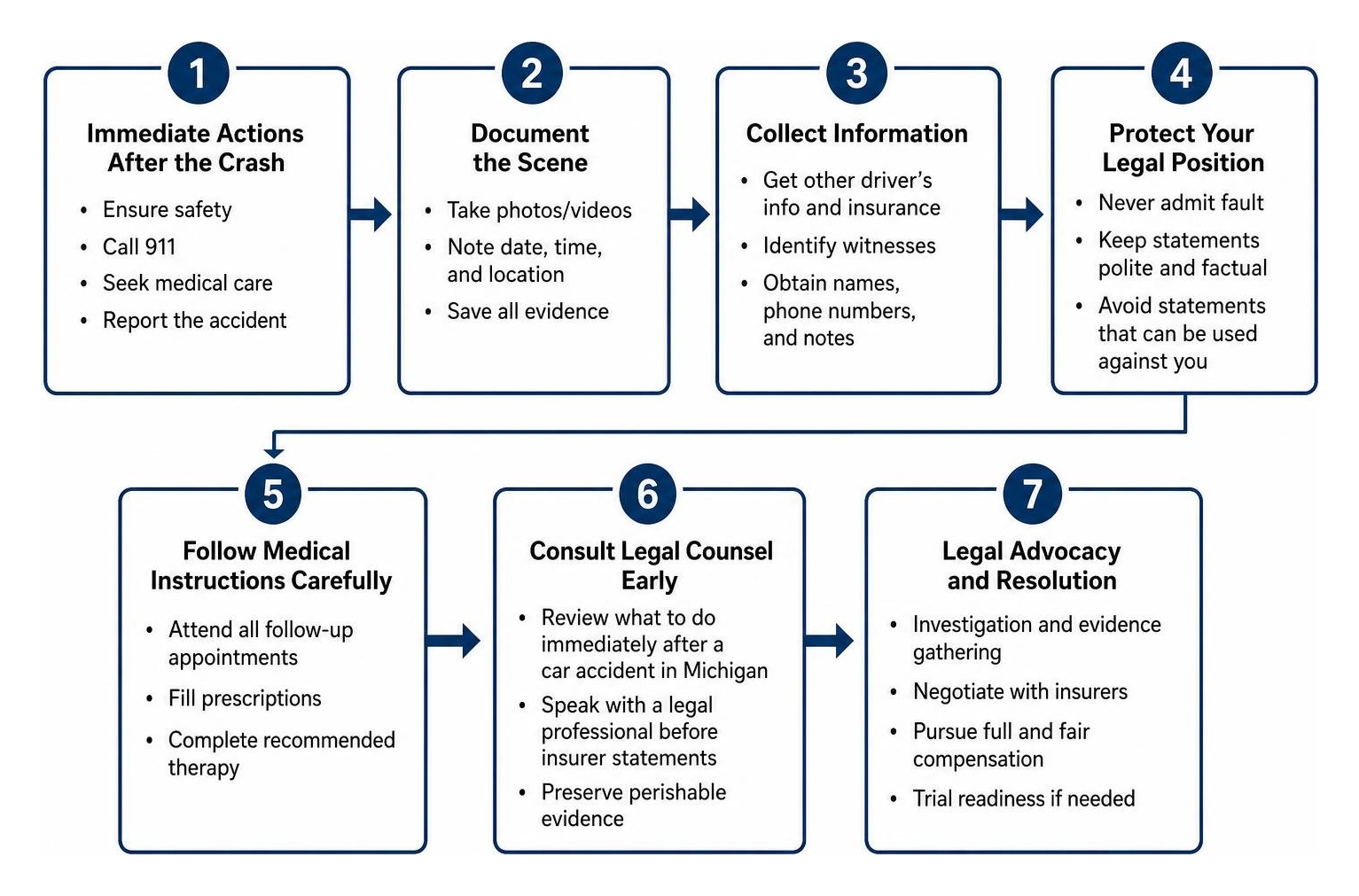
The actions you take in the hours and days following a distracted driving collision directly impact your physical recovery and legal rights. Here is what you must do:
- Seek immediate medical evaluation: Even if you believe your injuries are minor, adrenaline can mask serious conditions such as internal bleeding, soft-tissue tears, or traumatic brain injuries. Prompt medical documentation creates a clear timeline connecting the crash to your injuries.
- Contact law enforcement: Call 911 immediately so the Dearborn Police Department or Michigan State Police can secure the scene, interview witnesses, and create an official crash report.
- Document everything at the scene: If you are physically able, take wide and close-up photographs of vehicle positions, skid marks, property damage, traffic signals, and weather conditions. Capture photos of the other driver’s license, insurance certificate, and license plate.
- Identify witnesses: Obtain names, phone numbers, and brief notes on what bystanders saw, especially if they noticed the other driver looking down at a mobile phone.
- Never admit fault: Keep conversations polite and factual. Avoid making statements such as “I didn’t see you” or “I’m sorry,” which insurance adjusters twist into admissions of liability.
- Follow medical instructions carefully: Attend every follow-up appointment, fill your prescriptions, and complete all recommended physical therapy sessions.
- Consult legal counsel early: Before giving recorded statements to any insurer, review what to do immediately after a car accident in Michigan and speak with a legal professional who can take immediate action to preserve perishable evidence.
Hiring a Dearborn Distracted Driver Injury Lawyer on Contingency
Legal representation should be accessible to everyone, not just large corporations and deep-pocketed insurance companies. For this reason, we handle distracted driving injury cases on a contingency fee basis.
Under a contingency fee agreement:
- You pay zero upfront legal fees to get your case started.
- We cover all upfront case expenses, including investigation fees, accident reconstruction reports, court filing costs, and medical records retrieval.
- We only receive an attorney fee if we successfully recover a financial settlement or court verdict on your behalf.
- If we do not win compensation for your claim, you do not owe us attorney fees.
When you are researching how to choose a Dearborn auto accident lawyer, selecting a firm that combines aggressive trial readiness with compassionate client care gives you the confidence needed to focus entirely on your physical healing.
Frequently Asked Questions About Distracted Driving Claims in Dearborn
What is the statute of limitations for a distracted driving injury lawsuit in Michigan?
Under Michigan Compiled Laws Section 600.5805, the general statute of limitations for filing a personal injury lawsuit against an at-fault driver is three years from the date of the crash. If you fail to file a lawsuit before this three-year window closes, you lose your legal right to pursue compensation forever. Additionally, claims for first-party no-fault PIP benefits have strict one-year notice and claim filing deadlines under Michigan law.
Can I sue a distracted driver if Michigan is a no-fault state?
Yes. While your own insurance provides PIP benefits for baseline medical costs and wage loss, you retain the legal right to file a third-party lawsuit against the distracted driver if their negligence caused your crash and your injuries meet Michigan’s legal injury threshold: death, permanent serious disfigurement, or serious impairment of an important body function.
How much does it cost to hire an attorney for my distracted driving case?
Hiring our firm costs nothing out of pocket. We operate on a contingency fee structure, meaning our legal fee is paid as an agreed-upon percentage of the final settlement or jury verdict we secure for you. We provide free initial case reviews, allowing you to understand your legal options without financial risk.
Stand Up for Your Rights with Jalal Abdallah PLLC
A distracted driving crash can upend your life in an instant, leaving you with mounting medical bills, time away from work, and physical suffering. You should not have to carry the financial burden of someone else’s reckless decision to look at their phone while behind the wheel.
At Jalal Abdallah PLLC, we pride ourselves on being relentless advocates for everyday people. We refuse to let insurance carriers push our clients around, undervalue their pain, or deny them the compensation they rightfully deserve under Michigan law. If you or a loved one has suffered an injury due to a careless motorist, reach out to us today to contact a Dearborn auto accident attorney and take the first step toward securing the justice and financial recovery you need.
Share This Article

Schedule Your Free Consultation Today!
Reach out today and receive a consultation, completely free of charge - we'll evaluate your case and let you know what comes next.


