 Skip to content

Legal Requirements for a Dearborn Nursing Home Death Claim
When a family suspects that fatal harm occurred inside a skilled nursing or long-term care facility in Wayne County, Michigan law imposes rigorous procedural hurdles. Pursuing accountability requires identifying the precise legal theory governing the action. A case against a care facility typically falls into one of two categories: ordinary negligence or medical malpractice.
The distinction hinges on whether the conduct involves medical judgment. In Michigan, if the reasonableness of the healthcare provider’s action can be evaluated by a jury using common everyday knowledge, the claim sounds in ordinary negligence. However, when the claim raises questions of specialized medical assessment, clinical monitoring, wound staging, or systemic infection control, Michigan courts classify the action as medical malpractice. This distinction was underscored in COA 367609 ESTATE OF KAREN SUE EDWARDS V THE RIVERS OF GROSSE POINTE-SNF Opinion, where the Michigan Court of Appeals held that allegations concerning the worsening of decubitus ulcers and subsequent sepsis inherently sound in medical malpractice rather than ordinary negligence because they require evaluating professional clinical judgment.
Families navigating elder and nursing home neglect claims in metro detroit must understand that pressure sores (decubitus ulcers) and sepsis are rarely treated as simple slip-and-fall matters. Establishing causation requires proving that the facility’s failure to turn, reposition, hydrate, or treat the resident directly led to tissue breakdown, systemic infection, and death.
| Factor | Ordinary Negligence | Medical Malpractice |
|---|---|---|
| Standard of Care | Reasonable person standard under similar circumstances | Professional standard of care for similar health professionals |
| Basis of Claim | Lay knowledge, common sense, physical hazards | Medical judgment, clinical charting, specialized treatment |
| Pre-Suit Notice | None required | 182-day Notice of Intent (MCL 600.2912b) required |
| Pleading Requirements | Standard summons and complaint | Affidavit of Merit executed by a qualified healthcare professional |
| Statute of Limitations | 3 years from the date of injury | 2 years from the date of the act or omission |
Distinguishing Medical Malpractice from Ordinary Negligence
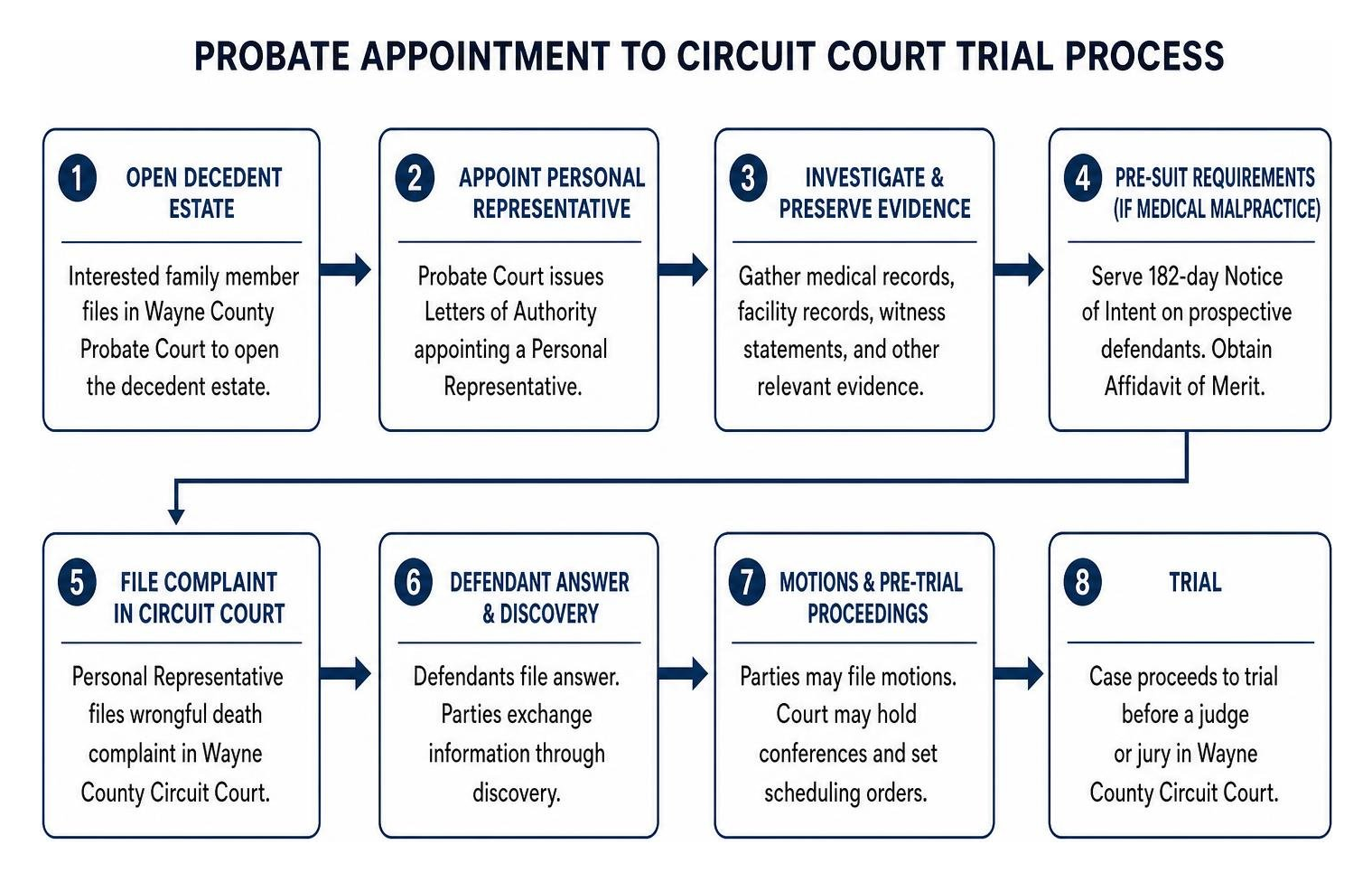
Labeling a lawsuit as “ordinary negligence” does not prevent a Michigan court from evaluating its true legal nature. Under MCL 600.2912b, before filing a medical malpractice claim, a plaintiff must serve a detailed Notice of Intent (NOI) on all prospective defendants at least 182 days prior to filing the complaint. This waiting period allows the parties to evaluate settlement options, but it also tolls the statute of limitations if served correctly.
When filing the actual complaint, the personal representative must attach an Affidavit of Merit signed by a licensed healthcare professional who practices or teaches in the same health discipline as the defendant professionals. If your legal team fails to serve an NOI or omits an Affidavit of Merit because they misjudged the action as ordinary negligence, the Wayne County Circuit Court will dismiss the case. Working with a dedicated team starts by finding a trusted nursing home abuse attorney in dearborn mi who understands these statutory nuances.
Overcoming Immunity Defenses in a Dearborn Nursing Home Death Claim
Many long-term care facilities attempt to shield themselves from liability by raising the Pandemic Health Care Immunity Act (PHCIA), MCL 691.1475. Enacted during the initial public health emergency, the PHCIA granted broad immunity to healthcare providers supporting the state’s pandemic response, covering actions between March 29, 2020, and July 14, 2020, unless gross negligence or willful misconduct was established.
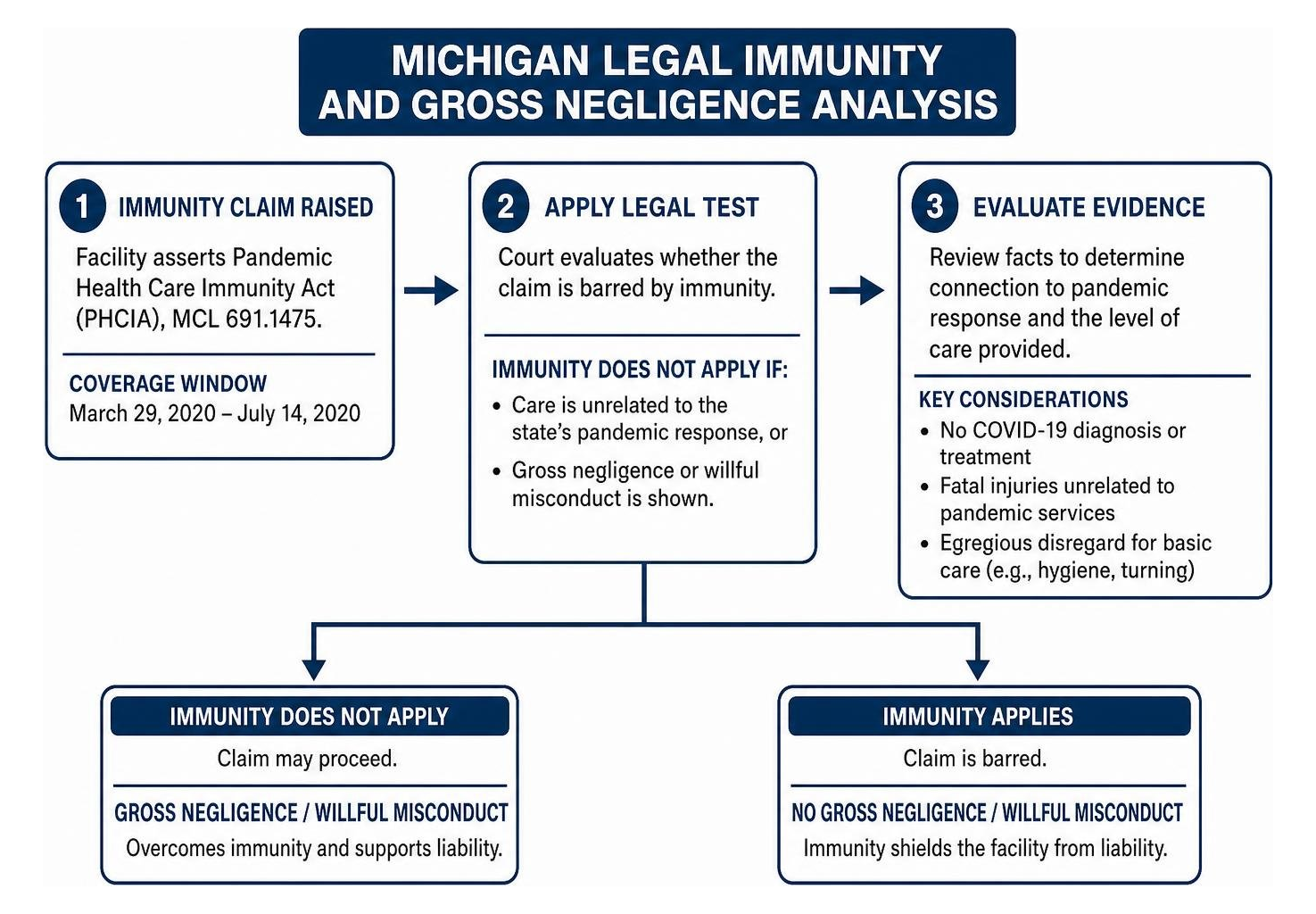
However, immunity is not a blanket shield for all fatal neglect. In Estate of Shirley Jokinen v. Beaumont Hospital Troy, Michigan Court of Appeals, 2025, the Michigan Court of Appeals reversed summary disposition for healthcare defendants. The court ruled that the PHCIA did not bar a medical negligence claim where the 88-year-old decedent was never diagnosed with or treated for COVID-19, and the fatal injuries—severe sacral pressure ulcers leading to sepsis—were entirely unrelated to the state’s pandemic response.
To overcome immunity defenses, we carefully draft the complaint to demonstrate either that the underlying care had no connection to pandemic services or that the facility’s egregious disregard for basic hygiene and turning schedules constituted gross negligence. Our comprehensive dearborn medical malpractice death claim guide for grieving families offers additional insights on handling these complex institutional defenses.
Step-by-Step Process for Investigating and Filing a Fatal Neglect Lawsuit
Securing justice after a fatal incident in a Dearborn facility requires a methodical, evidence-driven approach. Because the resident has passed away, individual family members cannot simply file a lawsuit in their personal capacity. The action must be brought through the probate court system by an authorized representative.
For a broader understanding of fatal accident litigation in our area, review a familys guide to fatal accident lawsuits in dearborn to see how local courts handle estate claims.
How to Initiate a Dearborn Nursing Home Death Claim in Wayne County
To establish standing, an interested family member must open a decedent estate in the Wayne County Probate Court. The probate court issues Letters of Authority appointing a Personal Representative, who is the sole party legally authorized to pursue a wrongful death action under Michigan’s Wrongful Death Act (MCL 600.2922).
Filing timelines require strict attention to Michigan’s wrongful-death saving provision, MCL 600.5852. While medical malpractice claims generally have a two-year statute of limitations from the date of the negligent act:
- The personal representative may file the action within two years after Letters of Authority are issued.
- The lawsuit must be initiated within three years after the period of limitations has run.
- Serving a timely Notice of Intent (NOI) can toll the applicable limitations period, but waiting too long to open the probate estate can extinguish your rights entirely.
Retaining the best wrongful death attorneys in dearborn ensures all probate petitions, letters of authority, and pre-suit notices are coordinated before critical statutory cutoffs expire.
Gathering Evidence and Securing Qualified Clinical Testimony
A strong wrongful death claim requires undeniable documentary evidence. We immediately request and audit:
- Electronic health record (EHR) audit trails to confirm when staff accessed or modified charts.
- Nursing flowsheets detailing turning schedules, incontinence care, and fluid intake.
- Medication administration records (MARs) showing whether prescribed antibiotics or pain relievers were delivered.
- Centers for Medicare & Medicaid Services (CMS) inspection reports, deficiency citations, and staffing ratio logs.
- Internal facility incident reports and infection control committee logs regarding pathogens such as Clostridioides difficile (C. diff) or Methicillin-resistant Staphylococcus aureus (MRSA).
Concrete proof is indispensable. In ESTATE OF ADELINDA O’DONNELL V SHELBY NURSING CENTER, the Michigan Court of Appeals affirmed summary disposition for a nursing facility because the estate failed to present admissible evidence establishing that a failure in fall prevention protocols or infection tracking proximately caused the resident’s death. The court confirmed that plaintiffs cannot rely on the doctrine of res ipsa loquitur (the thing speaks for itself) in long-term care settings, because falls and medical declines can occur without professional negligence. The plaintiff must present qualified healthcare testimony to bridge the gap between facility conduct and the cause of death.
Navigating Pretrial Motions and Defending Against Summary Disposition

Corporate nursing home operators routinely attempt to dispose of lawsuits before trial by filing motions for summary disposition under Michigan Court Rule (MCR) 2.116:
- MCR 2.116(C)(7) (Immunity and Timeliness): Defendants argue the claim is barred by the statute of limitations or statutory immunity, such as the PHCIA. We counter by presenting certified probate records, proof of timely NOI service, and medical records establishing that the resident’s injuries fell outside pandemic relief operations.
- MCR 2.116(C)(8) (Failure to State a Claim): Defendants argue that the complaint lacks legal sufficiency. We draft detailed, fact-specific complaints asserting both vicarious liability (holding the facility responsible for the negligent acts of its nurses, aides, and physicians) and direct corporate liability (such as systemic understaffing, negligent hiring, and failure to enforce infection protocols).
- MCR 2.116(C)(10) (No Genuine Issue of Material Fact): Defendants assert that no reasonable jury could find in the plaintiff’s favor. To defeat a (C)(10) motion, we submit detailed affidavits from qualified clinicians, nursing logs, physical wound photography, and deposition testimony demonstrating clear breaches of the standard of care.
By building an unassailable evidentiary record early in the litigation, we protect the estate from premature dismissal and position the claim for trial or fair settlement. To understand the financial components involved in these proceedings, explore our resource on dearborn fatal accident compensation what families may be able to recover.
Frequently Asked Questions About Nursing Home Death Lawsuits in Michigan
What is the deadline to file a fatal nursing home neglect lawsuit in Michigan?
In Michigan, medical malpractice actions generally carry a two-year statute of limitations from the date of the negligent act or omission. However, under the wrongful-death saving provision (MCL 600.5852), a personal representative appointed by the probate court has up to two years from receiving Letters of Authority to file suit, provided the action begins within three years after the initial two-year period expires. Serving a proper Notice of Intent tolls this clock, but calculating deadlines requires careful review of your probate timeline. Learn more in our overview of dearborn fatal accident claim essential legal steps for families.
Can a facility claim pandemic immunity for fatal pressure ulcers or sepsis?
No, facilities cannot claim blanket immunity simply because an injury occurred during the pandemic window. Under recent Michigan appellate decisions like Jokinen v. Beaumont Hospital Troy, the Pandemic Health Care Immunity Act only applies to healthcare services directly provided in support of the state’s COVID-19 response. Routine nursing care, such as turning bedridden residents, changing dressings, and managing pressure ulcers, is not automatically immune, especially if gross negligence is properly pleaded and proven.
What damages can surviving family members recover in a wrongful death claim?
Under Michigan’s Wrongful Death Act (MCL 600.2922), eligible family members—including surviving spouses, children, parents, and siblings—may recover financial compensation for:
- Reasonable medical, hospital, and nursing home expenses incurred prior to death.
- Funeral, burial, and memorial service costs.
- Compensation for the conscious pain and suffering endured by the deceased between the time of injury and death.
- Loss of the decedent’s society, companionship, advice, and emotional support.
Standing Up for Families When Care Facilities Fail
When a vulnerable parent or relative dies due to neglect in a long-term care facility, grieving families face well-funded corporate operators and aggressive defense insurers. At Jalal Abdallah PLLC, we stand up as relentless advocates for underdogs. We dismantle corporate defense tactics, hold neglectful facilities accountable, and navigate complex Michigan probate and medical malpractice statutes so your family can find answers.
If your loved one suffered a preventable decline, severe pressure ulcers, or untreated sepsis in Wayne County, do not let facility administrators hide behind complex legal technicalities. Explore our wrongful death legal resources or reach out directly through our contact page to schedule a confidential, comprehensive case evaluation with our team.
Share This Article

Schedule Your Free Consultation Today!
Reach out today and receive a consultation, completely free of charge - we'll evaluate your case and let you know what comes next.


