 Skip to content

What to Do After a Lyft Crash in Dearborn, Michigan
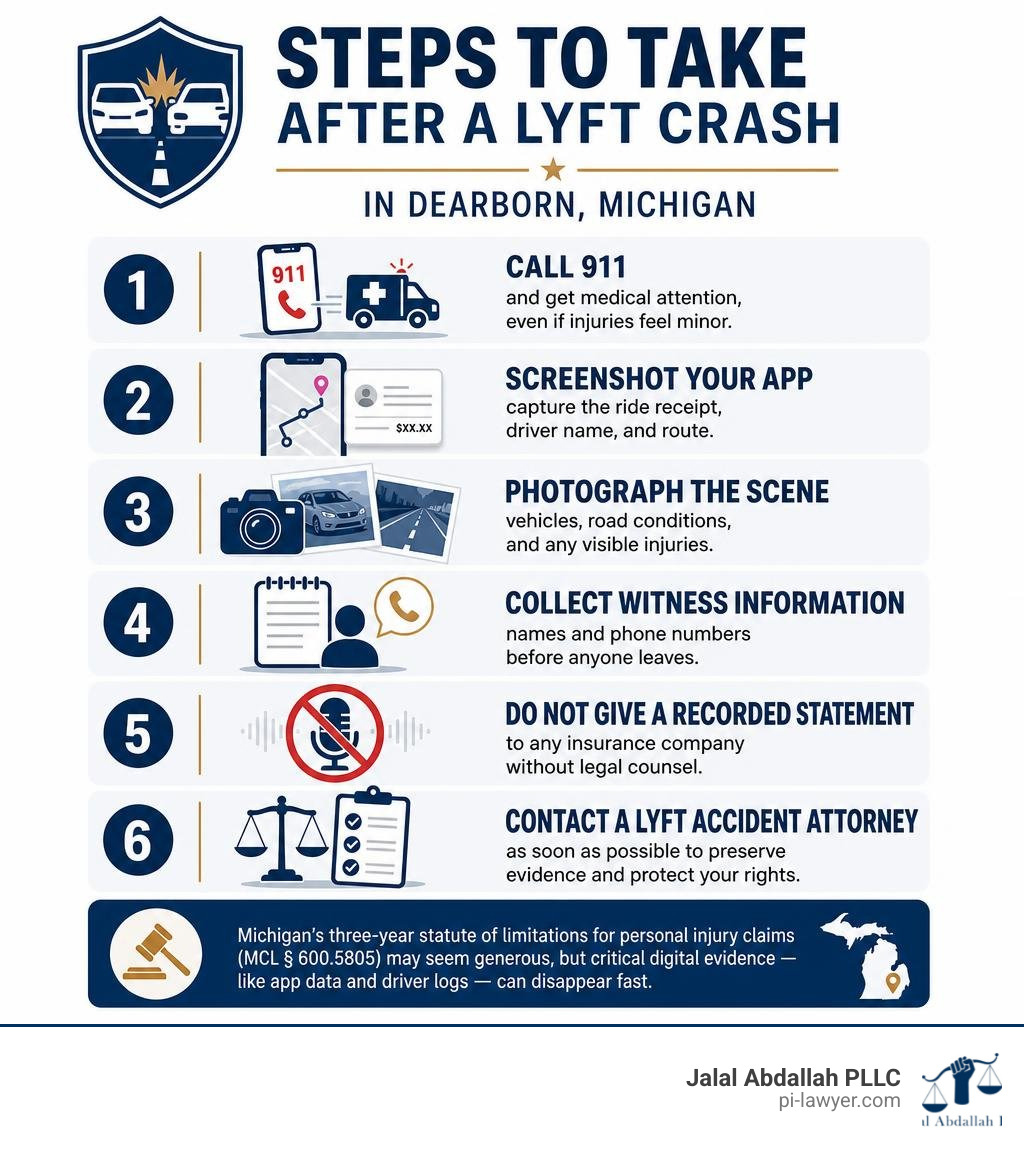
If you need a Dearborn Lyft crash attorney, here is what matters most right now:
- Call 911 and get medical attention, even if injuries feel minor
- Screenshot your Lyft app — capture the ride receipt, driver name, and route
- Photograph the scene — vehicles, road conditions, and any visible injuries
- Collect witness information — names and phone numbers before anyone leaves
- Do not give a recorded statement to any insurance company without legal counsel
- Contact a Lyft accident attorney as soon as possible to preserve evidence and protect your rights
Michigan’s three-year statute of limitations for personal injury claims (MCL § 600.5805) may seem generous, but critical digital evidence — like Lyft app data and driver logs — can disappear fast.
Every day, thousands of Lyft rides happen in and around Dearborn. Most are uneventful. But when something goes wrong, injured passengers, drivers, and pedestrians quickly discover that a rideshare crash is nothing like a standard car accident. Multiple insurance policies, shifting liability depending on the driver’s app status, and Michigan’s complex No-Fault system can make even a straightforward injury claim feel impossible to resolve on your own.
Lyft’s arrival in cities like Dearborn has been linked to a measurable rise in traffic fatalities — research associates rideshare services with approximately a 3% increase in fatal accidents. That is not a small number when real lives are at stake.
The insurance process is designed to be confusing. Lyft classifies its drivers as independent contractors, and its coverage can swing from $1 million in liability protection when a passenger is on board down to far more limited amounts when a driver is simply waiting for a ride request. Knowing exactly which policy applies — and fighting to enforce it — is where the right legal representation makes all the difference.
I’m Jalal Abdallah, a personal injury attorney based in Dearborn who has built a career fighting insurance companies on behalf of people who feel outmatched by the system — and as a Dearborn Lyft crash attorney, I understand both Michigan’s No-Fault laws and the specific tactics rideshare insurers use to minimize payouts. If you or someone you love has been hurt in a rideshare crash, keep reading — this guide will walk you through everything you need to know.
Why Rideshare Accidents Are More Complex Than Standard Car Crashes
In a traditional car accident, you are typically dealing with two drivers and their respective personal auto insurance policies. The lines of responsibility are usually clear. However, when a rideshare vehicle is involved, the situation becomes complicated instantly.
The core of this complexity lies in how rideshare companies structure their businesses. Lyft and Uber classify their drivers as independent contractors rather than employees. This legal distinction is a deliberate shield. It allows multi-billion-dollar tech giants to argue that they are not directly responsible for a driver’s negligence behind the wheel. When a crash occurs, their default stance is often to point the finger back at the driver’s personal insurance policy.
At the same time, personal auto insurance companies almost always exclude coverage for commercial activities. If a driver is using their vehicle to carry passengers for hire, their personal insurer will likely deny the claim. This leaves victims caught in a frustrating game of finger-pointing, where both insurers deny responsibility. Understanding how insurance companies try to devalue your injury claim is critical to avoiding these traps.
Common Causes of Rideshare Collisions in Wayne County
Rideshare drivers in Wayne County face unique pressures that increase the likelihood of a crash. Some of the most common contributing factors we see include:
- Distracted Driving: Rideshare drivers must constantly interact with their phones to accept rides, navigate via GPS, and monitor passenger communications. Looking at a screen instead of the road is just as hazardous as driving under the influence.
- Driver Fatigue: Many Lyft and Uber drivers work long hours, often after completing a full shift at another job. Fatigued driving severely slows reaction times.
- Sudden Stops and Unsafe Pull-Overs: Drivers frequently stop abruptly or pull over illegally on busy Dearborn corridors to let passengers in or out.
- Unfamiliar Routes: Drivers are often guided into unfamiliar neighborhoods or high-risk areas, leading to sudden lane changes or missed turns.
These hazards are amplified on high-traffic corridors like Telegraph Road, Ford Road, Michigan Avenue, and the Southfield Freeway, where heavy congestion and high speeds create a volatile environment for distracted rideshare drivers.
Why You Need a Dearborn Lyft Crash Attorney
Attempting to handle a rideshare claim on your own is an uphill battle. You are not just negotiating with a local insurance agent; you are up against corporate legal teams and commercial insurance adjusters whose sole job is to protect their bottom line.
A dedicated Dearborn Lyft crash attorney acts as your shield and advocate. We take over all communications with the insurance companies, gather black-box and GPS data from the rideshare platform, and build a trial-ready case. If you are unsure of how to proceed, reviewing a guide to choosing a Dearborn vehicle collision attorney can help you identify a firm that possesses the litigation experience required to secure a fair recovery.
How a Dearborn Lyft Crash Attorney Resolves Complex Insurance Claims
Resolving a rideshare claim requires a deep understanding of how commercial insurance policies interact with Michigan’s unique auto laws. Because liability is tied directly to what the driver was doing at the exact millisecond of the collision, recovering compensation depends on securing digital evidence. We routinely subpoena trip logs, GPS data, and internal app records to establish the driver’s precise status during the crash.
To understand how these claims are pursued in Southeast Michigan, it is essential to look at the statutory guidelines established under Michigan’s Insurance Code and the local court processes in Wayne County. Navigating the Third Judicial Circuit Court requires a strategic approach to filing complaints, managing discovery, and presenting digital evidence to establish liability. These legal frameworks highlight the immense value of commercial policies when properly navigated.
Understanding the Four Periods of Rideshare Liability
Under Michigan law, Lyft must provide tiered insurance coverage based on the driver’s activity. This is broken down into four distinct periods:
| Rideshare Period | Driver Activity | Primary Insurance Coverage | Liability Limits |
|---|---|---|---|
| Period 0 | App is closed / offline | Driver’s personal auto insurance | Driver’s personal policy limits |
| Period 1 | App is open; waiting for a ride request | Lyft’s contingent liability coverage (if personal policy denies) | $50,000 per person / $100,000 per accident for bodily injury; $25,000 for property damage |
| Period 2 | Ride accepted; driver is en route to pick up passenger | Lyft’s commercial liability insurance | Up to $1 million in third-party liability coverage |
| Period 3 | Passenger is inside the vehicle | Lyft’s commercial liability insurance | Up to $1 million in third-party liability coverage; includes uninsured/underinsured motorist cover |
How a Dearborn Lyft Crash Attorney Decodes Insurance Gaps
The transition between these periods is where insurance companies look for “gaps” to deny coverage. For example, if a driver has the app open but has not yet accepted a ride (Period 1), Lyft’s commercial policy only provides limited coverage. If the driver’s personal insurer denies the claim due to a commercial-use exclusion, the victim may find themselves with significantly less coverage than they would if the driver was actively transporting a passenger.
We know how to investigate these gaps. By cross-referencing the driver’s mobile phone activity, app log-in data, and GPS tracking, we can verify the driver’s exact status. If you need assistance determining how these layers apply to your crash, learning how to choose a Dearborn auto accident lawyer is an essential step in protecting your rights.
Michigan’s No-Fault Insurance System and Lyft Accidents
Michigan operates under a unique No-Fault insurance system. This means that regardless of who caused the accident, your own auto insurance policy is generally responsible for paying your medical bills and lost wages through Personal Injury Protection (PIP) benefits.
However, rideshare accidents introduce a layer of complexity to this system. Depending on whether you were a passenger in the Lyft, a driver of another vehicle, or a pedestrian, the “priority” of which insurance company must pay your PIP benefits changes. To understand what your claim is truly worth under these rules, consult our Dearborn car wreck compensation guide.
Personal Injury Protection (PIP) and Third-Party Claims
Under Michigan’s No-Fault rules, PIP benefits cover:
- Reasonable and necessary medical expenses for your lifetime (subject to the PIP limit selected on your policy).
- Up to 85% of your lost wages for up to three years if your injuries prevent you from working.
- Replacement services (up to $20 per day) to help with household chores you can no longer perform.
While PIP covers your economic losses, it does not compensate you for pain, suffering, or mental anguish. To recover these non-economic damages, you must file a “third-party” lawsuit against the at-fault rideshare driver and Lyft’s commercial policy. To do this, your injuries must meet Michigan’s “serious impairment of body function” threshold.
Furthermore, Michigan utilizes a modified comparative negligence system. If you are found to be more than 50% at fault for the accident, you are legally barred from recovering any non-economic damages. A skilled attorney will fight to ensure the insurance companies do not unfairly shift the blame onto you to avoid paying what you deserve.
Statute of Limitations and Crucial Deadlines
Time is your enemy after a rideshare crash. Michigan has strict statutory deadlines that cannot be missed:
- The One-Year PIP Deadline: You must file an application for No-Fault PIP benefits with the correct insurance carrier within one year of the date of the accident. If you miss this deadline, you lose your right to PIP benefits forever.
- The One-Year-Back Rule: Even if you file your claim on time, you cannot recover No-Fault benefits for any medical expenses incurred more than one year before a lawsuit is filed.
- The Three-Year Third-Party Deadline: You have three years from the date of the crash to file a personal injury lawsuit for pain and suffering (MCL § 600.5805).
For a detailed breakdown of these timelines and how they apply to your case, see our car accident lawyer Dearborn guide.
Steps to Take Immediately After a Dearborn Rideshare Crash
The actions you take in the hours and days following a rideshare crash will directly impact the success of your legal claim. Insurance companies look for any excuse to deny coverage or minimize your injuries, so building a strong foundation of evidence early is paramount. For a comprehensive list of immediate steps, read our guide on what to do immediately after a car accident in Michigan.
Preserving Critical Evidence at the Scene
If you are physically able, take the following steps while still at the scene of the crash:
- Take Screenshots: Open your Lyft app and take screenshots of your ride details, driver profile, receipt, and the map route. This information can disappear or update once the ride is marked complete or canceled.
- Document the Scene: Photograph the damage to all vehicles, skid marks on the road, traffic signs, and any visible physical injuries.
- Identify Witnesses: Get the names, phone numbers, and addresses of any bystanders who saw the crash occur. Do not rely solely on the police report to capture this.
- Avoid Recorded Statements: Do not agree to have your statement recorded by any insurance adjuster — including your own — until you have spoken with an attorney.
For more strategic advice on protecting your claim from day one, review our article on 5 moves to make after a car accident lawyer Dearborn.
Frequently Asked Questions About Dearborn Lyft Accidents
What Compensation Can I Recover in a Lyft Accident Claim?
You can recover both economic and non-economic damages. Economic damages cover tangible financial losses such as outstanding medical bills, rehabilitation costs, future medical care, and lost wages. Non-economic damages compensate you for physical pain, emotional trauma, loss of enjoyment of life, and permanent scarring or disability.
When Should I Contact a Lyft Accident Lawyer in Dearborn?
You should contact an attorney immediately after your accident. The sooner we can begin investigating, the easier it is to preserve digital app data, obtain nearby traffic camera footage, and prevent insurance companies from taking advantage of you during a vulnerable time.
Secure Justice with Relentless Legal Advocacy
At Jalal Abdallah PLLC, we do not back down from fights against massive insurance corporations or tech giants. We understand that behind every case file is a real person in Dearborn, Detroit, Southfield, or Warren who is trying to rebuild their life after a devastating crash.
We work on a contingency fee basis, meaning you pay nothing upfront, and we only get paid if we win your case. Let us handle the complex insurance negotiations while you focus on your physical recovery.
If you are ready to hold the responsible parties accountable and secure the compensation you deserve, contact our legal team today for a free, no-obligation case evaluation.
Share This Article

Schedule Your Free Consultation Today!
Reach out today and receive a consultation, completely free of charge - we'll evaluate your case and let you know what comes next.


