 Skip to content

How a Long-Term Care Lawyer in Dearborn Can Help Protect Your Retirement
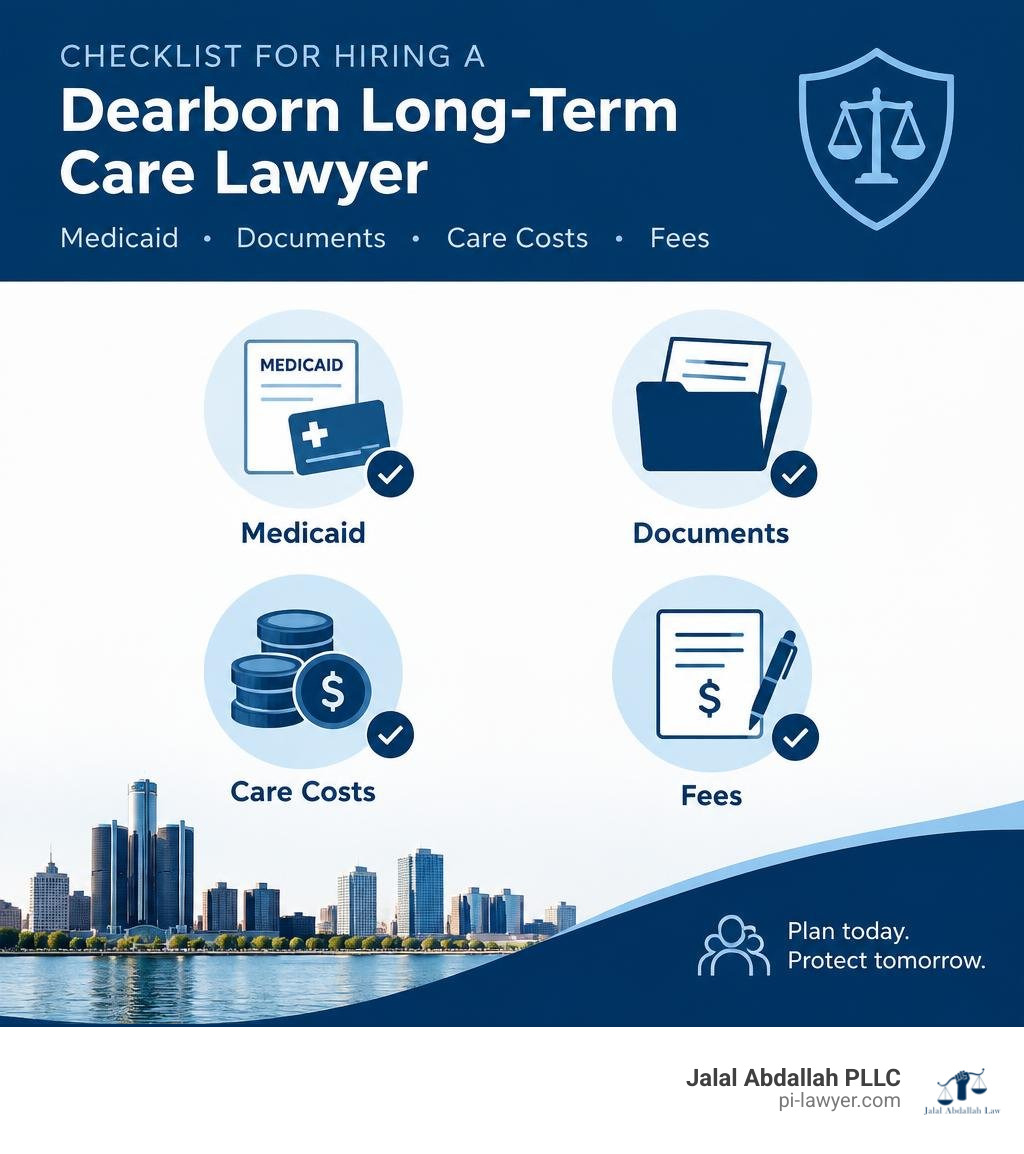
A long term care lawyer Dearborn families trust can help you plan for care costs, check Michigan Medicaid eligibility, prepare decision-making documents, and protect a spouse’s finances. Before hiring one, ask about their experience with Medicaid applications and Wayne County probate matters. Bring bank statements, insurance policies, and any estate documents to your first meeting.
Michigan nursing home care can exceed $100,000 a year. Planning early gives you more options, but even if care is needed now, get legal advice before moving assets: Medicaid generally reviews transfers made during the previous five years.
I’m Jalal Abdallah, a Michigan attorney and licensed life and health insurance producer who earned my bachelor’s degree at the University of Michigan-Dearborn. My legal and insurance background informs this guide for residents evaluating their long-term legal options. At Jalal Abdallah PLLC, we help Dearborn families protect their retirement from long-term care costs.
Related legal guidance for seniors and families:
- assisted living attorney dearborn
- medical malpractice attorney Dearborn
- wrongful death attorney dearborn
Understanding Long-Term Care Planning and Healthcare Costs in Michigan
Long-term care encompasses a broad spectrum of medical, personal, and social services needed by individuals who lack the capacity for self-care over an extended period. In Michigan, the financial reality of aging has caught countless families off guard. As medical advances extend lifespans, the odds of requiring custodial or skilled nursing support rise dramatically.
The primary hurdle facing Dearborn seniors is the staggering cost of residential facilities. The annual cost of skilled nursing home care in Michigan regularly exceeds $100,000 per year, often surpassing $8,500 to $9,000 per month in Wayne County. Paying out-of-pocket causes rapid private-pay depletion, draining life savings that took decades to build. When families explore securing quality senior care with a dedicated assisted living attorney in Dearborn, they quickly discover that Medicare provides only limited, short-term rehabilitation benefits, leaving the resident responsible for ongoing custodial room and board.
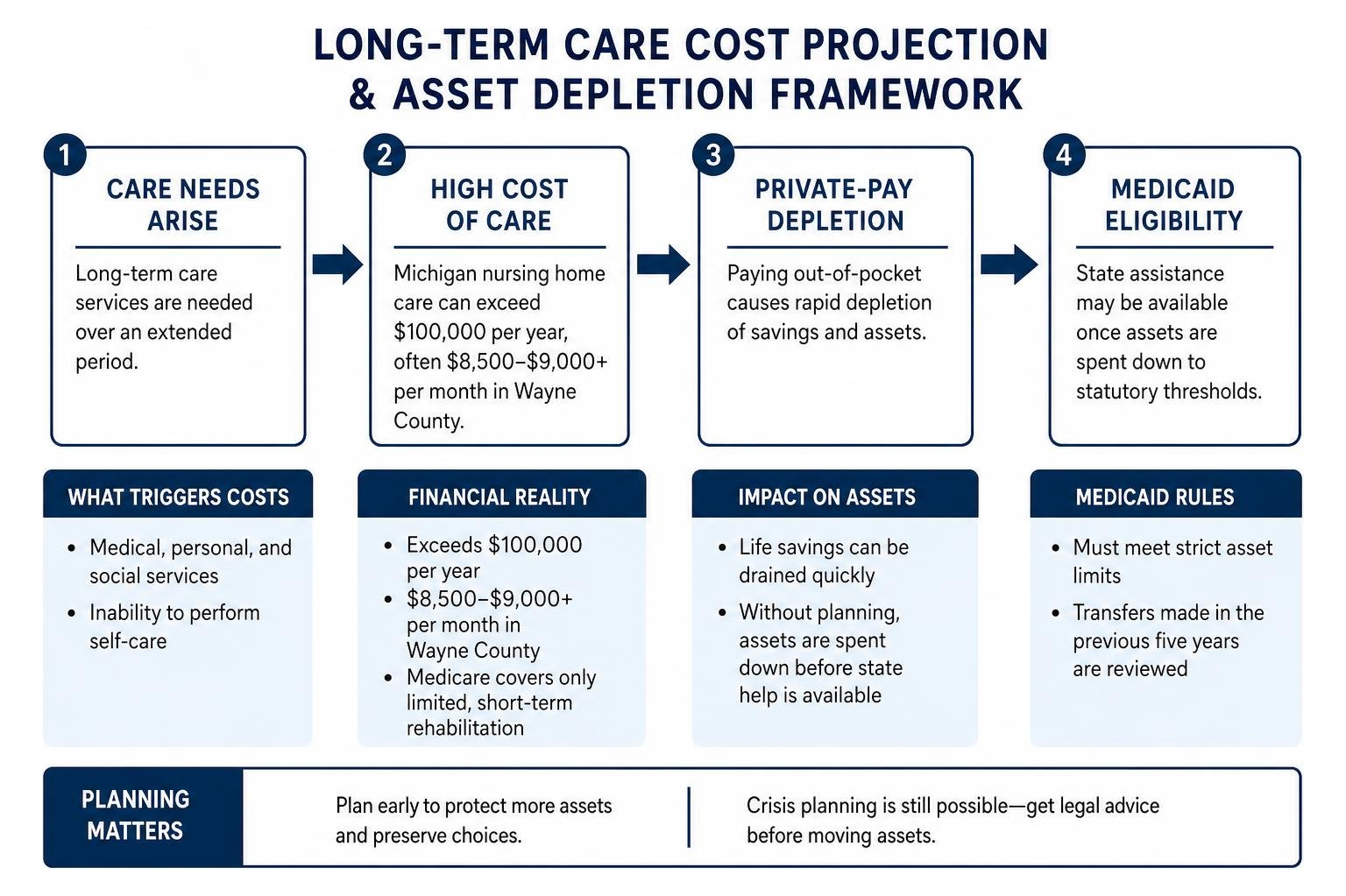
Without legal intervention, an individual must spend their resources down to strict statutory thresholds before state assistance kicks in. Furthermore, when unexpected incapacity strikes without prior planning, families end up trapped in lengthy, public Wayne County Probate Court proceedings just to manage daily finances.
Essential Legal Documents for Long-Term Preparedness
Comprehensive planning requires proactive legal instrumentation. A complete elder care estate plan incorporates several core documents:
- Durable Financial Power of Attorney (DPOA): Authorizes a designated agent to handle banking, tax filings, real estate transactions, and Medicaid restructuring without court intervention.
- Designation of Patient Advocate (Healthcare Power of Attorney): Grants a trusted individual the authority to make critical medical choices if you cannot communicate.
- Living Wills and Advance Medical Directives: Expresses your direct preferences concerning life-sustaining treatment, tube feeding, and palliative care.
- Revocable and Irrevocable Living Trusts: Protects real estate and capital while dictating seamless asset distribution.
- HIPAA Authorizations: Ensures family members obtain necessary medical records without bureaucratic delays.
Having these documents coordinated can be vital, such as when safeguarding rights with a Dearborn survivor benefits attorney after the passing of a spouse.
Guardianship vs. Conservatorship Under Michigan Probate Law
When an aging adult becomes legally incapacitated without valid powers of attorney, families must petition the Wayne County Probate Court for authority. Michigan law divides this oversight into two distinct roles:
| Legal Role | Primary Authority | Court Oversight & Scope |
|---|---|---|
| Guardianship | Care, custody, medical decisions, living arrangements | Appointed when an individual lacks capacity to make personal care choices; requires annual reporting to the court. |
| Conservatorship | Financial management, estate protection, asset administration | Appointed to collect income, pay bills, manage property, and sell real estate; requires formal annual accountings and court bonds. |
Navigating probate court can be emotionally exhausting and financially draining. Establishing strong powers of attorney early allows you to select your own decision-makers and bypass the court system entirely.
Why Hiring a Long Term Care Lawyer in Dearborn Is Essential for Asset Protection
Qualifying for Michigan Medicaid (administered through the Michigan Department of Health and Human Services) is a primary legal defense against nursing home costs. However, Medicaid is a strictly means-tested program. For an individual applicant, countable assets are generally restricted to just $2,000.
Navigating the line between exempt assets (such as an owner-occupied primary residence up to state equity thresholds, one vehicle, and prepaid funeral contracts) and countable liquid resources requires careful legal guidance. At Jalal Abdallah PLLC, we use proven legal strategies—such as Medicaid-compliant annuities, Lady Bird deeds (Enhanced Life Estate Deeds), and irrevocable trusts—to shield resources while staying compliant with state and federal regulations.
These strategies protect healthy spouses through Spousal Impoverishment Protections, ensuring the community spouse preserves their allowable Community Spouse Resource Allowance (CSRA) and monthly income without sinking into poverty.
Proactive vs. Crisis Strategies with a Long Term Care Lawyer in Dearborn
Timing dictates your legal options. Elder law strategies generally fall into two categories:
| Feature | Proactive Planning (5+ Years Ahead) | Crisis Planning (Immediate Facility Placement) |
|---|---|---|
| Timing | Initiated well before health deteriorates | Initiated when nursing home entry is imminent or underway |
| Asset Protection Rate | Up to 100% of family assets shielded | Typically preserves 50% or more of remaining assets |
| Look-Back Impact | Clears the mandatory 5-year look-back period | Must structure around divestment penalty calculations |
| Primary Tools | Irrevocable asset protection trusts, Lady Bird deeds | “Half-a-loaf” gifting strategies, promissory notes, crisis annuities |
Medicaid imposes a strict 60-month (five-year) look-back period on all asset transfers. Giving money away directly to family triggers penalty periods of Medicaid ineligibility. However, when faced with an emergency admission, a skilled attorney can utilize “half-a-loaf” planning. This time-tested strategy pairs a calculated gift with a Medicaid-compliant promissory note or annuity, allowing families to save 50% or more of their life savings rather than losing everything to private facility rates.
Leveraging Government Benefits and Veterans Aid & Attendance
For wartime veterans and their surviving spouses, the Department of Veterans Affairs offers pension enhancements, including the Non-Service Connected Pension with Aid & Attendance. This monthly benefit provides tax-free funds to offset the cost of home care, assisted living, or skilled nursing.
The VA applies a three-year look-back period for asset transfers. Coordinating VA benefits with future Medicaid needs requires balanced structuring. By coordinating structured IRA distributions, minimizing taxable events, and securing maximum community spousal allowances, we help veterans and their families assemble a comprehensive payment strategy.
Protecting Senior Rights, Facility Admissions, and Preventing Elder Abuse
Entering a long-term care facility involves signing extensive admission contracts. Many facilities insert arbitration clauses or attempt to obligate children financially as third-party guarantors. An attorney reviews these agreements to protect resident rights and ensure families do not assume unintended personal liabilities.
Moreover, if quality of care breaks down, legal oversight becomes critical. When safety standards are ignored, families must understand their recourse for navigating elder and nursing home neglect claims in Metro Detroit.
Safeguarding Vulnerable Adults from Financial Exploitation and Neglect
Cognitive decline leaves older adults vulnerable to financial exploitation by predatory caregivers, unscrupulous family members, or third-party fraudsters. Common red flags include:
- Unexplained withdrawals or sudden changes in banking habits.
- Abrupt amendments to wills, trusts, or beneficiary designations.
- Isolation of the senior from their longtime friends and family.
- Unpaid utility bills or care expenses despite ample retirement funds.
When fiduciary breaches occur, swift legal steps—such as securing emergency asset-freezing orders, filing protective petitions in Wayne County Probate Court, reporting to Adult Protective Services, or identifying issues with a trusted nursing home abuse attorney in Dearborn MI—are necessary to halt abuse and recover stolen assets.
Selecting Legal Counsel and Navigating Wayne County Elder Care Law
Elder law blends healthcare coordination, government benefit rules, tax law, and estate planning. Navigating this intersection requires counsel familiar with the administrative staff of the Michigan Department of Health and Human Services (MDHHS) and local Wayne County probate judges.
How to Choose the Right Long Term Care Lawyer in Dearborn
When selecting a long term care lawyer Dearborn residents can rely on to protect their interests, consider these practical factors:
- Focused Elder Law Experience: Verify their background in handling Medicaid applications, spend-down strategies, and probate litigation.
- Transparent Fee Structures: Seek firms offering clear flat-fee or milestone structures for Medicaid applications rather than unpredictable hourly billing.
- Multi-Disciplinary Coordination: Ensure the firm works smoothly alongside financial planners, tax accountants, and care managers.
- Consultation Readiness: Assemble your essential paperwork—including deeds, tax returns, banking statements, and insurance policies—before your first meeting to streamline the analysis.
Frequently Asked Questions About Long-Term Care Planning in Dearborn
How much does nursing home care cost in Michigan?
In Michigan, skilled nursing home care costs often exceed $100,000 annually, with Wayne County facilities averaging between $8,500 and $10,000 per month for private-pay residents. These expenses can exhaust an average retirement nest egg within one to two years without Medicaid or long-term care insurance.
What is the Medicaid five-year look-back period?
The Medicaid five-year look-back period is a 60-month window preceding your application date during which the state reviews all asset transfers. If MDHHS discovers that assets were transferred for less than fair market value, they assess a divestment penalty period during which Medicaid will not pay for nursing home care.
Can Medicaid take my home if I enter a nursing home in Dearborn?
Under the Michigan Medicaid Estate Recovery Program, the state may seek reimbursement from a deceased recipient’s probate estate. However, your primary residence is generally an exempt asset while you or your spouse reside there. Proper planning tools—such as a Lady Bird deed or an asset protection trust—allow you to transfer real estate outside of probate, protecting your home from state recovery claims.
Securing Your Legacy and Protecting Your Family’s Future
Long-term care planning is about protecting your autonomy, your dignity, and the family wealth you spent decades building. You do not have to watch your life savings disappear to nursing home bills or navigate complex government benefit programs alone. At Jalal Abdallah PLLC, we provide dedicated advocacy against complex bureaucracies to ensure our clients secure the care they deserve while preserving their hard-earned assets. Take control of your retirement today and schedule a consultation with our Dearborn legal team.
Share This Article

Schedule Your Free Consultation Today!
Reach out today and receive a consultation, completely free of charge - we'll evaluate your case and let you know what comes next.


