Dearborn Bus Crash Claim: Your Roadmap to Recovering Compensation
What a Dearborn Bus Crash Claim Really Means for You
Filing a Dearborn bus crash claim is not the same as filing a regular car accident claim — and missing even one deadline can cost you everything.
Here is what you need to know right away:
- File for PIP benefits within 1 year of the crash
- Send written notice to public transit providers (DDOT, SMART) within 60 days
- File your personal injury lawsuit within 3 years
- Get medical care first — then document everything
- Do not give recorded statements to insurers before speaking with an attorney
Michigan’s no-fault system means you can recover medical expenses and lost wages through PIP benefits regardless of who caused the crash. But if your injuries are serious, you may also have the right to sue the at-fault party — whether that’s a bus driver, transit authority, or private operator — for pain and suffering and other damages.
Bus accidents in Dearborn fall under Wayne County, which leads all Michigan counties in total crashes, fatal crashes, and injury crashes. These are not minor incidents. Buses carry many passengers, hit with tremendous force, and often involve government agencies with strict legal rules that protect them — unless you act fast.
The clock starts the moment the crash happens. If a public bus was involved, you may have as little as 60 days to preserve your right to sue.
Understanding Your Rights Under Michigan No-Fault Law
Michigan’s auto insurance system is famously unique, and when a massive commercial vehicle like a bus is involved, things get complicated quickly. If you are injured while riding a bus, walking as a pedestrian, or driving another vehicle that gets hit by a bus, your primary path to medical and financial recovery is governed by Michigan’s No-Fault Insurance Law.
Under this system, your own auto insurance policy is typically responsible for paying your Personal Injury Protection (PIP) benefits. These benefits are designed to keep you afloat financially while you recover. They cover:
- Medical Expenses: All reasonably necessary medical care, rehabilitation, and therapy costs resulting from your injuries.
- Lost Wages: Up to 85% of your lost income for up to three years if your injuries prevent you from returning to work.
- Attendant Care: Payment for in-home nursing or daily living assistance if your injuries are severe enough to require daily help.
- Replacement Services: Up to $20 per day to pay for household tasks you can no longer perform, such as cleaning, cooking, or yard work.
These PIP benefits are paid regardless of who caused the bus accident. However, the Michigan Department of Insurance and Financial Services (DIFS) sets strict guidelines on how these claims are administered, and insurance companies often look for any excuse to delay, minimize, or deny your benefits.
If your injuries are severe, PIP benefits may not cover the full extent of your physical and emotional trauma. In these cases, you have the right to step outside the no-fault system and file a third-party liability lawsuit against the at-fault bus driver, the bus company, or the public transit agency. This third-party claim allows you to pursue non-economic damages, such as pain and suffering, as well as excess economic losses that exceed your PIP coverage limits.
How No-Fault Rules Apply to a Dearborn Bus Crash Claim
If you were a passenger on a bus in Dearborn and do not own a vehicle or have your own auto insurance policy, you might wonder who pays for your medical bills. Michigan law establishes a strict “priority order” to determine which insurance company is responsible for your PIP benefits after a bus accident:
- Your Own Policy: If you have personal auto insurance, your insurer pays first.
- Spouse or Relative’s Policy: If you do not have a policy, the insurer of a spouse or a resident relative you live with is next in line.
- The Bus Owner’s Insurer: If no personal or household policies exist, the insurance company that covers the bus itself must provide your PIP benefits.
- The Bus Driver’s Insurer: If the bus is uninsured, the personal auto insurer of the bus driver is responsible.
- Michigan Assigned Claims Plan (MACP): If no other insurance is available, your claim is submitted to the MACP, which assigns an insurer to handle your benefits (subject to a $250,000 PIP cap).
Navigating this priority order can be incredibly stressful when you are trying to heal. Insurance companies frequently argue over who is responsible for paying, leaving injured victims caught in the middle. To protect your rights and ensure your medical bills are paid on time, it is highly recommended to consult with the Best Bus Accident Lawyer Dearborn to untangle the insurance web for you.
Meeting the Injury Threshold for Third-Party Lawsuits
To successfully sue the at-fault party for non-economic damages (pain and suffering, emotional distress, loss of enjoyment of life), Michigan law requires you to prove that your injuries meet a specific legal threshold. Under Michigan Compiled Laws, this is known as a “serious impairment of body function.”
The landmark Michigan Supreme Court case McCormick v Carrier established the three-pronged test used to determine if an injury meets this threshold:
- Objectively Manifested Impairment: The injury must be physically observable or detectable by medical professionals (e.g., through X-rays, MRIs, or clinical exams), rather than just subjective complaints of pain.
- Important Body Function: The impairment must affect a body function that is significant or of great consequence to your daily life (such as walking, lifting, or cognitive processing).
- Affecting Your General Ability to Lead a Normal Life: The injury must have an impact on your capacity to live your normal, day-to-day life, including your work, hobbies, and family responsibilities. There is no minimum time limit for how long the impairment must last, but the impact must be clear.
If your injuries meet this standard, we can help you file a third-party lawsuit to recover full compensation for your pain and suffering, as well as any excess economic losses (such as medical bills and lost wages that exceed your PIP limits or continue beyond the three-year mark).
Crucial Deadlines for Filing a Dearborn Bus Crash Claim
When it comes to bus accidents, procrastination is your absolute worst enemy. The legal system imposes incredibly tight deadlines, particularly when government-run public transit providers are involved. If you miss these statutory deadlines, you will lose your right to recover compensation forever.
| Claim Type | Applicable Entity / Scenario | Filing Deadline | Legal Authority |
|---|---|---|---|
| No-Fault PIP Application | Any bus accident (medical bills, wage loss) | 1 Year from the date of the crash | MCL 500.3145 |
| Written Notice of Claim | Regional Transit Authorities (SMART, DDOT) | 60 Days from the date of the crash | MCL 124.419 |
| Notice of Intent | State-owned vehicles / University buses | 6 Months from the date of the crash | MCL 600.6431 |
| Third-Party Lawsuit | Private charter, school bus, or third-party driver | 3 Years from the date of the crash | MCL 600.5805 |
The 60-Day Notice Rule for Public Transit Providers
If your accident involved a public bus operated by a regional transit authority like the Suburban Mobility Authority for Regional Transportation (SMART) or the Detroit Department of Transportation (DDOT), you face one of the shortest deadlines in Michigan law.
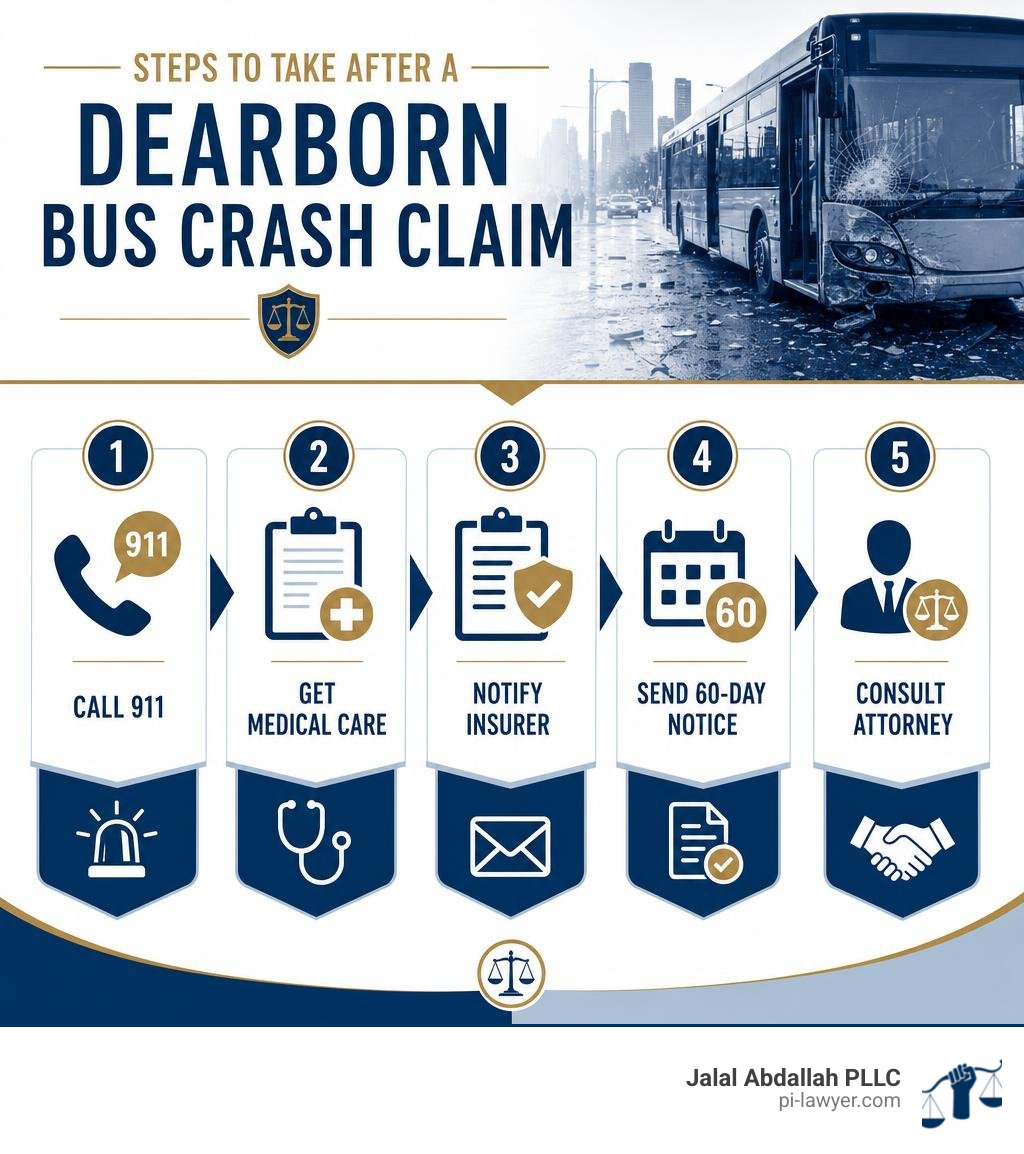
Under MCL 124.419, you must serve a formal, written notice of your claim to the transit authority within 60 days of the crash. This written notice must contain specific details, including:
- The exact date, time, and location of the accident.
- A description of how the crash occurred.
- The names of any injured parties and the nature of their injuries.
- The bus number, driver’s name, and any other identifying details.
The Michigan Supreme Court reinforced this strict requirement in the case Atkins v SMART, ruling that failing to provide this written notice within 60 days completely bars you from filing a third-party lawsuit for bodily injuries. However, the court did clarify that this 60-day notice rule does not apply to your first-party No-Fault PIP benefits. Even if you miss the 60-day window to sue for pain and suffering, you still have up to one year to apply for your medical and wage loss benefits.
General Deadlines for Private and School Bus Accidents
If you were injured in an accident involving a private charter bus, a commercial tour bus, or a school bus, the 60-day public transit notice rule generally does not apply. Instead, you are governed by the standard Michigan statute of limitations for personal injury claims, which is three years from the date of the accident.
School bus accidents require careful investigation to determine who owns and operates the vehicle. For example, a crash involving a local school district bus might have different notice requirements depending on whether the district is considered a municipal entity. If you are dealing with a local school bus accident, such as the widely discussed School bus crashes in Dearborn Heights, no injuries reported – WXYZ , proving liability and securing compensation still requires a prompt, thorough legal review to ensure no local government notice deadlines are overlooked.
Steps to Take Immediately After a Bus Accident in Dearborn
The chaotic moments immediately following a bus crash can be terrifying. However, the actions you take at the scene and in the days that follow will directly impact your physical recovery and the strength of your Dearborn bus crash claim.

If you find yourself in this situation, follow these steps to protect your health and your legal rights:
- Check for Injuries and Call 911: Your health is the number-one priority. Call emergency services immediately to report the crash and request medical assistance for anyone who is hurt.
- Remain at the Scene: Never leave the scene of an accident. Wait for law enforcement officers to arrive so they can document the crash and create an official police report.
- Seek Immediate Medical Attention: Even if you feel fine or believe your injuries are minor, go to an emergency room or urgent care facility. Adrenaline can mask severe injuries, such as concussions, internal bleeding, or soft tissue damage. Having a medical record created on the day of the crash is vital for proving your injuries were directly caused by the accident.
- Document the Scene: If you are physically able, use your phone to take photos and videos of the crash site. Capture the positions of the vehicles, the damage to the bus and other cars, skid marks, road conditions, traffic signs, and any visible injuries.
- Exchange Information: Collect the names, phone numbers, driver’s license numbers, and insurance details of the bus driver and any other drivers involved. Be sure to note the bus number and any agency markings on the side of the vehicle.
- Talk to Witnesses: Bus crashes often draw a crowd. Get the names and contact details of other passengers, bystanders, or drivers who witnessed the collision. Their independent statements can be invaluable later.
- Do Not Admit Fault or Give Statements: Avoid discussing the cause of the accident with the bus driver, transit representatives, or insurance adjusters at the scene. Simply stick to the facts when speaking to the police.
- Contact a Lawyer: Before you speak to any insurance representatives or sign any paperwork, consult with a legal team that understands Michigan’s complex transit laws.
The physical dangers of local roads are real. Major collisions, such as the incident where Several people injured in high-speed multi-vehicle crash in Dearborn , highlight how quickly a normal commute can turn into a life-altering disaster. Protecting yourself starts with immediate medical care and prompt legal action.
Gathering and Preserving Key Evidence for Your Dearborn Bus Crash Claim
To build a winning case, we must compile a mountain of clear, undeniable evidence. Because commercial bus companies and government transit agencies move quickly to protect themselves, we must act just as fast to preserve critical evidence before it disappears:
- Onboard Camera Footage: Most modern DDOT, SMART, and school buses are equipped with interior and exterior surveillance cameras. This footage can clearly show how the crash occurred and how passengers were thrown about inside the cabin. We must send a formal spoliation letter to prevent the bus company from overwriting this video.
- Black Box Data: Commercial buses use Electronic Control Modules (ECMs) that record speed, braking, steering input, and engine data in the seconds leading up to a crash. This data provides objective proof of driver negligence.
- Driver Logs and Employment Records: We will review the bus driver’s training history, driving record, drug and alcohol test results, and hours-of-service logs to see if driver fatigue or lack of training played a role in the crash.
- Maintenance and Inspection Records: Buses are subject to strict federal and state safety regulations. If a mechanical failure, such as brake failure or bald tires, caused the crash, the maintenance logs will reveal if the owner neglected routine repairs.
- Police and Accident Reports: We will obtain and analyze the official police report, including any diagrams, citations issued, and officer narratives.
Frequently Asked Questions About Dearborn Bus Accidents
Can I sue the government if I was injured on a SMART or DDOT bus?
Yes, but it is much harder than suing a private citizen. In Michigan, government agencies generally enjoy “governmental immunity” from lawsuits under MCL 691.1407. However, there are a few very narrow exceptions to this rule.
The most important exception for bus accident victims is the motor vehicle exception under MCL 691.1405. This statute states that government agencies can be held liable for bodily injury and property damage resulting from the negligent operation of a government-owned motor vehicle by an employee.
If a DDOT or SMART bus driver runs a red light, speeds, or drives recklessly and injures you, you can sue the transit agency for damages. However, you must still strictly adhere to the 60-day written notice requirement to preserve this right.
What compensation can I recover in a third-party lawsuit?
If your injuries meet the “serious impairment of body function” threshold and we can prove the bus driver or another party was at fault, you can pursue a third-party lawsuit. This allows you to recover damages that are not covered by your standard PIP benefits, including:
- Pain and Suffering: Compensation for physical pain, discomfort, and the loss of physical abilities.
- Mental Anguish: Damages for emotional trauma, anxiety, depression, PTSD, and sleep disturbances caused by the crash.
- Loss of Companionship: If a loved one was killed in a fatal bus crash, surviving family members can file a wrongful death claim under MCL 600.2922 to recover compensation for the loss of society, comfort, and financial support.
- Excess Economic Loss: If your medical bills exceed your PIP policy limits, or if your lost wages go beyond the three-year statutory limit or exceed the monthly cap, you can recover these out-of-pocket costs from the at-fault party.
How do insurance companies handle bus accident claims?
Insurance companies are profit-driven businesses, and their main goal is to pay you as little as possible. When dealing with a high-value bus accident claim, they will deploy several aggressive tactics to protect their bottom line:
- The Recorded Statement Trap: Insurance adjusters may call you shortly after the crash, acting friendly and asking to record your description of the accident. They will try to twist your words or get you to admit that you feel “okay” to use against you later.
- Lowball Settlement Offers: Insurers often offer quick, lump-sum settlements early in the process. These offers are usually a fraction of what your claim is actually worth and require you to sign away your right to pursue any future compensation.
- Delaying Payments: They may delay paying your medical bills or wage loss benefits, hoping the financial strain will force you to accept a smaller settlement out of desperation.
- Blaming the Victim: Under Michigan’s modified comparative negligence rule, if you are found to be more than 50% at fault for your injuries, you are completely barred from recovering non-economic damages. Insurers will look for any reason to shift the blame onto you.
Secure Your Recovery with Relentless Legal Advocacy
Recovering from a serious bus accident is hard enough without having to fight powerful insurance companies and government lawyers on your own. At Jalal Abdallah PLLC, we believe in relentless advocacy for the underdog. We understand the complex interplay of Michigan’s no-fault laws, transit authority notice deadlines, and commercial vehicle regulations.
We handle every aspect of your Dearborn bus crash claim so you can focus entirely on your physical recovery. From gathering black box data and securing video footage to fighting lowball insurance offers and representing you in court, our team is committed to securing the maximum compensation you deserve.
We represent clients across Metro Detroit, including Dearborn, Detroit, Southfield, and Warren. Best of all, we work on a contingency fee basis. This means you do not pay us a single penny in attorney fees unless we win your case.
Don’t let a public transit provider or a greedy insurance company deny you the justice you deserve. Protect your rights before the clock runs out. Explore our car accident services to learn more about how we fight for crash victims, discover our full range of legal services, or visit our homepage to see our track record of success.
Contact our legal team today or call us to schedule your free, no-obligation case consultation. Let us put our strength and dedication to work for you.
Share This Article

Schedule Your Free Consultation Today!
Reach out today and receive a consultation, completely free of charge - we'll evaluate your case and let you know what comes next.