 Skip to content
What You Need to Know About a Dearborn Bus Accident Settlement
A Dearborn bus accident settlement can be the difference between financial ruin and real recovery after a crash — but the process is far more complex than a standard car accident claim.
Here’s a quick overview of what determines your settlement:
| Factor | What It Means for You |
|---|---|
| Injury severity | More serious injuries = higher potential compensation |
| Liability (who’s at fault) | Drivers, transit agencies, or municipalities can all be responsible |
| Michigan no-fault rules | PIP benefits apply first, regardless of fault |
| 60-day notice rule | Miss this deadline on public transit claims and you may lose your right to sue |
| Comparative negligence | You can still recover if you’re 50% or less at fault |
| Settlement ranges | Minor injuries: $10,000–$50,000 / Severe injuries: $250,000+ |
Bus accident claims in Michigan involve layers that most people don’t expect. You’re dealing with no-fault insurance rules, potential government immunity protections, strict filing deadlines, and insurers who are motivated to pay you as little as possible.
In 2024 alone, Michigan recorded 511 bus accidents — 166 of which resulted in injuries. If you were in one of them, the clock is already running on your claim.
I’m Jalal Abdallah, a personal injury attorney based in Dearborn who has built his practice on fighting for everyday people against powerful insurance companies — including in Dearborn bus accident settlement cases where the system feels stacked against you. I’ll walk you through exactly how these settlements work so you can make informed decisions about your recovery.
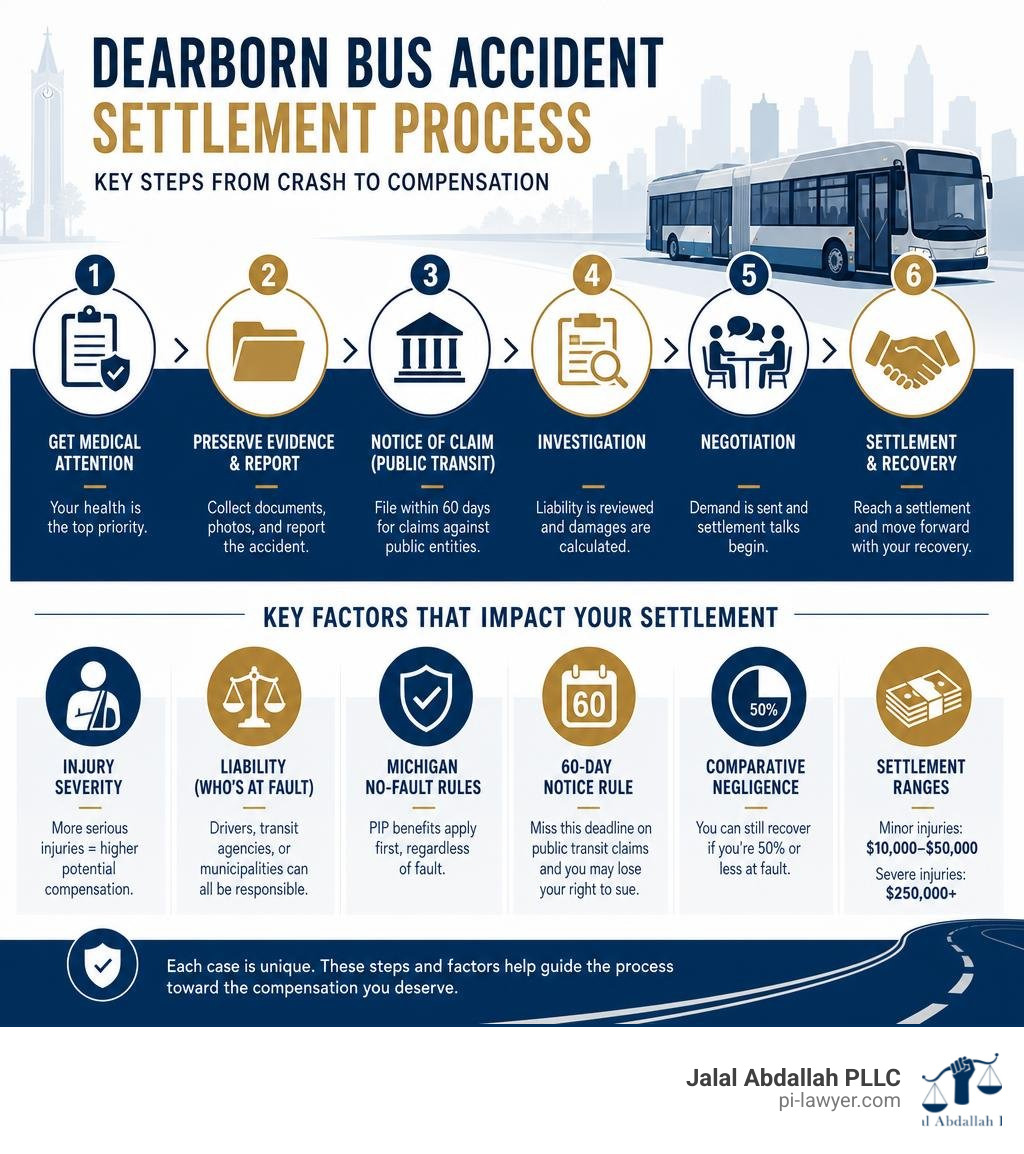
Quick Dearborn Bus Accident Settlement resource:
Key Factors in a Dearborn Bus Accident Settlement
When we sit down to evaluate what a client’s Dearborn bus accident settlement might be worth, we have to look at several moving parts. Unlike a standard two-car fender bender on Michigan Avenue, a bus crash involves commercial vehicles, public entities, and unique safety regulations.
Several key elements directly dictate the ultimate settlement value of your case:
- The Severity of Your Injuries: This is always the primary driver of any injury claim. A minor muscle strain that heals in two weeks will not command the same settlement as a traumatic brain injury (TBI), spinal damage, or a compound fracture requiring surgery.
- Liability and Fault Disputes: Under Michigan law, if there is clear evidence that the bus driver was speeding, distracted, or blew through a red light, your claim is significantly stronger. If the defense can argue that you or another third-party driver contributed to the crash, it complicates negotiations.
- Insurance Coverage Limits: Public transit authorities and private charter bus companies carry substantial commercial liability policies—often worth millions of dollars. However, accessing those funds requires piercing through aggressive defense teams.
- The Impact on Your Daily Life: Can you go back to work? Do you need daily assistance? The broader the disruption to your career and personal life, the higher the value of your non-economic damages.
To understand how these pieces fit together to build a strong legal strategy, check out this guide on recovering compensation in Dearborn bus crash claims.
Maximizing Your Dearborn Bus Accident Settlement Value
Insurance adjusters are not in the business of writing generous checks. In fact, their primary goal is to close your file for as little money as possible. To protect yourself and maximize your settlement, you must treat your recovery like a well-documented business case from day one.
First, medical documentation is king. You need objective medical evidence—such as MRIs, X-rays, and physical therapy progress notes—to prove the physical reality of your pain. If you stop going to your doctor or skip physical therapy sessions, the insurance company will immediately claim that you are either fully healed or exaggerating your injuries.
Second, we highly recommend keeping a daily “pain and recovery journal.” Write down your pain levels, the daily tasks you can no longer perform, and the emotional toll the accident has taken on your family. This simple habit provides a powerful human narrative that numbers on a medical bill simply cannot convey.
To learn more about the common traps adjusters lay out for victims, read about how insurance companies try to devalue your injury claim.
Timeline for a Dearborn Bus Accident Settlement
“How long is this going to take?” is usually the very first question clients ask us. The honest answer is that there is no single, universal timeline. A settlement can take anywhere from a few months to several years, depending on the complexity of the crash.
The process generally unfolds in two major phases:
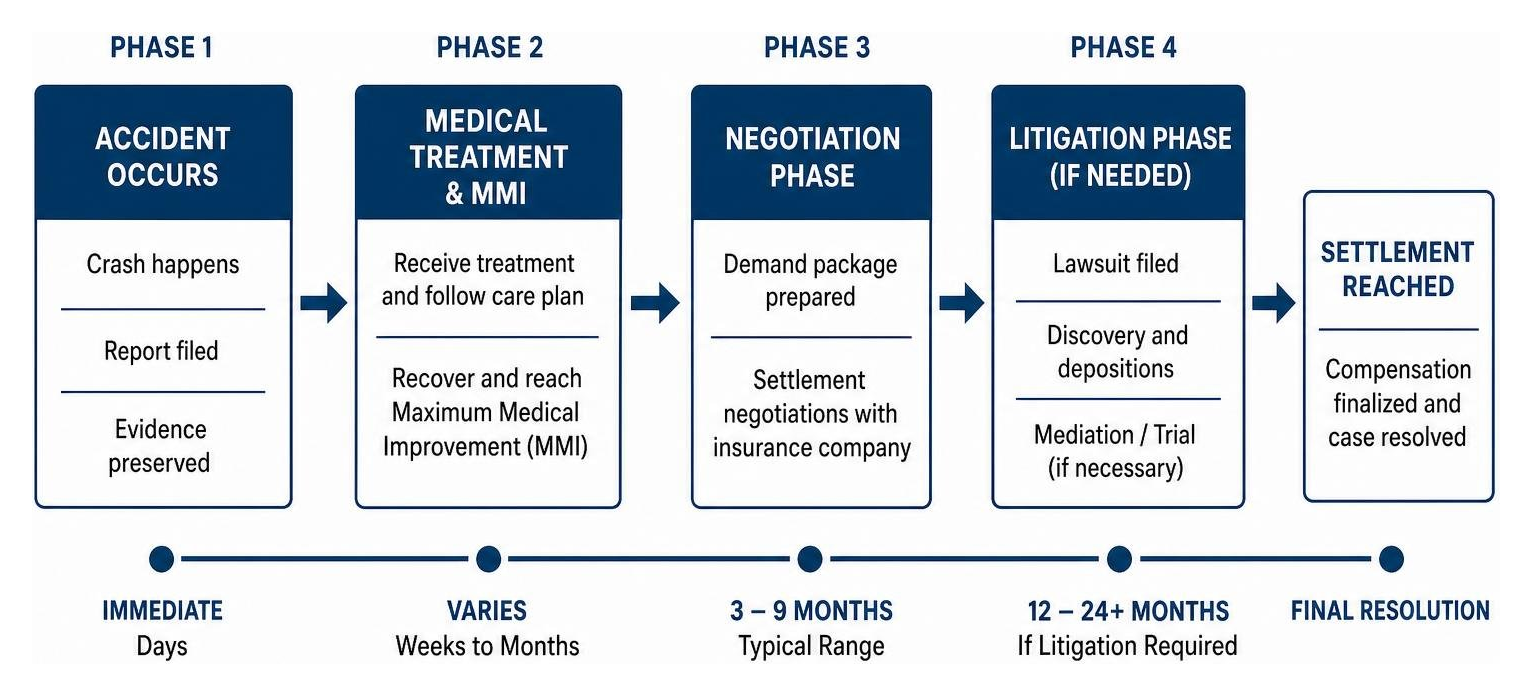
- The Negotiation Phase: This begins once you reach Maximum Medical Improvement (MMI)—the point at which your doctors believe your condition has stabilized. We do this because settling before you are fully healed is incredibly risky; if you need a future surgery that you didn’t anticipate, you cannot ask for more money later. Once MMI is reached, we compile a demand package and negotiate with the insurer. This phase can take 3 to 9 months.
- The Litigation Phase: If the insurance company refuses to offer a fair settlement, we file a formal lawsuit. This moves the case into discovery, depositions, and potentially a trial. While most cases still settle before reaching a courtroom, litigation can easily extend the timeline by 12 to 24 months.
For a deeper dive into how timelines and injury values intersect, check out our Dearborn car wreck compensation guide.
How Michigan No-Fault Laws Impact Bus Crash Claims
Michigan’s auto insurance system is notoriously complicated. We operate under a “no-fault” framework, which means that if you are injured in a motor vehicle accident, your own auto insurance policy is responsible for paying your medical bills and lost wages through Personal Injury Protection (PIP) benefits. This rule applies even if you were a passenger on a bus and did not cause the crash.
PIP benefits cover essential recovery services, including:
- All reasonable and necessary medical expenses related to the crash.
- Up to 85% of your lost wages if your injuries prevent you from working (for up to three years).
- Attendant care services if you need daily assistance with tasks like bathing, dressing, or eating.
- Replacement services (up to $20 per day) for household chores you can no longer perform.
Understanding what steps to take immediately following a collision is crucial to preserving these benefits. Read our step-by-step breakdown of what to do immediately after a car accident in Michigan to ensure you don’t accidentally forfeit your rights.
PIP Coverage and Priority Rules for Passengers
What happens if you don’t own a car and don’t have your own auto insurance policy? This is a very common scenario for public transit passengers in Dearborn. Under Michigan’s strict “order of priority” rules, the state determines who is responsible for paying your PIP benefits in the following sequence:
- Your own personal auto insurance policy.
- The auto insurance policy of a spouse or a resident relative living in your household.
- The insurer of the owner or operator of the bus you were riding.
- The insurer of the driver of any other vehicle involved in the crash.
- The Michigan Assigned Claims Plan (MACP)—a state-administered fund designed to provide PIP coverage to uninsured victims.
Navigating this bureaucratic maze can be incredibly stressful when you are trying to heal. To make sure you are targeting the correct insurer from the start, read about getting your dues after a bus collision.
Proving Liability and Negligence in Dearborn Bus Crashes
While your PIP benefits cover your immediate medical bills and lost wages regardless of fault, they do not compensate you for your physical pain, emotional suffering, or decreased quality of life. To recover those “non-economic” damages, you must file a third-party lawsuit against the negligent party who caused the accident.
Proving negligence in a bus accident requires gathering a mountain of physical and digital evidence:
- Bus Black Box Data: Modern commercial buses are equipped with Electronic Control Modules (ECMs) that record speed, braking, steering angles, and throttle position leading up to a crash.
- Dashcam and Traffic Camera Footage: Many regional transit buses feature internal and external cameras that capture the exact moments of the collision.
- Driver Logs and Employment Records: We look for evidence of driver fatigue, hours-of-service violations, and whether the transit company failed to conduct proper background checks or drug screenings.
- Maintenance Logs: If a mechanical failure—such as worn-out brakes or bald tires—caused the crash, the maintenance contractor or bus owner can be held directly liable.
In addition to collecting evidence, third-party claims against government-run public transit providers must overcome the hurdle of governmental immunity. If you fail to file a highly specific written notice with the government agency within 60 days of the crash, your case will be permanently dismissed.
To see how complex liability and government immunity play out in high-stakes litigation, read about these major county and bus company liability rulings.
Charter Bus vs. Public Transit Claims
The legal path you take depends entirely on whether you were hit by a public city bus or a private charter bus.
- Public Transit (e.g., SMART buses, DDOT): These are public entities funded by taxpayers. Because they are government operations, they are shielded by “governmental immunity” laws. To sue them, you must jump through strict procedural hoops, including the 60-day written notice requirement.
- Private Charter and Tour Buses: Companies operating private coaches or school bus fleets do not enjoy governmental immunity. However, they are heavily regulated by the Federal Motor Carrier Safety Administration (FMCSA). These cases often involve massive commercial insurance policies, but they also bring aggressive corporate defense lawyers who will fight tooth and nail to protect their bottom line.
If you were injured while riding a private tour or rental coach, you can find specialized guidance on our charter bus accident legal help page.
Types of Damages Recoverable in Bus Accident Claims
A comprehensive Dearborn bus accident settlement is designed to make you whole again. In legal terms, the compensation you can recover is divided into economic and non-economic damages:
| Category | Type of Damage | What It Covers |
|---|---|---|
| Economic Damages | Medical Bills | Surgeries, hospital stays, medication, physical therapy, and future medical care. |
| Lost Income | Wages lost during recovery and loss of future earning capacity if permanently disabled. | |
| Out-of-Pocket Costs | Transportation to medical appointments, home modifications, and specialized equipment. | |
| Non-Economic Damages | Pain and Suffering | Physical discomfort, chronic pain, and the physical toll of your injuries. |
| Mental Anguish | PTSD, anxiety, depression, and sleep disturbances caused by the trauma. | |
| Loss of Enjoyment of Life | The inability to participate in hobbies, sports, or family activities you once loved. |
In the most tragic circumstances, where a bus accident results in the loss of a family member, Michigan law allows the surviving family to pursue a wrongful death claim. This can recover funeral and burial costs, loss of financial support, and compensation for the loss of companionship. You can learn more about this sensitive legal process by reading our guide on wrongful death claims in Michigan.
Frequently Asked Questions About Dearborn Bus Accidents
What is the 60-day notice rule for public transit in Michigan?
If your accident involved a public transit provider—such as a SMART bus or a DDOT bus—Michigan law requires you to serve a formal, written notice of your intent to sue to the transit authority within 60 days of the accident.
This notice must include highly specific details, including the exact location, time, cause of the crash, and the nature of your injuries. If you miss this incredibly short window, or if your written notice contains minor technical errors, you will lose your right to seek compensation forever.
Can I recover compensation if I was partially at fault?
Yes. Michigan follows a modified comparative negligence rule. This means you can still recover non-economic damages (like pain and suffering) as long as your percentage of fault is 50% or less.
However, your final financial recovery will be reduced by your percentage of fault. For example, if a jury determines your total damages are $100,000, but finds you were 20% at fault for the accident, your final settlement payout will be $80,000. If you are found to be 51% or more at fault, you are legally barred from recovering any pain and suffering damages.
What is the average settlement for a bus accident in Michigan?
Because every injury and crash scenario is completely unique, there is no single “average” settlement. However, we can look at historical data and general industry ranges to get an idea of how cases are valued based on injury severity:
- Minor Injuries ($10,000 – $50,000): Soft tissue injuries, minor whiplash, or bruises that resolve within a few months with standard medical care.
- Moderate Injuries ($50,000 – $250,000): Broken bones, herniated discs requiring injections, or mild concussions that require extended physical therapy and cause you to miss significant time from work.
- Severe and Catastrophic Injuries ($250,000 – Millions): Traumatic brain injuries, spinal cord damage, amputations, or injuries requiring lifelong medical care.
For more context on how these ranges are calculated and to see historical settlement examples across the state, you can read our Dearborn car wreck compensation guide.
Secure Your Recovery with Relentless Legal Advocacy
When you are recovering from a bus crash, the last thing you need is a massive insurance company or a government legal team trying to pressure you into a lowball settlement. They have teams of adjusters and lawyers whose sole job is to protect their pockets. You deserve an advocate who is just as relentless in protecting yours.
At Jalal Abdallah PLLC, we pride ourselves on being the voice for the underdog. We understand the complex interplay of Michigan’s no-fault rules, government immunity deadlines, and commercial insurance policies. We don’t back down when insurers try to devalue your pain, and we are always prepared to take your case to court if they refuse to treat you fairly.
If you or a loved one has been injured and you want to discuss your options for a Dearborn bus accident settlement, we are here to help. You can explore our full range of personal injury services or learn more about our focus on motor vehicle collisions.
Do not let a complex system stand between you and the recovery you deserve. Reach out to us today to schedule a free, no-obligation consultation with our team. We will listen to your story, evaluate your claim, and outline a clear path forward—and you won’t pay us a single dime unless we win your case.
Share This Article

Schedule Your Free Consultation Today!
Reach out today and receive a consultation, completely free of charge - we'll evaluate your case and let you know what comes next.


