What a Property Owner Injury Attorney Can Do for You After a Landlord Negligence Incident
If you’ve been hurt on a rental property, hiring a property owner injury attorney is often the most important step you can take to protect your rights and recover fair compensation.
Here’s what you need to know right away:
- You may have a valid claim if a hazardous condition on the property caused your injury and the landlord knew — or should have known — about it.
- Michigan law requires landlords to maintain reasonably safe conditions for tenants and visitors.
- You generally have 3 years from the date of injury to file a premises liability claim in Michigan.
- Compensation can include medical bills, lost wages, pain and suffering, and more.
- Hiring an attorney matters — studies show represented clients recover up to 40% more than those who handle claims alone.
Every year, over 1 million people in the U.S. are injured due to slips, trips, and falls on someone else’s property. Many of those injuries happen in rental homes and apartment complexes — places where people expect to be safe. When a landlord ignores a broken staircase, a missing railing, or a serious security flaw, the consequences can be life-changing.
Yet most injury victims don’t know their rights. Insurance companies act fast to minimize payouts. Evidence disappears. Deadlines pass. The legal system feels overwhelming — especially when you’re already dealing with pain, medical bills, and missed work.
That’s exactly why this guide exists.
I’m Jalal Abdallah PLLC — a personal injury attorney based in Dearborn, Michigan, with experience fighting for injury victims against powerful insurance companies in premises liability cases, including those involving property owner injury attorney matters where landlords fail their legal duties. My goal is to give you the clear, honest information you need to understand your options and take action.
When to Hire a Property Owner Injury Attorney for Landlord Negligence
When you rent an apartment, a townhouse, or a single-family home in Michigan, you are entering into a legal contract. That contract, along with state law, grants you certain rights as a tenant. One of the most fundamental rights is the expectation of a safe living environment. If a landlord fails to provide this, and you or a loved one suffers a physical injury as a result, the legal concept of premises liability comes into play.
Premises liability is the area of Personal Injury law that holds property owners, managers, and landlords legally responsible for accidents that occur on their property due to unsafe conditions. However, a landlord is not automatically responsible for every single injury that happens on their rental property. To build a successful case with a property owner injury attorney, we must look closely at the legal status of the person who was hurt and the specific duties the landlord owed to them.
In Michigan, your legal status on the property determines the level of care the landlord owed you:
- Invitees: This category includes tenants who pay rent. Because tenants are on the property for the mutual business benefit of both parties (the tenant gets a home, the landlord gets rent), landlords owe them the highest duty of care. This means landlords must actively inspect the property, repair known hazards, and warn tenants of any hidden dangers.
- Licensees: These are social guests who have permission to be on the property, such as a friend visiting your apartment. Landlords owe licensees a duty to warn them of any hidden, dangerous conditions that the landlord knows about, but they generally do not have an active duty to inspect the property specifically for social guests.
- Trespassers: These are individuals who enter the property without permission. Generally, landlords owe no duty of care to adult trespassers, other than refraining from causing them intentional harm. However, exceptions exist for children under the “attractive nuisance” doctrine, such as unsecured swimming pools.
If you are a tenant or a guest who was lawfully on the property, and the landlord’s failure to maintain a safe environment caused your injury, it is time to consult a property owner injury attorney.
Legal Duties Owed to Tenants and Visitors
Under Michigan law, specifically Michigan Compiled Laws (MCL) Section 554.139, landlords have strict statutory covenants that they must uphold in every residential lease. These covenants require the landlord to:
- Keep the premises and all common areas fit for the use intended by the parties.
- Keep the premises in reasonable repair during the term of the lease, and to comply with the applicable health and safety laws of the state and local administrative units (such as local building codes in Dearborn, Detroit, Southfield, or Warren).
These duties are non-delegable. This means a landlord cannot escape liability by claiming they hired an independent contractor to fix a broken stairwell, or by pointing a finger at a property management company. If the common areas-such as hallways, parking lots, courtyard sidewalks, and shared laundry rooms-are unsafe, the landlord remains legally on the hook.
For example, if you live in an apartment complex in Warren, MI, and the outdoor steps leading to your building have been crumbling for months, the landlord has a duty to repair them. If they ignore the issue and you fall, their failure to uphold this duty of care constitutes negligence. If you find yourself in this situation, consulting with our team can help clarify who is responsible and what steps you should take next.
Common Hazards That Require a Property Owner Injury Attorney
Landlord negligence can manifest in dozens of different ways. Some of the most common hazards that lead to serious injuries and require the help of a property owner injury attorney include:
- Slip and Fall Accidents: Slippery walkways, unshoveled icy sidewalks, poorly lit parking lots, and liquid spills in common hallways are classic examples. If you want to dive deeper into how these cases work locally, you can read about Don’t Let a Bad Fall Ruin Your Wallet: Dearborn’s Best Slip and Fall Lawyers to understand the local legal landscape.
- Structural Failures: Collapsing balconies, rotting wooden stairs, loose handrails, and ceiling collapses due to long-term water leaks.
- Negligent Security: Broken locks on building entry doors, dark common areas, and a lack of working security cameras in high-crime neighborhoods can allow criminals access to the property, resulting in physical assaults.
- Dog Bites: If a landlord allows a tenant to keep a dog known to be dangerous, or fails to enforce pet policies in common areas, they may share liability if that dog attacks a visitor or another tenant.
- Defective Systems: Broken furnaces in the dead of a Michigan winter, faulty electrical wiring causing fires, or malfunctioning elevators.
No matter the specific hazard, if you suffered a severe injury, we recommend reviewing our comprehensive resource, The Ultimate Guide to Choosing a Slip and Fall Accident Lawyer, to learn how to identify the right legal advocate for your needs.
Proving Fault and Liability in a Rental Property Accident

Winning a premises liability lawsuit against a landlord is not as simple as showing up to court with a medical bill and a picture of a bruise. To win, you must prove that the landlord was negligent.
In legal terms, proving negligence requires us to establish four distinct elements:
- Duty: The landlord owed you a legal duty of care (established by your status as a tenant or lawful visitor).
- Breach: The landlord breached that duty by failing to maintain the property or warn you of a hazard.
- Causation: The landlord’s breach of duty directly caused your accident and subsequent injuries.
- Damages: You suffered actual physical, financial, and emotional damages as a result.
One of the most heavily contested battlegrounds in these cases is the concept of notice. To be held liable, the landlord must have had either actual notice or constructive notice of the hazard before your accident occurred.
- Actual Notice: This means the landlord was directly informed of the danger. For example, if you sent an email or a text message to your property manager stating that the handrail on the second-floor stairs was loose, the landlord had actual notice.
- Constructive Notice: This means the hazard existed for such a length of time that the landlord should have discovered and repaired it if they were exercising reasonable care in maintaining the property. For instance, if a wooden step had been rotting in a highly visible common courtyard for six months, the landlord cannot claim ignorance.
Because insurance companies will do everything they can to protect their bottom line, they often try to twist these rules. To understand their tactics, read our guide on How Insurance Companies Try to Devalue Your Injury Claim.
Establishing Negligence Under Michigan Law
Michigan’s premises liability laws have historically been very favorable to landowners due to a legal defense known as the “open and obvious” doctrine. For decades, if a hazard was so visible that an average person should have seen and avoided it, landlords could argue they owed no duty to warn or protect you from it.
However, the legal landscape in Michigan shifted dramatically. In the landmark case Kandil-Elsayed v. F&E Land Holding, LLC, the Michigan Supreme Court ruled that the “open and obvious” nature of a hazard is no longer a complete bar to a landlord’s liability. Instead, whether a danger was open and obvious is now analyzed under comparative fault. This means that even if a puddle of ice or a broken tile was visible, you can still sue your landlord for failing to fix it, though your compensation might be adjusted based on your own level of care.
This legal shift is incredibly important for tenants in Dearborn, Detroit, and Southfield. If you slipped on an icy sidewalk outside your Dearborn apartment complex, the landlord can no longer simply say, “Well, you should have seen the ice, so we aren’t paying.” We can hold them accountable for failing to salt the walkways, while local building codes and safety standards help us demonstrate their breach of duty. If you find yourself in this situation, reaching out to our team can help you understand your options under these updated laws.
How a Property Owner Injury Attorney Gathers Crucial Evidence
To prove notice and build an airtight case, we must move quickly to gather and preserve evidence before it is repaired, deleted, or forgotten. When we take on a landlord negligence case, we immediately work to secure:
- Surveillance Footage: Many apartment complexes have security cameras monitoring lobbies, parking lots, and hallways. This footage can prove exactly how long a hazard existed and how your accident occurred.
- Maintenance Logs and Work Orders: We will demand copies of the landlord’s internal records to see if other tenants complained about the same hazard, or if the landlord ignored scheduled maintenance.
- Lease Agreements: We review your lease to identify which areas are designated as common spaces under the landlord’s control.
- Witness Statements: We talk to your neighbors, delivery drivers, and visitors who can testify to the dangerous condition of the property.
- Expert Testimony: In complex structural cases, we may consult building inspectors or safety engineers to prove the landlord violated local building codes.
If you are looking for a dedicated legal team to represent you in a premises liability claim in Michigan, our firm is ready to step in and handle this heavy lifting for you.
Damages and Compensation You Can Recover
When a landlord’s negligence causes you to fall down stairs, break a bone, or suffer a traumatic brain injury, the financial toll can be devastating. A successful premises liability claim allows you to recover financial compensation—known as damages—for the losses you have suffered.
These damages are generally split into two main categories: economic and non-economic damages.
Economic and Non-Economic Damages
- Economic Damages: These are the direct, quantifiable financial losses resulting from your injury. They include:
- Medical Expenses: Emergency room visits, hospital stays, surgeries, physical therapy, prescription medications, and any future medical care you will require.
- Lost Wages: The income you lost because you had to miss work while recovering.
- Loss of Earning Capacity: If your injury causes a permanent disability that prevents you from returning to your career, you can recover compensation for your future lost earnings.
- Non-Economic Damages: These are the intangible, non-monetary losses that affect your quality of life. They include:
- Pain and Suffering: The physical pain and discomfort caused by your injuries. To learn more about how these are calculated, see our article on Understanding Pain and Suffering Damages in Personal Injury Cases.
- Emotional Distress: Anxiety, depression, PTSD, or sleep disturbances resulting from the trauma of the accident.
- Loss of Enjoyment of Life: The inability to participate in hobbies, sports, or family activities that you enjoyed before your injury.
In the most tragic cases, where landlord negligence results in a fatal accident—such as an apartment fire caused by faulty wiring or a drowning in an unsecured pool—the surviving family members can file a claim for Wrongful Death.
How Comparative Fault Affects Your Recovery
Michigan operates under a modified comparative fault system. This means that if you are found partially to blame for your own accident, your financial recovery will be reduced by your percentage of fault.
For example, if a jury determines that your total damages are $100,000, but they decide you were 20% at fault for the accident because you were looking at your phone when you tripped over a broken step, your final award will be reduced by 20% to $80,000.
Crucially, under Michigan law, if you are found to be more than 50% at fault for your injuries, you are completely barred from recovering any non-economic damages (like pain and suffering). You can still recover economic damages (like medical bills), but they will still be reduced by your percentage of fault. This is why having a aggressive legal advocate is so important—insurance companies will try to pin 51% or more of the blame on you to avoid paying for your pain and suffering.
Frequently Asked Questions About Landlord Lawsuits
What is the statute of limitations for a rental property injury in Michigan?
In Michigan, the statute of limitations for a personal injury claim based on premises liability is three years from the date the injury occurred. If you fail to file a lawsuit before this three-year deadline passes, you will permanently lose your right to seek compensation.
While three years may sound like a long time, it is highly recommended to act quickly. Evidence can easily be lost, witnesses’ memories fade, and landlords may repair the hazard, making it much harder to prove the dangerous condition existed at the time of your accident.
Can I sue my landlord if a guest is injured on the property?
Yes. If a guest, friend, or delivery worker is injured on the property due to a hazard in a common area (like a cracked sidewalk or a dark stairwell), the landlord can be held liable.
However, if the guest was injured inside your private rental apartment due to a hazard that you created (such as a spilled drink on your kitchen floor), the liability would generally fall on you as the tenant, rather than the landlord. Landlords are typically only responsible for the structural integrity of the rental unit and the maintenance of shared common spaces.
What should I do immediately after getting hurt in my apartment?
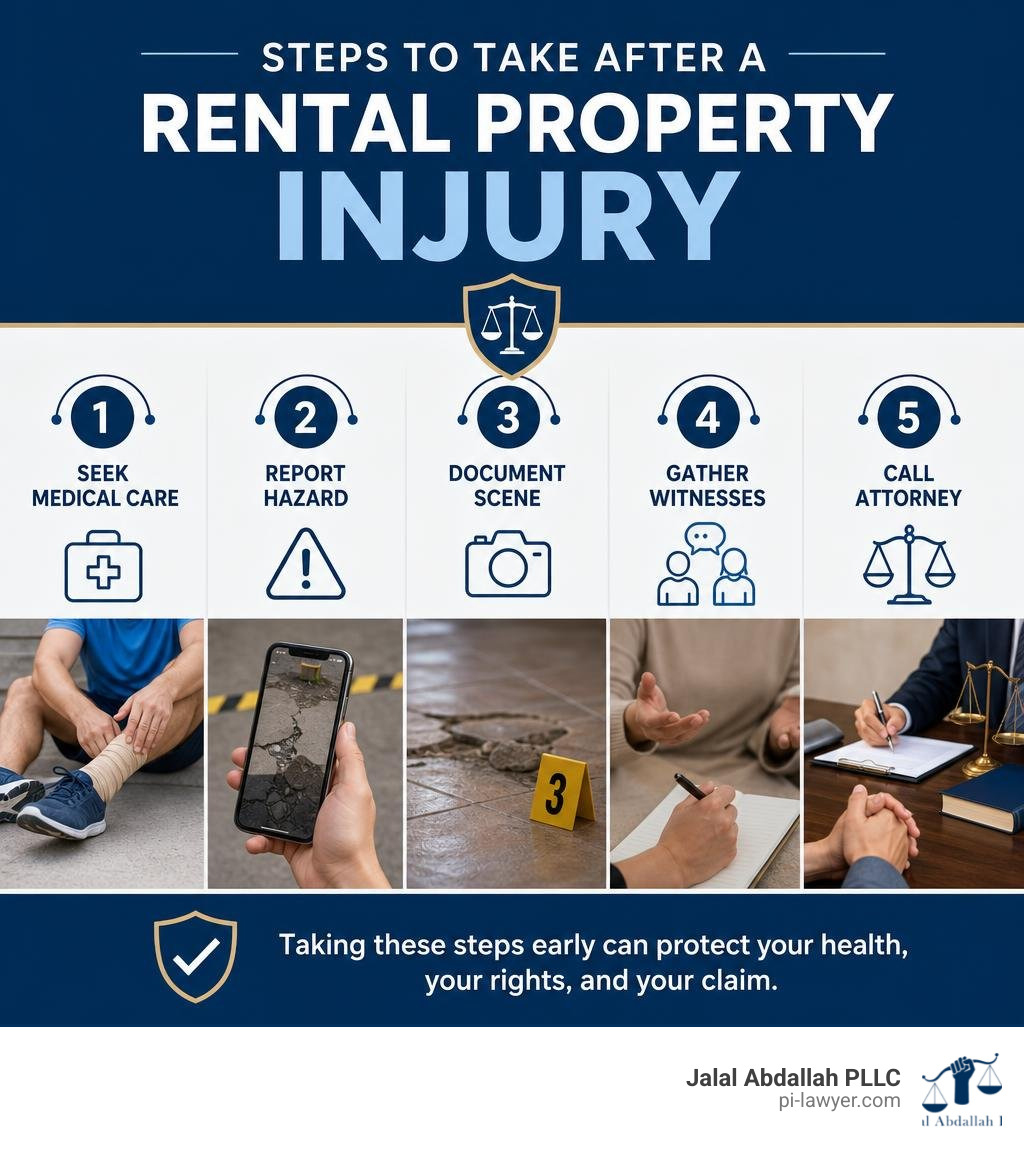
If you are injured on a rental property, taking these steps immediately can protect both your health and your legal rights:
- Seek Medical Attention: Your health is the number one priority. Go to an urgent care or emergency room right away. This also creates an official medical record linking your injuries directly to the accident.
- Document the Hazard: Take clear photos and videos of the dangerous condition that caused your injury (e.g., the broken step, the patch of ice, the missing handrail) before the landlord has a chance to fix it.
- Report the Incident: Notify your landlord or property manager in writing (email or text is best so you have a paper trail) and request that they create an incident report. Keep a copy for your records.
- Gather Witness Contact Info: If anyone saw you fall or can testify to the ongoing existence of the hazard, get their names and phone numbers.
- Do Not Give Statements to Insurance: The landlord’s insurance adjuster may call you asking for a recorded statement. Politely decline and tell them to speak to your attorney.
Protect Your Rights with Relentless Legal Advocacy
Going up against a landlord and their insurance company can feel like a classic David vs. Goliath battle. Large property management companies and landlords in Detroit, Dearborn, Southfield, and Warren carry substantial commercial liability insurance policies. These insurance providers employ teams of adjusters and lawyers whose sole job is to deny, delay, and devalue your claim.
At Jalal Abdallah PLLC, we don’t back down from a fight. We believe in relentless advocacy for the underdog. When you partner with us, we handle every aspect of your premises liability injury claim so that you can focus entirely on your physical recovery.
We will investigate the scene, secure critical evidence like security footage and maintenance logs, manage all communication with the insurance companies, and build a compelling case to secure the maximum compensation you deserve.
Do not let a landlord’s negligence ruin your financial future. Contact us today to schedule your free, no-obligation case evaluation, and let us stand up for your rights.
Share This Article

Schedule Your Free Consultation Today!
Reach out today and receive a consultation, completely free of charge - we'll evaluate your case and let you know what comes next.