 Skip to content

How to Choose an Underinsured Driver Attorney in Dearborn
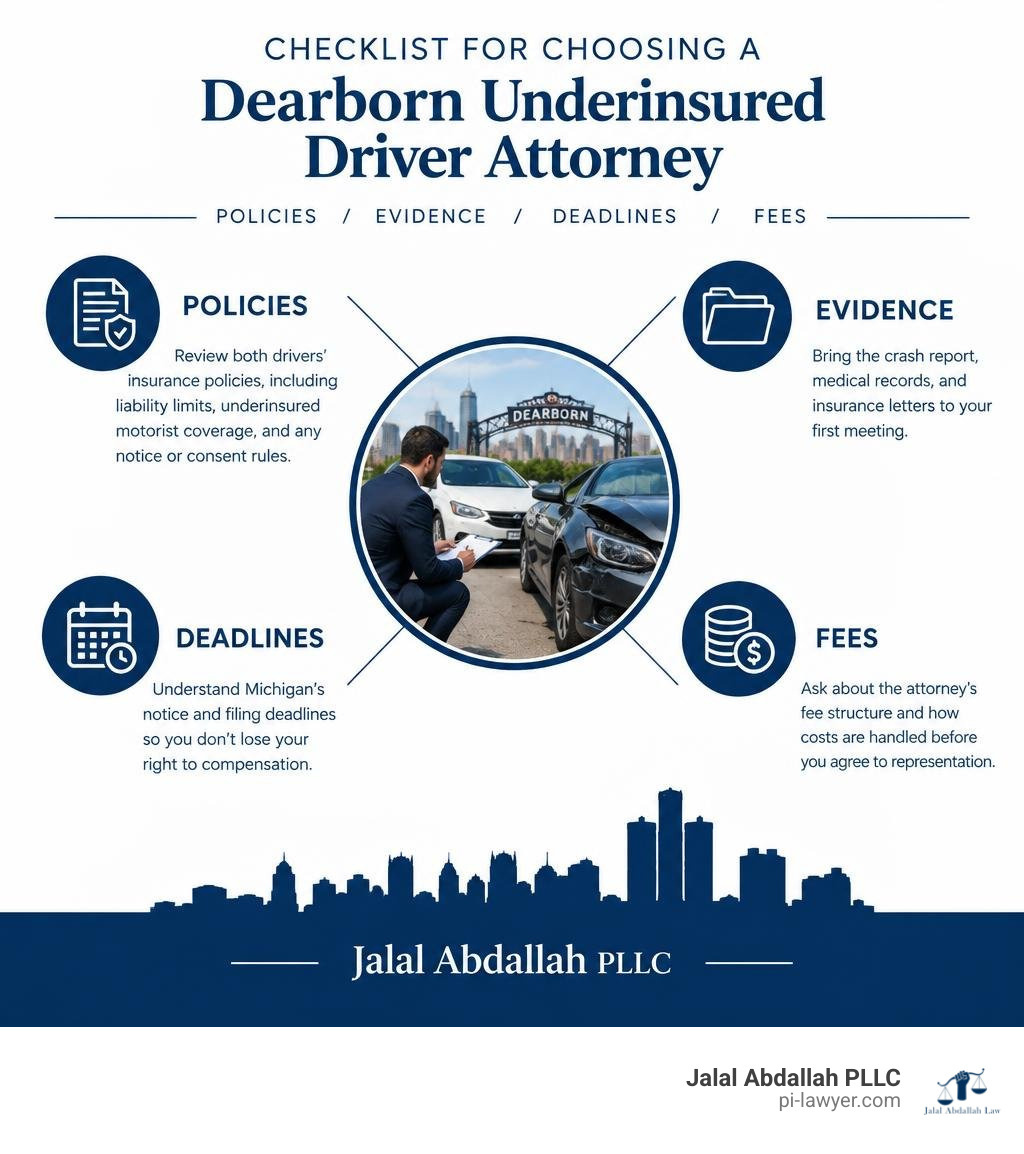
Choose a Dearborn attorney who handles Michigan auto injury claims and will review both drivers’ insurance policies before you accept a settlement. Ask how they will check the other driver’s liability limits, your underinsured motorist coverage, and any notice or consent rules in your policy. Bring the crash report, medical records, and insurance letters to your first meeting.
Michigan no-fault benefits may cover some losses, but they do not settle every question about compensation after a serious crash. A lawyer can help you see where coverage ends and whether another claim is available.
I’m Jalal Abdallah, a Michigan personal injury trial attorney and licensed insurance producer who represents injured people in disputes with insurers. If you’re looking for an underinsured driver attorney Dearborn residents can call, this guide will help you ask the right questions before choosing counsel.
Basic underinsured driver attorney dearborn glossary:
Understanding Underinsured Motorist Claims in Michigan
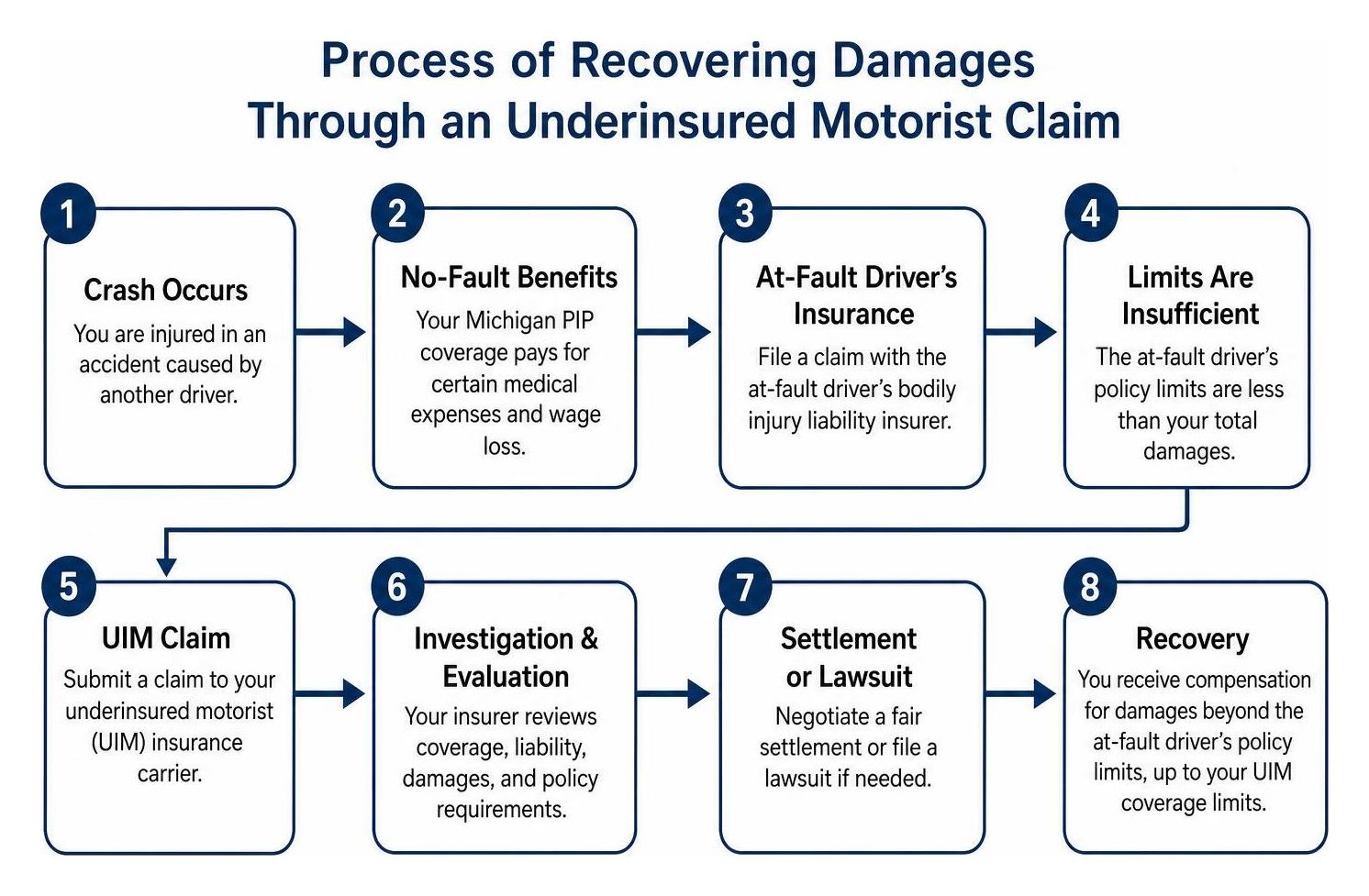
Navigating Michigan’s auto insurance system can feel overwhelming after a serious collision. Between personal injury protection (PIP) coverage and third-party bodily injury liability, understanding who pays for what is rarely simple. In Michigan, drivers carry no-fault insurance to handle their immediate medical expenses and basic wage loss, regardless of who caused the collision.
However, when another driver causes a devastating crash that leaves you with severe trauma, permanent disability, or extensive pain and suffering, their insurance coverage might not be enough. If their bodily injury liability limits fall short of your actual losses, you are dealing with an underinsured driver. Securing appropriate car accident legal representation ensures you do not leave rightful recovery on the table when standard coverage runs out.
Differences Between Uninsured and Underinsured Motorist Coverage
While they sound similar, uninsured motorist (UM) and underinsured motorist (UIM) coverages serve completely different functions under Michigan insurance policies.
Uninsured motorist coverage applies when the at-fault motorist has no auto insurance at all, or when you are the victim of a hit-and-run crash where the driver cannot be identified. In contrast, underinsured motorist coverage kicks in when the at-fault driver has valid insurance, but their policy limits are lower than the total value of your injuries and losses.
| Coverage Feature | Uninsured Motorist (UM) | Underinsured Motorist (UIM) |
|---|---|---|
| At-Fault Driver Status | No insurance policy or hit-and-run driver | Has insurance, but policy limits are insufficient |
| Coverage Trigger | Complete lack of third-party coverage | Exhaustion of at-fault driver’s liability limits |
| Primary Purpose | Replaces missing third-party liability policy | Bridges gap between low limits and true damages |
| Policy Requirement | Optional purchase in Michigan policies | Optional purchase in Michigan policies |
| Insurer Consent Needed | Notice of claim filed with your insurer | Formal consent to settle required before third-party payout |
Understanding these distinctions prevents severe procedural errors. If you settle with an underinsured driver without your insurer’s formal permission, you could accidentally waive your right to collect UIM benefits.
Michigan No-Fault Insurance and Third-Party Policy Limits
Michigan’s unique no-fault system provides Personal Injury Protection (PIP) benefits directly through your own auto insurer. Depending on the tier chosen on your policy, PIP can provide up to unlimited, lifetime medical coverage for allowable expenses related to your care. It also provides three years of wage loss benefits and daily replacement services.
However, PIP does not cover non-economic damages—commonly known as pain, suffering, and loss of enjoyment of life. To pursue non-economic damages against the at-fault driver, your injuries must meet Michigan’s legal threshold:
- Death,
- Permanent serious disfigurement, or
- Serious impairment of body function.
When your injuries meet this statutory threshold, you can file a third-party tort claim against the negligent driver. But if that driver carries only Michigan’s default minimum bodily injury coverage (often $50,000 per person or $250,000 under newer reforms, though drivers can legally opt down), their policy will quickly run dry in a major wreck. We routinely see cases where catastrophic medical bills exceed policy limits in Michigan, leaving injured people reliant on their own UIM endorsements to make up the difference.
Why You Need an Underinsured Driver Attorney Dearborn for Complex Claims

When pursuing an underinsured motorist claim, you are actually managing two separate legal actions at once: a third-party tort claim against the at-fault driver and a first-party contractual claim against your own insurance company. Insurance companies excel at finding loopholes to avoid paying out full policy values.
At Jalal Abdallah PLLC, we stand up for underdogs against massive insurance carriers that prioritize quarterly profits over injured people. Handling a UIM claim involves navigating strict Wayne County court rules, managing insurer cooperation clauses, and preventing lowball settlement traps.
When to Hire an Underinsured Driver Attorney Dearborn After a Crash
You should consult legal counsel as early as possible after a collision, especially under specific high-stakes circumstances:
- Catastrophic and Permanent Injuries: If you suffered traumatic brain injuries, spinal cord trauma, broken bones requiring surgical repair, or chronic nerve damage.
- Multiple Injured Parties: If several people were hurt in the crash, the at-fault driver’s per-occurrence liability limit must be split among all claimants, rapidly shrinking your share.
- Disputed Fault: If the other driver’s insurer claims you were partially or fully at fault under Michigan’s comparative negligence framework.
- Contractual Traps: If your own auto insurer begins requesting recorded statements, independent medical examinations (IMEs), or extensive authorizations.
Attempting to resolve these claims without legal backing often leads to missed deadlines or policy violations that completely extinguish your right to UIM compensation.
Countering Bad Faith and Claim Devaluation Tactics
Your own auto insurer owes you a duty of good faith and fair dealing, but that does not mean they will hand over a maximum check without resistance. Because UIM claims are technically adversarial, your own carrier essentially steps into the shoes of the at-fault driver’s defense team.
Insurers commonly use tactics such as:
- Delaying the investigation until medical records become stale or memories fade.
- Demanding unreasonable documentation to stall negotiations.
- Arguing that your injuries were pre-existing rather than crash-related.
- Offering lowball payouts before you fully grasp the long-term impact of your condition.
Learning how insurance companies devalue injury claims helps you recognize bad faith practices before they wreck your financial recovery. We step in to handle all communication, hold adjusters accountable to policy timelines, and prepare claims for formal arbitration or litigation if the carrier acts unfairly.
Steps to Maximize Recovery After an Underinsured Collision
Maximizing your financial recovery after an accident involving an underinsured driver requires a systematic, evidence-driven approach.
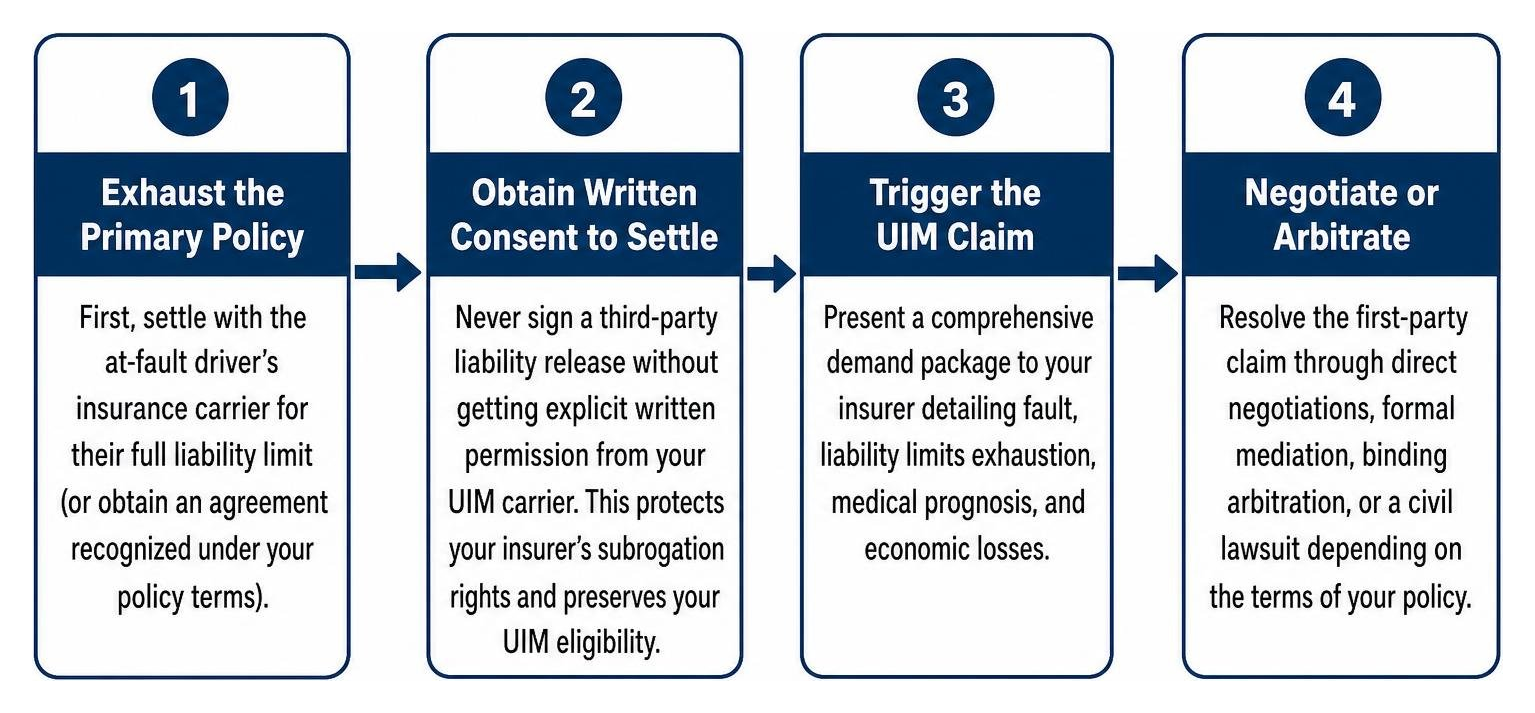
- Exhaust the Primary Policy: You must first settle with the at-fault driver’s insurance carrier for their full liability limit (or obtain an agreement recognized under your policy terms).
- Obtain Written Consent to Settle: Never sign a third-party liability release without getting explicit written permission from your UIM carrier. Doing so protects your insurer’s subrogation rights and preserves your UIM eligibility.
- Trigger the UIM Claim: Present a comprehensive demand package to your insurer detailing fault, liability limits exhaustion, medical prognosis, and economic losses.
- Negotiate or Arbitrate: Resolve the first-party claim through direct negotiations, formal mediation, binding arbitration, or a civil lawsuit depending on the terms of your policy.
Essential Evidence to Prove Damages and Insufficient Policy Limits
To build an airtight claim, you must prove both the other driver’s negligence and the exact shortfall of their insurance coverage. Key evidence includes:
- UD-10 Traffic Crash Reports: Documenting initial officer observations, citations issued, and road conditions in Dearborn.
- Insurance Declaration Pages: Verifying the at-fault driver’s underlying bodily injury limits and your own UIM endorsement caps.
- Medical Records and Imaging: Showing objective evidence of physical injury, emergency room treatments, surgical reports, and physical therapy regimens.
- Vocational and Economic Reports: Proving lost earning capacity and future medical care costs.
- Daily Impact Documentation: Personal journals, photos of physical injuries, and statements from family members detailing daily limitations.
Recoverable Damages in Underinsured Motorist Lawsuits
A successful underinsured motorist claim allows you to recover damages that the negligent driver’s policy could not cover.
These include:
- Non-Economic Damages: Physical pain and suffering, emotional distress, mental anguish, scarring, and loss of companionship.
- Excess Economic Losses: Wage loss exceeding Michigan PIP’s three-year statutory window or monthly maximum caps.
- Loss of Future Earning Potential: Long-term reductions in your ability to work and support your household.
- Out-of-Pocket Expenses: Co-pays, medical deductibles, and secondary care needs not fully handled by primary insurance.
To understand what your case could yield, consult our Dearborn car wreck compensation overview for detailed loss breakdowns.
How to Select the Right Legal Advocate for Your Case
Selecting legal representation after a serious crash is one of the most critical decisions you will make. You need a dedicated firm that understands the intricacies of local courts, possesses deep insight into Michigan insurance contracts, and operates on a contingency fee model—meaning you owe zero attorney fees unless compensation is successfully recovered.
Key Qualities of a Top Underinsured Driver Attorney Dearborn
When interviewing potential counsel for your claim, prioritize the following attributes:
- Deep Insurance Background: An advocate with practical experience interpreting policy endorsements, subrogation clauses, and arbitration provisions.
- Relentless Underdog Advocacy: A firm dedicated to fighting back against multibillion-dollar corporate insurance carriers.
- Direct Communication: Attorneys who keep you informed throughout the entire process rather than passing you off to unassisted staff.
- Local Insight: Practical experience dealing with judges, defense firms, and court procedures across Dearborn and Wayne County.
Reviewing our guide on choosing a Dearborn auto accident lawyer will give you a strong list of questions to ask during your initial consultation.
Evaluating Trial Experience and Local Settlement Records
While many insurance disputes settle through negotiation, insurance carriers know which law firms actually take cases to trial and which ones settle for pennies on the dollar. Choosing an attorney with verified courtroom readiness puts substantial pressure on the insurance adjuster.
Our Dearborn car accident lawyer guide outlines how local court knowledge in the 19th District Court and Wayne County 3rd Circuit Court directly influences claim outcomes. A lawyer ready to file a formal complaint and take a case before a jury provides the leverage needed to secure a fair settlement.
Frequently Asked Questions About Underinsured Motorist Claims in Dearborn
How does Michigan’s no-fault law interact with underinsured motorist coverage?
Michigan no-fault insurance pays your direct medical costs and basic lost wages through PIP benefits regardless of fault. Underinsured motorist coverage handles the remaining damages that no-fault does not pay—specifically your pain and suffering, physical impairment, and excess economic losses when the at-fault party’s liability policy is too small to cover your total harm.
What happens if my damages exceed the at-fault driver’s policy limits?
When your damages surpass the at-fault driver’s bodily injury coverage, you first collect their policy maximum. You then file an underinsured motorist claim against your own auto insurance policy to recover the difference up to your own UIM policy limits. If you do not have UIM coverage, you may pursue the at-fault driver’s personal assets, though collecting from individuals without insurance assets is often difficult.
How long do I have to file an underinsured motorist claim in Michigan?
While Michigan’s standard statute of limitations for third-party auto negligence is three years from the date of the crash, underinsured motorist coverage is governed by contract law. Many auto policies include strict contractual deadlines requiring you to give notice or file an arbitration demand within one to three years. Missing this internal policy deadline can permanently bar your claim, which is why reviewing your policy immediately is vital.
Protecting Your Right to Full Compensation
When a negligent driver turns your life upside down, discovering that their insurance policy is insufficient can be discouraging. But having the right legal partner means you do not have to absorb that financial burden alone. We aggressively investigate coverage layers, hold uncooperative insurance companies accountable, and push for every dollar your policy provides.
If you or a loved one was injured by an underinsured motorist, don’t let the insurer dictate what your recovery is worth. Contact Jalal Abdallah PLLC by visiting our contact page today to schedule a confidential, no-obligation case review.
Share This Article

Schedule Your Free Consultation Today!
Reach out today and receive a consultation, completely free of charge - we'll evaluate your case and let you know what comes next.


