 Skip to content
Start Your Dearborn Drunk Driver Claim Before Evidence Disappears
After a drunk-driving crash, seek medical care, call police, save every record, and notify the at-fault driver’s insurer. A Dearborn drunk driver claim may also include Michigan no-fault benefits and, when a licensed bar served a visibly intoxicated person, a claim against that establishment under the Dram Shop Act.
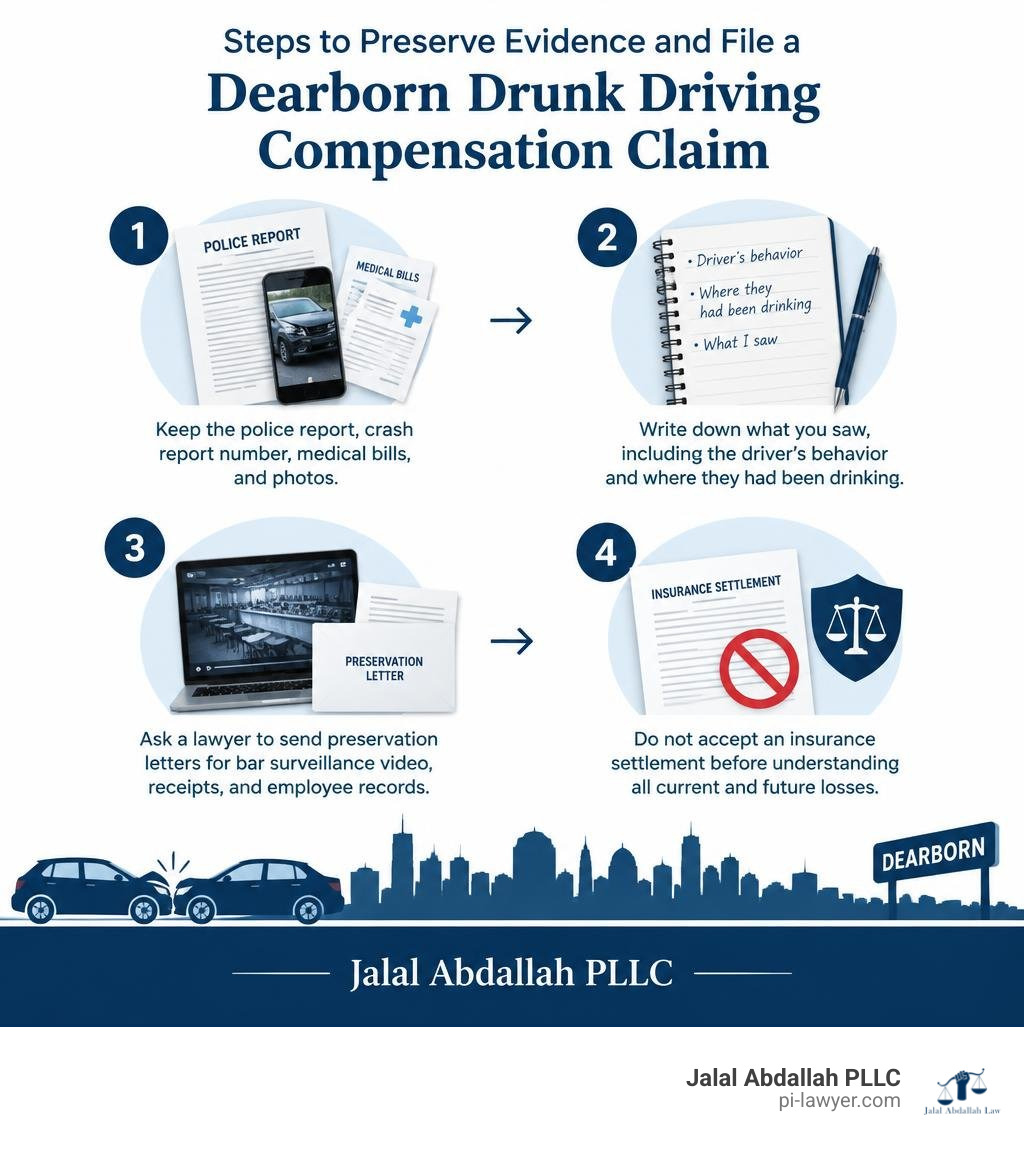
Take these steps promptly:
- Keep the police report, crash report number, medical bills, and photos.
- Write down what you saw, including the driver’s behavior and where they had been drinking.
- Ask a lawyer to send preservation letters for bar surveillance video, receipts, and employee records.
- Do not accept an insurance settlement before understanding all current and future losses.
A drunk driver can be liable for the harm they cause. In some cases, a bar’s actions matter, too. A Wayne County jury once assigned most of the fault in a fatal impaired-driving crash to a Dearborn establishment after evidence showed staff interactions with the intoxicated patron. The available damages may include medical costs, lost income, pain and suffering, vehicle damage, and, after a fatal crash, funeral costs and loss of companionship for qualifying family members.
I am Jalal Abdallah, a Michigan trial attorney and licensed insurance producer who represents people facing insurers and complex injury claims. In a Dearborn drunk driver claim, I help injured people and families pursue accountability from every party the evidence supports.
Learn more about Dearborn drunk driver claim:
- Dearborn car wreck compensation
- Dearborn vehicle collision attorney
- affordable car accident lawyer Dearborn
Legal Options and Evidence Gathering for a Dearborn Drunk Driver Claim
When an impaired motorist causes devastation on local roads, Michigan law provides several distinct avenues to demand financial compensation. Understanding how these legal mechanisms interact is vital to building an unshakeable case. At Jalal Abdallah PLLC, we stand up for injured community members by taking on large insurance carriers that attempt to reduce payout amounts.
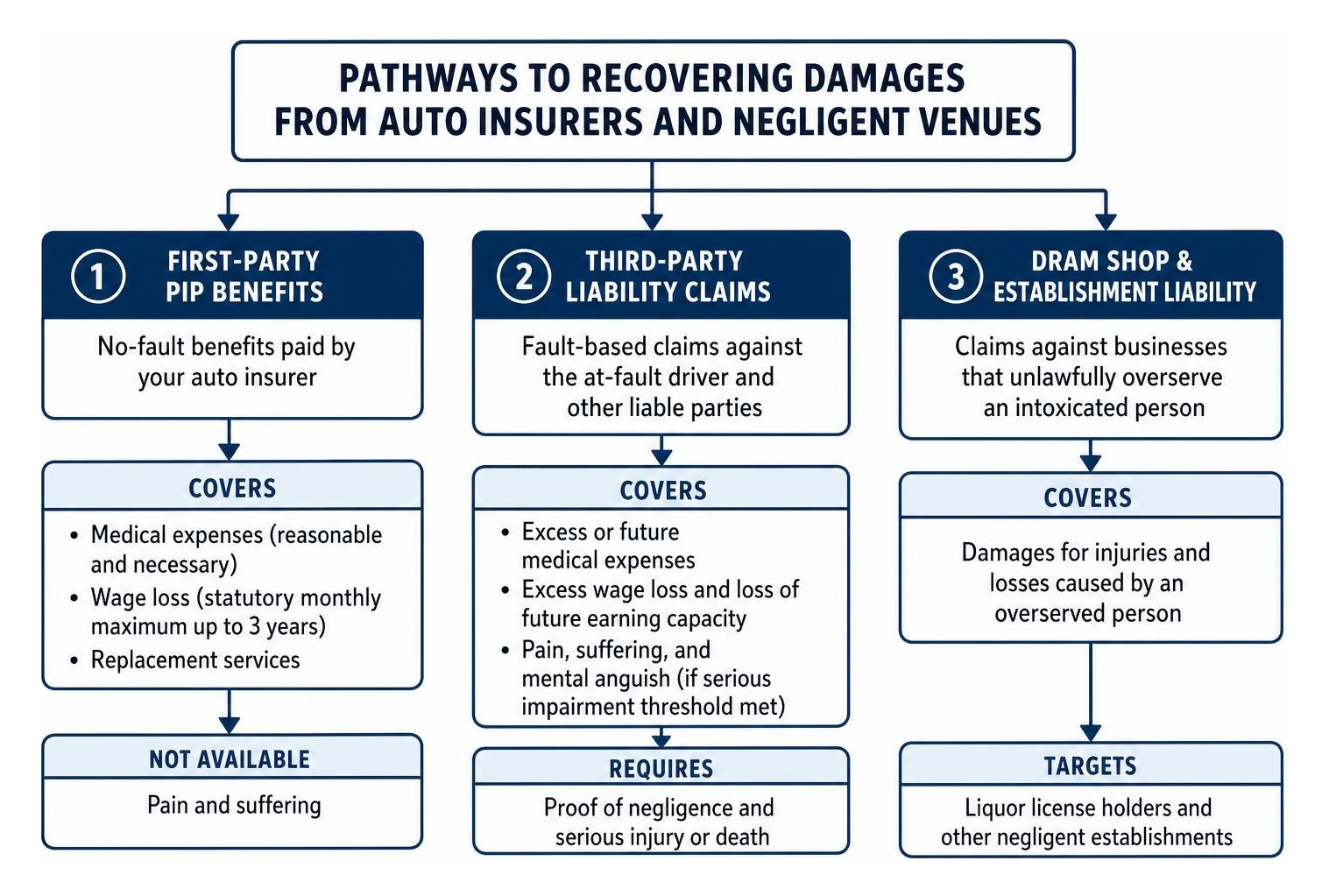
Under Michigan’s hybrid auto insurance structure, victims must navigate both first-party Personal Injury Protection (PIP) claims and third-party tort actions:
- First-Party PIP Benefits: Regardless of who caused the collision, your own auto insurance policy covers allowable medical expenses, a percentage of lost wages, and essential replacement services.
- Third-Party Bodily Injury Claims: If you have suffered a serious impairment of body function, permanent serious disfigurement, or if a loved one was killed, you can bring a third-party lawsuit directly against the intoxicated driver for non-economic damages such as pain, suffering, and mental anguish.
- Dram Shop and Establishment Liability Claims: When commercial venues unlawfully overserve an individual who subsequently causes harm, you may pursue damages directly against the liquor license holder.
Knowing the right 5 moves to make after a car crash in Dearborn ensures you do not inadvertently compromise your rights against any responsible party.
| Benefit / Damage Type | First-Party PIP Claims | Third-Party Liability Claims |
|---|---|---|
| Fault Requirement | No-Fault (paid regardless of fault) | Fault-Based (must prove negligence) |
| Medical Expenses | Reasonable and necessary medical care up to policy limits | Excess or future medical expenses not covered by PIP |
| Wage Loss | Statutory monthly maximum for up to three years | Excess wage loss and loss of future earning capacity |
| Pain & Suffering | Not available under first-party coverage | Recoverable if injury meets the serious impairment threshold |
| Responsible Payor | Your auto insurer (or Michigan Assigned Claims Plan) | At-fault driver, vehicle owner, and liable liquor establishments |
Preserving Critical Law Enforcement Records for a Dearborn Drunk Driver Claim
Local law enforcement agencies work tirelessly to curb impaired driving throughout Wayne County. For instance, Officer Bilal Bazzy made 375 drunk and drug-impaired driving arrests since joining the Dearborn Heights Police Department in fall 2023—the highest total in Michigan, earning commendation from organizations like Mothers Against Drunk Driving (MADD).
When police arrest an impaired driver, they compile valuable objective evidence. These materials include:
- Official preliminary breath test (PBT) and evidential blood alcohol concentration (BAC) reports.
- Standardized Field Sobriety Test (SFST) performance logs.
- Dashcam and body-worn camera recordings capturing slurred speech, balance loss, or admissions.
- Collision reconstruction diagrams, especially during high-impact wrecks such as the 7-vehicle crash in Dearborn Heights stemmed from driver who was drunk.
Securing these records immediately provides definitive proof that the motorist operated a vehicle well over the legal limit of 0.08% BAC or under the influence of intoxicating substances.
Proving Fault and Overcoming Comparative Negligence Defense Tactics
In Wayne County Circuit Court, defense attorneys and insurance adjusters often attempt to deflect blame by alleging comparative negligence against the victim. They may claim that driving slightly over the speed limit or failing to brake quickly enough contributed to the collision.
To counter these tactics, our team secures comprehensive evidence:
- Crash data retrieval from vehicle “black boxes” showing speed, braking, and steering inputs.
- Scene measurements, skid marks, and crush damage patterns analyzed by collision reconstruction investigators.
- Independent eyewitness statements detailing erratic maneuvers prior to the impact.
Having comprehensive Dearborn car accident legal representation gives victims the legal resources needed to refute bad-faith defense arguments and demonstrate clear liability.
Holding Establishments Accountable Under Michigan Dram Shop and Negligence Laws
A driver who chooses to drink and get behind the wheel is undeniably responsible for their actions. However, commercial establishments that profit from serving alcohol also share an obligation to follow state safety laws. The guide to selecting a Dearborn auto accident lawyer highlights the value of finding legal counsel capable of identifying every liable entity, including liquor licensees.
Establishing Dram Shop Violations Through Bar Surveillance and Employee Admissions
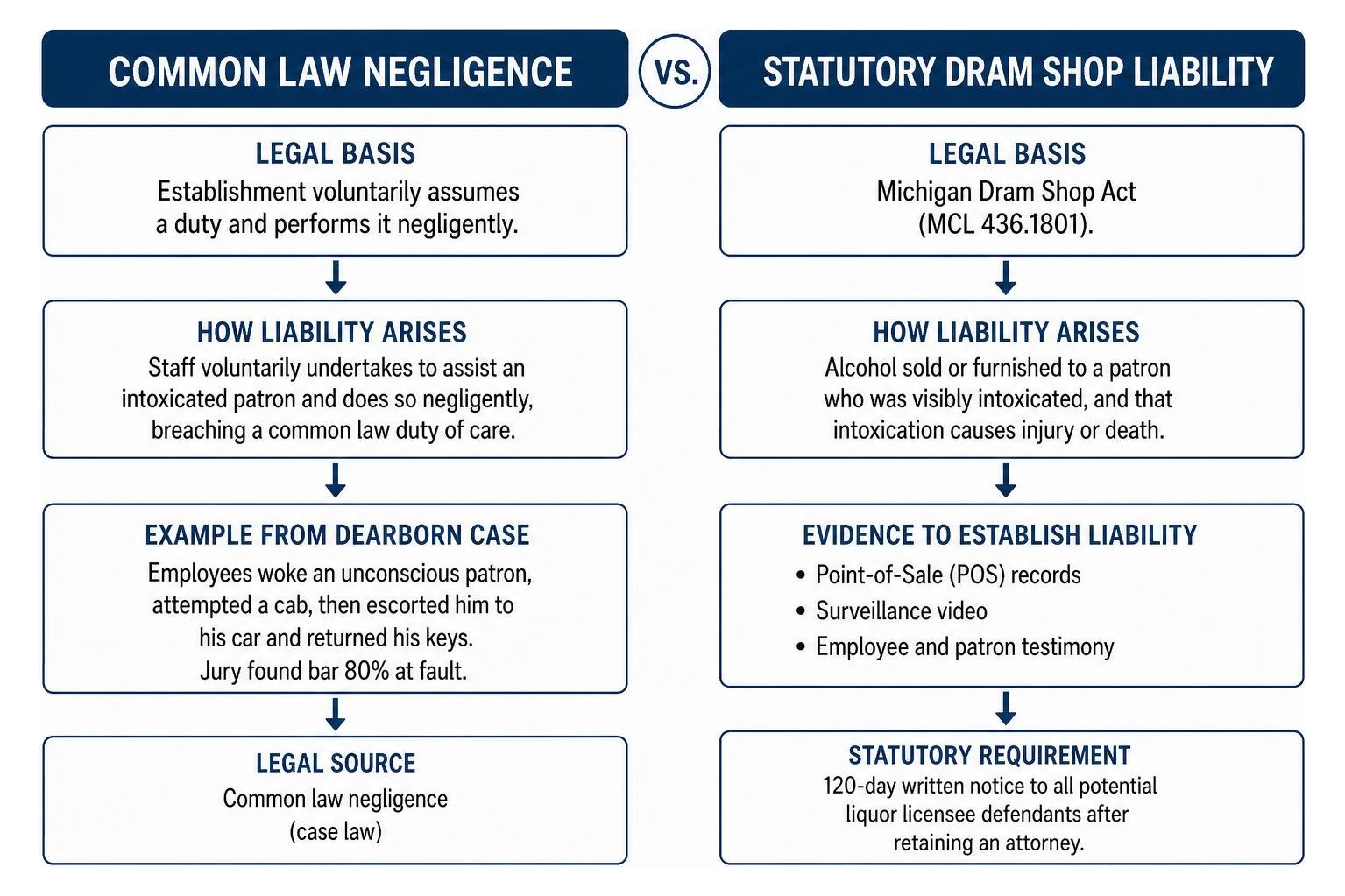
Under the Michigan Dram Shop Act (MCL 436.1801), a licensed retail establishment is liable for injuries or deaths caused by an intoxicated patron if the bar sold or furnished alcohol to that person while they were visibly intoxicated.
Proving visible intoxication requires establishing that the patron displayed outward physical signs—such as slurred speech, unsteadiness, loud behavior, or glassy eyes—while still being served alcohol. Critical evidence includes:
- Point-of-Sale (POS) Records: Itemized, time-stamped receipts showing the frequency and volume of alcohol purchased.
- Surveillance Video: Internal and external bar footage capturing the patron’s demeanor at the counter, at tables, and in the parking lot.
- Employee and Patron Testimony: Statements from bartenders, waitstaff, or other customers regarding the patron’s visible state.
Michigan law enforces a strict 120-day notice requirement under the Dram Shop Act. Victims must provide formal written notice to all potential liquor licensee defendants within 120 days of retaining an attorney. Getting a prompt evaluation of your Dearborn injury claim helps ensure you do not forfeit your right to hold negligent bars accountable.
Pursuing General Negligence Claims for Voluntary Assumption of Duty
In addition to statutory dram shop claims, an establishment may face general common law negligence claims if its staff voluntarily undertakes an affirmative duty to assist an intoxicated customer and carries it out negligently.
A powerful example of this principle occurred in Wayne County Circuit Court, reported by Michigan Lawyers Weekly, where a jury found a Dearborn club 80% at fault and the drunk driver only 20% at fault for a fatal nine-car pileup caused at speeds exceeding 80 mph. The jury awarded $2,261,486 to the victim’s estate. In that case, evidence showed that club employees—including a disc jockey and valet—woke the unconscious patron, attempted to call a cab, but ultimately helped escort him to his car and handed him his keys.
By voluntarily stepping in to manage an incapacitated patron, the establishment assumed a common law duty of care that it subsequently breached, creating liability separate from the dram shop statute.
Pursuing Catastrophic and Fatal Crash Damages Under Michigan Law
When an impaired driver causes severe harm, the financial consequences can be staggering. Properly valuing your Dearborn collision settlement requires calculating both current losses and lifelong financial burdens.
Victims of severe injuries can pursue damages for:
- Traumatic brain injuries, spinal damage, and amputations.
- Past and future medical rehabilitation costs.
- Diminished future earning capacity.
- Physical pain, emotional trauma, and loss of quality of life.
Recovering Wrongful Death Damages in a Dearborn Drunk Driver Claim
When an impaired motorist causes a fatal crash, surviving family members must pursue justice through the Michigan Wrongful Death Act (MCL 600.2922). Reviewing family legal options after a fatal Dearborn accident helps survivors understand their rights during this painful time.
Recoverable damages under the Wrongful Death Act include:
- Reasonable medical, hospital, funeral, and burial expenses.
- Compensation for the decedent’s conscious pain and suffering between the time of injury and death.
- Loss of financial support and contributions the deceased would have provided to dependents.
- Loss of society, companionship, guidance, and protection suffered by surviving spouses, children, parents, and siblings.
Critical Immediate Steps and Legal Timelines to Protect Survivor Rights
Surviving families should consult guidance on first steps for survivors navigating fatal crash claims to avoid procedural missteps:
- Appoint a Personal Representative: Wrongful death actions in Michigan must be brought by the personal representative of the decedent’s estate, appointed through the Wayne County Probate Court.
- Issue Spoliation Letters: Formal legal notices must be dispatched immediately to preserve traffic camera footage, nearby commercial security tapes, bar POS logs, and vehicle electronic control modules before data is overwritten.
- Comply with Statutes of Limitations: In Michigan, standard auto negligence and wrongful death claims must generally be filed within three years of the incident, while dram shop notices must be served within 120 days of retaining counsel.
Frequently Asked Questions About Dearborn Impaired Driving Claims
What is the difference between a dram shop claim and a general negligence claim against a bar?
A dram shop claim is a statutory cause of action under MCL 436.1801 that requires proving a licensed bar sold alcohol directly to a visibly intoxicated individual. A general negligence claim involves common law principles where bar staff took affirmative actions outside routine service—such as confiscating keys, promising to arrange safe transport, or waking an unconscious person and walking them to their vehicle—thereby assuming a duty of care that they failed to exercise reasonably.
How is liability split between a drunk driver and an alcohol-serving business in Michigan?
Under Michigan’s comparative fault system, the jury assesses the actions of all responsible parties and assigns a percentage of fault to each. For instance, in severe Wayne County cases where bar staff actively facilitated an impaired patron’s departure to their vehicle, juries have assigned the vast majority of liability (such as 80%) to the establishment, holding the drunk driver responsible for the remainder (20%).
What damages can surviving family members claim after a fatal drunk driving crash?
Through the personal representative of the estate, qualifying survivors—such as spouses, children, parents, and siblings—can recover funeral and burial costs, medical expenses incurred prior to passing, compensation for the decedent’s conscious pain and suffering, loss of expected financial support, and non-economic damages for the permanent loss of companionship, love, and guidance.
Demand Total Accountability with Jalal Abdallah PLLC
When drunk drivers and irresponsible establishments disrupt innocent lives, they must be held accountable. At Jalal Abdallah PLLC, we pride ourselves on relentless advocacy for underdogs against large insurance carriers, negligent commercial venues, and impaired motorists. We gather every piece of evidence, stand firm against unfair settlement offers, and fight for full financial recovery for our clients.
If you or someone you care about has been injured by an impaired driver, schedule a car accident consultation with us today to discuss your rights and pursue the justice you deserve.
Share This Article

Schedule Your Free Consultation Today!
Reach out today and receive a consultation, completely free of charge - we'll evaluate your case and let you know what comes next.


