 Skip to content
What to Do After a Public Transit Accident in Dearborn
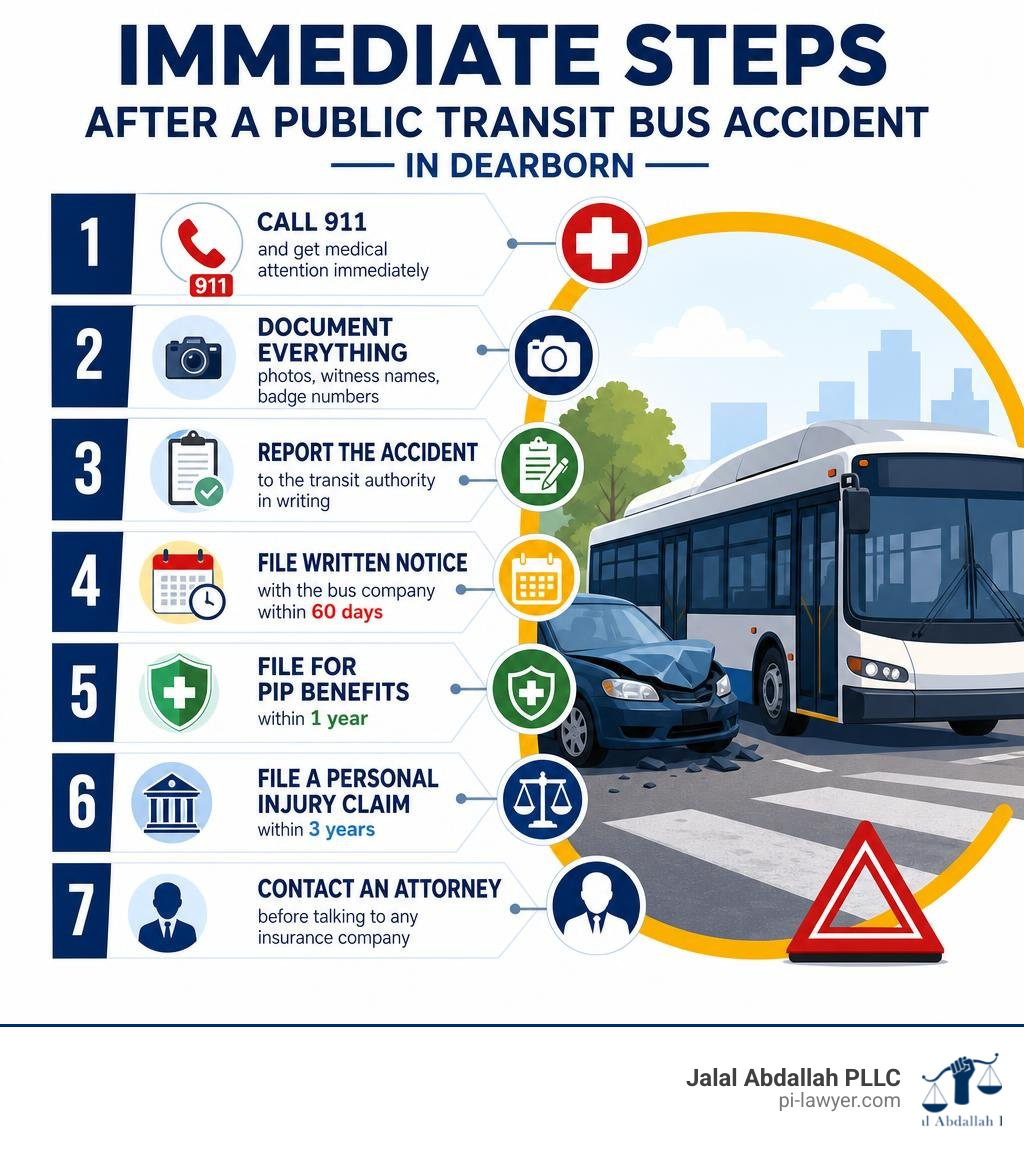
If you’ve been hurt in a public transit accident in Dearborn, here’s what matters most right away:
- Call 911 and get medical attention immediately
- Document everything — photos, witness names, badge numbers
- Report the accident to the transit authority in writing
- File written notice with the bus company within 60 days
- File for PIP benefits within 1 year
- File a personal injury claim within 3 years
- Contact an attorney before talking to any insurance company
Dearborn’s roads and transit system see serious accidents more often than most residents realize. In April 2024, a school bus lost control and crashed directly into Bambi Land Child Care on a Monday evening — the driver said a water bottle had lodged under her brake pedal. Only four children were inside at the time. On a typical daytime weekday, over 100 kids would have been there. It was a narrow escape that reminded the whole community just how quickly a routine transit trip can turn dangerous.
Whether you were a passenger on a SMART bus, a DDOT route, or a SMART Flex ride — or a bystander caught in a crash — your rights matter. And Michigan’s no-fault laws make these cases more complicated than a standard car accident claim.
I’m Jalal Abdallah, a personal injury attorney based in Dearborn who has built his practice on fighting for everyday people after a public transit accident in Dearborn and across Michigan. If you’re feeling overwhelmed by insurance companies or unsure where to start, this guide will walk you through exactly what you need to know.
Explore more about Public Transit Accident Dearborn:
Recent Bus Crashes and Public Transit Safety in Dearborn
When we look at local safety, the numbers and stories paint a vivid picture of the risks passengers and pedestrians face daily on our streets. The Bambi Land Child Care incident was a chilling wake-up call. The school bus crashed into the daycare building after 5 p.m. on a Monday, completely destroying a structural pillar. According to the FOX 2 Detroit report on the Bambi Land daycare crash, the driver claimed a rogue water bottle rolled under her brake pedal, preventing her from stopping. Miraculously, no injuries were reported, but it highlighted how a single minor distraction or mechanical mishap can lead to a near-catastrophe.
Unfortunately, this is not an isolated event. Our local roads see a steady stream of commercial and public vehicle incidents. For instance, a separate incident involved a WXYZ report on Dearborn Heights school bus crash where, once again, the community breathed a sigh of relief as no injuries were reported.
However, other recent collisions in the Dearborn area have had devastating outcomes. In July 2026, a horrific collision occurred on eastbound I-94 near Wyoming Avenue. A Westland man, who was later determined to be speeding and driving drunk, slammed his vehicle into a stopped semi-truck. The impact killed three passengers in his car: Myles Bland, 27, of Dearborn; Jailyn Riley, 24, of Detroit; and Alexandria Boynton, 24, of Detroit. As detailed in the ClickOnDetroit report on the July 2026 I-94 triple fatal crash, the driver faced multiple counts of operating while intoxicated causing death and reckless driving.
Additionally, a tragic crash on Michigan Avenue near Nowlin Street involved a 26-year-old woman speeding at over 100 mph through a red light, striking a pickup truck and killing a 33-year-old local doctor and mother of three. You can read more about this devastating event in the Dearborn Patch report on the fatal Michigan Avenue crash.
These severe incidents underscore the sheer force and danger present on major transit corridors like Michigan Avenue, I-94, and the Southfield Freeway. Whether a crash involves a passenger vehicle, a semi-truck, or a public bus, the physical and emotional aftermath can be life-altering. If you or a loved one has been caught in a collision, exploring our bus accident category can help you understand the broader legal landscape.
Strict Deadlines for Filing a Public Transit Accident Dearborn Claim
If you are injured while riding a public bus, waiting to take action is the single biggest mistake you can make. When dealing with municipal entities like the Suburban Mobility Authority for Regional Transportation (SMART) or the Detroit Department of Transportation (DDOT), the legal runway is incredibly short.
Under Michigan law, you must provide written notice to the public transit provider within 60 days of the accident.

This 60-day rule is a strict, unforgiving deadline. If you do not submit a highly specific written notice detailing the time, place, nature of the injury, and names of witnesses to the transit authority within those two months, you will likely lose your right to sue the agency forever. This is true even if the bus driver was clearly at fault.
Beyond the 60-day municipal notice, you must also navigate two other critical timelines under Michigan’s insurance laws:
- The 1-Year PIP Deadline: You have exactly one year from the date of the accident to file an application for No-Fault Personal Injury Protection (PIP) benefits.
- The 3-Year Statute of Limitations: You have three years from the crash date to file a third-party personal injury lawsuit against the at-fault driver or negligent entity for non-economic damages, such as pain and suffering.
To ensure you do not miss these critical windows, consult our comprehensive Dearborn bus crash claim guide for a step-by-step breakdown of how to preserve your claim.
How Michigan No-Fault Laws Apply to a Public Transit Accident Dearborn
Michigan’s auto insurance landscape is notoriously complex, and public transit accidents add an extra layer of difficulty. Normally, if you are hurt in a car crash, your own auto insurer pays your medical bills under your PIP policy. But what happens if you were a passenger on a SMART bus and do not own a vehicle?
Michigan establishes a strict “order of priority” to determine which insurance company is responsible for paying your PIP benefits after a bus accident:
Furthermore, public transit operators are classified as “common carriers.” Under Michigan law, common carriers owe their passengers a duty of due care. However, this duty is not absolute. In the landmark Michigan Court of Appeals ruling in Marsha Anderson v. Transdev Services, Inc., the court reaffirmed that a transit operator is not required to wait until every single passenger is seated before moving the vehicle, unless there is an obvious, special reason to do so. The court also noted that the normal, routine jerks and sudden movements of a bus or streetcar are considered ordinary incidents of travel that passengers must expect.
To overcome this hurdle and prove negligence, we must show that the bus driver’s actions were unnecessarily violent, sudden, or reckless. For specialized insights on these types of commercial vehicle cases, you can read more about charter bus accident legal help to see how common carrier liability is established.
Steps to Take Immediately Following a Public Transit Accident Dearborn
The moments directly following a bus crash are chaotic, but taking the right steps can protect your health and your legal rights:
- Call 911 Immediately: Ensure the police and paramedics are dispatched to the scene. A formal police report is vital.
- Seek Medical Attention: Even if you feel fine, adrenaline can mask severe injuries, such as internal bleeding or concussions. Go to an emergency room or urgent care right away.
- Document the Scene: If you are physically able, take photos of the bus, the surrounding vehicles, any road hazards, and your visible injuries.
- Gather Witness Information: Get the names, phone numbers, and statements of fellow passengers and bystanders. Do not rely on the police or the bus driver to do this for you.
- Identify the Bus and Driver: Write down the bus number, route details, license plate, and the driver’s name or badge number.
- Avoid Giving Statements to Insurance Adjusters: The transit company’s insurance representatives may contact you quickly, acting friendly but looking for ways to get you to admit you aren’t really hurt.
For a deeper dive into protecting yourself at the scene, check out our guide on what to do immediately after a car accident in Michigan.
Compensation and Benefits Available to Injured Passengers
When you are injured in a public transit accident in Dearborn, Michigan law allows you to pursue two distinct types of compensation: first-party PIP benefits and third-party liability claims.
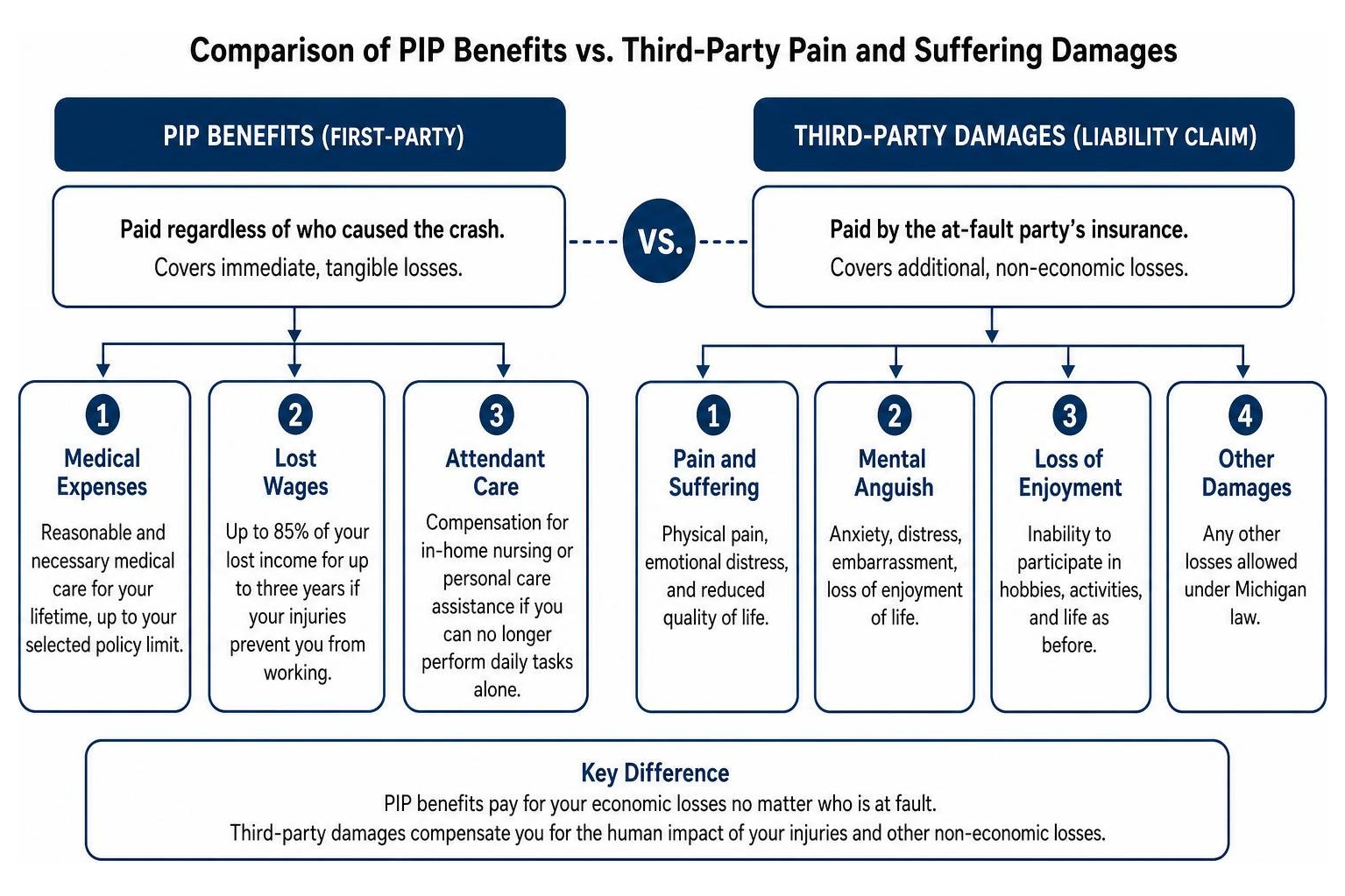
First-party benefits are paid regardless of who caused the crash. They cover your immediate, tangible financial losses:
- Medical Expenses: Reasonable and necessary medical care for your lifetime, up to your selected policy limit.
- Lost Wages: Up to 85% of your lost income for up to three years if your injuries prevent you from working.
- Attendant Care: Compensation for in-home nursing or personal care assistance if you can no longer perform daily tasks alone.
If the bus driver or another motorist was at fault, and your injuries meet Michigan’s “serious impairment of body function” threshold, we can also pursue a third-party claim. This allows you to recover non-economic damages, such as physical pain, mental anguish, loss of enjoyment of life, and permanent scarring.
To understand what your case might be worth, read our Dearborn car wreck compensation guide. You can also learn how courts calculate non-economic recovery in our resource on understanding pain and suffering damages.
Be prepared, however: insurance companies will use every trick in the book to minimize your pain. From scouring your social media accounts to twisting your medical history, they want to pay you as little as possible. Learn what to watch out for in our guide on how insurance companies try to devalue your injury claim.
Frequently Asked Questions About Dearborn Bus Accidents
What public transit options are available in Dearborn?
Dearborn is well-connected by several public transit networks. The Suburban Mobility Authority for Regional Transportation (SMART) operates traditional bus routes throughout the city, while the Detroit Department of Transportation (DDOT) provides connecting service into Detroit.
For more flexible local travel, the SMART Flex service offers on-demand, point-to-point rides within Dearborn for affordable rates, typically ranging from $2 to $8 depending on the distance. For regional travel, residents can access the Amtrak station located at 21201 Michigan Avenue, as well as Greyhound and Megabus services. While these options make getting around convenient, the high volume of transit vehicles sharing the road with passenger cars increases the risk of local transit accidents.
What happens if a government-owned bus causes my injuries?
When a bus owned by a government entity (like a public school district or a municipal transit authority) causes an accident, a legal doctrine known as “governmental immunity” comes into play. Generally, government agencies are immune from lawsuits. However, Michigan law provides a critical exception for the negligent operation of a government-owned vehicle.
To successfully sue a government transit authority, you must strictly adhere to the 60-day written notice requirement. Failing to do so bar you from seeking recovery. Because these cases involve navigating complex administrative hurdles, having strong legal representation is essential. You can explore how we handle these high-stakes cases on our personal injury practice area page.
How do I obtain a copy of my Dearborn crash report?
To obtain a crash report for an accident that occurred within Dearborn city limits, you have a couple of options through the Dearborn Police Department (located at 16099 Michigan Ave):
- For Traffic Crash Reports: You can purchase and download your crash report online through the CLEMIS (Oakland County’s OakNet) system. You will need the incident number, the date of the crash, and the date of birth of one of the drivers or passengers involved.
- For Other Police Reports: If you need a full incident report or investigative file, you must submit a Freedom of Information Act (FOIA) request to the Dearborn Police FOIA Unit. These requests typically take 5 to 15 business days to process.
Protect Your Rights and Hold Transit Authorities Accountable
When a massive public transit vehicle collides with a passenger car or a pedestrian, the physical, financial, and emotional toll is immense. Municipalities and their massive insurance providers have teams of lawyers working immediately to limit their financial exposure. You deserve an advocate who will stand up to them and fight just as hard for you.
At Jalal Abdallah PLLC, we pride ourselves on relentless advocacy for underdogs. We understand the complex web of Michigan’s no-fault system, the strict municipal deadlines, and the tactics insurers use to deny valid claims. We handle the legal heavy lifting so you can focus entirely on your physical recovery.
If you or a loved one has been injured, don’t face the insurance giants alone. Work with the best bus accident lawyer Dearborn has to offer. Reach out to us today and contact us for a free consultation. We don’t collect a dime unless we win your case.
Share This Article

Schedule Your Free Consultation Today!
Reach out today and receive a consultation, completely free of charge - we'll evaluate your case and let you know what comes next.


