 Skip to content
What to Know About Slip and Fall Claims in Dearborn
Slip and fall claims Dearborn can involve a private business, a landlord, or the City of Dearborn, but the right steps depend on who controlled the property and what caused the fall.
- Private property claim: You generally must show the owner or business knew, or should have known, about a dangerous condition and failed to act reasonably.
- City property claim: Governmental immunity may apply. A claim involving a highway or street defect can require formal written notice within 120 days under Michigan law.
- Ice, snow, and spills: Weather records, photos, store reports, and witness accounts can shape whether the condition was reasonably discoverable and whether the property owner acted with reasonable care.
- Act quickly: Conditions change fast. Photograph the area, report the incident, get medical care, and preserve the shoes and clothing worn during the fall.
A fall in a parking lot, store aisle, sidewalk, or public street may seem simple at first. In Michigan, though, the details matter: the exact location, the property owner’s notice of the hazard, the weather, available routes, and your own observations can all affect the outcome.
I am Jalal Abdallah, a Michigan trial attorney and personal injury advocate who helps injured people face insurers, businesses, and government entities. My work on slip and fall claims Dearborn is grounded in clear guidance, careful investigation, and protecting the rights of people who feel outmatched by the legal system.
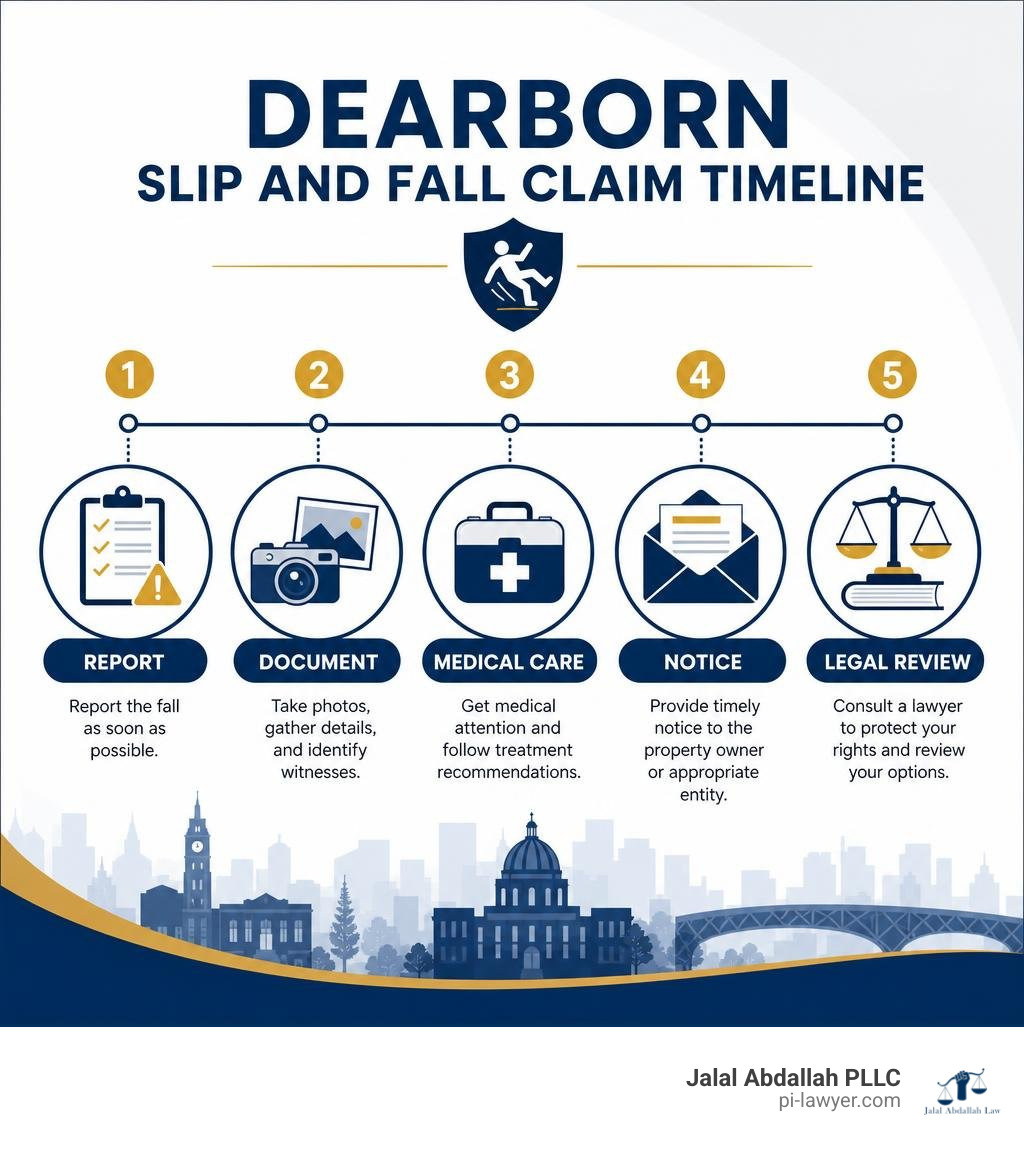
Quick slip and fall claims Dearborn terms:
Understanding Legal Duties: Premises Liability vs Ordinary Negligence
When someone slips and falls in a local retail store or commercial building, understanding the exact legal basis of the claim is critical. Under Michigan law, there is a strict distinction between a premises liability action and an ordinary negligence claim.
Premises liability arises solely out of property ownership or possession. A land possessor owes business invitees—customers lawfully on the premises—a duty to exercise reasonable care to protect them from unreasonable risks of harm caused by dangerous conditions on the land. If a spill sits on a store aisle for an extended period and management fails to clean it up, that is a classic premises liability scenario.
Ordinary negligence, on the other hand, requires proof of affirmative conduct by the property owner or its employees. In other words, an employee must have done something active that directly created the danger or caused the incident, rather than simply failing to maintain the property.
This distinction was highlighted in federal litigation involving a store spill, such as in the McCarver v. Target Corporation trial court document. In that case, a customer carrying a large item (a television) slipped on a pink liquid spill in a main walkway. The court emphasized that failing to discover or clean up a liquid spill is a matter of premises liability, not ordinary negligence, unless there is direct evidence that an employee affirmatively spilled the liquid. Furthermore, if a customer carries an object that blocks their own line of sight, Michigan courts do not hold the landowner responsible for that self-imposed view obstruction.
To learn more about how these duties apply across various local businesses, check out our Dearborn Slip and Fall Guide.
Navigating Slip and Fall Claims Dearborn: Key Legal Rules
Navigating slip and fall claims Dearborn requires understanding who owns the land where the fall happened. The rules governing public sidewalks and city streets differ drastically from those governing private grocery stores, shopping centers, or apartment complexes.
Government vs Private Store Slip and Fall Claims Dearborn
If you slip and fall on private property—such as a big-box retailer, supermarket, or commercial parking lot—your case falls under standard premises liability rules. Private property owners must maintain their premises in a reasonably safe condition and warn invitees of hidden hazards they know about or should have discovered through reasonable inspection.
When a fall happens on municipal property, such as a city street or sidewalk maintained by the City of Dearborn, the legal framework changes completely. Governmental entities in Michigan enjoy broad statutory immunity from tort liability. To bring a successful claim against a municipality, your case must fit strictly within a specific statutory exception, such as the highway exception under MCL 691.1402.
For a deeper dive into these requirements, see our guide on What to Know About a Dearborn Premises Liability Lawsuit.
Strict 120-Day Notice Deadlines for Municipal Claims
Under MCL 691.1404(1), if you are injured due to a defective highway, street, or public sidewalk maintained by a governmental agency, you must serve formal written notice on the governmental entity within 120 days of the injury. Missing this deadline by even a single day will permanently bar your claim.
The statutory notice cannot be a vague summary. Under Michigan law, the written notice must explicitly detail:
- The exact location and nature of the defect (e.g., specific street address and clear photos showing nearby landmarks).
- The precise injuries sustained (e.g., “fractured left ankle” rather than general phrasing like “significant injuries”).
- The names of any known witnesses to the incident.
Furthermore, proper service of process is mandatory under court rules such as MCR 2.105(G). Notice must be served directly on authorized municipal officials, such as the Mayor, City Clerk, or City Attorney.
The danger of procedural missteps was highlighted in the COA McLean v. City of Dearborn opinion. In that case, a pedestrian fell into a street pothole across from a specific address. Although she submitted photos, her initial notice described her harm vaguely as “significant injuries” rather than identifying her specific broken foot, and follow-up correspondence was mailed to a third-party claims administrator rather than the City Clerk. The court ruled that sending notice to an outside insurance adjuster or claims administrator does not satisfy statutory requirements, leading to the complete dismissal of her lawsuit. At Jalal Abdallah PLLC, we ensure that every administrative detail and service requirement is handled meticulously from day one.
Defeating the Open and Obvious Defense in Ice and Spill Cases
The most common defense raised by property owners in Michigan slip and fall lawsuits is the “open and obvious” doctrine. Under this rule, a land possessor generally owes no duty to protect or warn invitees against hazards that an average person of ordinary intelligence would discover upon casual inspection.
To evaluate whether a condition was open and obvious, courts apply an objective test: Would a reasonable person in the plaintiff’s position have seen and recognized the danger?
Black Ice and Seasonal Winter Weather Hazards
In Michigan, winter conditions bring frequent black ice hazards. Defendants often argue that black ice is open and obvious whenever surrounding weather conditions provide “indicia” of potential ice formation—such as freezing temperatures, recent snowfall or freezing rain, or visible snow accumulation nearby.
This argument was central in the federal court ruling Jaafar v. Home Depot USA summary judgment order. In Jaafar, a shopper stepped out of his vehicle in a Dearborn parking lot on a gloomy November morning and slipped on black ice, injuring his back. The court granted summary judgment for the property owner, ruling that official NOAA weather data showing below-freezing temperatures in the preceding 24 hours, combined with light snow visible on surrounding roofs and vehicles and the plaintiff’s long-time residency in Michigan winters, constituted sufficient visual cues to make the ice legally open and obvious.
To counter these arguments, injury victims must demonstrate that unique site conditions masked the hazard or that environmental indicators were absent. Consulting an experienced Dearborn Premises Liability Injury Claim Attorney helps preserve critical weather and scene data before it disappears.
Effectively Unavoidable Hazards and Retail Obstructions
Even if a hazard is considered open and obvious, property owners may still be held liable if “special aspects” make the hazard unreasonably dangerous or “effectively unavoidable.”
A condition is deemed effectively unavoidable only when a person is required to confront the risk with no practical alternative route available. For example, if the single public entrance to a commercial building is completely blocked by an icy patch or standing water, an invitee entering for business has no choice but to cross it. However, if a secondary, safe path exists—or if the customer previously noticed the spill and chose to walk through it again—the court will find the hazard was not effectively unavoidable.
As established in retail cases like McCarver v. Target, if a customer carries an item (like a large box) that obstructs their view of an open spill, the obstruction is caused by the customer’s own conduct, not a special aspect of the premises.
| Hazard Condition | Legal Classification | Key Legal Standard |
|---|---|---|
| Visible pink spill in broad daylight | Open & Obvious | Discoverable upon casual inspection by an average person. |
| Black ice with surrounding snow & freezing temps | Open & Obvious | Weather indicia provide sufficient warning of ice risks. |
| Single accessible exit blocked by ice accumulation | Effectively Unavoidable (Special Aspect) | Plaintiff is forced to confront hazard with no alternative path. |
| Spill obscured because plaintiff carried a large TV | Open & Obvious | Vision blockage created by plaintiff does not alter open nature. |
Step-by-Step Evidence Gathering for Injury Victims
Building a robust case requires gathering concrete evidence immediately following an incident. Because weather changes and property owners clean up spills quickly, immediate proof collection is vital for slip and fall claims Dearborn.
Building Proof for Slip and Fall Claims Dearborn
To establish liability and protect your rights, follow these steps to secure key evidence:
- Take High-Resolution Photos and Videos: Capture the hazard from multiple angles. Take close-up shots of the defect, ice, or spill, as well as wide shots showing surrounding landmarks, store signage, or building addresses to fix the precise location.
- Obtain Official Weather Data: In ice and snow cases, historical meteorological records from the National Oceanic and Atmospheric Administration (NOAA) establish exact hourly temperatures, precipitation, and freeze-thaw cycles.
- File an Official Incident Report: Notify store managers or property owners immediately and request a copy of the written incident report before leaving.
- Gather Witness Contact Information: Collect names, phone numbers, and statements from eyewitnesses who saw the fall or observed the condition beforehand.
For additional insight into structuring your claim, review our resources on Finding a Top Premises Liability Lawyer in Dearborn MI.
Demonstrating Property Owner Negligence and Overcoming Defenses
To overcome defense claims of comparative fault or lack of knowledge, plaintiffs must show that the land possessor had actual or constructive notice of the danger:
- Actual Notice: Store personnel created the hazard or were directly notified about it prior to the fall.
- Constructive Notice: The dangerous condition existed for a sufficient length of time that a reasonable property owner inspecting the premises should have discovered and corrected it.
Maintenance logs, sweep logs, security camera footage, and employee shift records are critical tools we use to demonstrate how long a hazard remained unaddressed. Scheduling a prompt Dearborn Slip Lawyer Consultation ensures these records are preserved before store video files are overwritten.
Frequently Asked Questions
What is the notice deadline for filing a claim against the City of Dearborn?
Under Michigan statute MCL 691.1404(1), you must serve formal written notice on the governmental agency within 120 days of the injury. The notice must specify the exact location and nature of the defect, the specific medical injuries sustained, and all known witnesses, served directly on authorized city officials like the City Clerk.
Is black ice always considered an open and obvious danger in Michigan?
Not automatically, but courts frequently deem black ice open and obvious if surrounding weather cues (“indicia”) were present. These cues include below-freezing temperatures, recent snow or freezing rain, or visible snow on nearby lawns, vehicles, or roofs.
How does carrying a large item affect a retail slip and fall claim?
Under Michigan premises liability law, carrying an object (such as groceries or a large box) that blocks your downward vision does not make a visible hazard hidden. Courts consider view obstructions caused by items being carried by the plaintiff as part of the plaintiff’s conduct, keeping the objective hazard classified as open and obvious.
Stand Up for Your Rights After a Dearborn Slip and Fall
A sudden slip and fall can lead to unexpected medical bills, lost wages, and painful injuries. Whether your fall occurred on a neglected city street or inside a busy commercial store, navigating strict 120-day notice deadlines, governmental immunity hurdles, and complex open and obvious defenses requires determined advocacy.
We fight relentlessly for everyday people and underdogs against powerful insurance carriers and government bodies. If you or a loved one suffered an injury, do not let procedural traps or aggressive insurance adjusters derail your recovery. Hire a Dearborn Premises Liability Injury Claim Attorney Today to ensure your rights are fully protected from day one.
Share This Article

Schedule Your Free Consultation Today!
Reach out today and receive a consultation, completely free of charge - we'll evaluate your case and let you know what comes next.


