 Skip to content
When One Wrong Step Changes Everything in Dearborn
If you’re looking for a trip and fall attorney in Dearborn, here’s what you need to know right away:
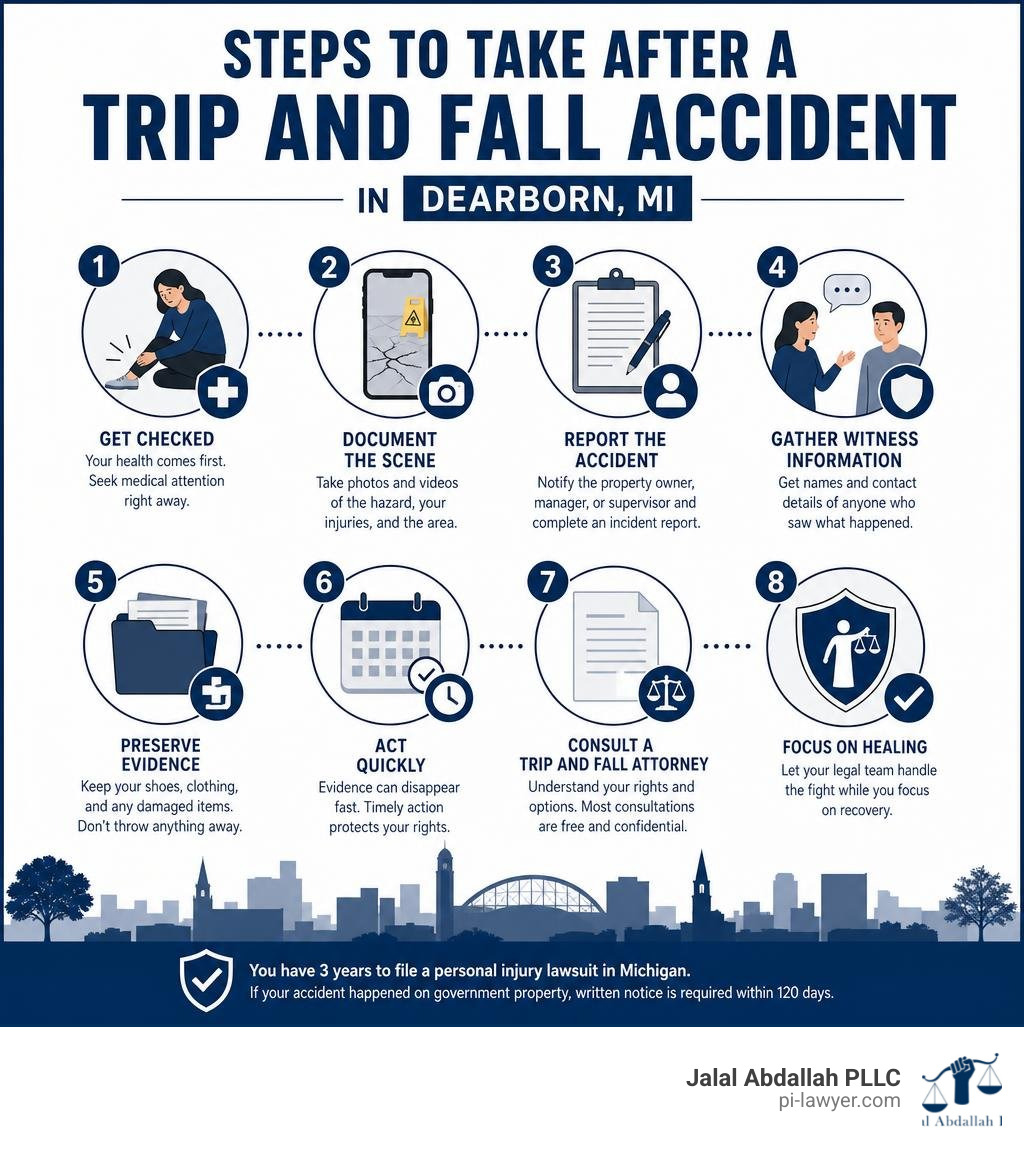
- You have 3 years to file a personal injury lawsuit in Michigan (MCL § 600.5805)
- Government property claims require written notice within 120 days of the accident
- Michigan’s comparative fault rule means you can still recover compensation even if you were partly at fault — as long as you were less than 50% responsible
- You don’t pay upfront — trip and fall attorneys typically work on a contingency fee basis
- Evidence disappears fast — acting quickly protects your claim
One moment you’re walking into a store or stepping along a Dearborn sidewalk. The next, your foot catches a cracked concrete lip, a buckled floor mat, or an uneven pavement edge — and you’re down. Hard.
These accidents don’t just hurt. They can fracture wrists, cause traumatic brain injuries, and put you out of work for weeks or months. More than a million Americans experience a slip, trip, or fall injury each year, and the physical and financial toll can be devastating.
What makes it harder? Property owners and their insurance companies rarely accept blame without a fight. They have legal teams and defenses ready — including the argument that the hazard was “open and obvious” and you should have seen it coming.
You deserve someone equally prepared to fight back.
I’m Jalal Abdallah, founder of Jalal Abdallah PLLC, a personal injury law firm serving Dearborn and the surrounding Michigan communities. I’ve built my practice on challenging powerful insurance companies and holding negligent property owners accountable. As a member of the Michigan Association for Justice and a fierce advocate for injured people, I’m here to make sure your voice is heard and your rights are protected.
Understanding the Legal Difference Between Slip and Fall and Trip and Fall
While people often use the terms “slip and fall” and “trip and fall” interchangeably, they describe completely different physical events. In the legal arena of premises liability, these differences dictate how we build your case, the types of evidence we gather, and how we explain your injuries to a jury.
A slip and fall occurs when there is too little traction between your footwear and the walking surface. This is typically caused by wet floors, spilled liquids, ice, snow, or freshly waxed surfaces. The physical mechanics of a slip usually cause your feet to slide forward out from under you, causing you to fall backward. These accidents frequently result in injuries to the back, neck, tailbone, and the back of the head (including concussions or traumatic brain injuries).
Conversely, a trip and fall happens when your foot strikes an unexpected obstacle, halting your forward momentum while the rest of your body keeps moving. This is a forward-pitching event. Common causes include uneven sidewalk slabs, buckled carpeting, exposed cords, or unexpected steps.
Because your body pitches forward during a trip, your natural instinct is to throw your hands out to break your fall. This forward momentum leads to distinct upper-body injuries, such as:
- Colles’ fractures (severe wrist fractures caused by landing on an outstretched hand)
- Fractured elbows and shoulders
- Facial lacerations and dental damage
- Frontal head trauma
Understanding these mechanics is essential when browsing through our Slip and Fall category resources. When we present your medical records alongside the physical evidence of the hazard, the alignment between how you fell and the injuries you sustained provides powerful proof of how the accident occurred.
Why You Need a Trip and Fall Attorney Dearborn to Prove Liability
Property owners have a legal obligation to keep their premises reasonably safe. However, simply falling on someone else’s property does not automatically mean they have to pay for your medical bills. To secure compensation, you must prove they were negligent.

Establishing negligence requires proving that:
- A dangerous condition existed on the property.
- The property owner knew, or reasonably should have known, about the hazard (known as “actual or constructive notice”).
- The owner failed to repair the hazard, cordon it off, or warn you about it in a reasonable timeframe.
- This specific hazard directly caused your trip, fall, and subsequent injuries.
In Michigan, the level of care a property owner owes you depends on your legal classification at the time of the accident:
- Invitees: This is the highest level of protection. If you are a customer in a retail store, a grocery store, or a restaurant, you are an invitee. Property owners must actively inspect their premises to discover and fix hidden dangers.
- Licensees: This applies to social guests visiting private homes. Property owners must warn licensees of known hazards but are generally not obligated to inspect the property for unknown dangers.
- Trespassers: Property owners owe very little duty of care to individuals on their land without permission, though they cannot set intentional traps.
Proving that a business owner had “constructive notice” (that a hazard existed long enough that they should have discovered it) is incredibly difficult without legal help. A dedicated trip and fall attorney in Dearborn will immediately work to preserve critical evidence before it is altered or destroyed. This includes demanding interior security camera footage, obtaining store maintenance logs, interviewing witnesses, and taking precise measurements of the tripping hazard.
To understand how to navigate this selection process and protect your rights, read The Ultimate Guide to Choosing a Slip and Fall Accident Lawyer.
Overcoming the Open and Obvious Defense in Michigan
For decades, the single largest obstacle for slip and fall victims in Michigan was the notorious “open and obvious” doctrine. Under this rule, property owners argued they owed no duty of care to protect visitors from hazards that an average person would notice upon casual inspection—such as a large puddle, a patch of ice, or a broken step. If a judge deemed a hazard “open and obvious,” the case was dismissed before it ever reached a jury.
Fortunately, the legal landscape in Michigan shifted dramatically. In the landmark ruling of Kandil-Elsayed v. F&E Land Association (decided in late 2023 and heavily shaping cases in 2026), the Michigan Supreme Court altered how this defense is applied.
Today, the “open and obvious” nature of a hazard is no longer an automatic escape hatch for negligent property owners. Instead, it is treated as a factor of comparative fault. This means your case can still move forward, allowing a jury to decide how responsibility should be shared between you and the landowner.
Despite this positive shift, defense attorneys still try to use exceptions to escape liability. We counter these arguments by proving specific legal exceptions, such as:
- Effectively Unavoidable: The hazard was impossible to bypass. For example, if a patch of ice blocked the only public entrance to a medical building, you had no choice but to cross it.
- Special Aspects: The hazard presented an unreasonably high risk of severe harm (such as an unguarded, deep trench directly next to a walkway).
- The Distraction Exception: Your attention was naturally directed elsewhere. If a retail store placed a large, bright promotional sign at eye level directly in front of a 2-inch concrete lip, they cannot blame you for looking at their sign instead of the floor.
| Defense Argument | Our Legal Counter-Strategy |
|---|---|
| “The hazard was visible; you should have looked down.” | Prove the distraction exception (e.g., promotional signs, doorway handles directing eyes upward). |
| “You chose to walk across the icy patch.” | Demonstrate the hazard was effectively unavoidable (e.g., the only entrance to a workplace). |
| “The uneven surface was minor.” | Use building code standards and concrete height measurements to prove an unreasonable hazard. |
To understand how these evolving rules apply to your specific situation, read our detailed breakdown in What to Know About a Dearborn Premises Liability Lawsuit.
Liability on Public vs. Private Property in Dearborn
Where you fall matters just as much as how you fall. The legal path to recovering compensation changes dramatically depending on whether your injury occurred on private commercial property, a residential rental, or a public municipal sidewalk.
Filing Claims Against Private Landlords with a Trip and Fall Attorney Dearborn
If you trip and fall in an apartment complex hallway, a rented home, or a private commercial plaza, your claim is filed against the landlord or property management company. Landlord negligence often involves:
- Buckled carpets in common hallways
- Poorly lit stairwells with missing or loose handrails
- Violations of local Dearborn building codes
- Failure to perform routine maintenance outlined in lease agreements
Landlords frequently try to shift the blame to their tenants or independent maintenance contractors. We cut through these deflections by reviewing lease agreements, identifying the party with direct control over the area where you fell, and holding them accountable. For a deeper look into this process, check out our guide on How to Sue a Negligent Landlord and Win.
Overcoming Government Immunity with a Trip and Fall Attorney Dearborn
Tripping on a public sidewalk, in a municipal park, or inside a government building in Dearborn introduces a massive legal hurdle: governmental immunity. Under Michigan’s Governmental Tort Liability Act, public entities are generally immune from lawsuits unless your case fits into a strict statutory exception.
The two most common exceptions we leverage are:
- The Highway Exception (MCL § 691.1402): This allows you to hold a municipality liable for failing to maintain public sidewalks in reasonable repair. However, Michigan law includes a “two-inch rule” for sidewalks. Generally, a municipal sidewalk defect must have a vertical height discontinuity of two inches or more to overcome immunity, though smaller defects may qualify under unique circumstances.
- The Public Building Exception (MCL § 691.1406): This applies if you trip due to a dangerous physical defect inside a government-owned building that is open to the public.
The most critical factor in government claims is the timeline. While you have three years to sue a private party, you must file a formal written notice of your injury with the municipal entity within 120 days of the accident (and sometimes as short as 60 days depending on the specific public entity). If you miss this deadline, your claim will be permanently dismissed, regardless of the severity of your injuries.
Comparative Fault and Your Compensation in Michigan
Insurance adjusters love to claim that you were distracted, clumsy, or wearing inappropriate footwear when you fell. They do this because of Michigan’s modified comparative fault rule (MCL § 600.2959).
Under this system, a jury will assign a percentage of fault to both you and the property owner. Your financial recovery is then reduced by your percentage of blame. For example, if you are awarded $100,000 in damages but are found to be 20% at fault because you were looking at your phone, your final payout is reduced by 20% to $80,000.
The 50% Threshold: If you are found to be more than 50% at fault for your fall, Michigan law bars you from recovering any non-economic damages (which includes pain and suffering, mental anguish, and loss of enjoyment of life). You can still recover economic damages (like medical bills and lost wages), but your recovery is still reduced by your percentage of fault.
This is why insurance companies fight so hard to place the blame on you. They want to push your fault above that 50% mark to wipe out pain and suffering damages entirely. We anticipate these tactics from day one, building a wall of evidence to prove the property owner’s negligence was the primary cause of your injuries.
To protect your wallet and ensure you aren’t unfairly blamed for a property owner’s carelessness, read Don’t Let a Slip Up Cost You and Hire a Dearborn Premises Liability Injury Claim Attorney Today.
Frequently Asked Questions About Dearborn Fall Injuries
What is the statute of limitations for a fall injury in Michigan?
Under MCL § 600.5805, the standard statute of limitations for a personal injury claim resulting from a fall in Michigan is three years from the date of the accident.
However, there are critical exceptions:
- Government Property: As noted, a formal written notice must be filed within 120 days (and sometimes 60 days) of the injury to preserve your right to sue a city, county, or state entity.
- The Discovery Rule: If an injury resulting from a fall was not immediately apparent, Michigan allows a six-month discovery window from the date the injury should have reasonably been discovered, though this is highly scrutinized by courts.
What steps should I take immediately after tripping and falling?
To protect your health and your legal claim, take these steps immediately:
- Seek Medical Attention: Go to an urgent care or emergency room right away. This ensures your injuries are documented immediately, preventing insurance companies from claiming your injuries were caused by something else after the fall.
- Document the Scene: Take clear photos and videos of the hazard that caused you to trip. Capture close-ups with a physical object (like a coin or key) to show scale, as well as wider shots showing the surrounding area, lighting, and lack of warning signs.
- Identify Witnesses: Gather the names and phone numbers of anyone who saw you fall or noticed the hazard.
- Report the Incident: Notify the store manager, landlord, or property owner. Request a written copy of the incident report, but do not sign any statements admitting fault or downplaying your injuries.
- Preserve Your Clothes and Shoes: Keep the unwashed clothing and shoes you wore during the fall in a safe place. They can serve as key evidence to disprove allegations of traction issues.
How much is my premises liability claim worth?
The value of a trip and fall claim varies based on several factors:
- Economic Damages: This includes all tangible financial losses, such as past and future medical bills, physical therapy costs, prescriptions, lost wages, and diminished earning capacity if you cannot return to your previous job.
- Non-Economic Damages: This covers pain and suffering, physical impairment, scarring, and emotional distress.
- Injury Severity: Traumatic brain injuries, spinal damage, and complex fractures requiring surgery yield significantly higher settlements than minor sprains.
To learn more about how these factors are calculated in local cases, you can consult with a dedicated legal advocate who understands Michigan’s premises liability landscape.
Fight for Your Rights with Relentless Dearborn Advocacy
Insurance companies are not in the business of paying out fair settlements willingly. They employ aggressive adjusters and legal defense teams whose sole job is to minimize your injuries, delay your claim, or find a way to blame you for your fall. They want you to feel overwhelmed so you will accept a quick, lowball offer that won’t even cover your future medical expenses.
We don’t let them get away with it.
At Jalal Abdallah PLLC, we believe in relentless advocacy for the underdog. We prepare every single case as if it is going to trial from day one. This aggressive approach lets insurance companies know we won’t back down, giving us a position of strength during settlement negotiations. If they refuse to offer a fair settlement, we are fully prepared to present your case to a jury.
We handle all trip and fall cases on a contingency fee basis. This means you pay absolutely nothing upfront, and we only get paid if we secure a successful settlement or verdict for you.
Don’t let a negligent property owner’s carelessness ruin your financial future. If you or a loved one has been injured in a trip and fall accident, reach out to us today. Let us handle the insurance companies, the paperwork, and the legal battles so you can focus on what matters most: your recovery.
Read more about protecting your financial recovery in Don’t Let a Bad Fall Ruin Your Wallet Dearborn’s Best Slip and Fall Lawyers, and when you are ready to take action, visit our Contact page to schedule your free, no-obligation case evaluation.
Share This Article

Schedule Your Free Consultation Today!
Reach out today and receive a consultation, completely free of charge - we'll evaluate your case and let you know what comes next.


