 Skip to content

How to Protect Your Long-Term Disability Benefits in Dearborn
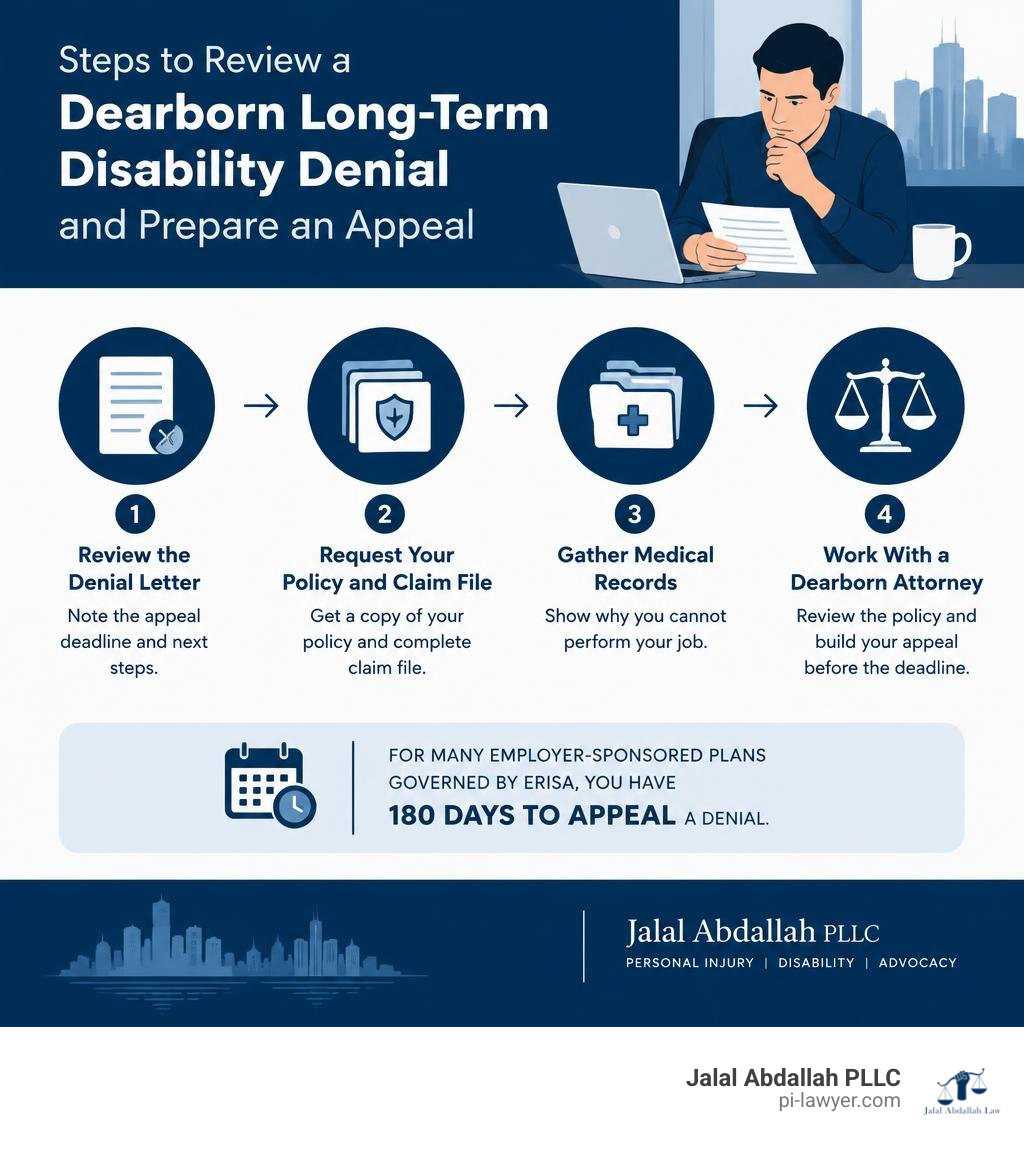
If your long-term disability claim was denied, start with the denial letter. Note the appeal deadline, request a copy of your policy and claim file, and gather medical records that show why you cannot perform your job. Working with a dedicated long term disability attorney Dearborn claimants rely on can help you review the policy and build a compelling appeal before the deadline. For many employer-sponsored plans governed by ERISA, you have 180 days to appeal a denial.
I’m Jalal Abdallah, a Michigan attorney and licensed insurance producer who has challenged insurers in personal injury cases. If you are navigating an unexpected denial, that background informs the questions I ask about your coverage, policy terms, and next steps.
Additional legal resources for Dearborn claimants:
- Guidance from a car accident lawyer in Dearborn
- Representation from a medical malpractice attorney in Dearborn
- Resolving claims with an underinsured driver attorney in Dearborn
Understanding Long-Term Disability: Private LTD Insurance vs. SSDI
Facing a severe injury or debilitating illness can disrupt your financial stability overnight. Dearborn is Michigan’s eighth largest city, home to nearly 100,000 residents living and working across diverse industries. When health issues halt your career, understanding your safety net is critical. Claimants often confuse private long-term disability (LTD) policies with government programs like Social Security Disability Insurance (SSDI) and Supplemental Security Income (SSI).
Private LTD insurance is typically purchased directly by an individual or provided through an employer. Employer-sponsored group plans are governed by federal legislation called the Employee Retirement Income Security Act (ERISA). These plans generally pay between 40% and 75% of your pre-disability earnings. In contrast, SSDI is a federal program based on accumulated work credits and past tax contributions, with average monthly benefits nationwide historically ranging between $1,000 and $2,000. SSI serves as a needs-based safety net, providing a standard rate under $1,000 for individuals and slightly over $1,000 for qualifying couples.
| Feature | Private Individual LTD | Employer Group LTD (ERISA) | Social Security Disability (SSDI) | Supplemental Security Income (SSI) |
|---|---|---|---|---|
| Funding Source | Personal premiums | Employer/Employee shared | Federal payroll taxes (FICA) | General federal revenues |
| Governing Law | State insurance contract law | Federal ERISA statutes | Federal Social Security Act | Federal Social Security Act |
| Monthly Payout | 40% to 75% of earnings | 40% to 75% of earnings | $1,000 to $2,000 average | Under $1,000 individual base |
| Offset Rules | Rarely offset by SSDI | Almost always offset by SSDI | Offsets public pensions | Offsets any earned income |
| Court Venue | Michigan State Courts | U.S. Federal District Court | Federal Administrative Courts | Federal Administrative Courts |
Most employer-sponsored LTD policies contain strict offset provisions. If you win SSDI benefits, your private insurance company reduces its monthly payment by that exact amount. Securing top legal representation with a personal injury lawyer in Dearborn ensures that all potential avenues of recovery are coordinated properly without allowing insurance carriers to shortchange your household.
When to Hire a Long Term Disability Attorney Dearborn Claimants Trust
Disability insurers are profit-driven corporations that routinely protect their bottom line by denying valid claims. Nationally, about 80 percent of people are denied at least once when applying for Social Security disability benefits, and private insurance carriers maintain similarly aggressive denial tactics. You should consult legal counsel as soon as you realize your condition will prevent you from working long-term.
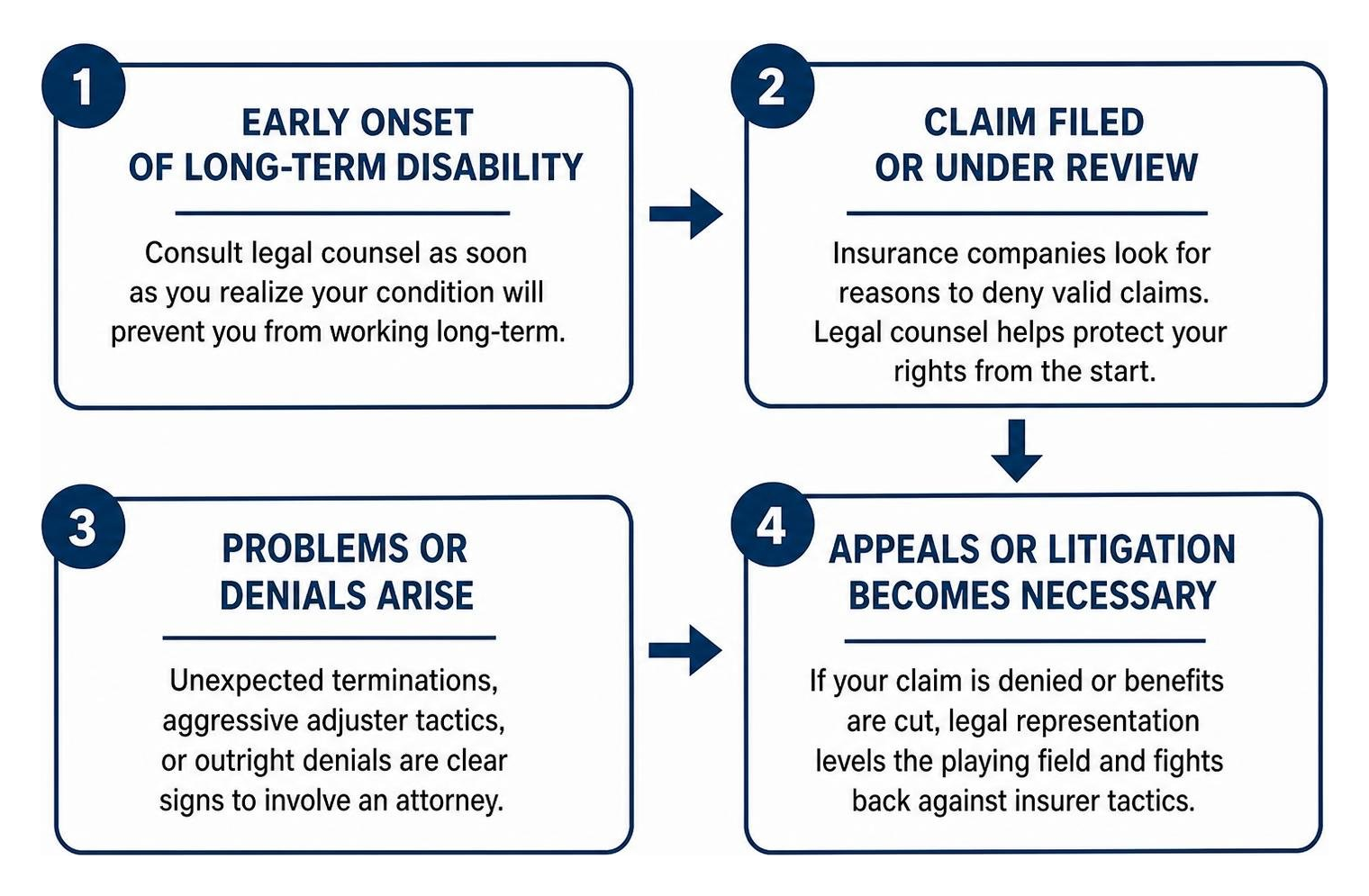
Retaining an experienced long term disability attorney Dearborn claimants can turn to helps avoid common policy traps. Insurance companies frequently look for ambiguities in claim forms to argue that you failed to provide satisfactory proof of loss. If you are experiencing unexpected benefit terminations, aggressive correspondence from adjusters, or an outright refusal to honor policy terms, scheduling a comprehensive injury attorney evaluation can immediately level the playing field against bad-faith insurer tactics.
Common Reasons Insurers Deny Long-Term Disability Claims
Insurance claim examiners review files looking for reasons to reject coverage. Common justifications include:
- Insufficient Objective Medical Evidence: Insurers argue that subjective complaints like pain or fatigue are not backed by clinical diagnostic tests.
- Missed Administrative Deadlines: Failing to submit supplementary records or appeals within strict time limits results in an automatic forfeiture of rights.
- Pre-Existing Condition Clauses: Carriers frequently review medical histories over the 12 months prior to your policy start date to allege a condition was pre-existing.
- “Hired-Gun” Medical Reviews: Insurers pay third-party doctors who never physically examine you to conduct file-only reviews concluding you can work.
- Video Surveillance and Social Media Monitoring: Adjusters hire private investigators to record you doing ordinary tasks like carrying groceries, using out-of-context footage to dispute your physical restrictions.
- Definition of Disability Shifts: Most policies transition after 24 months from an “own-occupation” standard (unable to perform your specific job) to an “any-occupation” standard (unable to perform any job suited to your education and experience).
Qualifying Medical Conditions and Work Limitations
Any chronic illness, physical injury, or mental impairment that prevents you from performing the material duties of your occupation can qualify for benefits. We routinely handle claims involving:
- Musculoskeletal Disorders: Degenerative disc disease, severe spinal stenosis, cervicalgia, herniated discs, and chronic joint osteoarthritis.
- Neurological Impairments: Traumatic brain injuries, neuropathy, multiple sclerosis, stroke complications, and epilepsy.
- Chronic Illnesses and Autoimmune Diseases: Lupus, rheumatoid arthritis, fibromyalgia, and chronic fatigue syndrome.
- Post-Viral Conditions: Long COVID complications resulting in respiratory issues, cognitive brain fog, and severe physical exhaustion.
- Cardiovascular and Respiratory Conditions: Congestive heart failure, coronary artery disease, and chronic obstructive pulmonary disease.
- Mental Health Conditions: Severe clinical depression, post-traumatic stress disorder, and bipolar disorder (often subject to a 24-month policy limitation).
Step-by-Step Guide to Appealing a Denied LTD Claim Under ERISA

If your employer-provided disability claim is denied, your claim is governed by federal ERISA law. This statute sets up a rigid procedural framework that heavily favors the insurance carrier unless you follow specific rules. The most important rule is the strict 180-day appeal deadline from the date on your denial notice.
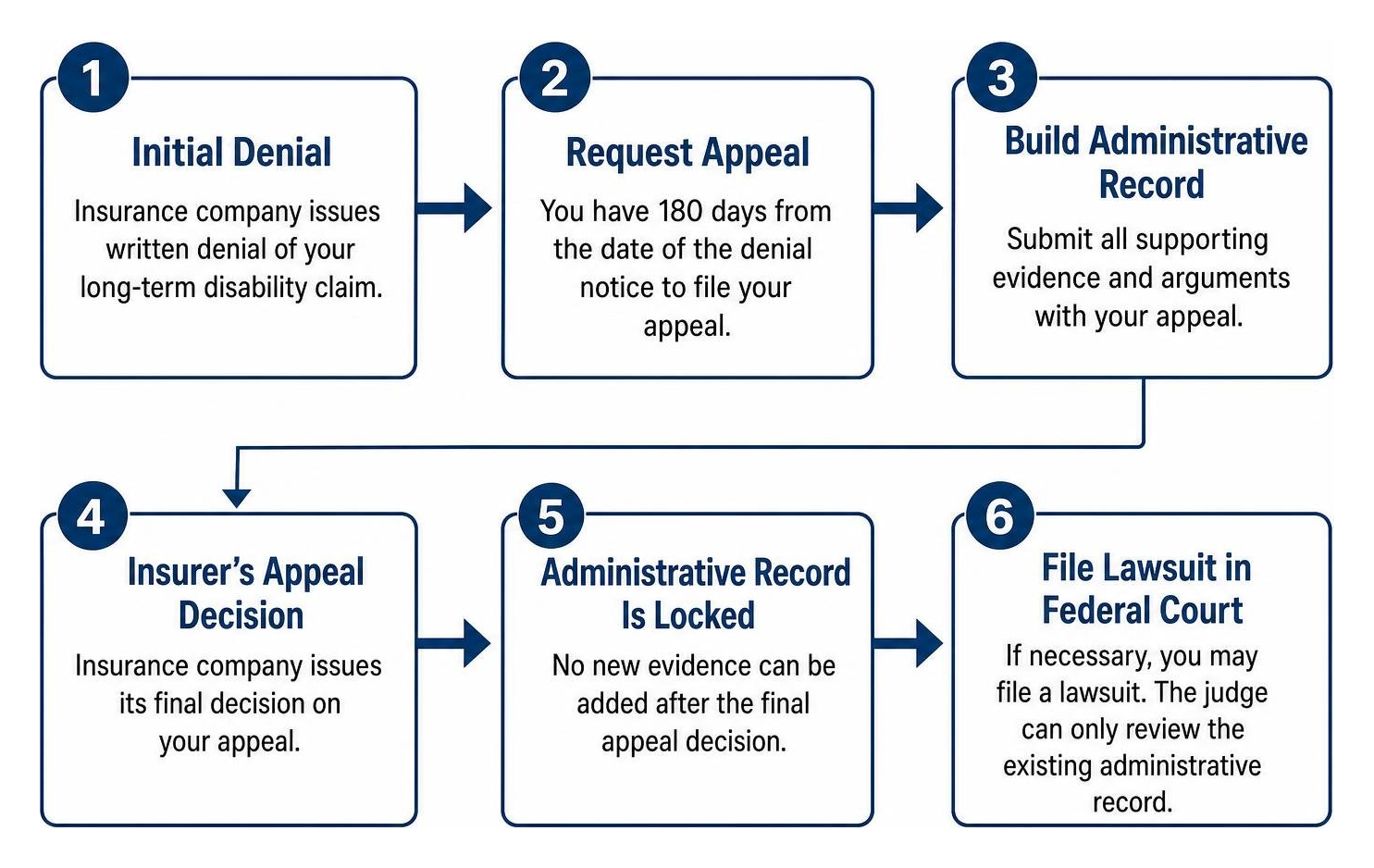
The administrative appeal is your single opportunity to submit all supporting evidence. Under ERISA regulations, once the insurance company issues its final appeal decision, the administrative record is permanently locked. If you later file a lawsuit in federal court, the judge cannot consider any new doctor letters, MRI scans, or vocational reports that were not included in your administrative appeal package.
If your disability stemmed from a severe motor vehicle crash, our team also assists in securing necessary PIP benefits after an auto collision to cover immediate medical expenses while your long-term disability appeal progresses.
How a Long Term Disability Attorney Dearborn Fights ERISA Claim Denials
When fighting an ERISA denial, we approach your appeal as if we are preparing for federal court trial:
- Obtaining the Complete Claim File: We demand the insurer’s full claim file, including adjuster notes, internal medical reviews, and surveillance video.
- Scheduling Functional Capacity Evaluations (FCE): We arrange comprehensive physical testing that objectively measures your sitting, standing, lifting, and postural tolerances.
- Securing Detailed Treating Physician Statements: We work with your doctors to complete narrative reports detailing specific workplace restrictions rather than simple diagnoses.
- Retaining Vocational Consultants: We gather vocational reports confirming that your specific physical and cognitive limitations preclude you from working in the local or national economy.
- Rebutting Insurer Doctor Opinions: We identify flaws, mischaracterizations, and cherry-picked records in the insurer’s peer review reports.
Attorney Fees and Cost Structures for Disability Claims
Legal representation for disability claims must remain accessible. At Jalal Abdallah PLLC, we represent disability clients on a contingency fee basis. This means there are no upfront retainers or hourly charges. We only collect an attorney fee if we secure a successful recovery or settlement on your behalf.
For federal Social Security Disability appeals, fees are strictly regulated by federal law and capped at the smaller of 25% or the statutory dollar maximum from retroactive back pay. For private ERISA appeals and litigation, contingency fees are agreed upon beforehand and paid as a percentage of back benefits recovered or through negotiated buyout agreements.
Navigating Complex Benefit Claims and Settlement Buyouts
When an insurer accepts liability or is facing litigation after a wrongful termination, they may propose a lump-sum buyout. A buyout pays out a percentage of the present-day value of all future monthly benefits in exchange for releasing the policy. Deciding between steady monthly checks and a lump-sum settlement requires calculating life expectancy, future interest rates, tax implications, and inflation.
Before agreeing to any buyout, completing a detailed injury case evaluation helps ensure you do not accept an undervalued offer. Additionally, if you have dependents relying on your household income, protecting long-term survivor benefits for your family is an essential consideration when negotiating policy terminations.
How to Choose the Right Long Term Disability Attorney Dearborn Residents Rely On
When choosing legal representation in Wayne County, look for an attorney with:
- Direct ERISA Litigation Experience: ERISA claims do not involve juries; they require a thorough command of federal administrative law and district court brief writing.
- Deep Roots in the Dearborn Community: Familiarity with major local employers, regional health systems, and local federal courts provides a distinct advantage.
- A Track Record of Relentless Advocacy: Insurers track which law firms settle quickly and which firms are prepared to challenge them aggressively in federal court.
- Direct, Transparent Communication: You should work directly with your legal team, receiving straightforward updates without confusing legal jargon.
Frequently Asked Questions About Long-Term Disability in Dearborn
How long does it typically take to get approved for long-term disability benefits?
Initial disability applications generally take between 45 and 90 days for an insurance company to review, following an initial elimination period (typically 90 to 180 days from the date of disability). If your claim is denied, the ERISA administrative appeal process takes an additional 45 to 90 days. If federal litigation becomes necessary, resolving the matter can take between 12 and 18 months depending on court schedules.
Can I work while applying for long-term disability benefits?
Attempting to work while claiming total disability can severely jeopardize your claim. Under an “own-occupation” standard, earning income in your customary field is viewed by insurers as conclusive proof that you are not disabled. Some policies offer “partial” or “residual” disability provisions that allow limited part-time work, but your earnings must stay below strict policy thresholds. You should always review your policy’s exact terms before performing any paid work.
What happens if my final ERISA administrative appeal is denied?
Once you have exhausted your mandatory administrative appeal with the insurance company, your next legal remedy is filing a civil lawsuit in the United States District Court (for Dearborn residents, the Eastern District of Michigan). A federal judge will review the locked administrative record to determine whether the insurer’s denial was arbitrary and capricious or unsupported by substantial evidence.
Secure Your Financial Future with Dedicated Legal Advocacy
When an unexpected disability cuts off your livelihood, you should not have to fight a massive insurance conglomerate alone. At Jalal Abdallah PLLC, we stand up for hardworking individuals against corporate insurers looking for excuses to avoid paying valid claims. We handle the paperwork, gather the necessary evidence, and manage the complex appeal process so you can focus entirely on your health.
If your monthly disability benefits have been delayed, denied, or terminated, do not let critical filing deadlines expire. Contact our Dearborn disability legal team for a free consultation today to protect your rights and fight for the benefits you earned.
Share This Article

Schedule Your Free Consultation Today!
Reach out today and receive a consultation, completely free of charge - we'll evaluate your case and let you know what comes next.


