 Skip to content
When Winter Sidewalks in Dearborn Turn Dangerous
If you need a Dearborn MI icy sidewalk lawyer, here is what you should know right away:
- You likely have a valid claim if you slipped on ice on someone else’s property and suffered injuries.
- The property owner — not always the snowplow company — is usually the primary target in these cases under Michigan law.
- You have 3 years from the date of your fall to file a personal injury lawsuit in Michigan.
- Evidence matters immediately — photos, weather records, and witness information can make or break your case.
- An attorney can identify the correct liable party, which is not always obvious after a winter slip and fall.
Winter in Dearborn is brutal. Sidewalks and parking lots ice over fast, especially after a quick rain followed by a freeze. One wrong step and you can fracture an ankle, break a wrist, or suffer a serious head injury — all before you even make it to the front door of a store.
The legal side of these cases is more complicated than most people expect. Michigan premises liability law has strict rules about who is actually responsible for an icy hazard. Suing the wrong party — say, the snowplow contractor instead of the property owner — can get your case dismissed before it ever reaches a jury. In fact, a Michigan Court of Appeals case involved a woman who fractured her ankle slipping on an undetected patch of ice in a shopping center parking lot, and the snowplow company walked away without liability.
Understanding why that happened — and how to protect your own claim — is exactly what this guide is for.
I’m Jalal Abdallah, a personal injury attorney at Jalal Abdallah PLLC with experience fighting for injured Dearborn residents in premises liability and slip-and-fall cases, including icy sidewalk claims where insurance companies try to shift blame or deny responsibility entirely. As your Dearborn MI icy sidewalk lawyer, my job is to find who is truly liable and hold them accountable.
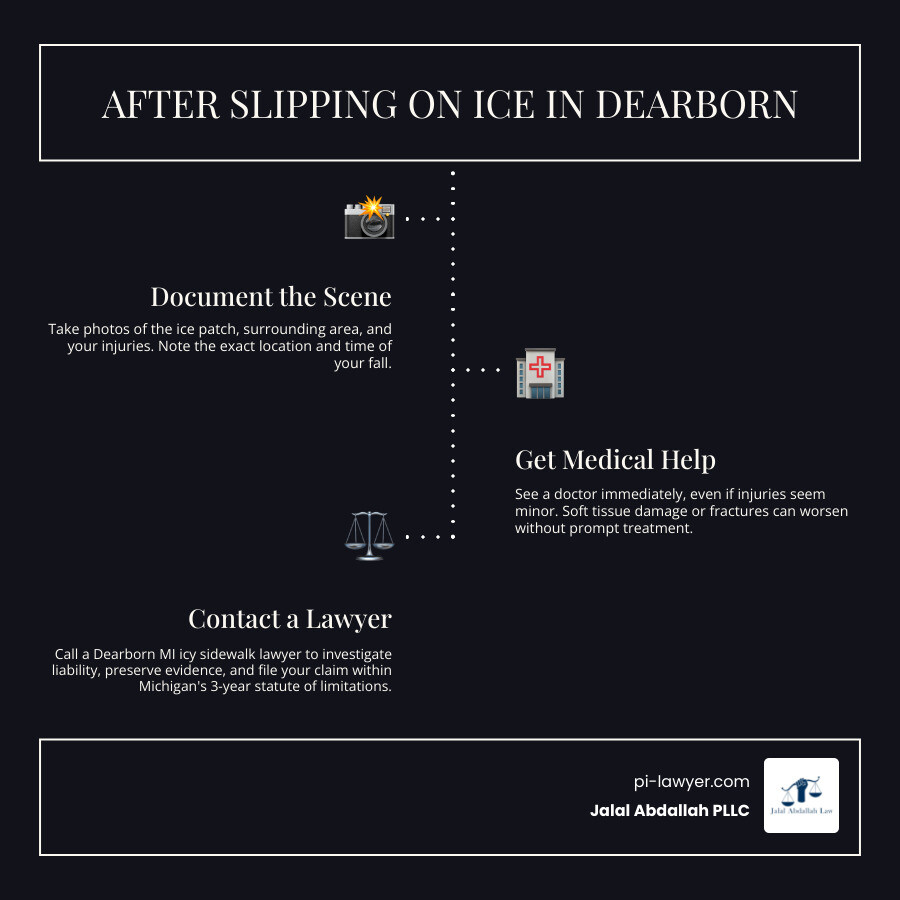
Dearborn MI icy sidewalk lawyer terms simplified:
Understanding Premises Liability and the Role of a Dearborn MI Icy Sidewalk Lawyer
When you slip on a sheet of black ice outside a local Dearborn grocery store or on a commercial sidewalk, your immediate reaction is probably embarrassment, followed quickly by pain. Once the dust settles, the question becomes: Who is going to pay for my medical bills and lost wages?
To answer that, we have to look at Michigan premises liability law. This legal framework determines who is responsible for keeping a property safe. Under Michigan law, liability does not automatically fall on whoever owns the deed to the land. Instead, liability rests on the “possessor” of the property.

According to the Restatement (Second) of Torts § 328E, which Michigan courts use to define a “possessor,” a person or entity is in possession of land if:
- They occupy the land with the intent to control it.
- They were the last to occupy the land with intent to control it, if no other person has subsequently occupied it.
- They are entitled to immediate occupation of the land, if no other person is a possessor under the first two points.
In simple terms, a possessor is the party who actually has day-to-day control over the property. This distinction is vital. If a business owner rents a retail space in Dearborn, they—the tenant—might be the legal possessor of the sidewalk directly in front of their store, rather than the out-of-state landlord.
Sorting out these details is exactly why having a local advocate on your side is so important. If you want to understand the broader landscape of these claims, our Dearborn slip and fall guide breaks down the initial steps of building a strong injury claim.
Who Is Liable? Property Owners vs. Snow Removal Contractors
One of the most common mistakes people make after slipping on an icy sidewalk is assuming they should sue the snowplow company. It makes intuitive sense: the property owner hired a snow removal contractor to clear the ice, the contractor failed to do so, and you got hurt. Surely, the contractor is at fault, right?
Not so fast. Under Michigan law, the rules of contractor liability are highly counterintuitive.
To understand why, we have to look at a landmark Michigan Court of Appeals case: Derbabian v. S & C Snowplowing, Inc..
In this case, the plaintiff, Robyn Derbabian, fractured her ankle after slipping on an ice patch in a shopping center parking lot. The ice patch was roughly the size of two parking spaces. She sued both the property owner and S & C Snowplowing, the contractor hired to keep the lot clear. S & C had actually salted the lot extensively, using at least 8 tons of salt over the preceding days, but a sudden freeze-thaw cycle allowed a new patch of ice to form.
The court ultimately ruled that the snowplow contractor could not be held liable under a premises liability theory. Why? Because the contractor did not have “possession and control” of the parking lot. They were hired to perform a specific service, and once they completed that service and left the property, they ceded possession back to the premises owner and tenants.
If you are preparing to file a lawsuit, knowing these legal boundaries is critical. You can learn more about how these dynamics play out in court by reading our guide on what to know about a Dearborn premises liability lawsuit.
Why You Need a Dearborn MI Icy Sidewalk Lawyer to Prove Possession and Control
Proving who had actual “possession and control” at the exact moment of your fall is a complex legal hurdle. A snow removal company only occupies a parking lot or sidewalk for the brief window of time they are actively plowing or salting. Once their trucks drive away, they do not maintain “exclusive dominion” over the property.
Because of this, the law generally treats the property owner or the business tenant as the primary possessor. They are the ones who remain on-site, observe the changing weather conditions, and have the ongoing duty to protect visitors (known in legal terms as “invitees”) from dangerous conditions.
When we investigate your slip and fall, we carefully analyze property deeds, commercial lease agreements, and snow removal contracts to identify the correct target for your lawsuit. Suing the wrong entity can lead to a quick dismissal of your case, wasting valuable time. For guidance on finding the right legal representation for this process, see our article on choosing a slip and fall accident lawyer.
Negligent Performance vs. Nonperformance of a Snow Removal Contract
So, can you ever sue a snowplow contractor? Yes, but only under very specific circumstances.
Michigan law draws a sharp line between the negligent performance of a contract and the nonperformance of a contract. This distinction stems from a classic Michigan Supreme Court case, Hart v. Ludwig, which established that a breach of contract does not automatically give rise to a personal injury lawsuit (a tort claim) by a third party.
Here is how the distinction works in the real world:
- Passive Nonperformance (No Liability to You): The snowplow contractor simply fails to show up and plow. While the property owner can sue the contractor for breaching their contract, you—as a pedestrian walking by—cannot sue the contractor. The contractor’s failure to act is considered “nonperformance.” They did not owe you an independent common-law duty to protect you; their only duty was to the property owner via the contract.
- Active Negligence (Potential Liability to You): The snow contractor shows up, but they perform their job so poorly that they create a new hazard that didn’t exist before. For example, if the plow driver piles a massive mound of snow directly uphill from a major walkway, knowing it will melt, run across the sidewalk, and freeze into a sheet of glare ice, they have actively created a new danger. This is “negligent performance,” and they can be held liable for your injuries because they breached a common-law duty not to make the property more dangerous than they found it.
Proving Liability and Constructive Notice in Michigan Slip and Fall Cases
To win a slip-and-fall case involving ice in Dearborn, you must prove that the possessor of the property had “notice” of the icy condition. Notice can be either actual or constructive.
- Actual Notice: The property owner knew the ice was there. For example, an employee saw the ice patch, or a customer complained about it hours before you fell, but the business did nothing to salt or clear it.
- Constructive Notice: The property owner should have known the ice was there. This means the ice patch existed for such a length of time that a reasonably careful property owner would have discovered and cleared it during routine inspections.
Proving constructive notice is one of the hardest parts of a winter slip-and-fall claim. In the Derbabian case, the court ruled that the snowplow company did not have constructive notice of the ice patch because it was relatively small, had not been observed by any employees or customers prior to the fall, and was caused by a sudden temperature drop following rain.
To help visualize how courts evaluate these distinct concepts of negligence and notice, consider the following comparison:
| Legal Concept | Definition | Example in Icy Sidewalk Cases | Can a Third-Party Pedestrian Sue the Contractor? |
|---|---|---|---|
| Active Negligence | Performing a task in a way that actively creates a new, dangerous hazard. | Piling snow on a slope where it melts and refreezes across a busy walkway. | Yes, because the contractor created a new danger. |
| Passive Nonperformance | Failing to perform a contractual duty (doing nothing at all). | Failing to show up to salt the parking lot after a freezing rain storm. | No, the contractor only owes a duty to the property owner, not to passersby. |
How a Dearborn MI Icy Sidewalk Lawyer Establishes Constructive Notice
How do we prove that a business owner should have known about a patch of ice? We build a timeline using circumstantial evidence. This involves:
- Local Weather Records: We pull historical weather data for Dearborn to show the exact timing of rain, snow, and temperature fluctuations. If the temperature dropped below freezing 12 hours before your fall, we can argue the property owner had half a day to inspect and salt the walkways.
- Size and Visibility of the Ice: A tiny, invisible patch of black ice that formed five minutes before you stepped on it is hard to hold an owner responsible for. However, a massive, thick sheet of ice covering half a parking lot suggests it had been accumulating for a long time.
- Property Maintenance Logs: We demand the business’s internal logs to see when employees last conducted a safety sweep of the exterior. If they went hours without checking the sidewalks during a winter storm, that is strong evidence of negligence.
If you have been injured, securing this evidence quickly is paramount. Our Dearborn premises liability injury claim attorney team can step in immediately to preserve security camera footage and maintenance records before they are overwritten or destroyed.
Applying Osman and Courtright to Michigan Icy Sidewalk Claims
When arguing these cases in court, we look to key appellate decisions like Osman v. Summer Green Lawn Care and Courtright v. Design Irrigation.
In Osman, the court held that a snow removal contractor could be held liable to an injured third party because the contractor had broad discretion under its contract to determine when salting was necessary, and by failing to salt when conditions clearly required it, they actively increased the hazard.
In Courtright, the court further clarified the “separate and distinct” duty of care that a contractor owes to the public. If a contractor’s actions—or lack thereof—create a physical hazard that is separate and distinct from their simple failure to fulfill a contract, they can be held liable in tort.
As your legal team, we use these precedents to counter the standard defense arguments and demonstrate that either the property owner or the contractor (or both) breached their legal duties to you.
Summary Disposition Standards in Michigan Slip and Fall Lawsuits
In Michigan, the vast majority of premises liability lawsuits face a major hurdle before they ever reach a jury: the motion for summary disposition.
Under Michigan Court Rule (MCR) 2.116(C)(10), a defendant can ask the judge to dismiss the case because there is “no genuine issue as to any material fact.” Essentially, the defense argues that even if everything you say is true, the law does not support your claim, and a trial is unnecessary.
To survive a motion for summary disposition in July 2026, we must present concrete evidence showing a genuine dispute over key facts. We must show:
- The defendant was the legal possessor of the land.
- The ice was a hazard that the defendant knew or should have known about.
- The defendant failed to take reasonable steps to clear or salt the hazard.
- Your injuries were a direct result of that failure.
Because the standard of review for summary disposition is highly favorable to defendants in premises liability cases, your complaint and supporting evidence must be meticulously prepared. We do not rely on guesswork; we build cases designed to withstand these aggressive defense motions.
Frequently Asked Questions About Icy Sidewalk Injuries in Dearborn
Can I sue a snowplow company directly if I slip on ice in a parking lot?
Generally, no. Under the precedent set by cases like Derbabian, you cannot sue a snowplow contractor simply because they failed to clear the ice as promised in their contract with the property owner. You can only sue them if they actively created a new hazard through negligent performance (such as piling snow in a way that causes dangerous melting and refreezing across a walkway). Your primary lawsuit will almost always be against the property owner or tenant who had possession and control of the land at the time of your fall.
What evidence do I need to gather immediately after falling on ice?
If you are physically able, you should take the following steps immediately:
- Take photos and video: Capture close-up shots of the ice patch, as well as wider shots showing the lack of salt or warning signs. Take these before the weather changes or someone salts the area.
- Identify witnesses: Get the names and phone numbers of anyone who saw you fall or helped you up.
- Report the incident: Tell the business manager or property owner immediately and ask them to write an incident report. Get a copy of it.
- Seek medical care: Go to an urgent care or emergency room right away. This establishes a clear medical record linking your injuries to the fall.
How does the “open and obvious” defense affect my icy sidewalk claim in Michigan?
For years, Michigan property owners used the “open and obvious” defense to get slip-and-fall cases thrown out, arguing that if a reasonable person could see the ice, the owner had no duty to warn them or clear it.
However, the legal landscape shifted dramatically with the Michigan Supreme Court’s landmark decision in Kandil-Elsayed v. F&E Land Holding LLC. The court ruled that the “open and obvious” nature of a hazard is no longer a complete bar to a property owner’s duty of care. Instead, it is analyzed under comparative negligence. This means that even if the ice was visible, the property owner can still be held liable for failing to maintain a safe premises, though your own fault in failing to avoid the hazard may reduce your final compensation. This makes it much easier for injured victims to get their day in court.
Standing Up for Underdogs in Dearborn When Winter Strikes
If you have been injured on an icy sidewalk or parking lot in Dearborn, Southfield, Detroit, or Warren, the insurance companies representing the property owners will do everything they can to minimize your injuries or blame you for not watching your step. They have teams of lawyers working to get your case dismissed under Michigan’s complex premises liability rules.
You do not have to fight them alone. At Jalal Abdallah PLLC, we pride ourselves on being relentless advocates for the underdog. We understand the physical, emotional, and financial toll a sudden injury takes on your family. We will dive deep into the contracts, track down the weather data, and push back against unfair insurance tactics to make sure you get the full compensation you deserve for your medical bills, lost wages, and pain and suffering.
Do not let a bad fall ruin your financial future. Contact Dearborn’s best slip and fall lawyers today to schedule your free consultation, and let us start building your case.
Share This Article

Schedule Your Free Consultation Today!
Reach out today and receive a consultation, completely free of charge - we'll evaluate your case and let you know what comes next.


