 Skip to content
When a Dearborn Public Transit Accident Turns Your Life Upside Down
A Dearborn public transit accident can happen in seconds — and leave you dealing with injuries, lost wages, and confusing insurance rules for months.
Here’s what you need to know right away:
- You have a 60-day window to give written notice to a public transit provider before your claim is lost.
- No-fault PIP benefits cover your medical bills and lost wages regardless of who caused the crash.
- Michigan has 82 public transit providers — and the rules for suing them are different from suing a private driver.
- You have 3 years to file a personal injury claim, but 1 year to claim PIP benefits.
- Common causes include driver error, distracted driving, mechanical failure, and pedestrian violations near bus stops.
These accidents don’t just happen on freeways. A woman was fatally struck on Michigan Avenue in Dearborn while crossing against a red light to catch a SMART bus. A school bus crashed into a Dearborn daycare, collapsing a structural pillar, after a water bottle jammed under the brake pedal. These incidents are real, they happen close to home, and they affect ordinary people every day.
Knowing your rights before you need them can make all the difference.
I’m Jalal Abdallah, a personal injury attorney at Jalal Abdallah PLLC with deep roots in the Dearborn community and hands-on experience handling the kind of Dearborn public transit accident claims that insurance companies try to minimize or deny. This guide walks you through everything you need to know — clearly and without the runaround.
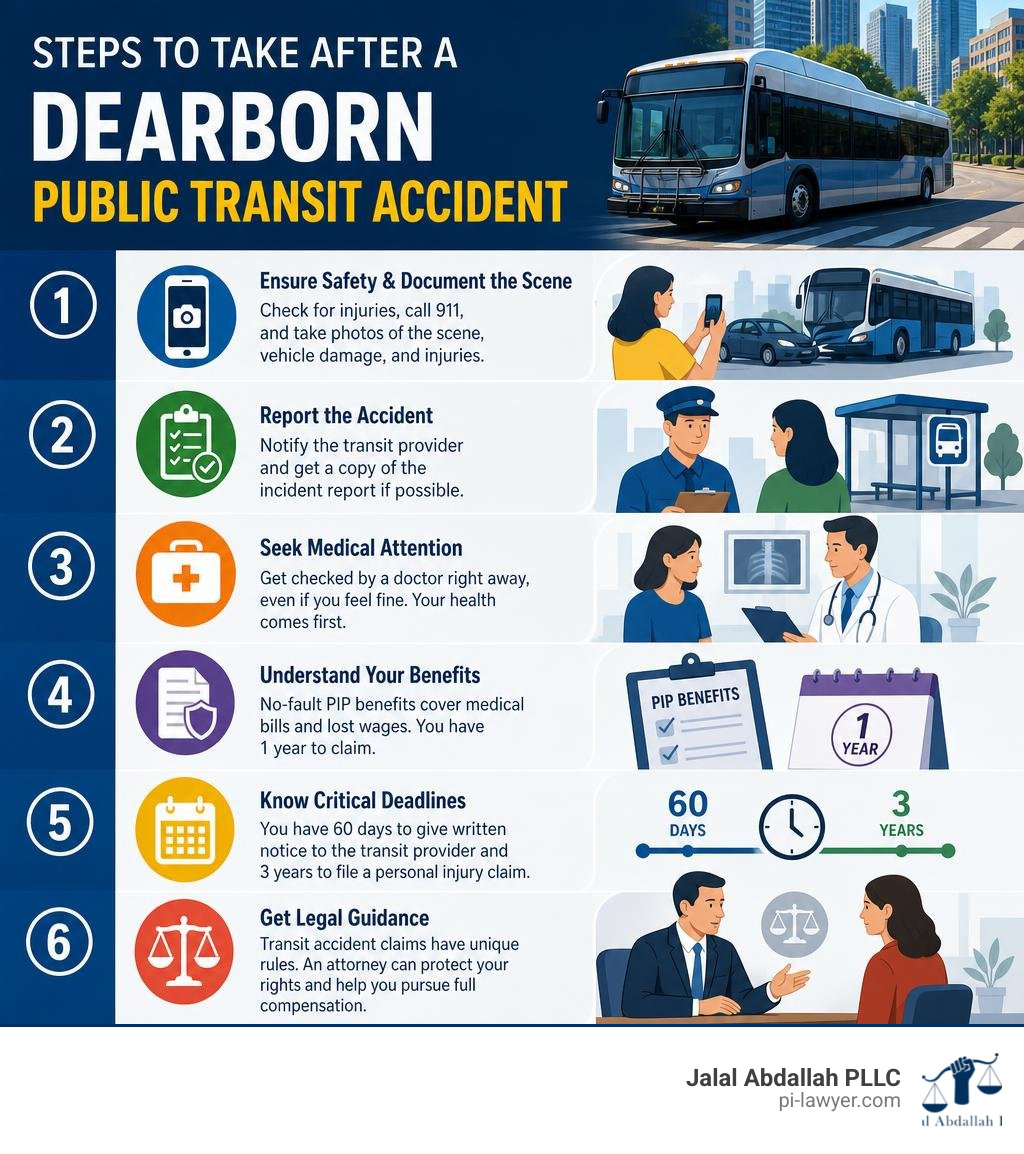
Dearborn public transit accident word guide:
Understanding the Reality of a Dearborn Public Transit Accident
Every single day, thousands of commuters in Wayne County rely on public transportation to get to work, school, medical appointments, and shopping centers. Whether you are catching a SMART bus along Michigan Avenue, riding a DDOT bus into Detroit, or booking a ride via the SMART Flex on-demand service, these transit options are vital to our local economy.
However, sharing the road with multi-ton commercial vehicles comes with inherent risks. When a Dearborn public transit accident occurs, the sheer size and weight of a transit bus mean that any resulting collision is likely to cause severe, life-altering injuries.
Public transit vehicles are legally classified as “common carriers.” This means they are held to a higher standard of care than ordinary passenger vehicles because they carry members of the public for a fee. Yet, despite this strict legal standard, public transit operators are human. They make mistakes, drive while fatigued, get distracted, or fail to yield to pedestrians.
Because these vehicles are owned and operated by government entities or heavily regulated regional authorities, pursuing a claim after a collision is vastly different from a standard two-car fender bender. If you have been hurt as a passenger, a pedestrian, or a driver in another vehicle, working with a team that understands these unique local operations is crucial. You can learn more about how we approach these cases by checking out our guide on finding the Best Bus Accident Lawyer Dearborn.
Common Causes and Key Incidents in Wayne County
When we look at how a Dearborn public transit accident typically unfolds, several recurring patterns emerge. These incidents are rarely simple accidents; they are almost always the result of preventable errors, systemic failures, or negligent behaviors.
Some of the most common causes of transit collisions in our area include:
- Driver Distraction or Fatigue: Bus drivers work long shifts, often navigating heavy traffic on routes like Michigan Avenue, Telegraph Road, and Warren Avenue. A single moment of distraction—checking a route schedule, adjusting a mirror, or dealing with a passenger disruption—can lead to a devastating crash.
- Mechanical Failures: Public transit fleets run constantly. If brakes, steering systems, or tires are not meticulously maintained by the transit agency, catastrophic failures can occur on active roadways.
- Sudden Stops and Passenger Falls: Because passengers on public buses are often standing or moving to find a seat while the vehicle is in motion, sudden braking can cause severe slip-and-fall or impact injuries inside the bus cabin.
- Tight Turning Radii and Blind Spots: Large buses have massive blind spots. When making tight turns at busy Dearborn intersections, drivers may fail to see pedestrians or smaller vehicles traveling alongside them.
A prime local example of how quickly things can go wrong occurred when a school bus crashed directly into a daycare center right here in Dearborn. The impact was severe enough to completely destroy a structural pillar holding up the front of the building. Fortunately, because the crash happened after 5:00 PM when most children had already gone home, a mass tragedy was avoided. The driver reported that the sudden loss of control occurred because a stray water bottle had rolled and become wedged directly beneath the brake pedal. This incident, detailed in the local report on the school bus daycare crash, highlights how even a minor oversight inside a commercial vehicle can lead to an immediate public safety crisis.
Recent Dearborn Public Transit Accident Case Studies
To truly understand the risks on our streets, we only have to look at recent local traffic reports. Dearborn’s busy commercial corridors, particularly Michigan Avenue, are hotspots for high-volume traffic where pedestrians and transit vehicles frequently cross paths.
In one tragic incident along the eastbound lanes of Michigan Avenue, a pedestrian was struck and killed by a passing vehicle while trying to cross the street to catch a waiting bus. Witnesses on a nearby SMART bus watched in horror as the victim attempted to cross against a red traffic signal. The police investigation later indicated that alcohol was a factor in the incident. This tragic Michigan Avenue pedestrian accident underscores the extreme dangers pedestrians face when navigating busy transit stops, especially when rushing to catch arriving buses during low-visibility hours.
Additionally, private contractors operating transit routes in Michigan, such as Dean Transportation, have faced intense scrutiny following fatal pedestrian collisions. In these cases, even when the driver is placed on administrative leave and the company cooperates with local police, grieving families are left searching for answers and accountability. These cases demonstrate that whether a crash involves a public regional authority like SMART or a private school bus contractor, the legal road to recovering compensation is incredibly complex.
Historical Context of Transit Safety in the Region
Public transit safety is not a new challenge for the Dearborn and Detroit metro area. Our region has been grappling with transit safety regulations for over a century.
Perhaps the most catastrophic historical incident in local transit history occurred in 1915, in nearby Delray, right on the border of Detroit and Dearborn. In what became known as the Delray disaster, a Fort Street streetcar operated by the Detroit United Railway (DUR) collided with a Detroit, Toledo & Ironton (DT&I) freight train.
The streetcar, packed with commuters, was handled by an inexperienced student motorman who failed to stop at a crossing where the safety derailer had been broken and out of service for over a year. The freight train struck the streetcar, splintering the wooden car and dragging it down the tracks. The catastrophic 1915 DUR streetcar collision claimed the lives of 15 people and injured dozens of others.
While modern public transit has traded wooden streetcars for heavy steel buses and advanced collision-avoidance technology, the core lessons of the Delray disaster remain highly relevant:
- Inadequate driver training leads to preventable tragedies.
- Neglected infrastructure and malfunctioning safety equipment cost lives.
- Transit agencies must be held strictly accountable when they cut corners on safety.
Legal Rights and Michigan No-Fault PIP Benefits
If you are injured in a Dearborn public transit accident, your first avenue of financial recovery typically goes through Michigan’s unique No-Fault auto insurance system. Under this system, Personal Injury Protection (PIP) benefits are designed to cover your medical expenses, a portion of your lost wages, and essential replacement services (like help around the house) regardless of who caused the collision.
However, because you were riding a public bus rather than driving your own car, determining which insurance policy pays your PIP benefits is not always straightforward. Michigan law establishes a strict “order of priority” to determine who pays:
- Your Own Auto Insurance: If you own a car and carry Michigan No-Fault insurance, your own auto insurer is first in line to pay your PIP benefits, even though your car was nowhere near the accident.
- A Spouse or Resident Relative’s Policy: If you do not own a vehicle, you look next to any auto insurance policy held by a spouse or a relative living in your household.
- The Insurer of the Bus Owner/Operator: If no household auto policy exists, the insurance company representing the public transit agency (such as SMART or DDOT) must step in to provide PIP benefits.
- The Michigan Assigned Claims Plan (MACP): If no other coverage is available, your claim is submitted to the MACP, which assigns an insurer to handle your medical benefits.
Navigating these layers of insurance can feel like a full-time job while you are trying to heal. To help you make sense of this process, we have put together a comprehensive Dearborn Bus Crash Claim: Your Roadmap to Recovering Compensation guide.
Additionally, because public transit vehicles are “common carriers,” passengers have unique legal protections. If a bus driver brakes violently without warning or takes a turn too fast, causing you to slam into a handrail, you may have grounds for a liability claim against the transit authority in addition to your PIP claim. To explore these options further, you can read our dedicated resources in our Practice Area: Bus Accident section.
Filing Deadlines for a Dearborn Public Transit Accident Claim
When dealing with government-run public transit providers, the clock ticks much faster than it does in a typical car accident case. If you miss these strict statutory deadlines, you will lose your right to recover compensation forever.
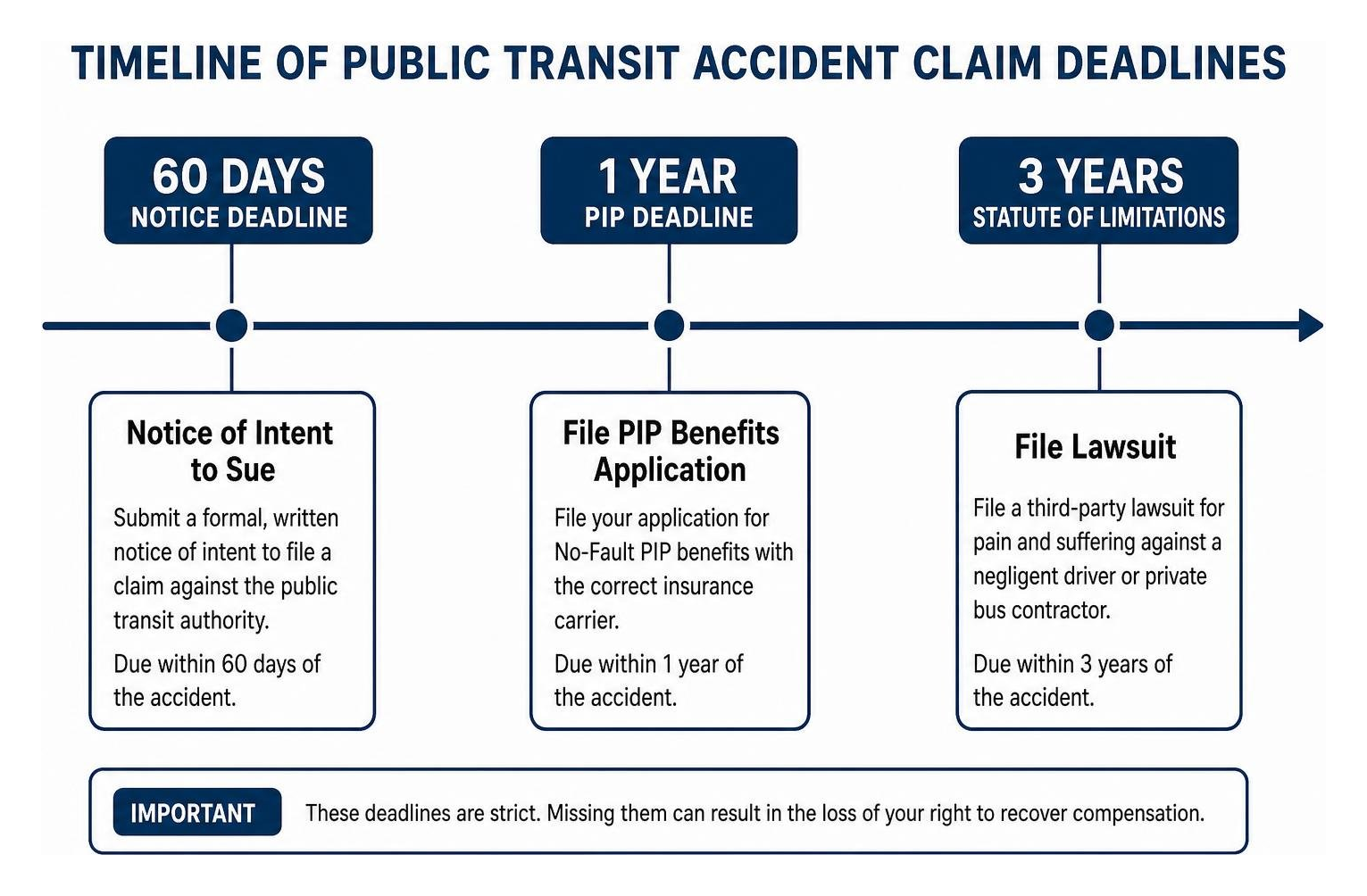
- The 60-Day Notice Rule: This is the most critical deadline. Under Michigan law, if you plan to sue a public transit authority (like SMART or DDOT) for personal injury damages, you must submit a formal, written notice of your intent to file a claim within 60 days of the accident. This notice must contain specific details about the crash, your injuries, and the transit vehicle involved.
- The 1-Year PIP Deadline: You must file your application for No-Fault PIP benefits with the correct insurance carrier within one year of the date of the crash.
- The 3-Year Statute of Limitations: For a third-party pain and suffering lawsuit against a negligent driver or private bus contractor, you generally have three years from the date of the accident to file a lawsuit.
Because these deadlines are unforgiving, getting a head start on your claim is essential. For more details on protecting your legal rights early on, check out our guide on Getting Your Dues After a Bus Collision Compensation Claim and learn what your case might actually be worth in our Dearborn Car Wreck Compensation Guide: What Your Crash Is Really Worth.
What to Do Immediately Following a Collision
The steps you take in the minutes, hours, and days following a Dearborn public transit accident will heavily impact both your physical recovery and your eventual legal claim. If you find yourself in this stressful situation, follow these steps to protect yourself:
- Seek Immediate Medical Attention: Even if you feel fine, adrenaline can mask severe injuries like whiplash, internal bleeding, or mild traumatic brain injuries. Go to a local emergency room, such as Corewell Health Dearborn Hospital, for a thorough evaluation.
- Call the Police and Ensure a Report is Filed: The Dearborn Police Department must document the scene. Make sure the responding officer knows you were a passenger on the transit vehicle or were involved in the collision, and obtain a copy of the police report number.
- Gather Evidence at the Scene: If you are physically able, take photos of the bus, the other vehicles involved, road conditions, traffic signals, and any visible injuries. If there is damage to the interior of the bus, photograph that as well.
- Collect Witness Contact Information: Public transit accidents often have many witnesses. Get the names and phone numbers of other passengers, bystanders, or drivers who saw what happened. Do not rely on the bus driver or police to gather this information for you.
- Do Not Give Recorded Statements to Insurance Adjusters: Representatives from the transit agency’s insurance company may contact you quickly, offering a fast settlement or asking for a recorded statement. Politely decline and speak with a lawyer first.
For a detailed, step-by-step breakdown of how to handle the immediate aftermath of a crash in our state, read our guide on What to Do Immediately After a Car Accident in Michigan.
Frequently Asked Questions About Dearborn Transit Crashes
Can I Sue the City of Dearborn for a Bus Accident?
Suing a city or government entity in Michigan is incredibly difficult due to a legal doctrine known as “governmental immunity.” Generally, government agencies are immune from tort liability while engaged in governmental functions.
However, there is a major exception to this rule: the motor vehicle exception. Under Michigan Compiled Laws (MCL) § 691.1405, government agencies can be held liable for bodily injury and property damage resulting from the negligent operation of a government-owned motor vehicle by an officer, agent, or employee of the agency. This means that if a city-owned bus or a regional transit bus (like SMART) causes an accident due to driver negligence, you can indeed pursue a lawsuit—provided you strictly adhere to the mandatory notice requirements, including the 60-day written notice rule.
Who Pays My Medical Bills If I Was a Passenger on a SMART Bus?
If you are injured while riding a SMART bus, your medical bills are paid through Michigan No-Fault PIP benefits. To determine who pays, you must follow the state’s strict order of priority.
First, your own personal auto insurance policy pays. If you do not own a car, the policy of a spouse or resident relative pays. If no one in your household has auto insurance, the claim goes to the insurer of the SMART bus. If that is unavailable, your claim is submitted to the Michigan Assigned Claims Plan (MACP). Because these entities often argue over who is responsible for paying, having a legal team to cut through the red tape is invaluable.
What Is the 60-Day Notice Rule for Public Transit Claims?
The 60-day notice rule is a strict statutory requirement for anyone seeking to file a personal injury claim against a public transit authority in Michigan. You must serve a formal, written notice of your claim to the transit agency within 60 days of the accident.
This written notice must outline:
- The exact date, time, and location of the crash.
- The nature of your injuries.
- The identity of the transit vehicle and driver (if known).
- A detailed description of how the accident occurred.
Failure to provide this precise notice within the 60-day window will result in the immediate and permanent dismissal of your liability claim, regardless of how severe your injuries are or how clearly the bus driver was at fault.
Secure Your Recovery with Relentless Legal Advocacy
Dealing with the aftermath of a Dearborn public transit accident can quickly leave you feeling overwhelmed. Between managing your physical recovery, dealing with pushy insurance adjusters, and trying to decipher complex government notice deadlines, it is easy to feel like you are getting the runaround.
At Jalal Abdallah PLLC, we do not let powerful insurance companies or government transit agencies push our clients around. We believe in providing relentless, compassionate advocacy for injured members of our community, ensuring you get the medical care and financial compensation you deserve to rebuild your life.
If you or a loved one has been injured in a transit collision in Dearborn, Southfield, Detroit, Warren, or anywhere in Wayne County, do not wait until a critical deadline passes. Reach out to our team today to discuss your case.
To take the first step toward securing your recovery, visit our main page at https://pi-lawyer.com/, explore our comprehensive legal offerings at https://pi-lawyer.com/services/, or directly contact our legal team today for a free, no-obligation consultation. We are here to fight for you every step of the way.
Share This Article

Schedule Your Free Consultation Today!
Reach out today and receive a consultation, completely free of charge - we'll evaluate your case and let you know what comes next.


