 Skip to content
What You Need to Know About Public Transit Injuries in Dearborn, Michigan
If you’ve been hurt on a bus, train, or school bus, hiring a public transit accident lawyer is often the most important step you can take to protect your rights — and your compensation.
Here’s what injured passengers in Michigan need to know right away:
- Government transit agencies have strict, short filing deadlines. Miss them, and you may lose your right to sue entirely.
- Transit vehicles are “common carriers,” meaning they are held to a higher standard of care than ordinary drivers.
- Multiple parties can be liable — the driver, the transit agency, a maintenance contractor, or even a parts manufacturer.
- Evidence disappears fast. Surveillance footage can be deleted in as little as 48 hours after a crash.
- You do not pay upfront. Most transit injury attorneys work on contingency — no fee unless you win.
Public transit crashes are not like typical car accidents. When a government agency operates the bus or train, the legal rules change completely. Special notice requirements, shortened deadlines, and sovereign immunity protections all create hurdles that most people aren’t aware of — until it’s too late.
Every year, thousands of riders across Michigan trust public buses, school buses, and paratransit vehicles to get them safely from point A to point B. When that trust is broken — through driver negligence, poor maintenance, or reckless operation — the consequences can be devastating and life-altering.
I’m Jalal Abdallah, a Michigan personal injury attorney who has built a career fighting for everyday people against powerful insurance companies and government entities — exactly the kind of opponents you face in a public transit accident case. I understand how overwhelming this process feels, and I’m here to cut through the confusion.
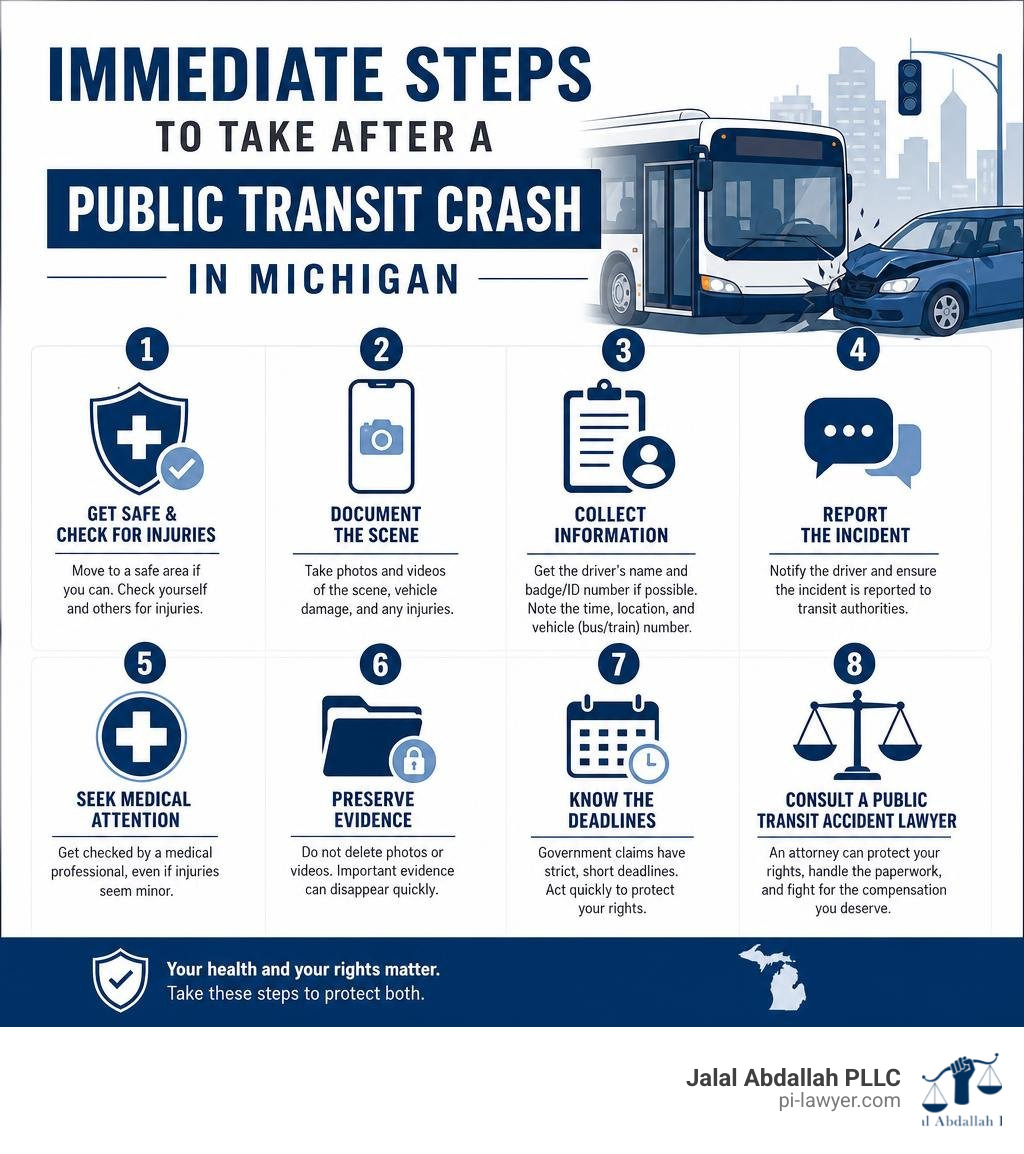
Common Causes of Mass Transit and School Bus Crashes
When we step onto a Detroit Department of Transportation (DDOT) bus, a Suburban Mobility Authority for Regional Transportation (SMART) bus, or watch our children board a school bus in Southfield or Warren, we expect a safe ride. Unfortunately, mass transit vehicles are massive, heavy, and difficult to maneuver. When things go wrong, the physical forces involved often lead to catastrophic injuries.
Through our work representing injured individuals in Southeast Michigan, we have identified several recurring factors that lead to transit accidents:
- Driver Fatigue and Drowsiness: Commercial drivers face intense scheduling demands. Nationally, driver drowsiness is a major contributor to commercial vehicle crashes. In fact, historical data shows that driver drowsiness has accounted for an estimated 846 fatalities in bus accidents across the United States in a single year. When drivers are pushed past their physical limits to meet strict route schedules, their reaction times drop to dangerous levels.
- Distracted Driving: Just like passenger car drivers, transit operators are susceptible to distractions. Whether it is adjusting onboard transit equipment, checking dispatch logs, or dealing with unruly passengers, a single second of distraction can cause a 40,000-pound city bus to collide with a pedestrian or another vehicle.
- Inadequate Training and Negligent Hiring: Operating a transit bus or school bus requires specialized skills. When transit authorities or private operators cut corners on training or fail to perform thorough background checks, unqualified drivers end up behind the wheel.
- Mechanical Failures: Buses and light rail vehicles run for hours on end, putting immense wear and tear on brakes, steering columns, and suspension systems. If a transit system fails to perform routine inspections and repairs, a catastrophic mechanical failure is waiting to happen.
- Rollover Risks and Sharp Turns: Because buses have a high center of gravity, they are highly susceptible to rollover accidents, especially when taking sharp turns too quickly or when struck from the side.
If you or a loved one was injured in a collision involving a school bus or public bus, understanding your rights is the first step toward recovery. You can learn more about this process by reviewing our comprehensive guide on the Dearborn Bus Crash Claim: Your Roadmap to Recovering Compensation.
Why You Need a Public Transit Accident Lawyer for Government Claims
The single biggest difference between a standard car accident and a transit accident is who you are suing. If you get into a crash with a private driver in Dearborn, you generally have up to three years under Michigan law to file a personal injury lawsuit.
However, if you are injured by a bus operated by a government entity — such as DDOT, SMART, or a local public school district — the legal landscape changes dramatically.
Government agencies are protected by a legal concept known as sovereign immunity. This means you cannot sue a government entity unless you strictly follow their highly specific rules.
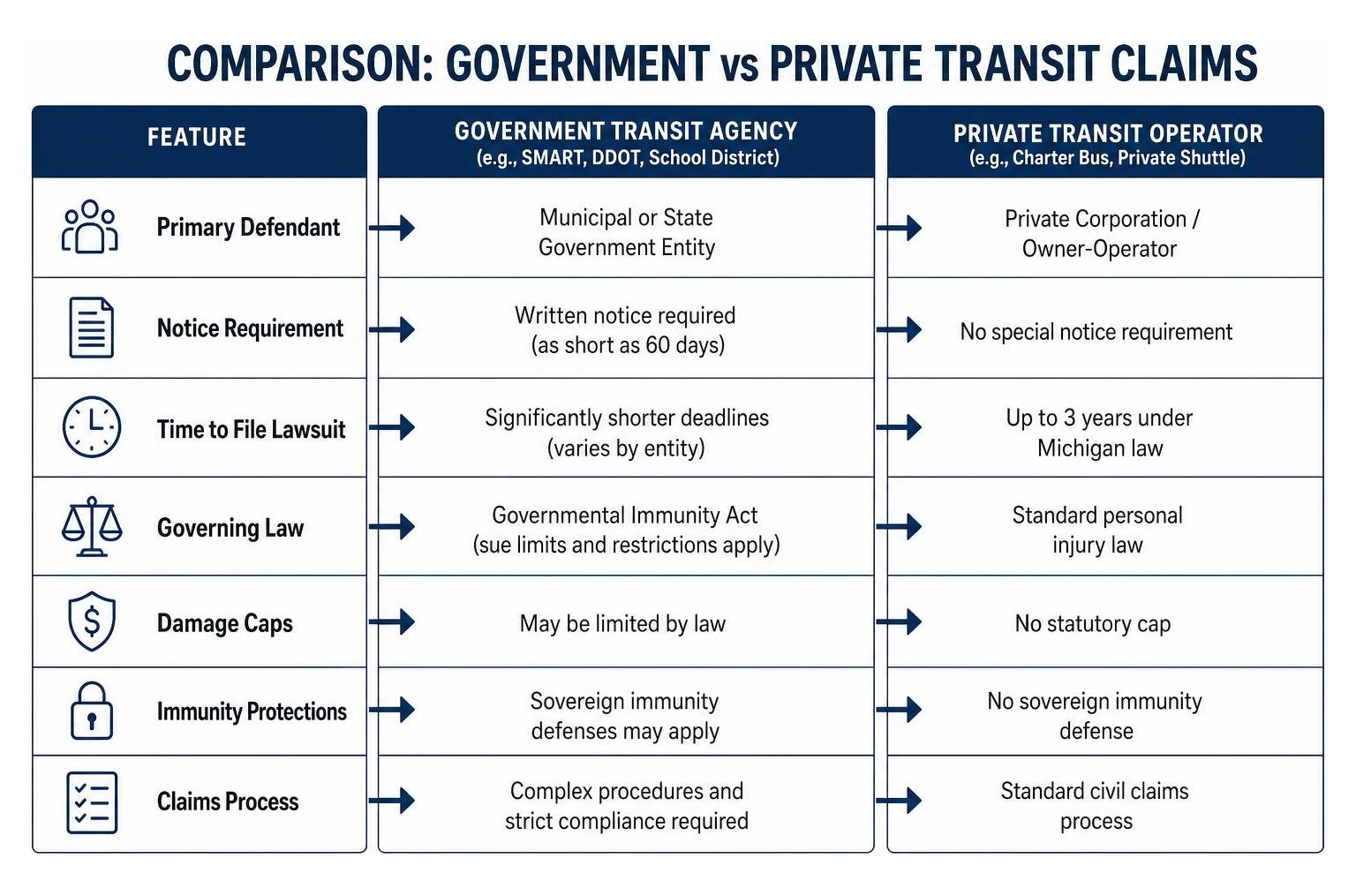
To illustrate how these rules differ, look at the stark contrast between public and private claims:
| Feature | Government Transit Agency (e.g., SMART, DDOT, School District) | Private Transit Operator (e.g., Charter Bus, Private Shuttle) |
|---|---|---|
| Primary Defendant | Municipal or State Government Entity | Private Corporation / Owner-Operator |
| Filing Deadlines (Notice) | Extremely Short (often 60 days to 6 months to file a formal Notice of Intent) | Standard Michigan Statute of Limitations (typically 3 years) |
| Legal Immunity | Government Immunity applies (must prove specific exceptions, like the motor vehicle exception) | No sovereign immunity protections |
| Applicable Standards | Subject to strict administrative rules and federal safety regulations | Standard commercial vehicle regulations |
In Michigan, if you fail to file a formal “Notice of Intent to File a Claim” with the appropriate government agency within their tight deadline — which can be as short as 60 days for certain municipal entities — you are permanently barred from recovering any compensation.
This is why trying to handle a public transit claim on your own is highly risky. A public transit accident lawyer understands these strict procedural traps and will work immediately to file the correct paperwork with the right department.
If you are looking for experienced legal representation in the Dearborn area to protect your claim before these deadlines expire, you can read about finding the Best Bus Accident Lawyer Dearborn to guide you through the process.
How Evidence Proves Liability in Mass Transit Crashes
Proving negligence in a mass transit accident requires a mountain of technical evidence. Government transit agencies and commercial bus lines have teams of investigators and defense attorneys on the scene almost immediately after a crash. Their job is to protect the agency’s bottom line, which often means finding ways to blame you or minimize your injuries.
To build a winning case, we must act quickly to preserve and analyze critical evidence. This includes:
- Surveillance and Onboard Video Footage: Most modern transit buses and school buses are equipped with multiple cameras. These cameras capture what was happening inside the passenger cabin, what the driver was doing, and the view of the road ahead. However, this footage is often on a continuous loop and can be automatically overwritten within days — sometimes as quickly as 48 hours. A lawyer must send an immediate preservation letter to prevent the deletion of this video.
- Eyewitness Statements: Transit accidents usually happen in busy areas with plenty of witnesses. Gathering contact information and statements from other passengers, pedestrians, and nearby drivers is vital.
- Police and Transit Incident Reports: We obtain and dissect the official police reports as well as internal transit agency reports. These documents often contain initial assessments of fault, road conditions, and mechanical issues.
If you are wondering what steps to take at the scene of a crash to ensure this evidence is saved, please review our guide on What to Do Immediately After a Car Accident in Michigan.
How a Public Transit Accident Lawyer Analyzes Black Box Data
Almost every modern commercial bus and light rail vehicle is equipped with an Event Data Recorder (EDR), commonly known as a “black box.” This device is a goldmine of objective data.
When we subpoena and download the black box data, we can analyze:
- Vehicle Speed: Exactly how fast the bus was traveling in the seconds leading up to the collision.
- Braking Patterns: Whether the driver applied the brakes, when they applied them, and how hard.
- Throttle Position: If the driver was accelerating or coasting.
- Steering Input: The angle and direction of steering, which can prove if the driver made sudden, unsafe lane changes.
This data is incredibly difficult for the defense to dispute. If a transit driver claims they were traveling at a safe speed and braked in time, but the black box shows they were speeding and never hit the brakes, we have the leverage we need to secure a fair settlement. For more details on how we handle commercial vehicle data, check out our resource on Charter Bus Accident Lawyer Help.
Why a Public Transit Accident Lawyer Must Subpoena Maintenance Logs
Buses are commercial vehicles subject to strict state and federal safety regulations. This means the operators must keep meticulous records of all inspections, maintenance, and repairs.
When we subpoena these logs, we look for:
- Deferred Maintenance: Did the transit agency ignore a known brake issue or tire wear to keep the bus on the road?
- Inadequate Inspections: Did the driver perform their mandatory pre-trip inspection, and was it properly logged?
- Driver Logs: We review the driver’s hours-of-service logs to determine if they exceeded legal driving limits, which directly contributes to driver fatigue.
Uncovering a history of poor maintenance or skipped inspections changes a case from simple driver error to systemic corporate or agency negligence. You can explore more articles on this topic in our Category: Bus Accident archive.
Recovering Compensation for Your Transit Injuries
Because passengers on public buses and school buses rarely wear seatbelts, even a minor collision can cause passengers to be thrown violently against hard metal poles, plastic seats, or other riders. The resulting injuries can be severe, including traumatic brain injuries (TBIs), spinal cord damage, broken bones, and deep lacerations.
If you have been injured, we help you pursue compensation for all of your losses, including:
- Medical Expenses: This covers emergency room visits, surgeries, hospital stays, physical therapy, prescription medications, and any future medical care you will need.
- Lost Wages and Diminished Earning Capacity: If your injuries prevent you from returning to work, or if you can no longer work at the same capacity as before the accident, you are entitled to recover those lost earnings.
- Pain and Suffering: These damages compensate you for the physical pain, emotional distress, anxiety, and loss of enjoyment of life caused by the crash. To understand how these non-economic damages are calculated in Michigan, read our detailed guide on Understanding Pain and Suffering Damages in Personal Injury Cases.
It is important to remember that insurance companies — whether they represent a private charter company or a municipal transit authority — are business entities focused on minimizing payouts. They will use a variety of tactics to devalue your claim, such as arguing that your injuries were pre-existing or that you were partially at fault.
We know how to counter these strategies. You can learn more about how to protect your claim by reading our article on How Insurance Companies Try to Devalue Your Injury Claim.
Frequently Asked Questions About Michigan Transit Accidents
Navigating the legal aftermath of a mass transit crash can be incredibly confusing. To help you understand your rights, we have answered some of the most common questions we receive regarding Michigan transit claims. For broader legal support, you can also visit our Practice Area: Personal Injury page.
How long do I have to file a claim against a public transit agency in Michigan?
While the standard personal injury statute of limitations in Michigan is three years, claims against government-operated transit agencies (like SMART, DDOT, or local school districts) have much shorter deadlines. Depending on the specific agency involved, you may need to file a formal written Notice of Intent to File a Claim within 60 days to 6 months of the accident. Missing this notice deadline will result in your case being dismissed, regardless of how severe your injuries are.
Can I sue if I was injured as a standing passenger during a sudden stop?
Yes. Public transit buses often carry standing passengers, especially during peak commute times. While some motion is expected, bus drivers are common carriers and owe passengers the highest duty of care. If a driver brakes violently due to distraction, speeding, or tailgating, and you are thrown to the floor and injured, you can hold the transit agency liable for negligence.
What should I do immediately after a school bus accident in Dearborn?
First, ensure that all children and passengers receive immediate medical attention. Call 911 so that the police can document the scene and create an official report. If you are a parent, obtain the school bus number, the driver’s name, and contact information for any witnesses. Take photos of the damage and the scene if it is safe to do so. Finally, contact a dedicated attorney before speaking with school representatives or insurance adjusters.
Fight for Your Rights with Relentless Dearborn Advocacy
Dealing with a public transit agency or a massive insurance corporation can feel like an impossible uphill battle. They have unlimited resources, teams of lawyers, and a system designed to delay, devalue, or deny your claim.
At Jalal Abdallah PLLC, we do not back down from a tough fight. We believe that everyday people deserve the highest level of legal advocacy when standing up to powerful government entities and insurance giants. We handle every aspect of your case — from filing the critical notice paperwork and subpoenaing black box data to aggressively negotiating with insurers — so you can focus on your physical recovery.
We proudly serve clients throughout Michigan, including Southfield, Dearborn, Detroit, and Warren. If you or a loved one has been injured in a public transit or school bus accident, do not wait until a government deadline passes. Contact Us Today for a free, confidential consultation, and let us help you secure the justice and compensation you deserve.
Share This Article

Schedule Your Free Consultation Today!
Reach out today and receive a consultation, completely free of charge - we'll evaluate your case and let you know what comes next.


