 Skip to content

What to Do When a Dearborn Bus Crash Turns Your Life Upside Down
Dearborn Bus Accident Claims can feel overwhelming — especially when you’re hurt, missing work, and getting pressure from insurance companies.
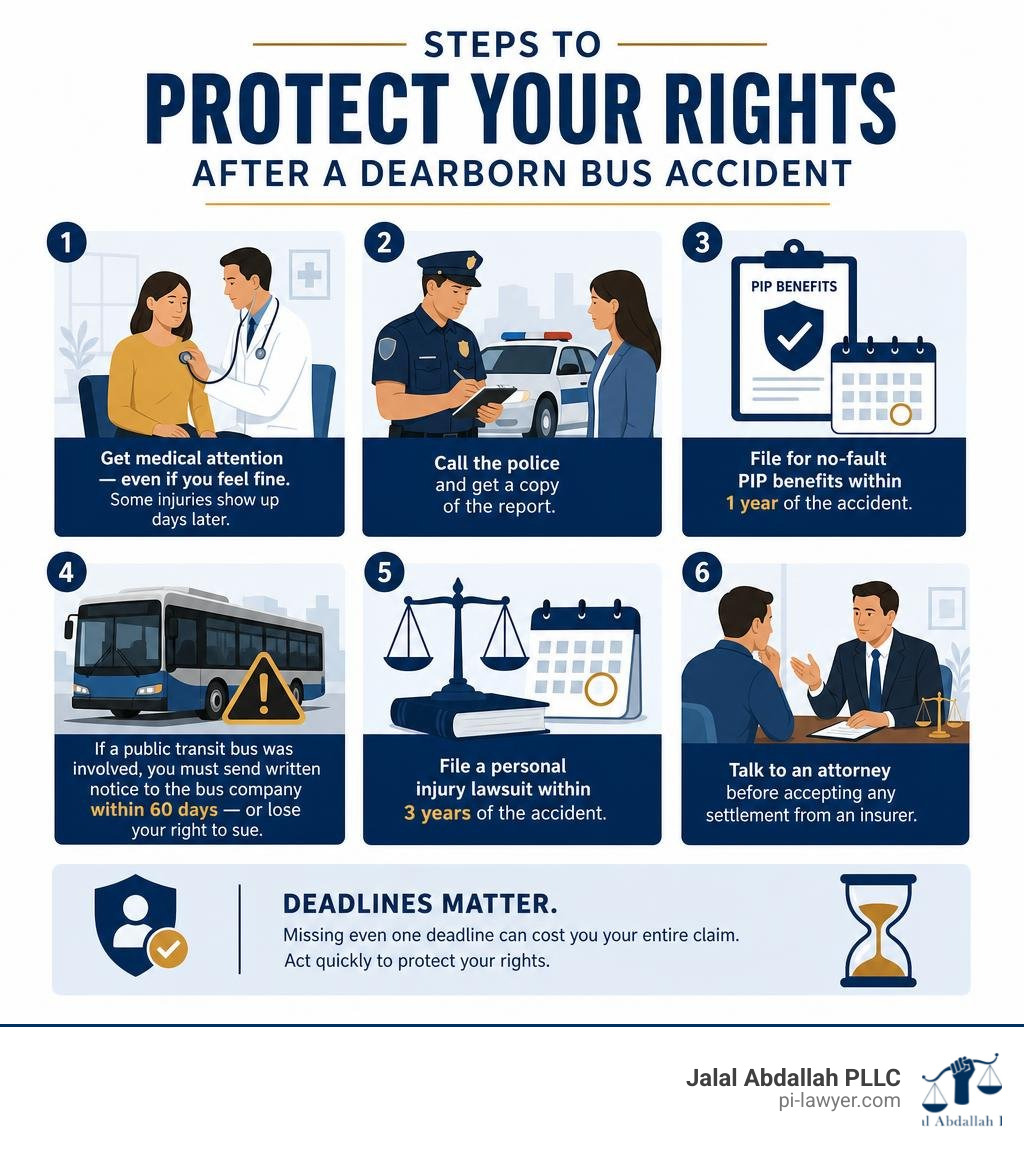
Here’s a quick overview of what you need to know right now:
- Get medical attention — even if you feel fine. Some injuries show up days later.
- Call the police and get a copy of the report.
- File for no-fault PIP benefits within 1 year of the accident.
- If a public transit bus was involved, you must send written notice to the bus company within 60 days — or lose your right to sue.
- File a personal injury lawsuit within 3 years of the accident.
- Talk to an attorney before accepting any settlement from an insurer.
Michigan’s no-fault insurance laws are complex. Bus accidents involving public agencies like DDOT or SMART add another layer — strict deadlines, government immunity rules, and multiple parties that can all affect your case.
Missing even one deadline can cost you your entire claim.
That’s why it matters to move quickly and understand exactly what you’re dealing with.
I’m Jalal Abdallah, a personal injury attorney based in Dearborn with hands-on experience handling Dearborn Bus Accident Claims — including cases against powerful insurance companies and government entities. As a graduate of the University of Michigan-Dearborn and a licensed insurance producer, I bring a unique combination of legal and insurance knowledge to fight for what you’re actually owed.
Dearborn Bus Accident Claims resources:
Immediate Steps to Take After a Dearborn Bus Crash
When a massive public bus or a charter vehicle collides with your car, the physical and emotional impact is immediate. In the chaotic moments right after a crash on Michigan Avenue or Telegraph Road, your adrenaline is pumping, making it hard to think straight. However, what you do in these first few hours and days will directly shape the success of your recovery.
Seek an Immediate Medical Evaluation
Your health is the absolute priority. Even if you think you only have minor bruises, you must be evaluated by a medical professional. Internal bleeding, concussions, and soft-tissue injuries like whiplash often mask themselves behind a wall of shock and adrenaline.
Furthermore, delaying medical care gives insurance adjusters a perfect excuse to argue that your injuries were not caused by the bus accident. Go to the nearest emergency room, such as Beaumont Hospital in Dearborn, or visit a local urgent care clinic immediately.
File a Police Report
Never leave the scene of a bus accident without a police officer filing an official report. In Dearborn, the responding officers will document the positioning of the vehicles, note the weather conditions, interview witnesses, and often issue citations. This report is a crucial piece of evidence when filing Dearborn Bus Accident Claims. Make sure to request a copy of the report as soon as it becomes available.
Document the Scene Thoroughly
If you are physically able, use your phone to gather as much real-time evidence as possible. Take photos and videos of:
- The damage to all vehicles involved (both interior and exterior).
- The position of the bus relative to the road, traffic signals, and skid marks.
- Road conditions, construction zones, or obstructed signs.
- Your visible injuries.
Collect Witness Contact Information
Buses carry many passengers, and crashes often attract onlookers. Do not rely solely on the police to gather witness statements. Politely ask passengers on the bus, nearby drivers, or pedestrians for their names, phone numbers, and a brief description of what they saw. Their unbiased accounts can make or break your case later.
For a deeper look at protecting your rights on the road, check out our guide on What to Do Immediately After a Car Accident in Michigan.
How Michigan No-Fault Laws Impact Dearborn Bus Accident Claims
Michigan’s auto insurance system is notoriously complex, and adding a bus to the mix makes it even trickier. Under Michigan’s No-Fault insurance system, if you are injured in a motor vehicle accident, your own auto insurance policy is typically responsible for paying your Personal Injury Protection (PIP) benefits. This is true regardless of who caused the crash.
PIP benefits are incredibly valuable, covering:
- Medical expenses: All reasonably necessary medical care related to the accident.
- Lost wages: Up to 85% of your income for up to three years if your injuries prevent you from working.
- Attendant care: Payment for someone to assist you with daily living activities.
- Replacement services: Up to $20 per day to hire help for household chores you can no longer perform.
The No-Fault Priority Rules for Bus Passengers
What happens if you were a passenger on a bus and do not own a car or carry your own auto insurance policy? Michigan law establishes a strict “order of priority” to determine which insurance company is responsible for paying your PIP benefits:
- Your own auto insurance policy: If you have one.
- A spouse’s or resident relative’s policy: If you live with a family member who has auto insurance.
- The insurer of the bus owner/registrant: If no personal or family policy exists.
- The insurer of the bus driver: If the bus owner is uninsured.
- The Michigan Assigned Claims Plan (MACP): The state-administered safety net of last resort.
Navigating these priority tiers requires precision. Filing with the wrong insurer can lead to denials, delayed medical care, and missed deadlines. For a detailed roadmap on how to secure these vital funds, read about the Dearborn Bus Crash Claim: Your Roadmap to Recovering Compensation and explore our resources on Getting Your Dues After a Bus Collision Compensation Claim.
Proving Negligence and Overcoming Government Immunity
While your PIP benefits cover immediate economic losses, they do not pay for your pain, suffering, or emotional distress. To recover these non-economic damages, you must file a “third-party” personal injury lawsuit against the negligent parties.
Proving fault in a bus crash is far more complicated than a standard two-car collision. Multiple parties may share liability, including:
- The bus driver (for distracted driving, speeding, or fatigue).
- The bus company or transit authority (for negligent hiring, poor training, or failure to maintain the vehicle).
- Third-party maintenance contractors (for faulty brake repairs or tire maintenance).
- Other negligent motorists who contributed to the collision.
The Hurdle of Government Immunity
If your accident involved a public transit provider — such as a Suburban Mobility Authority for Regional Transportation (SMART) bus or a Detroit Department of Transportation (DDOT) bus — you face a major legal obstacle: governmental immunity.
Under Michigan law, government entities are generally protected from lawsuits. However, there is a crucial exception known as the motor vehicle exception. You can sue a public transit authority if your injuries resulted from the negligent operation of a government-owned vehicle by an employee.
Even with this exception, the procedural rules are unforgiving. For instance, if a public bus damages your property, the rules for recovery differ significantly from bodily injury claims.
Public Transit vs. Private Charter Claims
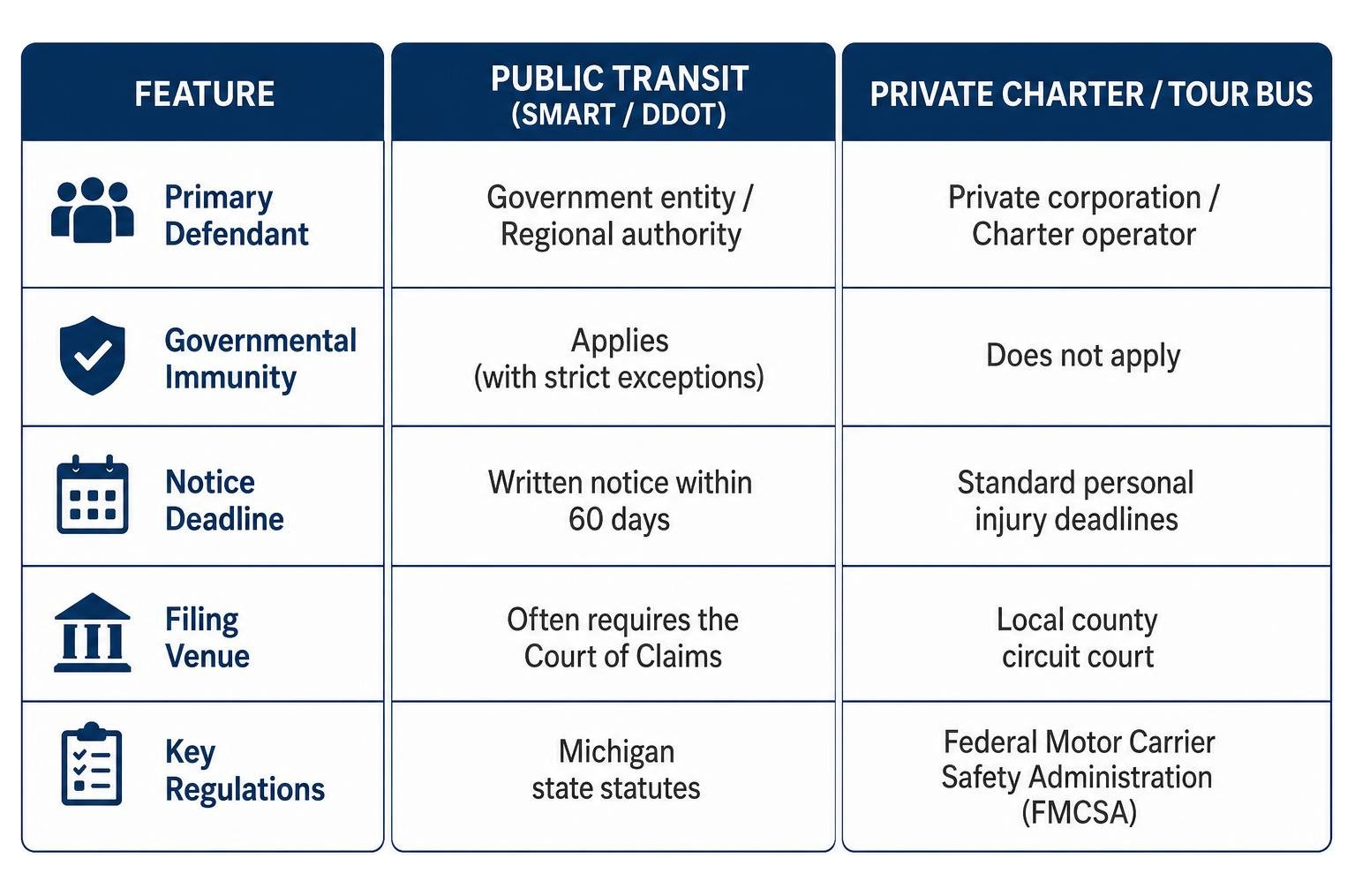
To illustrate how the type of bus changes your legal path, review the comparison below:
| Feature | Public Transit (SMART / DDOT) | Private Charter / Tour Bus |
|---|---|---|
| Primary Defendant | Government entity / Regional authority | Private corporation / Charter operator |
| Governmental Immunity | Applies (with strict exceptions) | Does not apply |
| Notice Deadline | Written notice within 60 days | Standard personal injury deadlines |
| Filing Venue | Often requires the Court of Claims | Local county circuit court |
| Key Regulations | Michigan state statutes | Federal Motor Carrier Safety Administration (FMCSA) |
Proving Fault in Dearborn Bus Accident Claims
To overcome government defenses or a private charter company’s high-powered legal team, we must build an ironclad case. Proving negligence requires gathering specialized evidence that goes far beyond a standard police report.
Our investigation into a bus crash typically involves securing:
- The bus’s “black box” (Electronic Control Module): This device records speed, braking patterns, and steering angles in the seconds leading up to the impact.
- Onboard camera footage: Most modern SMART and DDOT buses are equipped with multiple interior and exterior cameras.
- Maintenance and inspection logs: To determine if the bus was operating with worn brakes, bald tires, or other mechanical hazards.
- Driver qualification files: Including background checks, training records, and drug test results.
- Hours-of-Service (HOS) logs: To verify if the driver was operating past legal hourly limits, which leads to driver fatigue.
Because public transit authorities and commercial bus lines start building their defense immediately after a crash, you need a local advocate on your side who knows how to preserve this evidence before it mysteriously disappears. If you need dedicated local representation, you can read more about securing the Best Bus Accident Lawyer Dearborn.
Recoverable Damages and Strict Filing Deadlines
If you meet Michigan’s legal threshold for a third-party claim, you can seek compensation for both your financial losses and the personal toll the accident has taken on your life.
The “Serious Impairment” Threshold for Pain and Suffering
To sue for pain and suffering (non-economic damages) in Michigan, your injuries must meet the threshold of a serious impairment of body function or result in permanent, serious disfigurement.
A serious impairment is defined as an objectively manifested impairment of an important body function that affects your general ability to lead your normal life. Proving this requires comparing your lifestyle before and after the crash — examining your work, hobbies, and family interactions. For a deeper breakdown of how these damages are calculated, read about Understanding Pain and Suffering Damages in Personal Injury Cases.
In the most tragic circumstances where a crash results in a fatality, surviving family members can pursue justice through a Wrongful Death Practice Area claim to cover funeral expenses, loss of financial support, and loss of companionship.
The Clock is Ticking: Crucial Deadlines
When it comes to Dearborn Bus Accident Claims, missing a deadline is fatal to your case. The timeline is incredibly tight:
- The 60-Day Notice Rule: If your claim is against a regional transit authority (like SMART or DDOT), you must serve a formal, written notice of your claim to the transit agency within 60 days of the crash. If you miss this by even one day, your lawsuit will be dismissed.
- The 6-Month Court of Claims Notice: If the bus is state-owned, a notice of intent must be filed with the Court of Claims within six months.
- The 1-Year PIP Deadline: You must file an application for No-Fault PIP benefits with the correct insurance carrier within one year of the accident.
- The 3-Year Statute of Limitations: You have three years from the date of the crash to file a personal injury lawsuit for pain and suffering or wrongful death.
Maximizing Compensation for Dearborn Bus Accident Claims
Insurance companies — whether they represent a private charter line or a municipal transit authority — are businesses. Their primary goal is to protect their bottom line by paying you as little as possible.
To maximize the value of your claim, we focus on documenting every single dollar of your economic losses while painting a vivid picture of your non-economic suffering. This includes:
- Collecting pay stubs, tax returns, and employment records to prove lost earning capacity.
- Keeping a daily pain journal to document how your injuries limit your mobility, sleep, and mental well-being.
- Working with medical experts and life-care planners to project the lifetime cost of your rehabilitation, surgeries, and adaptive equipment.
Be prepared for aggressive insurance tactics. Adjusters may call you shortly after the crash, offering a quick, lowball settlement check. They might ask for a recorded statement, hoping you will say something that downplays your injuries or suggests you were at fault.
Never sign anything or give a recorded statement without legal representation. To understand these traps, read our analysis on How Insurance Companies Try to Devalue Your Injury Claim.
Frequently Asked Questions About Dearborn Bus Crashes
What is the 60-day notice rule for public transit accidents in Michigan?
If you are injured in a crash involving a public transit bus, such as SMART or DDOT, Michigan law requires you to submit a detailed written notice of your claim to the transit authority within 60 days of the accident. This notice must outline the time, place, nature of the injuries, and the names of any witnesses. Failure to provide this notice within the 60-day window completely bars you from filing a lawsuit to recover pain and suffering damages.
Can I still recover compensation if I was partially at fault?
Yes, but your recovery will be affected. Michigan follows a modified comparative negligence rule. You can still recover damages as long as your percentage of fault is 50% or less. However, your financial recovery will be reduced by your percentage of fault. For example, if you are awarded $100,000 but found to be 30% at fault, you will receive $70,000. If you are found to be 51% or more at fault, you are legally barred from recovering any non-economic damages (like pain and suffering) entirely.
How long does it take to settle a bus accident claim in Dearborn?
There is no single timeline for settling a bus accident claim. Simple cases with clear liability and minor injuries may settle in a few months. However, complex claims involving severe injuries, multiple liable parties, or government entities can take anywhere from one to three years (or longer) to resolve. A proper settlement should never be rushed; it is vital to wait until you have reached Maximum Medical Improvement (MMI) so the full scope of your future medical needs is known.
Secure Your Recovery with Relentless Legal Advocacy
At Jalal Abdallah PLLC, we do not back down from a fight. We specialize in relentless advocacy for the underdog, taking on powerful insurance companies, private corporate charter lines, and municipal government entities to secure the compensation you deserve.
If you or a loved one has been injured in a Dearborn bus crash, you do not have to carry this heavy burden alone. Let us handle the complex legal filings, negotiate with the insurance adjusters, and protect your rights while you focus on healing.
We invite you to explore our services or visit our main page at Jalal Abdallah PLLC to learn more about how we stand up for crash victims across Michigan.
Ready to get your claim moving? contact our team today to schedule your free, no-obligation consultation.
Share This Article

Schedule Your Free Consultation Today!
Reach out today and receive a consultation, completely free of charge - we'll evaluate your case and let you know what comes next.


