 Skip to content
Why a Michigan Premises Liability Lawyer Can Protect Your Injury Claim
If you were hurt because of a dangerous condition on someone else’s property, a Michigan premises liability lawyer can help determine who controlled the property, what duty they owed you, and whether they had notice of the hazard. Preserve photos, witness names, incident reports, medical records, and the shoes or clothing involved. These details can matter when an insurer claims the danger was obvious or blames you for the fall.
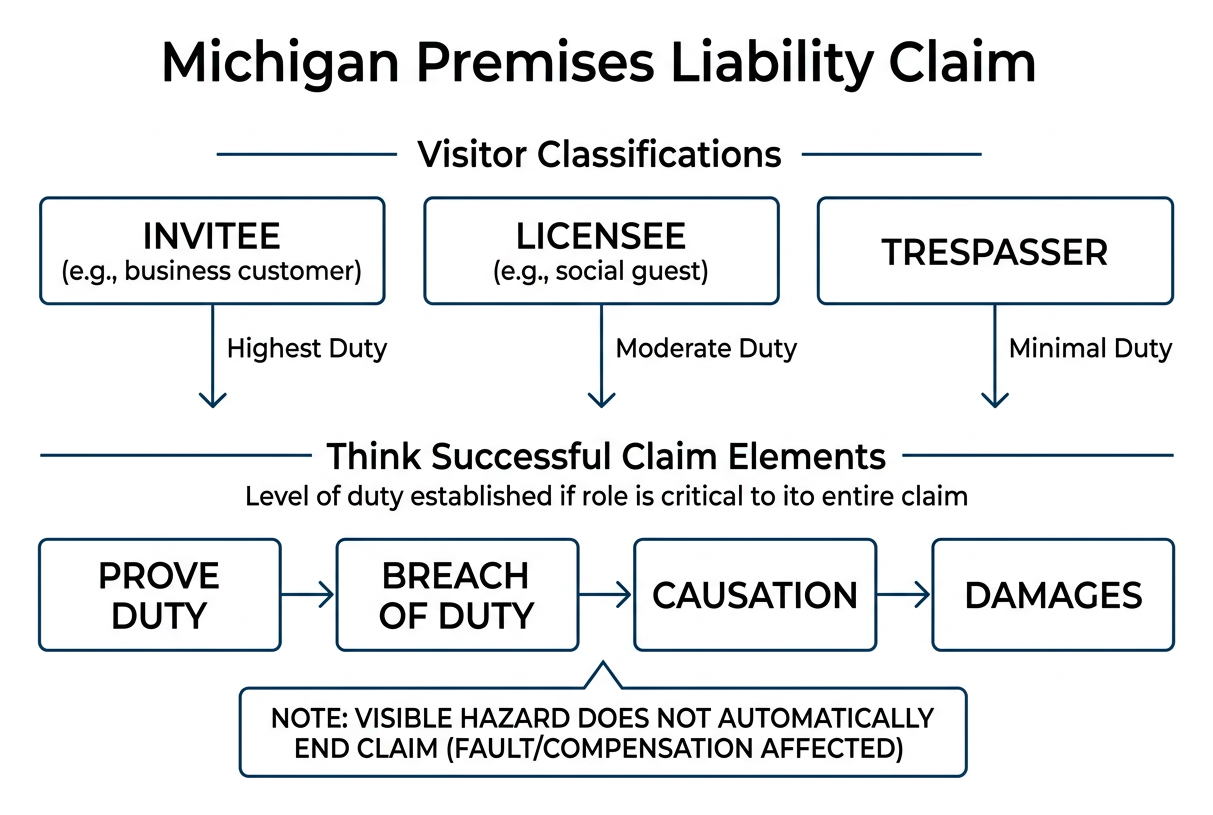
Michigan premises liability claims often involve wet floors, broken stairs, poor lighting, ice-covered parking lots, or unsafe conditions at businesses, apartments, and private homes. A successful claim generally requires proof of duty, breach, causation, and damages.
The law can be more favorable than many people realize. In Kandil-Elsayed v. F&E Oil, Inc. (2023), the Michigan Supreme Court moved the “open and obvious” issue away from the initial duty analysis. A visible hazard may still affect fault and compensation, but it does not automatically end an injured person’s claim.
I am Jalal Abdallah, a Michigan trial attorney at Jalal Abdallah PLLC who represents people facing insurers and difficult legal systems. As a Michigan premises liability lawyer, I use my personal injury and insurance background to evaluate the evidence that can protect an injured client’s claim.
Relevant articles related to Michigan premises liability lawyer:
Legal Status of Visitors and Property Owner Duties Under Michigan Law
Under Michigan tort law, the duty a property owner or occupier owes to an injured individual depends on the visitor’s legal classification at the time of the incident. When navigating property claims with a premises liability injury lawyer, identifying this status is the foundation of the case. Michigan courts divide visitors into three traditional common-law categories: invitees, licensees, and trespassers.
| Visitor Category | Relationship to Property | Duty Owed by Possessor | Duty to Inspect Premises? |
|---|---|---|---|
| Invitee | Enters for a business purpose or mutual commercial benefit. | Highest duty: maintain safe conditions, inspect for hidden hazards, and warn of or repair dangers. | Yes |
| Licensee | Enters with express or implied permission for personal/social reasons. | Intermediate duty: warn of known hidden dangers; no duty to inspect. | No |
| Trespasser | Enters without permission, legal right, or consent. | Lowest duty: refrain from willful and wanton misconduct once presence is discovered. | No |
Visitor Classifications: Invitee, Licensee, and Trespasser
An invitee is a person who enters the property upon an express or implied invitation for a business purpose, such as a customer at a grocery store or a patron at a gas station. Property possessors owe invitees the highest duty of care. This duty requires the possessor not only to warn of known dangers, but also to inspect the premises actively, discover unreasonably dangerous conditions, and conduct necessary repairs.
A licensee enters the property with the possessor’s consent for their own benefit or social reasons, such as a dinner guest at a private residence. The possessor owes a licensee a duty to warn of known hidden dangers that the guest is unlikely to discover on their own. However, the possessor has no affirmative legal duty to inspect the land for unknown defects before the licensee arrives.
A trespasser enters land without permission, invitation, or legal right. Generally, property possessors owe no duty of care to adult trespassers except to refrain from engaging in willful, wanton, or intentional conduct designed to cause harm once the trespasser’s presence is known.
The Attractive Nuisance Doctrine and Trespassing Children
While adult trespassers receive minimal protection, Michigan law recognizes that children lack the maturity to appreciate certain hazards. Under the attractive nuisance doctrine, codified through the Restatement (Second) of Torts § 339, a property possessor may be held liable for injuries to trespassing children caused by artificial conditions on the land if five specific elements are satisfied:
- Foreseeability of Trespass: The possessor knows or has reason to know that children are likely to trespass in the area containing the artificial structure or condition.
- Foreseeability of Unreasonable Risk: The possessor knows or has reason to know that the artificial condition involves an unreasonable risk of death or serious bodily harm to children.
- Child’s Lack of Appreciation: Because of their youth, the trespassing children do not discover the condition or realize the risk involved in intermeddling with it.
- Utility vs. Risk Balance: The utility to the possessor of maintaining the condition and the burden of eliminating the danger are slight compared to the risk to the children involved.
- Failure to Exercise Reasonable Care: The possessor fails to exercise reasonable care to eliminate the danger or otherwise protect the children.
Why a Michigan Premises Liability Lawyer Is Crucial After the Kandil-Elsayed Ruling
Historically, Michigan premises liability actions were heavily constrained by Lugo v. Ameritech Enterprises, Inc. (2001). Under the old Lugo framework, if a hazard was deemed “open and obvious,” the property possessor owed no legal duty to the injured person unless narrow “special aspects” applied. Insurance companies routinely used this rule to secure early summary dispositions, arguing that any visible defect eliminated their insured’s legal duty entirely.
In July 2023, the Michigan Supreme Court overhauled this framework in Kandil-Elsayed v. F&E Oil, Inc. (consolidated with Pinsky v. Kroger Co. of Michigan). The court overruled Lugo, ruling that whether a hazard is open and obvious no longer determines the existence of a duty. Instead, the duty of a land possessor remains intact, and the openness or obviousness of a condition is analyzed as part of whether the possessor breached their duty of care, alongside the injured party’s comparative fault. We use this modern framework to hold negligent commercial owners accountable when they leave hazards unaddressed.
Establishing Liability: Possession, Control, and Dangerous Conditions
A fundamental rule in Michigan injury law is that premises liability arises from possession and control of the land, not mere legal ownership. When tenants or commercial landlords dispute who is responsible for an unsafe area, working through the nuances of how to sue a negligent landlord requires identifying who actually exercised authority over the specific location where the injury happened.
Possession and Control Versus Property Ownership
Under the standard articulated in Merritt v. Nickelson, liability for an injury due to an unsafe condition falls upon the person or entity in possession and control of the property. A party possesses property when they occupy it with the intent to control it.
In commercial leasing, this distinction is critical. If a retail tenant leases a store inside a shopping plaza, the tenant typically has possession and control of the interior aisles, while the commercial landlord retains possession and control over common areas such as shared entryways, stairwells, and primary parking lots. If an independent property manager has been given exclusive control over facility maintenance, that management company may be the primary defendant. We thoroughly examine lease contracts, management agreements, and operational records to identify every responsible party.
How a Michigan Premises Liability Lawyer Proves Actual or Constructive Notice
To establish that a property possessor breached their duty to an invitee, a plaintiff must prove that the possessor had notice of the dangerous condition before the accident occurred. Notice is established through one of two legal methods:
- Actual Notice: Evidence showing that the possessor, property manager, or their employees directly created the hazard or were personally informed of its existence prior to the incident (e.g., an employee admitting they saw a spill or an email chain reporting a broken step).
- Constructive Notice: Evidence showing that the hazard existed for a sufficient length of time that a reasonably prudent possessor, through ordinary inspection, should have discovered and corrected it.
Proving constructive notice requires detailed evidence. When evaluating what to know about a Dearborn premises liability lawsuit, our team secures surveillance footage, electronic sweep logs, maintenance work orders, and employee shift records to establish the precise timeline of the dangerous condition.
Premises Liability vs. Ordinary Negligence Claims
Michigan courts draw a clear line between premises liability claims and ordinary negligence claims:
- Premises Liability: Arises strictly from a dangerous condition inherent in the land itself (e.g., an unmopped puddle, an unlit stairwell, or black ice).
- Ordinary Negligence: Arises from the active, overt conduct of the defendant or their employees (e.g., an employee hitting a patron with a forklift or dropping merchandise onto a customer).
Because different legal defenses apply to each claim, we evaluate whether an incident involves the physical state of the premises, active misconduct, or both, pleading alternative counts when the facts support multiple theories of liability.
How a Michigan Premises Liability Lawyer Evaluates Complex Claims and Defenses
Commercial property owners and their insurers deploy various statutory and common-law defenses to minimize their exposure. Taking the right steps to take when property negligence leads to a serious fall helps counter these tactics before critical evidence is lost or altered.
Slip and Fall Claims Involving Snow, Ice, and Contractors
Winter weather presents recurring hazards throughout Southeast Michigan. For invitees, property possessors owe a duty to take reasonable measures within a reasonable time after an accumulation of snow and ice to diminish the hazard. Possessors cannot simply leave untreated ice on high-traffic walkways indefinitely.
When handling icy sidewalk injury claims and parking lot accident claims, liability often extends beyond the property owner to third-party winter maintenance companies. Under Michigan contract and tort principles, if a snow removal contractor creates a new hazard (such as plowing snow into an elevated pile that melts across a pedestrian walkway and refreezes into black ice), the contractor can be held directly liable for the resulting harm.
Third-Party Criminal Acts and Property Security
Property possessors generally do not insure the public against the criminal acts of third parties. Under MacDonald v. PKT, Inc., a commercial merchant’s duty regarding third-party criminal conduct is limited.
A business owner does not have an ongoing duty to provide security guards or anticipate specific criminal behavior from unknown actors. However, when an imminent criminal threat or violent altercation occurs on the premises in a manner that endangers patrons, the possessor owes a basic duty of reasonable care to respond—typically by promptly contacting law enforcement.
Statutory Immunities: Recreational Use, Ski Area, and Bowling Acts
Michigan statutes provide specific liability protections for certain recreational facilities and private landowners:
- Recreational Use Act (MCL 324.73301): Protects landowners who allow individuals to use their property for outdoor recreational activities (such as hunting, fishing, or hiking) without paying a fee. In these cases, the owner is immune from liability unless the injured party proves gross negligence or willful and wanton misconduct.
- Ski Area Safety Act (MCL 408.321 et seq.): Places the assumption of risk upon skiers and snowboarders for injuries resulting from the inherent dangers of the sport, such as weather variations, terrain contours, and collisions with other participants.
- Bowling Center Safety Act (MCL 691.1581 et seq.): Limits the liability of bowling center operators for injuries resulting from the natural slickness of bowling lane approaches, provided the operator posts the required statutory warning notices.
Damages and Comparative Fault in Michigan Property Injury Lawsuits
When an individual suffers serious injuries due to unsafe property conditions, Michigan law permits recovery for both financial losses and personal suffering. Calculating these damages accurately ensures an injured person is not left bearing the financial cost of another party’s negligence.
Economic and Non-Economic Compensation
Victims of premises liability accidents may pursue two main types of damages:
- Economic Damages: Objective financial losses resulting from the injury. These include past and future medical expenses, emergency room treatment, surgeries, physical therapy costs, out-of-pocket medical supplies, past lost wages, and loss of future earning capacity.
- Non-Economic Damages: Subjective losses that impact the quality of life. These include physical pain and suffering, mental anguish, loss of enjoyment of daily activities, physical impairment, and permanent scarring or disfigurement.
Modified Comparative Negligence and Fault Allocation
Michigan follows a modified comparative fault system under MCL 600.2959. Under this statute, an injured person’s financial recovery is adjusted based on their percentage of responsibility for the incident:
- If the plaintiff is found partially at fault, their economic damages are reduced by their percentage of fault.
- Non-economic damages (pain and suffering) are reduced proportionally to the plaintiff’s fault, but if the plaintiff’s fault exceeds 50 percent, they are barred from receiving any non-economic compensation.
Following Kandil-Elsayed, insurance companies cannot automatically dismiss a case simply because a hazard was visible. Instead, juries assess whether the property possessor acted reasonably and weigh that conduct against any comparative negligence of the visitor, allowing many injured plaintiffs to maintain substantial recoveries.
Frequently Asked Questions About Michigan Premises Liability
What is the difference between a licensee and an invitee under Michigan law?
An invitee enters property for a commercial purpose or mutual business benefit (such as a shopper in a retail store) and is owed the highest duty of care, including regular property inspections. A licensee enters with permission for social or personal reasons (such as a friend visiting a home); the possessor must warn of known hidden hazards but is not legally required to inspect the property for unknown dangers.
How does the open and obvious defense work after the Kandil-Elsayed decision?
Following the Michigan Supreme Court’s decision in Kandil-Elsayed v. F&E Oil, Inc. (2023), the open and obvious nature of a condition is no longer a threshold defense that negates the property owner’s legal duty. Instead, juries evaluate whether a condition was open and obvious when deciding whether the property possessor breached their duty of care and whether the injured person shares comparative fault.
Who is liable if I slip on ice in a commercial parking lot?
Liability depends on who exercised possession and control over the parking area. In commercial settings, the responsible party may be the property owner, a commercial tenant, or an independent snow removal contractor who failed to perform their contractual duties or created an artificial accumulation of ice.
Protecting Your Legal Rights After a Michigan Premises Injury
Property owners and corporate insurers move quickly to protect their interests after an accident. If you or a loved one suffered an injury caused by poorly maintained property, unaddressed winter ice, or structural hazards, securing immediate legal guidance helps preserve essential evidence and protect your claim under Michigan tort law.
At Jalal Abdallah PLLC, we stand up for underdogs against insurance companies and corporate defendants. Our firm is dedicated to securing full economic and non-economic compensation for injured individuals throughout Michigan. Contact our office today for a free consultation and learn how our dedicated representation can protect your rights.
Share This Article

Schedule Your Free Consultation Today!
Reach out today and receive a consultation, completely free of charge - we'll evaluate your case and let you know what comes next.


