 Skip to content
Dearborn Premises Liability Injury Lawyer: What We Do — and When You Need One
A premises liability injury lawyer helps people who were hurt on someone else’s property get fair compensation by proving the property owner was negligent. Here is a quick overview of what that means for you:
- Who can file a claim: Anyone injured on public or private property due to a dangerous condition the owner knew about (or should have known about)
- What you must prove: The owner had a duty of care, breached it, and that breach directly caused your injury and losses
- What you can recover: Medical bills, lost wages, pain and suffering, and more
- How long you have: In Michigan, you generally have 3 years to file — but deadlines can be shorter for government-owned property
- What a lawyer does for you: Gathers evidence, handles insurance companies, and fights for full compensation
Getting hurt on someone else’s property turns an ordinary day into a nightmare. Whether you slipped on a wet grocery store floor with no warning sign, fell because of a broken staircase railing in your apartment building, or were harmed due to poor lighting in a parking lot — these are not just accidents. In many cases, they are the result of a property owner’s failure to keep their premises reasonably safe.
The challenge is that insurance companies do not have your best interests in mind. They often try to shift blame onto the injured person or offer settlements far below what the claim is actually worth. Without legal guidance, many injured people accept far less than they deserve — or miss critical deadlines that bar their claims entirely.
I’m Jalal Abdallah, a personal injury attorney and founder of Jalal Abdallah PLLC, and I have built my practice on fighting for everyday Michigan residents as a premises liability injury lawyer against powerful insurance companies and property owners who try to avoid accountability. If you were hurt on someone else’s property in Dearborn or anywhere in Michigan, this guide walks you through exactly what you need to know to protect your rights.

Understanding Visitor Classifications and Property Owner Duties
In Michigan premises liability law, property owners do not owe the exact same level of safety to everyone who steps onto their land. The legal obligation—known as the duty of care—depends directly on why you were on the property in the first place.
Courts break property visitors down into three distinct legal categories: Invitees, Licensees, and Trespassers. Knowing which category fits your situation is essential, as it dictates what we must prove to establish that a business or landlord was negligent. Check out our comprehensive Dearborn Slip and Fall Guide: Getting the Compensation You Deserve for an even deeper dive into local premises rules.
Here is how these categories work:
- Invitee: An invitee enters property for commercial or business reasons that benefit the owner. Think of grocery store shoppers, restaurant diners, mall visitors, or hotel guests. Property owners owe invitees the highest standard of care under Michigan law. Owners must actively inspect their property for hazards, repair dangerous conditions promptly, and place adequate warning signs around hazards that cannot be fixed immediately.
- Licensee: A licensee is a person invited onto private property for social or non-commercial purposes, such as a dinner guest at a neighbor’s house, a social caller, or an uncompensated visitor. Property owners owe licensees a duty to warn them of known, non-obvious dangerous conditions that the visitor is unlikely to discover on their own. However, owners generally do not have an affirmative legal duty to inspect their property for unknown defects on behalf of social guests.
- Trespasser: A trespasser enters property without permission, invitation, or legal right. In general, property owners owe no duty to maintain safe conditions for adult trespassers, though owners are prohibited from intentionally creating dangerous traps or willfully harming them. An exception exists for child trespassers under the “attractive nuisance” doctrine (like an unfenced swimming pool or an abandoned construction site), which forces property owners to secure hazards that naturally attract curious children.
| Visitor Category | Example | Property Owner Duty of Care |
|---|---|---|
| Invitee | Grocery store shopper, diner, tenant in common area | Highest duty: Must inspect premises, fix hazards, and warn of dangers |
| Licensee | Social guest, neighbor visiting | Moderate duty: Must warn of known hidden hazards; no duty to inspect |
| Trespasser | Unauthorized entrant | Lowest duty: Cannot deliberately harm; must secure attractive nuisances for kids |
Common Property Hazards and Proving Owner Fault
A hazardous condition can crop up on commercial or residential property in a split second or build up over months of deferred maintenance. When property owners cut corners on safety or ignore building upkeep, visitors end up paying the price with broken bones, spinal cord injuries, or traumatic brain injuries.
Some of the most common causes of premises liability claims in Dearborn, Detroit, Southfield, and across Wayne County include:
- Slip and Fall Hazards: Spilled liquids in retail aisles, melted ice near entryways, freshly mopped floors without caution cones, or grease build-up on kitchen walkways.
- Trip Hazards: Broken asphalt in parking lots, cracked sidewalk concrete, loose carpeting, raised door thresholds, or clutter left in dimly lit corridors.
- Negligent Security: Unlit stairwells, broken security gates, lack of security personnel, or missing locks on apartment building doors, which leave tenants and visitors vulnerable to violent crime in known high-crime areas.
- Structural Defects & Broken Handrails: Rotting wooden deck boards, missing handrails, uneven stair treads, or sudden ceiling collapses caused by long-ignored plumbing leaks.
- Elevator and Escalator Malfunctions: Misleveling elevators, abrupt stops, defective emergency brakes, or unmaintained mechanical parts leading to severe injuries.
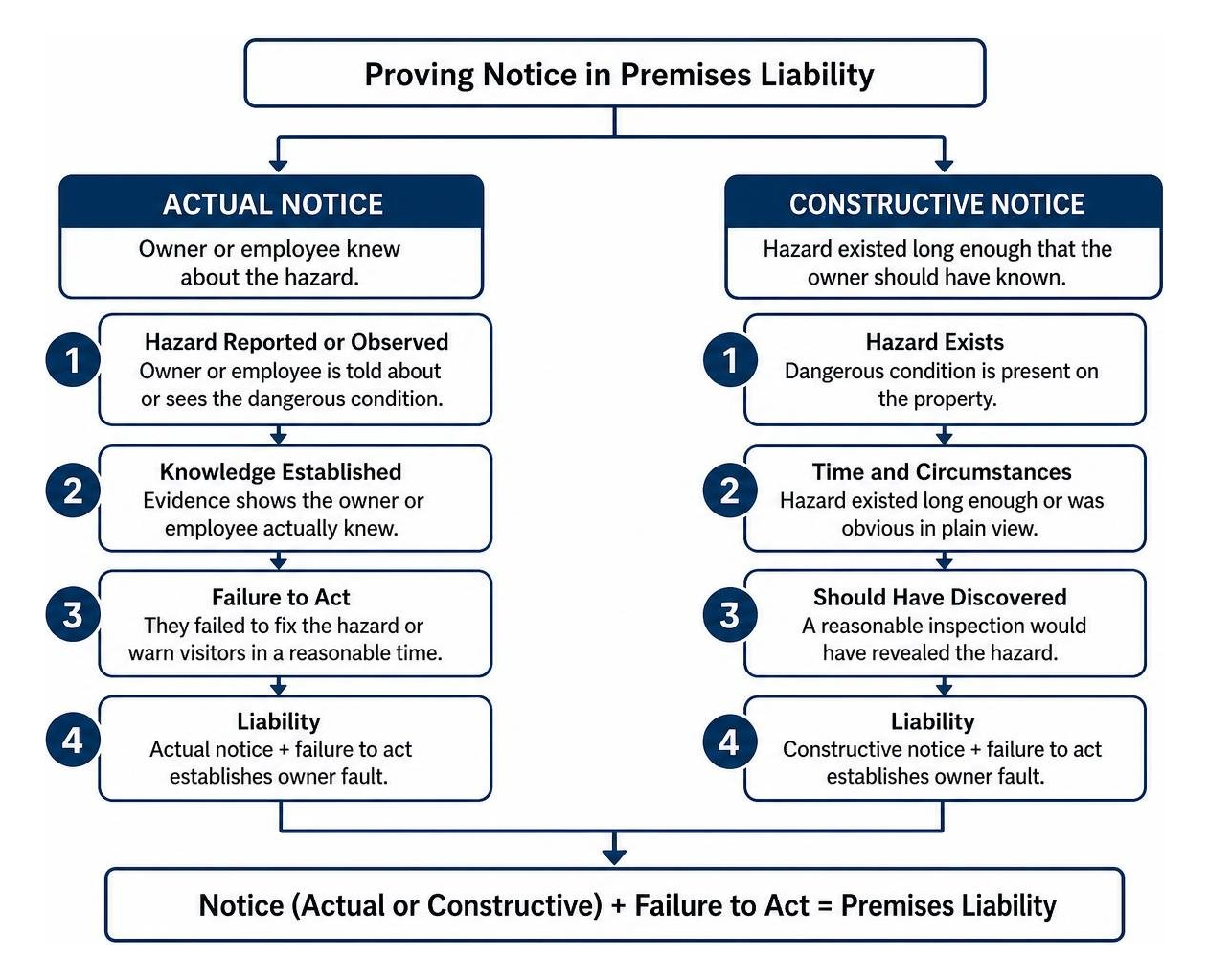
To secure compensation for your injuries, we must demonstrate that the property owner had legal notice of the hazard. Michigan law establishes two forms of notice:
- Actual Notice: The property owner, landlord, or employee directly knew the dangerous condition existed. For instance, a customer reported a leaking beverage cooler to store management, but no one cleaned it up or placed a caution sign before you slipped on it.
- Constructive Notice: The defect existed for long enough that a reasonably prudent property owner conducting routine inspections should have discovered and fixed it. For example, if a store roof has been dripping water into a main shopping aisle for three hours on a busy afternoon, management cannot claim ignorance simply because they neglected to walk the floor.
How a Premises Liability Injury Lawyer Proves Property Owner Negligence
When you are recovering from a painful fall or injury, commercial property owners and their insurance carriers are already moving fast to protect themselves. They might clean up the spill, repair the broken step, or claim their security cameras magically suffered a “glitch” during the exact hour you were hurt.
That is where an experienced premises liability injury lawyer steps in to lock down crucial evidence before it disappears.
When you hire our firm, we immediately take aggressive legal steps to prove property owner negligence, including:
- Sending Formal Spoliation Letters: We draft and serve spoliation of evidence demand letters to property management. This legally obligates them to preserve all relevant internal evidence—such as raw security camera footage, digital work orders, incident reports, and maintenance logs—under threat of severe court sanctions.
- Analyzing Surveillance Footage & Records: We meticulously review store camera feeds, sweep logs, and cleaning schedules to prove how long a hazard sat untouched.
- Conducting On-Site Inspections: We visit the scene to photograph hazards, take precise physical measurements of stairs or slopes, and examine whether structural defects breach local building codes.
- Gathering Eyewitness Testimony: We interview store customers, bystanders, and current or former employees to lock in sworn testimony before memories fade.
- Uncovering Landlord Violations: If your injury occurred in a rented property, we investigate building code violations and structural maintenance neglect. Learn more about tenant rights in our guide on How to Sue a Negligent Landlord and Win.
Recoverable Compensation and Strict Filing Deadlines

An unexpected property injury does not just hurt your health—it strains your household finances. Medical bills stack up quickly while you are forced to miss work, creating immense emotional stress. In a successful Michigan premises liability claim, you can recover both economic and non-economic damages to make you financially whole.
Economic Damages (Tangible Losses):
- Coverage for all past, present, and future medical treatment, surgeries, physical therapy, and prescription drugs
- Lost wages for missed workdays during recovery
- Diminished future earning capacity if your injuries leave you with permanent physical limitations
- Out-of-pocket costs, such as medical equipment, home accessibility modifications, or travel expenses for doctor appointments
Non-Economic Damages (Intangible Losses):
- Physical pain and suffering caused by your injuries and medical treatments
- Emotional distress, anxiety, depression, and loss of sleep
- Loss of enjoyment of life and inability to participate in hobbies or family activities
- Permanent scarring, disfigurement, or physical disability
Michigan Comparative Fault and Statutory Deadlines
Understanding how comparative fault and strict deadlines work under Michigan law is vital to safeguarding your recovery:
- Modified Comparative Fault: Michigan follows a comparative fault system. If you are found partially at fault for your accident (for example, if the defense claims you were distracted by your phone), your financial recovery is reduced by your percentage of fault. Crucially, under Michigan law, if your portion of fault is determined to be more than 50%, you are legally barred from recovering any non-economic damages (pain and suffering). This is why having strong legal defense against insurance delay tactics is essential.
- Statute of Limitations: In Michigan, the standard statute of limitations for personal injury claims—including premises liability actions—is 3 years from the date of the incident. If you do not file a formal lawsuit within this three-year window, you lose your legal right to pursue compensation forever.
- Municipal & Government Claim Rules: If your injury occurred on government-owned property (such as a city building, public park, or municipal sidewalk in Dearborn or Detroit), much tighter rules apply. You may be required to file a formal written notice of claim with the government entity in as little as 60 to 120 days after the injury. Missing this short notice window will permanently extinguish your claim. For a complete breakdown of legal procedures, review What to Know About a Dearborn Premises Liability Lawsuit.
Steps to Take Before Consulting a Premises Liability Injury Lawyer
What you do immediately following an injury on commercial or private property directly impacts your ability to collect financial recovery. Follow these critical action steps:
- Seek Immediate Medical Evaluation: Call 911 or visit an emergency room or urgent care center right away. Getting a prompt diagnosis creates an immediate medical record linking your physical trauma directly to the property accident.
- Report the Incident: Report your injury to the store manager, landlord, or property owner. Request an official copy of their internal incident report before leaving, but do not sign statements agreeing to fault.
- Photograph the Scene and Hazard: Take clear photos and videos of the exact hazard (the wet floor, missing handrail, or broken step), surrounding lighting, absence of warning signs, and your physical injuries.
- Collect Witness Information: Gather names, phone numbers, and email addresses from any bystanders who saw the incident or saw the hazard before you fell.
- Retain Physical Evidence: Keep the shoes and clothing you were wearing during the fall unwashed and untouched in a secure bag, as they can serve as evidence against claims that your shoes caused the slip.
- Decline Insurance Statements: Do not give recorded statements to the property owner’s insurance adjusters or sign release waivers until you have spoken with an attorney.
Why You Need a Dearborn Premises Liability Injury Lawyer
Commercial property owners and major corporations do not face claims alone—they carry high-limit liability insurance policies backed by aggressive corporate legal teams. Insurance adjusters are trained negotiators whose primary goal is minimizing payouts to protect corporate profit margins.
They use tactics like tricking injured victims into recorded statements, claiming the hazard was “open and obvious,” or offering quick “lowball” settlements hoping you sign away your legal rights before realizing the full extent of your future medical needs.
Having a dedicated premises liability injury lawyer on your side levels the playing field. At Jalal Abdallah PLLC, we handle all communications, evidence collection, settlement negotiations, and legal filings so you can focus entirely on healing. We prepare every claim with trial-level precision, showing insurers that we will not back down from taking them to court if they refuse to offer a full and fair settlement.
Explore your options with our detailed guide on Don’t Let a Slip Up Cost You and Hire a Dearborn Premises Liability Injury Claim Attorney Today, or read Don’t Let a Bad Fall Ruin Your Wallet: Dearborn’s Best Slip and Fall Lawyers to see how legal representation protects your financial future.
Frequently Asked Questions About Property Injury Claims
How long do I have to file a premises liability lawsuit?
In Michigan, the standard statute of limitations for personal injury and premises liability lawsuits is 3 years from the date of the injury. However, if your injury occurred on government or municipal property, you may have as little as 60 to 120 days to submit a mandatory written notice of claim. Contacting an attorney immediately ensures you don’t miss these deadlines.
What if I was partially at fault for my injury on someone else’s property?
Under Michigan’s modified comparative fault rules, you can still recover compensation as long as you were not entirely at fault. Your financial settlement will be reduced by your percentage of responsibility. However, if you are found to be more than 50% at fault, you cannot recover non-economic damages (pain and suffering), making proper legal representation essential to fight back against unfair fault allocation.
What damages can I recover in a premises liability claim?
You can recover both economic and non-economic damages. Economic damages cover past and future medical bills, lost wages, rehabilitation costs, and reduced earning capacity. Non-economic damages compensate for physical pain, emotional suffering, loss of enjoyment of life, and permanent disability or disfigurement.
Stand Up to Insurers and Protect Your Legal Rights
When an unexpected injury on unsafe property disrupts your life, you should not have to face corporate insurance adjusters, mountain-high medical bills, and lost paychecks alone. Property owners who invite the public onto their premises or collect rent from tenants have a clear legal obligation to keep their spaces safe—and when they fail, they must be held accountable.
At Jalal Abdallah PLLC, we stand up for everyday underdogs across Dearborn, Detroit, Southfield, Warren, and throughout Michigan against powerful property owners and insurance companies. We bring tireless advocacy, local courtroom experience, and personalized attention to every single client we represent.
For a deeper look into selecting the right legal partner for your claim, review The Ultimate Guide to Choosing a Slip and Fall Accident Lawyer.
Ready to get the justice and financial recovery you deserve? Contact Us today to schedule your free, no-obligation case evaluation. Let our team handle the legal fight so you can focus on making a full recovery.
Share This Article

Schedule Your Free Consultation Today!
Reach out today and receive a consultation, completely free of charge - we'll evaluate your case and let you know what comes next.


