 Skip to content

Why a Dearborn Public Transit Bus Crash Is Never Just a Minor Accident
A public transit bus crash can turn an ordinary commute into a mass casualty event in seconds — and the July 8, 2026 incident in Pikesville, Maryland proves exactly that. A Maryland Transit Administration bus slammed into a building on Reisterstown Road, involving seven other vehicles and sending 33 people to hospitals, with one person airlifted in critical condition. First responders described the scene as “like a war scene.”
Before diving deeper, here is what you need to know right away:
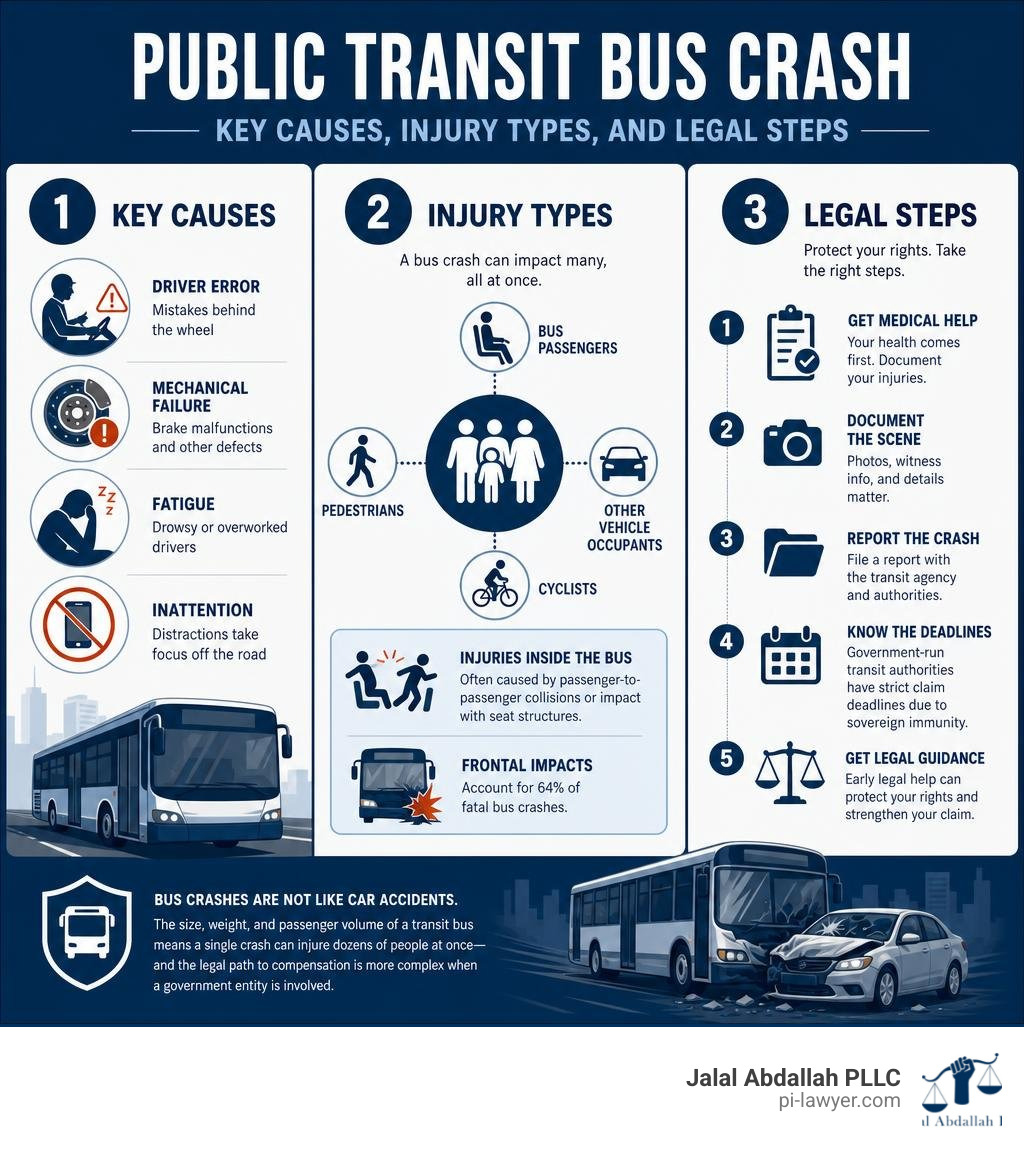
Key facts about public transit bus crashes:
- What causes them: Driver error, mechanical failure (like brake malfunctions), fatigue, and inattention
- Who gets hurt: Bus passengers, occupants of other vehicles, pedestrians, and cyclists
- How severe: An average of 18,430 bus occupant injuries occur in the U.S. every year
- Biggest crash risk: Frontal impacts — they account for 64% of fatal bus crashes
- What causes injuries inside the bus: Passenger-to-passenger collisions and impact with seat structures — not just the crash itself
- Your legal risk in Michigan: Government-run transit authorities have special claim deadlines due to sovereign immunity laws
Bus crashes are not like car accidents. The size, weight, and passenger volume of a transit bus means a single crash can injure dozens of people at once — and the legal path to compensation is far more complex when a government entity is involved.
I’m Jalal Abdallah, a personal injury attorney at Jalal Abdallah PLLC, and I have built my practice around holding powerful entities — including government transit authorities — accountable for the harm caused in a public transit bus crash. If you or someone you love was injured on a bus in Michigan, this guide will walk you through exactly what happened, why these crashes are so dangerous, and what your legal options are.
Discover more about public transit bus crash:
The Reality of a Public Transit Bus Crash: The Pikesville, Maryland Incident
To understand why a public transit bus crash is such a massive safety concern, we only have to look at the devastating incident on Reisterstown Road in Pikesville, Maryland. Shortly before 6:00 p.m. on July 8, 2026, a Maryland Transit Administration (MTA) bus collided with multiple civilian vehicles before crashing directly into a commercial building containing a print and ship center.
According to reports from USA Today and Fox News, the crash resulted in a second-alarm mass casualty incident. The force of the impact was so violent that:
- A total of 33 people were injured and transported to local hospitals.
- One civilian vehicle was completely overturned.
- Multiple victims were trapped, requiring complex extrication by local fire departments.
- One critically injured occupant had to be airlifted from the scene by a Medevac helicopter.
This crash demonstrates how a single transit vehicle can initiate a catastrophic chain reaction on busy suburban or urban roads. When a vehicle weighing upwards of 30,000 pounds loses control, it does not just bump into the car ahead of it. It acts as an unstoppable battering ram, crushing smaller passenger cars and causing severe structural damage to nearby commercial properties.
While this specific tragedy occurred in Maryland, we see the exact same risks on the busy streets of Wayne County, Michigan. Whether you are riding a Detroit Department of Transportation (DDOT) bus down Woodward Avenue or commuting on a Suburban Mobility Authority for Regional Transportation (SMART) bus through Dearborn or Warren, the physical forces of a crash remain just as terrifying.
Why Bus Interiors Cause Severe Injuries in a Collision
When we think of car crashes, we usually focus on the crushing of metal and the deployment of airbags. However, in a public transit bus crash, the interior engineering of the vehicle is often the primary culprit behind severe passenger injuries.
Unlike passenger cars, city transit buses are designed for maximum capacity and quick passenger turnover, not impact occupant protection. This means most public buses lack seatbelts, side airbags, and padded interior panels. When a collision occurs, passengers are thrown violently from their positions.
Scientific crashworthiness research reveals that the primary mechanisms of injury inside a transit bus are:
- Passenger-to-Seat-Structure Impact: Unrestrained passengers are thrown forward into the hard plastic or metal backs of the seats in front of them.
- Passenger-to-Passenger Collision: Passengers are launched into each other, creating a domino effect where occupants sustain injuries from colliding with fellow commuters.
To learn more about how to protect yourself and understand your rights, check out our comprehensive guide on how to navigate public transit injuries and school bus accidents safely.
Injury Mechanisms in a Public Transit Bus Crash
During a sudden deceleration or impact, passengers face unique physical hazards. One of the most common injuries is severe whiplash, caused by rapid neck extension and flexion.
Standard transit bus seats are engineered with low seatbacks to allow drivers to see across the entire vehicle. However, these low seatbacks fail to provide any head or neck support during a rear-end collision. When the bus is struck from behind, a passenger’s torso is pushed forward by the seat, but their unsupported head whips backward over the low seatback, causing severe soft-tissue, spinal, or neurological damage.
Furthermore, occupant ejection is a major cause of death and permanent disability in bus crashes. While non-ejection impacts inside the bus account for 53% of injuries, occupant ejection accounts for a massive 28% of all bus-related fatalities. Without seatbelts, passengers can easily be thrown through windows or out of emergency exits during a rollover or side-impact collision.
Design Recommendations to Prevent Public Transit Bus Crash Injuries
To combat these high injury rates, safety researchers and crashworthiness engineers have proposed several critical design upgrades for modern transit fleets:
- High Seatbacks: Transitioning to taller, energy-absorbing seatbacks that provide full head and neck support, reducing the risk of severe whiplash injuries during rear-end collisions.
- Child Restraints (LATCH Systems): Adapting automotive-style child safety seats to public transit buses, which currently offer absolutely zero built-in protection for infants and toddlers.
- Eliminating Rear Center-Aisle Seats: Removing the seats located directly at the back-center of the bus, which have no physical barrier in front of them. During a frontal crash, passengers in these seats are thrown completely down the center aisle of the bus.
- Reconsidering Side-Facing Seats: Side-facing seats offer poor lateral support, making passengers highly vulnerable to spinal injuries during side impacts and frontal crashes.
- Offset Seat Rows: Staggering seat rows to prevent passengers from directly colliding with one another during multi-directional impacts.
Bus Safety Statistics: Comparing Bus Travel vs. Car Travel
While a public transit bus crash is a high-profile, high-impact event, overall statistics show that public transit remains one of the safest ways to travel. However, when crashes do happen, the sheer volume of people involved leads to high injury counts.
On average, the United States sees about 40 fatalities and 18,430 injuries of bus occupants every year. Of these, mass transit buses account for approximately 14% of all bus-related fatalities and 23% of all bus-related injuries.
When we look at how fatalities occur in bus crashes, the direction of the impact matters immensely:
- Frontal Impacts: 64% of fatal crashes
- Rear Impacts: 16% of fatal crashes
- Side Impacts: 14% of fatal crashes
To put the safety of bus travel into perspective, let’s look at how it compares to driving a personal passenger car on urban roads:
| Safety Metric (Per Passenger-Kilometer) | Car Travel vs. Bus Travel Risk |
|---|---|
| Occupant Injury Rate | Car occupants have a 3.7 times higher injury rate than bus occupants. |
| Pedestrian Injury Rate | The rate of pedestrian injury is 4.1 times greater for car travel than bus travel. |
| Cyclist Injury Rate | The rate of cyclist injury is 5.3 times greater for car travel than bus travel. |
| Fatal/Severe Occupant Injury Rate | The rate of fatal or severe injuries is 6.3 times higher for car occupants. |
| Cyclist Fatality/Severe Injury Rate | The rate of severe or fatal cyclist injuries is over 9 times greater around cars. |
| U.S. Fatality Rate (Per 100M Trips) | The occupant fatality rate is 23 times higher for cars than for buses. |
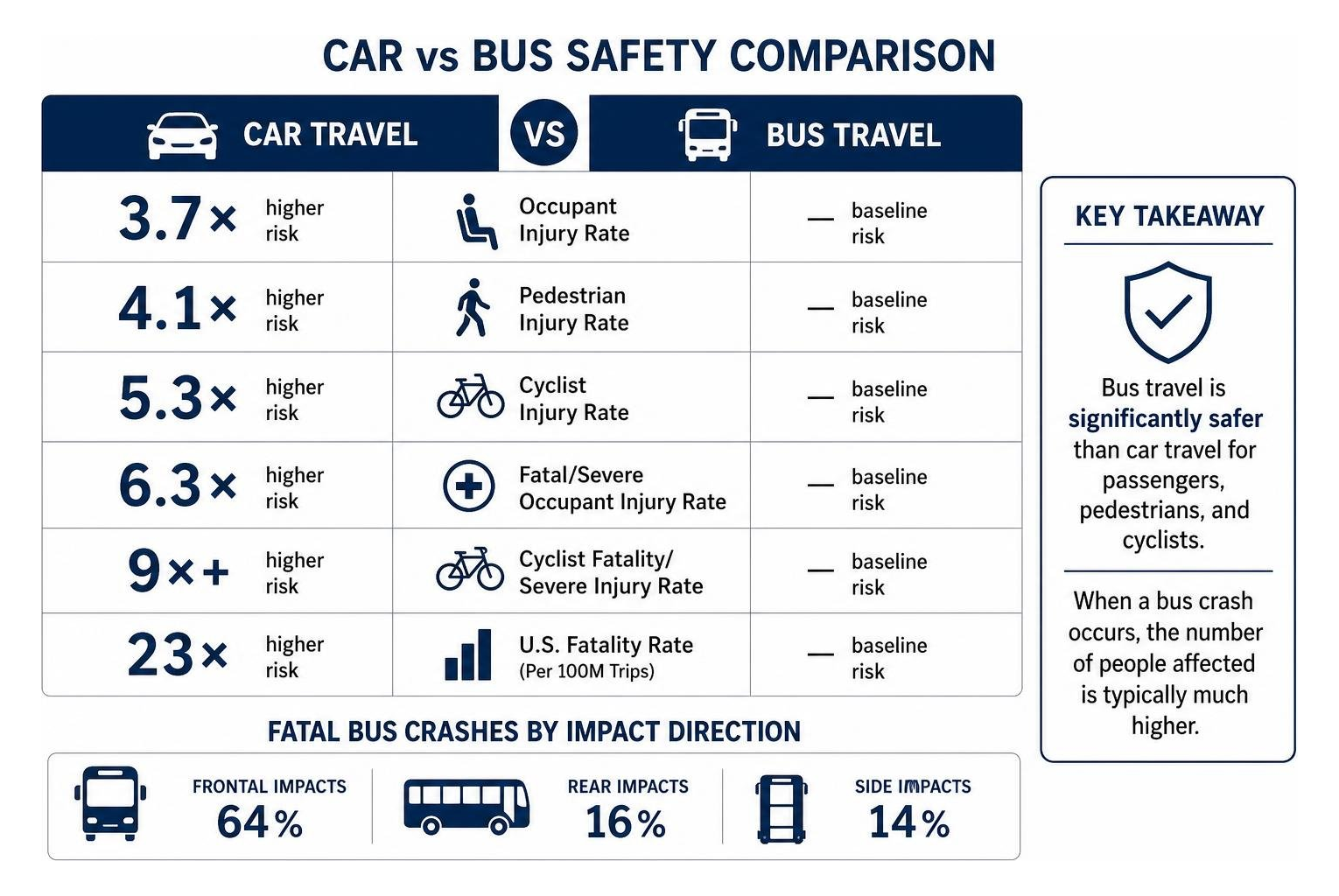
This data proves that riding the bus is incredibly safe for passengers, pedestrians, and cyclists alike compared to personal cars. However, when a municipal bus driver behaves negligently or a transit authority fails to maintain its braking systems, the resulting crash is a major community crisis.
Frequently Asked Questions About Bus Accidents
If you have been involved in a public transit bus crash in Michigan, you likely have a lot of questions about how to protect your health and your legal rights. We have compiled the answers to the most common questions our clients ask us.
For dedicated representation in Wayne County, consult with a best bus accident lawyer Dearborn to review your legal options.
Who is liable when a public transit bus crashes into a building?
When a public transit bus crashes into a building or multiple cars, liability usually falls on the government entity that operates the transit system (such as the City of Detroit for DDOT or the regional authority for SMART). However, holding a government agency liable is much harder than suing a private driver.
Government entities are protected by a legal doctrine known as sovereign immunity. This law shields government agencies from standard personal injury lawsuits unless very specific exceptions are met. In Michigan, you must prove that the government employee (the bus driver) was operating a government-owned vehicle negligently and that this negligence directly caused your injuries.
Because of these high legal hurdles, filing a claim requires a highly strategic approach. Read our step-by-step guide on filing a Dearborn bus crash claim to learn how we build these cases.
What should I do immediately after a bus collision in Michigan?
The moments after a bus crash are chaotic, but the steps you take can protect both your physical recovery and your eventual legal claim:
- Seek Immediate Medical Attention: Even if you feel fine, the adrenaline can mask severe injuries like internal bleeding, concussions, or whiplash. Go to the nearest emergency room in Dearborn, Detroit, Southfield, or Warren.
- Document the Scene: If you are physically able, take photos of the bus, the other vehicles involved, any structural damage, and the road conditions.
- Identify the Bus and Driver: Write down the bus number, the route name, and the driver’s name.
- Gather Witness Information: Get the names and phone numbers of other passengers and bystanders.
- Get the Police Report: Ensure the responding police department files an official accident report.
- Consult an Attorney Before Speaking to Adjusters: Never give a recorded statement to the transit authority’s insurance representatives without legal counsel.
For more detailed tips on handling the immediate aftermath of a collision, review our guide on what to do immediately after a car accident in Michigan.
How do I seek compensation for my injuries?
To get compensation after a bus accident, you must navigate both Michigan’s No-Fault insurance laws and third-party liability claims. If you have personal auto insurance, your own policy may cover your medical bills and lost wages through Personal Injury Protection (PIP). If you do not own a vehicle, you may have to file a claim through a family member’s policy or the Michigan Assigned Claims Plan (MACP).
Additionally, you can file a third-party lawsuit against the transit authority for pain and suffering if your injuries meet Michigan’s “serious impairment of body function” threshold.
However, the most critical detail is the statute of limitations and notice requirements. While standard car accidents in Michigan have a three-year filing limit, claims against government transit authorities require a formal “Notice of Intent to File a Claim” to be submitted in as little as 60 days to 6 months after the crash, depending on the specific transit system. If you miss this deadline, you lose your right to seek compensation forever.
Learn more about recovering your medical costs and damages in our post on getting your dues after a bus collision compensation claim.
Standing Up to Power: Your Dearborn Bus Crash Advocates
At Jalal Abdallah PLLC, we do not back down from a fight. We know that government transit authorities and their high-powered insurance companies will do everything they can to delay, minimize, or outright deny your injury claim. They rely on complex sovereign immunity laws and tight notice deadlines to escape liability.
We believe that everyday commuters, pedestrians, and motorists deserve a level playing field. Our legal team is dedicated to providing relentless, aggressive advocacy for injury victims across Michigan, including Southfield, Dearborn, Detroit, and Warren. We will investigate the crash, secure the bus’s black box data, gather witness testimony, and handle the strict government filing requirements so you can focus on healing.
Do not let a government agency or a powerful insurer dictate what your recovery is worth. Contact us for a free consultation today, and let us fight to get you the justice and compensation you deserve.
Share This Article

Schedule Your Free Consultation Today!
Reach out today and receive a consultation, completely free of charge - we'll evaluate your case and let you know what comes next.


